Historic Buildings of Massachusetts

  • About
  • Index by Town
  • CT
  • About
  • Index by Town
  • CT

Month: December 2008

Josiah Day House (1754)
by Dan/December 9, 2008September 17, 2016/Colonial, Houses, West Springfield

josiah-day-house.jpg

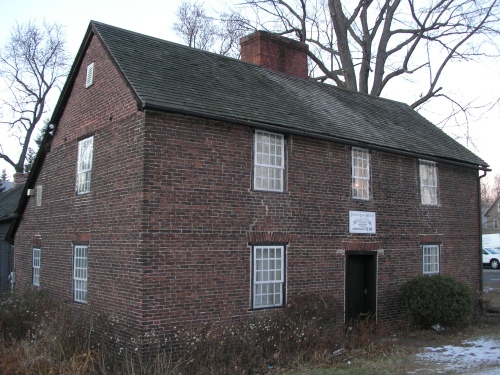
Josiah Day built his house in West Springfield by 1754 on land he had purchased in 1746. The house is the only known solid brick saltbox house of it’s period in the United States. The home remained in the Day family until 1903, when it was sold to the Ramapogue Historical Society. It is now a house museum open to the public.
North Center School (1810)

by Dan/December 6, 2008April 7, 2009/Federal, Schools, West Springfield

north-center-school.jpg

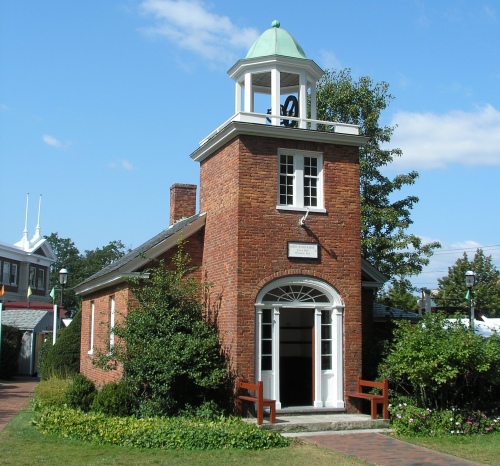
Built around 1810 in the Federal style, the North Center School is a one-room schoolhouse that originally stood in Whately. It was moved to the Eastern States Exposition grounds to become part of Storrowton. The entryway of the building was modified to resemble one in the Federal style, as seen on a schoolhouse in Vergennes, Vermont (since moved to the Shelburne Museum), by Storrowtown’s benefactor, Helen O. Storrow.

Captain John Potter House (1776)

by Dan/December 5, 2008September 17, 2016/Colonial, Houses, West Springfield

captain-john-potter-house.jpg

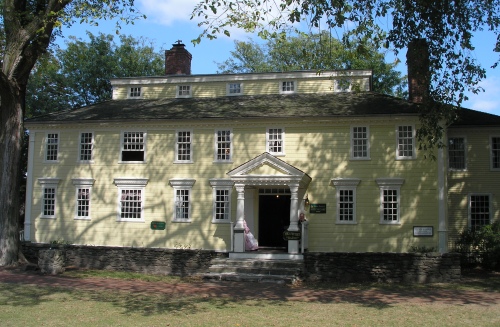
Captain John Potter built his house in North Brookfield, at the corner of South Main and Ward Streets, in 1776. Potter was a clockmaker and craftsman who also served as a captain in the Continental Army during the Revolutionary War. His mansion, which Potter built with his own hands, was started just before and completed just after the interruption of the war. It was constructed around Potter’s earlier house and features a faux-masonry exterior, actually made of wood. The house also had a large room for dancing on the second floor and a support pole was used in the dining room below whenever the upper room was used for dancing! Later, the Captain’s son, F.A. Potter, ran a shop attached to the house. In 1929, the Potter House, which had passed out of the Potter family’s hands in 1920, was moved to Storrowton, the recreation of a classic New England village, as imagined by benefactor Helen O. Storrow, at the Eastern States Exposition grounds in West Springfield. It is now open to the public for tours.

Massachusetts Building [Eastern States Exposition] (1919)

by Dan/December 2, 2008/Colonial Revival, Public Buildings, West Springfield

ma.jpg

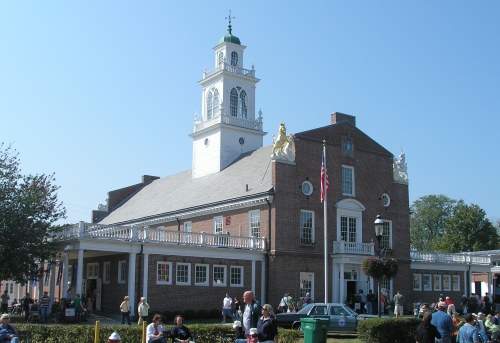
The first of the state pavilion buildings constructed as part of the Eastern States Exposition’s “Avenue of States” was the Massachusetts Building, dedicated in 1919 by then governor Calvin Coolidge. The building, designed by architect James H. Ritchie, is a replica of the Old State House in Boston.

Henry Vassall House (1746)

by Dan/December 1, 2008/Cambridge, Colonial, Houses

henry-vassall-house.jpg

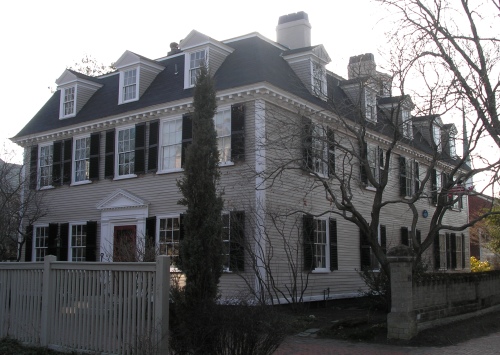
The oldest part of the Henry Vassall House, on Brattle Street in Cambridge, may date to as early as 1636, although the date usually given today is 1746. In that year, the property was sold by John Vassall Sr., who had purchased it in 1737, to his younger brother Henry Vassall. John Vassall’s son, Maj. John Vassall, built the nearby Vassall-Craigie-Longfellow House. Henry Vassall was a loyalist at the time of the Revolutionary War and the Vassall House is one of several homes belonging to loyalists along the section of Brattle Street known as Tory Row. These homes were either sold by their owners or seized during the Revolution. Vassall had died in 1769 and in 1775, his widow, Penelope Royall Vassall, fled to Boston and then to her estates in Antigua. According to the Historic Guide to Cambridge (1907):

“Just before sailing Madam Vassall petitioned the Provincial Congress, then sitting at Watertown, that she might be allowed to take with her some of her effects. Congress permitted her to take anything that she wanted except “provisions and her medicine chest.” The estate was not confiscated, as it belonged to a widow who had taken no active part against the patriots.”

The Continental Army at the time had only one other medicine chest besides the one in the Vassall House. “From these two all the regimental surgeons had to supply their needs. The fact that the medicines were here, and that there were twenty available rooms, besides halls and out-houses, may have been the reason that this house became the medical headquarters.” In 1775, Dr. Benjamin Church, who was effectively the first Surgeon General of the U.S. Army, was found to be sending secret letters to the British Commander, General Thomas Gage. Convicted of “communicating with the enemy,” Dr. Church was held for a time in the Vassall House as a prisoner. The house has remained a private home, with a number of alterations and additions being made to it over the years.

Posts navigation

Newer posts
Privacy Policy

Categories

  • Architectural Style (943)
    • Art Deco (9)
    • Byzantine (3)
    • Colonial (177)
    • Colonial Revival (85)
    • Craftsman (6)
    • Egyptian Revival (1)
    • Federal (190)
    • Foursquare (6)
    • Gothic (67)
    • Greek Revival (100)
    • Italianate (82)
    • Mission Revival (2)
    • Mission/Spanish Colonial (1)
    • Modern (2)
    • Neoclassical (56)
    • Octagon (3)
    • Postmodern (1)
    • Queen Anne (46)
    • Renaissance Revival (26)
    • Romanesque Revival (53)
    • Second Empire (26)
    • Shingle Style (12)
    • Stick Style (13)
    • Tudor Revival (8)
    • Vernacular (49)
    • Victorian Eclectic (15)
  • Building Type (943)
    • Apartment Buildings (8)
    • Banks (18)
    • Churches (119)
    • Collegiate (32)
    • Commercial (102)
    • Hotels (16)
    • Houses (508)
    • Industrial (23)
    • Libraries (22)
    • Lighthouses (1)
    • Military (15)
    • Monuments (1)
    • Museums (12)
    • Organizations (39)
    • Outbuildings (17)
    • Public Buildings (50)
    • Schools (23)
    • Stations (5)
    • Synagogues (1)
    • Taverns (21)
    • Theaters (9)
  • Town (943)
    • Adams (11)
    • Agawam (4)
    • Amherst (50)
    • Boston (64)
    • Boylston (6)
    • Cambridge (30)
    • Clinton (21)
    • Concord (15)
    • Cummington (1)
    • Danvers (14)
    • Deerfield (31)
    • Gloucester (18)
    • Granville (10)
    • Great Barrington (2)
    • Hadley (9)
    • Hancock (15)
    • Harvard (32)
    • Holyoke (47)
    • Lenox (5)
    • Lexington (8)
    • Longmeadow (32)
    • Marblehead (40)
    • Marlborough (4)
    • Natick (22)
    • Newton (2)
    • Northampton (68)
    • Peabody (4)
    • Pittsfield (20)
    • Salem (110)
    • Saugus (4)
    • Sheffield (4)
    • South Hadley (8)
    • Southborough (8)
    • Southwick (4)
    • Springfield (67)
    • Stockbridge (19)
    • Stow (1)
    • Sturbridge (18)
    • Sudbury (7)
    • Waltham (11)
    • Watertown (1)
    • Wayland (8)
    • West Springfield (14)
    • Westfield (46)
    • Weston (2)
    • Worcester (26)
  • Uncategorized (1)

Recent Comments

  • Wilber Blackson on South Hadley
  • Tami Speiden on Stockbridge
  • DexGuru on Stockbridge

Tags

Alcott Amherst College Asher Benjamin Back Bay Baptist Beacon Hill Big E Black Heritage Trail bowfront Bulfinch Catholic Congregational Episcopal Freedom Trail Gambrel H.H. Richardson Harvard Hawthorne Historic Deerfield Isaac Damon lit Longfellow mansard Methodist Mount Holyoke Museum Museums NPS Old Sturbridge Village PEM Revolutionary War row houses saltbox Samuel McIntire Shakers Smith College SPNEA Springfield Armory Stephen C. Earle Storrowton Underground Railroad UU Washington William Fenno Pratt Witch Trials

Meta

  • Log in
  • Entries feed
  • Comments feed
  • WordPress.org
Proudly powered by WordPress | Theme: ShowMe by NEThemes.