Historic Buildings of Massachusetts

  • About
  • Index by Town
  • CT
  • About
  • Index by Town
  • CT

Category: Colonial

Meetinghouse, Hancock Shaker Village (1793)
by Dan/May 12, 2013/Churches, Colonial, Hancock

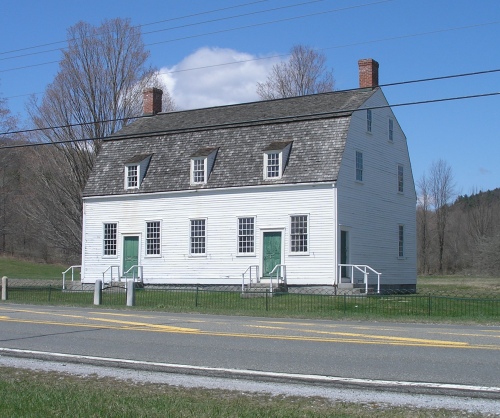
The Meetinghouse, Hancock Shaker Village

The original Meetinghouse at Hancock Shaker Village was built in 1786. To gain more space, its first roof, a gambrel, was altered to a gable roof in 1871. By the late nineteenth century, the Shakers primarily used the meeting room in the Brick Dwelling for worship services. In the early twentieth century the Meetinghouse was being used for storage. It was taken down in 1938. In 1962, after Hancock Shaker Village became a museum, it acquired the Meetinghouse from the former Shaker Village in Shirley. The Shirley Meetinghouse was then moved to Hancock. Built in 1793 by by Moses Johnson, who had constructed the Hancock Meetinghouse (among many others), the Shirley Meetinghouse is the only eighteenth-century Shaker Meetinghouse to remain unaltered in its original firm.
William Cullen Bryant Homestead (1785)

by Dan/April 29, 2013/Colonial, Cummington, Houses, Italianate, Victorian Eclectic

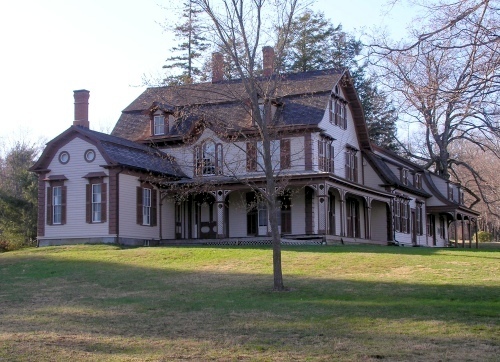
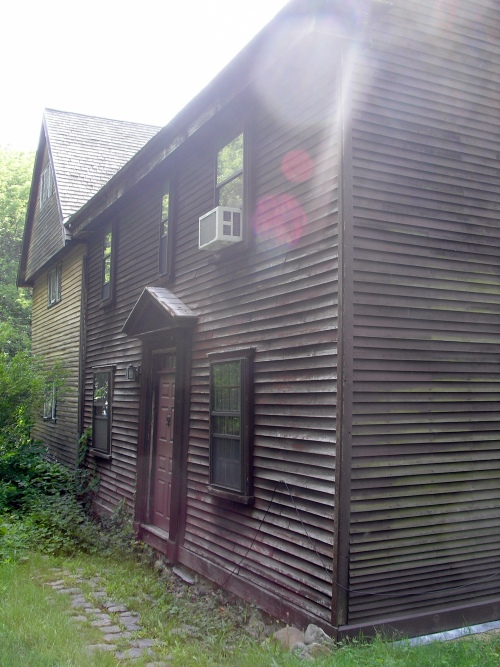
William Cullen Bryant Homestead

William Cullen Bryant (1794-1878) was a major poet and for 50 years was editor and publisher of The New York Evening Post. He was born in a log cabin in Cummington. When he was two, Bryant‘s father, Dr. Peter Bryant, moved the family to a house in Cummington that the doctor’s father-in-law had built in circa 1783-1785. The house became young William Cullen Bryant‘s boyhood home and is now called the William Cullen Bryant Homestead. In 1865, after the old farmhouse had been out of the family for 30 years, Bryant purchased and extensively altered it in to reflect Victorian stylistic tastes. He began by raising the original section of the house, creating a new ground floor. He also added a gambrel-roofed study, a replica of his father’s medical office, which projects from the front facade, and constructed an addition to the house’s original rear ell. The renovated house would serve as his summer home until his death. It is now owned by the Trustees of Reservations and can be toured by the public. Continue reading “William Cullen Bryant Homestead (1785)”

Browne House (1698)

by Dan/April 20, 2013/Colonial, Houses, Watertown

Browne House

It’s not a great picture above, but since Watertown is making headlines I’m featuring one of its most historic buildings. The Browne House at 562 Main Street in Watertown was built in 1698 by Captain Abraham Browne (1671-1729). The earliest section of the house is located on the far left of the image. On the right is the north ell, which was built in 1725. Browne descendents lived in the house until 1897. The house became dilapidated. It was purchased by preservationist William Sumner Appleton in 1919, just days before it was to be demolished. He restored the house, which is considered to be one of the best examples of a “First Period” New England residence. Appleton had founded the Society for the Preservation of New England Antiquities (now Historic New England) in 1910, but the trustees had not thought the house could be salvaged. Having purchased and restored it, Appleton gave the house to the Society in 1922, subject to a mortgage that was finally discharged in 1949. With its unique architectural features, it is now used by Historic New England as a study property.

Thomas Dickinson House (1762)

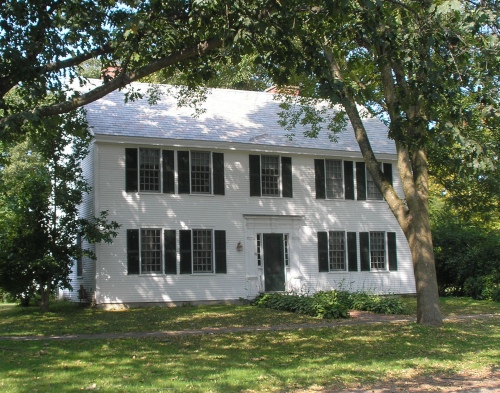
by Dan/March 4, 2013/Colonial, Deerfield, Houses

The Thomas Dickinson House in Deerfield is an early center hall house built in 1762. Capt. Thomas Dickinson, a slave owner, led the local militia in the Revolutionary War. There was an unsuccessful attempt to cultivate silkworms on the property in 1852.

Clapp Tavern (1743)

by Dan/January 17, 2013/Colonial, Houses, Taverns, Westfield

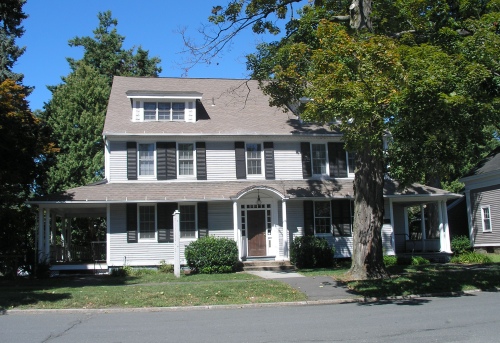
The Clapp Tavern in Westfield has gone through many changes over the years. Ezra Clapp came to Westfield in 1743 and built his house in 1747. From 1766 to the 1790s, the house was used as a tavern and was a meeting place for Westfield patriots during the Revolutionary War. General Henry Knox is said to have stayed at the Clapp Tavern while on his epic journey hauling artillery from Fort Ticonderoga to Cambridge in 1775-1776. In 1800, the house was bought by Samuel Fowler. In 1838, his son, James Fowler, first President of the Hampden National Bank, moved the house west from the corner of Elm and Court Streets to its present site at 53 Court Street to make way for a new house. Judge Homer Stevens had his home and office in the Tavern from 1870 to 1902. He made a number of alterations, including replacing the original central chimney with two smaller ones. A later owner, Zebina Caldwell, a carpenter, added the pent roof in front and the side porches.

Silas King House (1780)

by Dan/December 3, 2012/Colonial, Houses, Westfield

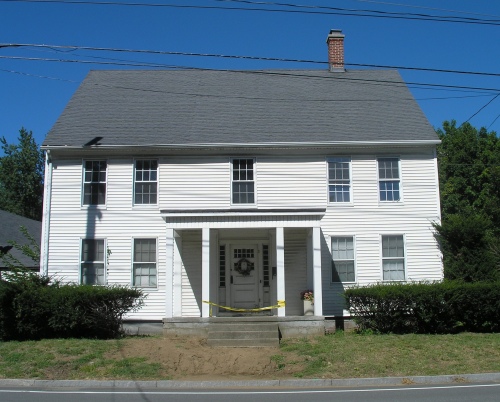
At 150 Main Street in Westfield is a colonial house, built c. 1780 for Silas King by his father Aaron, who lived across the street. In 1780, Silas King married Sally Eager Noble. Continue reading “Silas King House (1780)”

Dr. Thomas Williams House (1748)

by Dan/November 22, 2012/Colonial, Deerfield, Federal, Houses

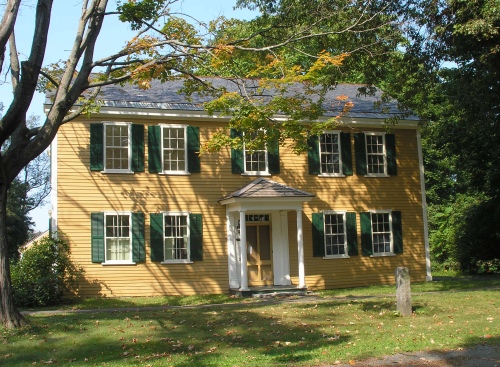
Happy Thanksgiving! Located along the main street of the village of Deerfield is a house, now painted a shade of yellow, which was built in 1748. It was originally the home of Dr. Thomas Williams. He was appointed surgeon to the to the regular and provincial troops by Royal Governor William Shirley and served in King George’s War and the French and Indian War. George Sheldon, in his book, A History of Deerfield Massachusetts (1895), writes that Dr. Williams (b. 1718)

came to Dfd. 1789; lived on No. 9; became a prominent figure as a man of affairs, as well as in his profession; was surgeon in the abortive Can[adian] expedition 1746 and for the line of forts; he left Fort Mass. only two days before its capture in 1746; was surgeon in the regt. of his brother Ephraim, at the battle of Lake George, Sept. 8, 1755, and dressed the wounds of Baron Dieskau, the captured commander of the Fr. army; in the campaign of 1756 he was lieut.-col.; rep 2 yrs; selectman 2; town clerk 17; judge of probate and justice of the court of common pleas; and had an extensive professional practice; d. Sept. 28, 1775.

A slave owner himself, Dr. Williams kept records of the treatment he gave to enslaved Africans and free blacks in Deerfield. Slave owners sometimes paid their debts to the doctor with their slaves’ labor. Upon the death of Dr. Williams, his practice was continued by his apprentice, Dr. Elihu Ashley (1750-1817), a son of Rev. Jonathan Ashley, who lived a few houses down the street from the doctor’s house.

Early in the nineteenth century, the exterior of the house was updated in the Federal style, when the original gambrel roof was removed, the front portico was added, and fanlights (not pictured above) were placed in the gable ends.

Posts navigation

Older posts
Newer posts
Privacy Policy

Categories

  • Architectural Style (943)
    • Art Deco (9)
    • Byzantine (3)
    • Colonial (177)
    • Colonial Revival (85)
    • Craftsman (6)
    • Egyptian Revival (1)
    • Federal (190)
    • Foursquare (6)
    • Gothic (67)
    • Greek Revival (100)
    • Italianate (82)
    • Mission Revival (2)
    • Mission/Spanish Colonial (1)
    • Modern (2)
    • Neoclassical (56)
    • Octagon (3)
    • Postmodern (1)
    • Queen Anne (46)
    • Renaissance Revival (26)
    • Romanesque Revival (53)
    • Second Empire (26)
    • Shingle Style (12)
    • Stick Style (13)
    • Tudor Revival (8)
    • Vernacular (49)
    • Victorian Eclectic (15)
  • Building Type (943)
    • Apartment Buildings (8)
    • Banks (18)
    • Churches (119)
    • Collegiate (32)
    • Commercial (102)
    • Hotels (16)
    • Houses (508)
    • Industrial (23)
    • Libraries (22)
    • Lighthouses (1)
    • Military (15)
    • Monuments (1)
    • Museums (12)
    • Organizations (39)
    • Outbuildings (17)
    • Public Buildings (50)
    • Schools (23)
    • Stations (5)
    • Synagogues (1)
    • Taverns (21)
    • Theaters (9)
  • Town (943)
    • Adams (11)
    • Agawam (4)
    • Amherst (50)
    • Boston (64)
    • Boylston (6)
    • Cambridge (30)
    • Clinton (21)
    • Concord (15)
    • Cummington (1)
    • Danvers (14)
    • Deerfield (31)
    • Gloucester (18)
    • Granville (10)
    • Great Barrington (2)
    • Hadley (9)
    • Hancock (15)
    • Harvard (32)
    • Holyoke (47)
    • Lenox (5)
    • Lexington (8)
    • Longmeadow (32)
    • Marblehead (40)
    • Marlborough (4)
    • Natick (22)
    • Newton (2)
    • Northampton (68)
    • Peabody (4)
    • Pittsfield (20)
    • Salem (110)
    • Saugus (4)
    • Sheffield (4)
    • South Hadley (8)
    • Southborough (8)
    • Southwick (4)
    • Springfield (67)
    • Stockbridge (19)
    • Stow (1)
    • Sturbridge (18)
    • Sudbury (7)
    • Waltham (11)
    • Watertown (1)
    • Wayland (8)
    • West Springfield (14)
    • Westfield (46)
    • Weston (2)
    • Worcester (26)
  • Uncategorized (1)

Recent Comments

  • Wilber Blackson on South Hadley
  • Tami Speiden on Stockbridge
  • DexGuru on Stockbridge

Tags

Alcott Amherst College Asher Benjamin Back Bay Baptist Beacon Hill Big E Black Heritage Trail bowfront Bulfinch Catholic Congregational Episcopal Freedom Trail Gambrel H.H. Richardson Harvard Hawthorne Historic Deerfield Isaac Damon lit Longfellow mansard Methodist Mount Holyoke Museum Museums NPS Old Sturbridge Village PEM Revolutionary War row houses saltbox Samuel McIntire Shakers Smith College SPNEA Springfield Armory Stephen C. Earle Storrowton Underground Railroad UU Washington William Fenno Pratt Witch Trials

Meta

  • Log in
  • Entries feed
  • Comments feed
  • WordPress.org
Proudly powered by WordPress | Theme: ShowMe by NEThemes.