Historic Buildings of Massachusetts

  • About
  • Index by Town
  • CT
  • About
  • Index by Town
  • CT

Category: Colonial

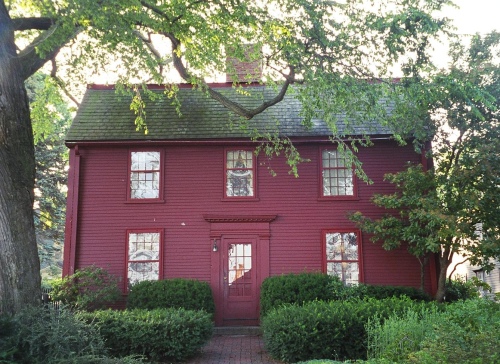
Nathaniel Hawthorne Birthplace (1730)
by Dan/June 23, 2008June 29, 2013/Colonial, Houses, Salem

hawthorne-birthplace.jpg

The house in which the author, Nathaniel Hawthorne, was born on July 4, 1804 and lived in until he was age 4 is located in Salem. It was originally on Union Street, but in 1958 it was moved to a site adjacent to the House of the Seven Gables, the building that would inspire Hawthorne to write the novel of the same name. The house was built between 1730 and 1745 for Joshua Pickman, a Boston mariner. It was bought by Hawthorne’s grandfather, the famous shipmaster Captain Daniel Hawthorne, in 1772. As part of the House of the Seven Gables Settlement Association property, the house is now a museum open to visitors.
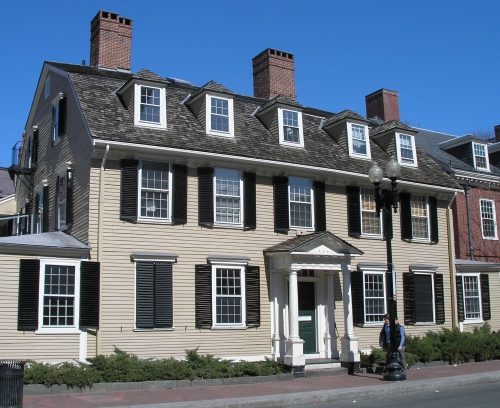
Benjamin Wadsworth House (1726)

by Dan/June 8, 2008September 17, 2016/Cambridge, Colonial, Houses

benjamin-wadsworth-house.jpg

In 1726, a house was constructed on Massachusetts Avenue in Cambridge, on the site where Harvard’s earliest building, the Peyntree House, had stood. It was first occupied by Harvard’s fourth president, Benjamin Wadsworth, his family and two slaves. After Wadsworth, it would serve as the home of eight other presidents, until 1849, when president Jared Sparks chose to reside in his own Cambridge home. During the Revolutionary War, the house was Washington’s first headquarters when he came to command the army during the siege of Boston in 1775. Do to its state of disrepair at the time, Washington soon moved to other quarters. Over the years, the house would serve as lodging for visiting ministers and student boarders (including Ralph Waldo Emerson). The building now houses the Office of the University Marshal and other offices. The Wadsworth House lost its front yard when Massachusetts Avenue was widened. Today it is the second oldest of Harvard’s surviving buildings, after Massachusetts Hall.

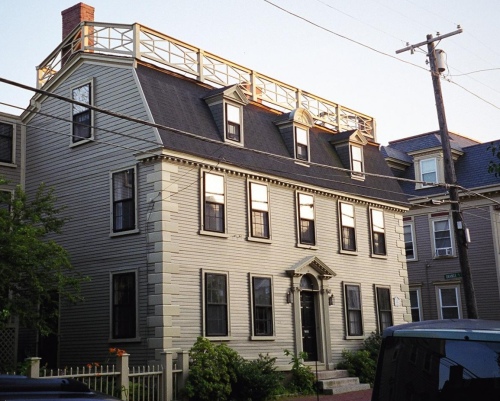
John Hodges House (1788)

by Dan/June 8, 2008September 17, 2016/Colonial, Houses, Salem

john-hodges-house.jpg

Built around 1788 on Essex Street in Salem, the John Hodges House is late Georgian-style home with a grand spiral staircase within. Hodges was a merchant and passed the house on to his son, Benjamin Hodges, after it was built.

Josiah Dwight House (1725)

by Dan/April 28, 2008September 17, 2016/Colonial, Deerfield, Houses

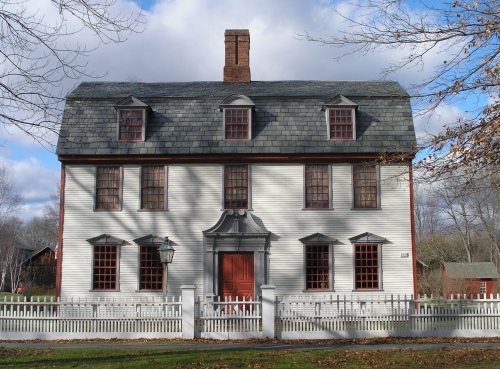
Originally built on Main Street in Springfield between 1722 and 1733 by David Ingersoll, the Dwight House was bought in 1743 by Josiah Dwight, who added a Connecticut River Valley Broken Scroll doorway, window pediments and a gambrel roof in the 1750s. Used as a rooming house in the later nineteenth century, the building was moved to Howard Street in 1884. In the early twentieth century, its original doorway pediment was purchased by Henry du Pont for his Long Island summer house (it was later moved to Winterthur). In 1950, when the house was facing demolition, it was purchased by Henry and Helen Flint for Historic Deerfield and stored until a location on the Street in Deerfield could be found. The Italianate-style Josiah Fogg House of 1868 was then demolished to make room for a restored Dwight House, complete with a reproduction of the original doorway pediment. Opened to the public in 1954, the Dwight House was originally interpreted as a the home of a doctor (complete with doctor’s office). It now presents the two contrasting interior decorative styles of Boston and the Connecticut River Valley on either side of the house. Continue reading “Josiah Dwight House (1725)”

Massachusetts Hall (1718)

by Dan/April 18, 2008April 18, 2008/Cambridge, Collegiate, Colonial

massachusetts-hall.jpg

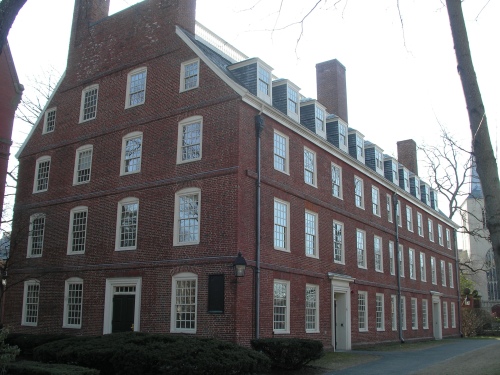
Harvard College was founded in 1636, making it the oldest institution of higher learning in the United States. The oldest surviving building on the Harvard campus is Massachusetts Hall, located in Harvard Yard in Cambridge and built between 1718 and 1720. It was designed by the successive Harvard Presidents John Leverett and Benjamin Wadsworth. Originally a dorm, it housed many famous students during the colonial period, including John Adams, John Hancock, Samuel Adams, Elbridge Gerry and James Otis. In 1722, when Thomas Hollis donated a quadrant and telescope, Massachusetts Hall also became the location of an informal observatory. During the Revolutionary War, the building was occupied by soldiers of the Continental Army. It has served many uses over the years, currently being the offices of the President of Harvard University and other administrators, who may soon take over the remaining areas of the building currently used as dormitory space. Please take a look at today’s companion post, about Yale’s Connecticut Hall, at Historic Buildings of Connecticut.

The Old Manse (1770)

by Dan/April 6, 2008June 29, 2013/Colonial, Concord, Houses

old-manse.JPG

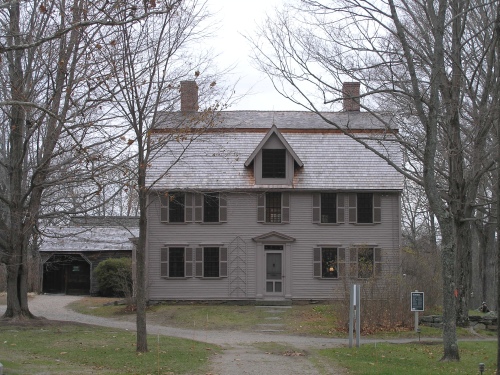
The famous house in Concord known as the “Old Manse,” has associations with the Revolutionary War and with two of America’s greatest literary figures. It was built in 1770 as a “manse”, or parsonage, for the town’s minister, William Emerson. Emerson was there, on April 19, 1775, when the Revolutionary War began at the Old North Bridge, located just behind the Manse property (and now part of Minute Man National Historical Park). Emerson went on to serve as a chaplain with the Continental Army, but died of a fever in October 1776, during the Fort Ticonderoga Expedition. In 1778, Ezra Ripley became Concord’s new minister. He boarded at the Old Manse and in 1780 married William Emerson’s widow, Phebe Bliss Emerson. William Emerson’s son, also named William, became a minister. His son was the famous Transcendentalist, Ralph Waldo Emerson, who lived in the Old Manse, his ancestral home, from 1834-1835, before purchasing his own house in Concord. It was during his residence in the Old Manse that Emerson wrote the first draft of his classic work, Nature.

Ezra Ripley died in 1841 and from 1842 to 1845, the Old Manse was rented by Nathaniel Hawthorne and his new wife, Sophia Peabody. It was during this period that Hawthorne would write many of the stories featured in his collection, Mosses from an Old Manse, including his introductory description of the Old Manse that would help make the building famous. In 1846, the Hawthorne’s left the Manse because Ezra Ripley’s son, Samuel Ripley, returned to live in his childhood home, although he died the following year. His wife, Sarah Alden Bradford Ripley, who had mastered numerous subjects and seven languages, lived on for another two decades, exchanging views with many of the intellectual leaders of the times. She lived through the Civil War, which claimed the life of her younger son, Lt. Ezra Ripley.

When Sarah and Samuel Ripley’s granddaughter, Sarah Ripley Thayer Ames, died in 1939, according to her wishes the house and its contents were sold to The Trustees of Reservations. The Old Manse is now a museum where visitors can tour this National Historic Landmark.

Orchard House (1675)

by Dan/April 3, 2008June 29, 2013/Colonial, Concord, Houses

orchard-house.JPG

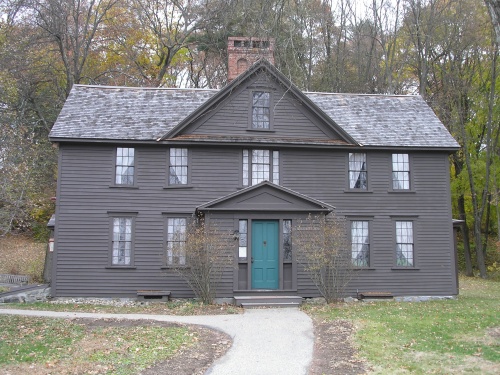
Orchard House is a home that many visitors feel they know before they even visit it. In 1857-8, Bronson Alcott, the Transcendentalist reformer and educator, purchased and combined two early eighteenth century houses, adding the smaller of the two to the rear of the main house and making many alterations to his new home. He named it “Orchard House” due to the property’s 12 acres of apple orchards. Alcott and his family made Orchard House their permanent home from 1858 to 1877. The house owes its greatest fame to fact that it was here, in 1868, that Bronson’s daughter, Louisa May Alcott, wrote the classic Little Women, loosely based on her own family. The house is now a museum, where visitors can learn about Alcott and see the room where Louisa wrote the famous book.

Posts navigation

Older posts
Newer posts
Privacy Policy

Categories

  • Architectural Style (943)
    • Art Deco (9)
    • Byzantine (3)
    • Colonial (177)
    • Colonial Revival (85)
    • Craftsman (6)
    • Egyptian Revival (1)
    • Federal (190)
    • Foursquare (6)
    • Gothic (67)
    • Greek Revival (100)
    • Italianate (82)
    • Mission Revival (2)
    • Mission/Spanish Colonial (1)
    • Modern (2)
    • Neoclassical (56)
    • Octagon (3)
    • Postmodern (1)
    • Queen Anne (46)
    • Renaissance Revival (26)
    • Romanesque Revival (53)
    • Second Empire (26)
    • Shingle Style (12)
    • Stick Style (13)
    • Tudor Revival (8)
    • Vernacular (49)
    • Victorian Eclectic (15)
  • Building Type (943)
    • Apartment Buildings (8)
    • Banks (18)
    • Churches (119)
    • Collegiate (32)
    • Commercial (102)
    • Hotels (16)
    • Houses (508)
    • Industrial (23)
    • Libraries (22)
    • Lighthouses (1)
    • Military (15)
    • Monuments (1)
    • Museums (12)
    • Organizations (39)
    • Outbuildings (17)
    • Public Buildings (50)
    • Schools (23)
    • Stations (5)
    • Synagogues (1)
    • Taverns (21)
    • Theaters (9)
  • Town (943)
    • Adams (11)
    • Agawam (4)
    • Amherst (50)
    • Boston (64)
    • Boylston (6)
    • Cambridge (30)
    • Clinton (21)
    • Concord (15)
    • Cummington (1)
    • Danvers (14)
    • Deerfield (31)
    • Gloucester (18)
    • Granville (10)
    • Great Barrington (2)
    • Hadley (9)
    • Hancock (15)
    • Harvard (32)
    • Holyoke (47)
    • Lenox (5)
    • Lexington (8)
    • Longmeadow (32)
    • Marblehead (40)
    • Marlborough (4)
    • Natick (22)
    • Newton (2)
    • Northampton (68)
    • Peabody (4)
    • Pittsfield (20)
    • Salem (110)
    • Saugus (4)
    • Sheffield (4)
    • South Hadley (8)
    • Southborough (8)
    • Southwick (4)
    • Springfield (67)
    • Stockbridge (19)
    • Stow (1)
    • Sturbridge (18)
    • Sudbury (7)
    • Waltham (11)
    • Watertown (1)
    • Wayland (8)
    • West Springfield (14)
    • Westfield (46)
    • Weston (2)
    • Worcester (26)
  • Uncategorized (1)

Recent Comments

  • Wilber Blackson on South Hadley
  • Tami Speiden on Stockbridge
  • DexGuru on Stockbridge

Tags

Alcott Amherst College Asher Benjamin Back Bay Baptist Beacon Hill Big E Black Heritage Trail bowfront Bulfinch Catholic Congregational Episcopal Freedom Trail Gambrel H.H. Richardson Harvard Hawthorne Historic Deerfield Isaac Damon lit Longfellow mansard Methodist Mount Holyoke Museum Museums NPS Old Sturbridge Village PEM Revolutionary War row houses saltbox Samuel McIntire Shakers Smith College SPNEA Springfield Armory Stephen C. Earle Storrowton Underground Railroad UU Washington William Fenno Pratt Witch Trials

Meta

  • Log in
  • Entries feed
  • Comments feed
  • WordPress.org
Proudly powered by WordPress | Theme: ShowMe by NEThemes.