Historic Buildings of Massachusetts

  • About
  • Index by Town
  • CT
  • About
  • Index by Town
  • CT

Category: Colonial

Goodrich-Robertson House (1727)
by Dan/March 2, 2020March 2, 2020/Colonial, Houses, Sheffield

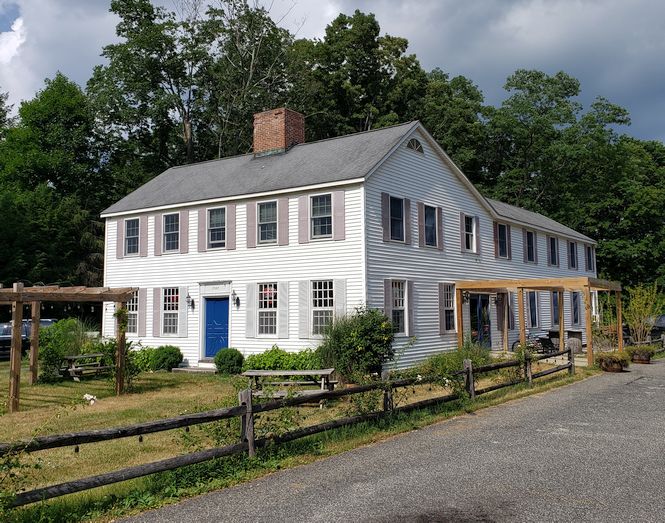
The saltbox house at 139 South Main Street in Sheffield was moved to its current location in 1946 from Wethersfield, Connecticut, where it had an address of 191 or 197 Main Street. It is thought to have been built c. 1727 by Jonathan Goodrich, who soon sold it in 1737 to Jonathan Stillman. In 1769 the property was acquired by Silas Deane (1737-1789), but it was not his residence. At the time he was erecting his own house next door at 203 Main Street. A wealthy merchant and lawyer, Deane played a vital role during the Revolutionary War. He was sent abroad by a secret committee of the Continental Congress in 1776 to secure aid from the French government. He later worked closely with Benjamin Franklin to negotiate the treaty of alliance with France that led to the sending of an army under the Comte de Rochambeau to aid George Washington. Together they would win the Battle of Yorktown in 1781. Deane’s house in Wethersfield is now part of the Webb-Deane-Stevens Museum.

Dr. Barwick Bruce, who came to Wethersfield from Barbados, purchased the Goodrich House in 1809. He sold it in 1816 to Dr. Ashbel Robertson (1787-1847). As related in Stiles’ History of Ancient Wethersfield, Vol. I (1904), page 728-729:

Dr. Robertson, for many years, carried on a mechantile business, sold wines and liquors (under a license) and practiced medicine. His store, with roof cut down and a brick front added, is now occupied by Comstock, Ferre & Co., as a seed warehouse, a little further up the same street. The mansion is now occupied by Mr. Austin Robertson, a son of the old doctor [.]

Austin Robertson was for many years the town tax collector and before the turn of the century, Wethersfield residents would come to his house where he accepted payment. In 1909, the house was still owned by Austin Robertson, but by the 1920s, after Robertson passed away, it was owned by E. Hart Fenn, who lived in the Silas Deane House next door. The Red Cross used the Goodrich-Robertson house during World War I. The house was moved to Sheffield in 1946 by a Mr. Tompkins, but its foundations can still be seen on the property of the Webb-Deane-Stevens Museum. There is also a c. 1910s Wallace Nutting photograph of paneling from the house.

Although Silas Deane did not live in the Goodrich-Robertson House, its former proximity to his Wethersfield home led to to its becoming known as the Silas Deane House. In 1956, ten years after its move to Sheffield, the house was bought by Mr. and Mrs. Ralph Jones, who ran an antiques shop in the building. Most recently, the house has been the Blue Door Market & Cafe.
Continue reading “Goodrich-Robertson House (1727)”

Hardy-Parsons House (1764)

by Dan/February 27, 2020/Colonial, Gloucester, Houses

Hardy-Parsons House

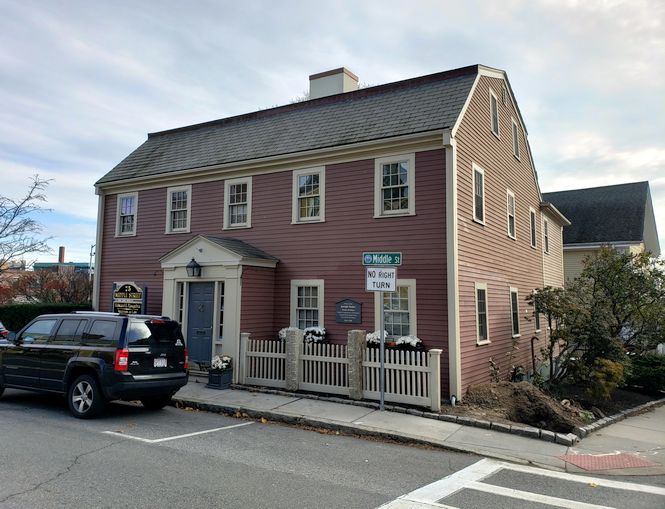
The Hardy-Parsons House at 90 Middle Street in Gloucester was built in 1764 (according to a historic marker on the house) by Capt. William Dolliver, a mariner. The Hardy family occupied the house for many years and, at some point, Judy Millett had a school for small children in the west room of the house. In the mid-twentieth century the house was occupied by Samuel H. Mansfield and his wife, Carrie Esther Parsons Mansfield. They collected works by artist Fitz Henry Lane that are now in the Cape Ann Museum. In 1948, Mrs. Mansfield left the house to the Cape Ann Historical Association. It is now privately owned.

Charles Olson, the poet and resident of Gloucester who railed against the destruction of old buildings wrought by urban renewal, references the Hardy-Parsons House in “Maximus, to Gloucester: Letter 2,” as “the house the street cuts off.” (see also “A Scream to the Editor“).

Joseph Foster House (1760)

by Dan/January 27, 2020/Colonial, Gloucester, Houses

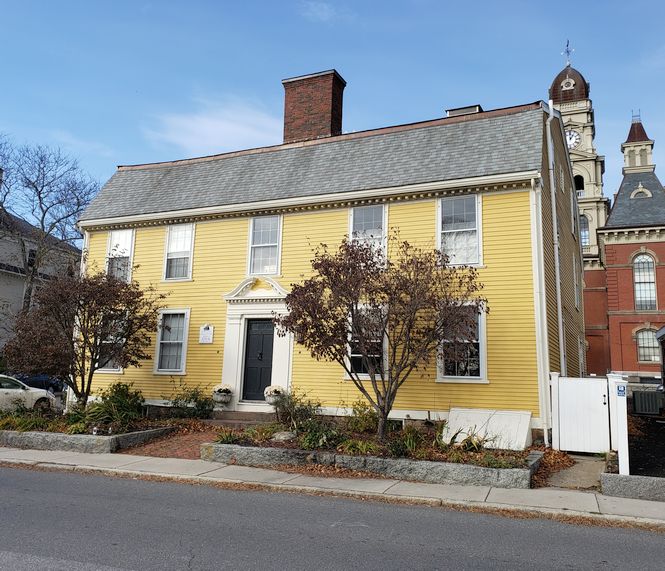
Erected circa 1760, the gambrel roof house at 75 Middle Street in Gloucester was the home of a merchant and Revolutionary War patriot named Joseph Foster (1730-1804). Originally from Ipswich, he became a ship captain, trading with the West Indies. He commanded privateers during the war and was a member of the Committee of Correspondence and the Massachusetts Constitutional Convention of 1779-1780.

At the start of the Revolutionary War, Foster was a hero of the Battle of Gloucester. On August 8, 1775, the Bristish sloop HMS Falcon, commanded by Capt. John Linzee, attacked two American schooners heading for Salem. He captured one, but the other escaped to Gloucester harbor and was grounded near Five Pound Island. Capt. Linzee sent barges with men to seize the grounded vessel, but local defenders, Joseph Foster playing a conspicuous part among them, fired on the British and effectively trapped them. In an attempt to distract the townspeople and relieve pressure on his men, Linzee fired Falcon‘s guns on the town of Gloucester, hitting the steeple of the First Church meeting house. He also sent a landing party to set fire to the town, but his men were captured by the locals. He then sent in his captured schooner, but its crewmen revolted and seized the ship. Linzee sailed off on the Falcon.

As related in The grandchildren of Col. Joseph Foster (1885), quoting from Babson’s History of the Town of Gloucester, Cape Ann:

It was in 1779, a “period of great poverty” in Gloucester, when paper money had “depreciated to about one-seventieth of its nominal value,” and “about one-sixth of the whole population were” “living chiefly upon charity,” “that a large troop of women, in want of the necessaries of life, marched to Col. Foster’s store, and made known their determination to supply themselves with provisions and groceries from his stock, in spite of all resistance. Some of the number were prepared to take an exact account of the articles delivered to each person, with reference to payment, if they should ever he able to pay; but, pay or no pay, they would have them, and proceeded to help themselves accordingly. This merchant was one of the most ardent patriots of the town; and it is related of him, that his conduct on this occasion proved him to be one of the most benevolent: for the tale of suffering and destitution that the women had to tell so touched his feelings, that he liberally supplied their wants, and dismissed them with words of the utmost kindness and sympathy ”

After the war, Capt. Foster returned to his farm. The house in town remained in the family until 1859. Since then it has had a number of owners and gone through alterations, serving at different times as a dry goods store, a piano and sweing machine shop, a confectionery shop, the Trust Department of the Cape Ann Bank & Trust Company, and now as offices.

Theodore Sedgwick House (1761)

by Dan/January 23, 2020/Colonial, Greek Revival, Houses, Sheffield

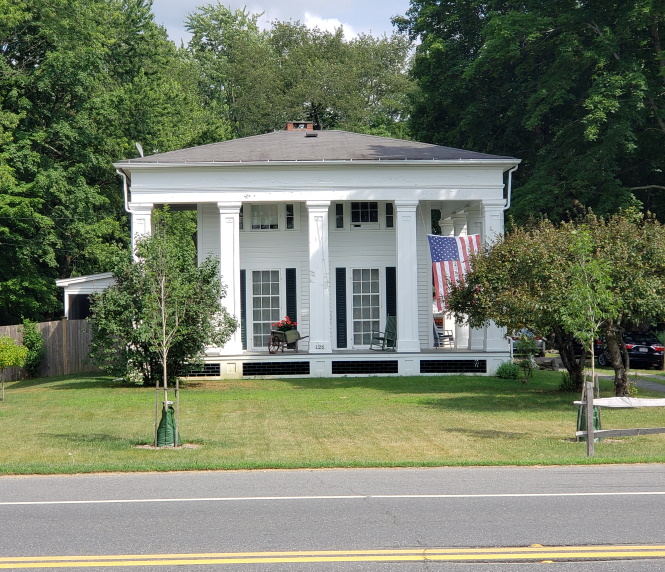
Although it now has a nineteenth-century Greek Revival appearance with eleven columns, the house at 126 Main Street in Sheffield dates back to 1761. In the 1760s, the house was rented by Dr. Lemuel Barnard, a physician who was one of the signers of the Sheffield Declaration, which was drawn up at the home of John Ashley in 1773. Seen as a predecessor of the Declaration of Independence, the Sheffield Declaration (or Sheffield Resolves) was a list of grievances against the British government and an outline of the basic rights of citizens. In 1768, David Ingersoll sold the house to Theodore Sedgwick, a Sheffield lawyer (born in West Hartford, Connecticut) who had written the text of the Sheffield Declaration. In 1781, he and Tapping Reeve represented Mum Bett, an enslaved woman at the house of John Ashley, who sued for her freedom under the Massachusetts constitution of 1780, part of which stated that “All men are born free and equal.” She won her freedom and took the name Elizabeth Freeman. Sedgwick was a delegate to the Continental Congress and would go on to serve as in the U.S. House and Senate. He was the forth Speaker of the House of Representatives (1799-1801) and served on the Massachusetts Supreme Court from 1802 until his death in 1813. In 1785, he sold the house at 126 Main Street to Elisha Lee, also an attorney, who was appointed the first postmaster of Sheffield in 1784.

Capt. John Bancroft House (1755)

by Dan/December 8, 2016/Colonial, Houses, Westfield

Capt. John Bancroft House

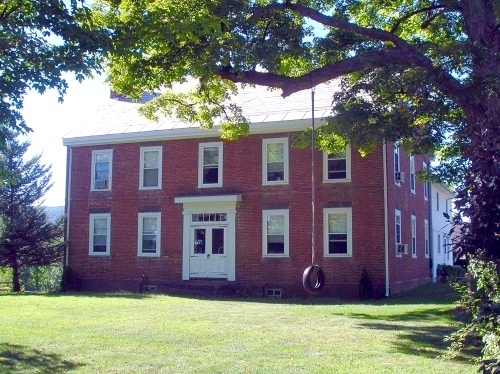
John Bancroft, who was a captain in the French and Indian War, built the brick house that still stands at 530 Pochassic Street in Westfield. Rev. John H. Lockwood, in his Westfield and Its Historic Influences (1922), writes of

Capt. John Bancroft who, in 1755, built in Pochassic what was probably the second brick house in the present Hampden County, the old Day house in West Springfield dating from 1754. The Bancroft house was by far the more massive and pretentious of the two and is still a notable mansion. Captain John, its builder, was a prosperous farmer, owning slaves, like a few of his fellow townsmen of the time. He was very proud of his elegant mansion. A tale, which may be pure romance founded on his well known characteristics, has come down to our time, somewhat as follows: He was wont to sit within his commodious domicile and watch for passers by in order to gloat over their envious glances. One day, while thus engaged, he called out to one on the road, “Did you think that you had reached paradise?” Quickly came the stunning response, “Yes! I did think so, until I saw the devil looking out of the window.” Sic transit gloria mundi!

In 1776, during the Revolutionary War, Capt. Bancroft’s name was published on a list of those considered “enemies of their country” and the Committee of Correspondence and Safety confined him within the limits of his farm. He regained some of his status after the War, but research long after his death revealed that he had been selling secrets to the British throughout the Revolution.

Salisbury Mansion (1772)

by Dan/September 17, 2016September 17, 2016/Colonial, Houses, Worcester

Salisbury Mansion

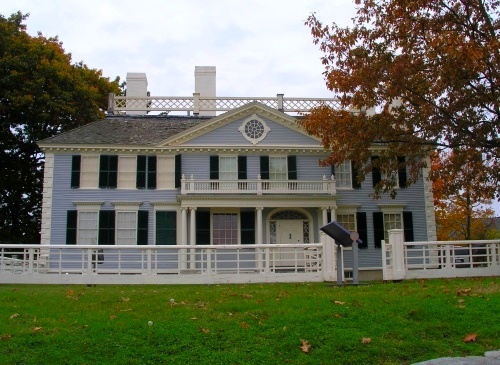
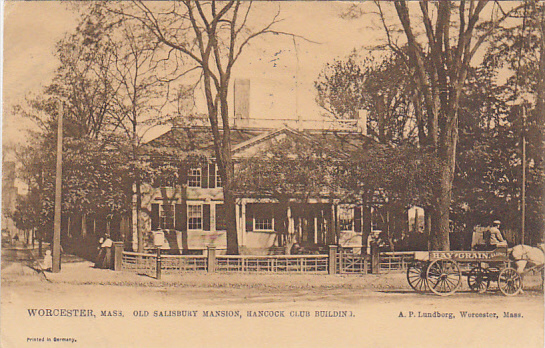
The Salisbury Mansion in Worcester was built in 1772 by merchant Stephen Salisbury to serve as both a residence and a store. The latter, where Salisbury sold imported goods, was closed down and converted to residential use in 1820. After Salisbury’s widow, Elizabeth Tuckerman Salisbury, died in 1851 the house was used as a rental property. In later years the house served as the Hancock Club, a gentleman’s social club. The mansion was originally located at Lincoln Square, which by the early twentieth century had become an industrialized area. In 1929 the mansion was willed to the American Antiquarian Society, which three years later transferred ownership to Worcester Art Museum. The house was moved to its current address at 40 Highland Street to make way for the Lincoln Square Boys Club. The Museum sold the mansion in 1950 to the Worcester Employment Society for use as a craft center. When that group later sought to tear down the building, concerned citizens formed the Salisbury Mansion Associates in 1955 and three years later purchased it. After sharing use of the mansion with the Worcester Girl Scouts Council for many years, the Associates restored the house, which in 1984 opened as Worcester’s first historic house museum. The following year the Associates merged with the Worcester Historical Museum, which now operates the historic site.

Nourse-Farwell House (1740)

by Dan/August 21, 2015/Colonial, Harvard, Houses

5 Elm St., Harvard

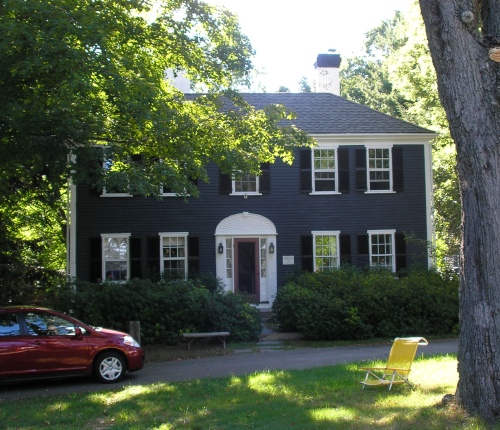
According to local tradition, the house at 5 Elm Street in Harvard was built c. 1740 by Benjamin Nourse at the time of his marriage to his second wife, the widow Hannah Atherton. It may also have been built c. 1755 or c. 1800 by John Nourse. In 1833 the house was bought by John Farwell, who owned a large meat and farm produce business and was also a teamster, a lumber dealer, and dealt in real estate. He served as town selectman in 1854 and as assessor from 1860 to 1863.

Posts navigation

Older posts
Newer posts
Privacy Policy

Categories

  • Architectural Style (943)
    • Art Deco (9)
    • Byzantine (3)
    • Colonial (177)
    • Colonial Revival (85)
    • Craftsman (6)
    • Egyptian Revival (1)
    • Federal (190)
    • Foursquare (6)
    • Gothic (67)
    • Greek Revival (100)
    • Italianate (82)
    • Mission Revival (2)
    • Mission/Spanish Colonial (1)
    • Modern (2)
    • Neoclassical (56)
    • Octagon (3)
    • Postmodern (1)
    • Queen Anne (46)
    • Renaissance Revival (26)
    • Romanesque Revival (53)
    • Second Empire (26)
    • Shingle Style (12)
    • Stick Style (13)
    • Tudor Revival (8)
    • Vernacular (49)
    • Victorian Eclectic (15)
  • Building Type (943)
    • Apartment Buildings (8)
    • Banks (18)
    • Churches (119)
    • Collegiate (32)
    • Commercial (102)
    • Hotels (16)
    • Houses (508)
    • Industrial (23)
    • Libraries (22)
    • Lighthouses (1)
    • Military (15)
    • Monuments (1)
    • Museums (12)
    • Organizations (39)
    • Outbuildings (17)
    • Public Buildings (50)
    • Schools (23)
    • Stations (5)
    • Synagogues (1)
    • Taverns (21)
    • Theaters (9)
  • Town (943)
    • Adams (11)
    • Agawam (4)
    • Amherst (50)
    • Boston (64)
    • Boylston (6)
    • Cambridge (30)
    • Clinton (21)
    • Concord (15)
    • Cummington (1)
    • Danvers (14)
    • Deerfield (31)
    • Gloucester (18)
    • Granville (10)
    • Great Barrington (2)
    • Hadley (9)
    • Hancock (15)
    • Harvard (32)
    • Holyoke (47)
    • Lenox (5)
    • Lexington (8)
    • Longmeadow (32)
    • Marblehead (40)
    • Marlborough (4)
    • Natick (22)
    • Newton (2)
    • Northampton (68)
    • Peabody (4)
    • Pittsfield (20)
    • Salem (110)
    • Saugus (4)
    • Sheffield (4)
    • South Hadley (8)
    • Southborough (8)
    • Southwick (4)
    • Springfield (67)
    • Stockbridge (19)
    • Stow (1)
    • Sturbridge (18)
    • Sudbury (7)
    • Waltham (11)
    • Watertown (1)
    • Wayland (8)
    • West Springfield (14)
    • Westfield (46)
    • Weston (2)
    • Worcester (26)
  • Uncategorized (1)

Recent Comments

  • Wilber Blackson on South Hadley
  • Tami Speiden on Stockbridge
  • DexGuru on Stockbridge

Tags

Alcott Amherst College Asher Benjamin Back Bay Baptist Beacon Hill Big E Black Heritage Trail bowfront Bulfinch Catholic Congregational Episcopal Freedom Trail Gambrel H.H. Richardson Harvard Hawthorne Historic Deerfield Isaac Damon lit Longfellow mansard Methodist Mount Holyoke Museum Museums NPS Old Sturbridge Village PEM Revolutionary War row houses saltbox Samuel McIntire Shakers Smith College SPNEA Springfield Armory Stephen C. Earle Storrowton Underground Railroad UU Washington William Fenno Pratt Witch Trials

Meta

  • Log in
  • Entries feed
  • Comments feed
  • WordPress.org
Proudly powered by WordPress | Theme: ShowMe by NEThemes.