Historic Buildings of Massachusetts

  • About
  • Index by Town
  • CT
  • About
  • Index by Town
  • CT

Category: Colonial

Bliss-Keep House (1713)
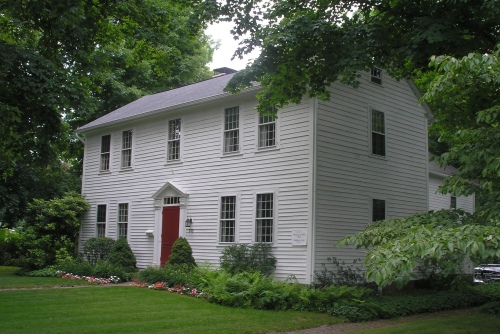
by Dan/September 6, 2009September 17, 2016/Colonial, Houses, Longmeadow

Bliss-Keep House

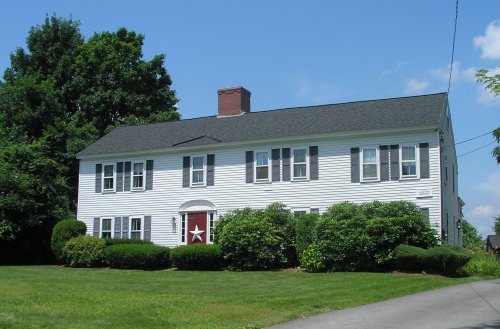
In 1744, Matthew Keep purchased a house on Longmeadow Green which had originally been owned by Nathaniel Bliss. Matthew’s ancestors, John Keep and his family, had been killed by Indians while crossing from the “long meddowe” by Pecousic Brook to attend church services in Springfield in 1676. Longmeadow became a separate precinct from Springfield in 1713, the same year the earliest section of the Bliss-Keep House (now at the rear of the building) was built. The front section was completed in 1733.
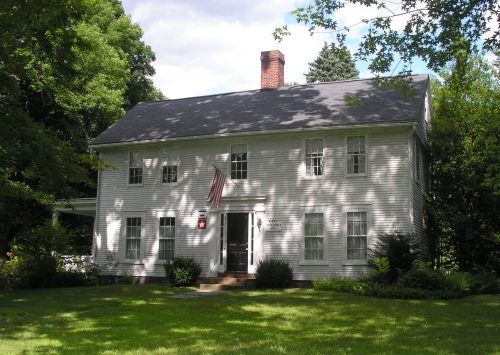
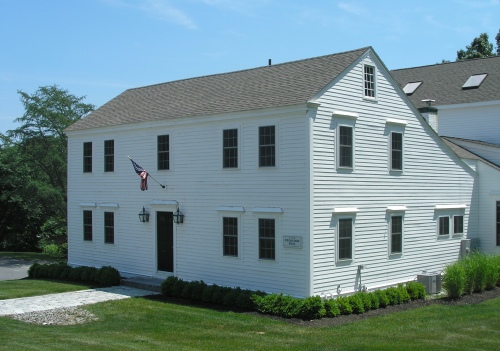
Thomas Bliss II House (1717)

by Dan/August 30, 2009September 17, 2016/Colonial, Houses, Longmeadow, Taverns

Bliss House

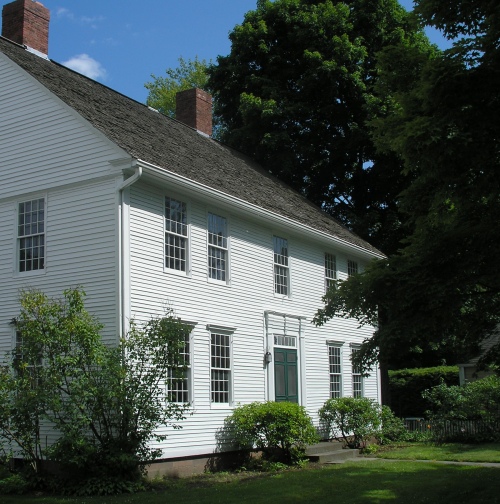
The Thomas Bliss II House in Longmeadow was built around 1717. In 1758, the house was converted into a tavern by Nathaniel Ely and served in that capacity until 1833. The house originally stood across Longmeadow Green from its current location. It was moved in 1855 to make way for the construction of Nathaniel Ely’s new mansion. Later in the nineteenth century, the house was lived in by Dr. Lester Noble, a dentist. He had a very interesting career, playing an important role in the famous Parkman Murder Trial. As described in “Our county and its people”: A history of Hampden County, Vol. I (1902), edited by Alfred Minott Copeland: Continue reading “Thomas Bliss II House (1717)”

William Hagar House (1760)

by Dan/August 30, 2009September 17, 2016/Colonial, Houses, Marlborough

William Hagar House

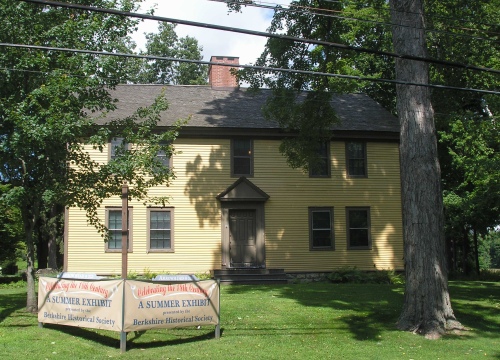
William Hager was a farmer and miller who built a house around 1760 on the Boston Post Road in Marlborough. William married Sarah Stow in 1761 (his brother, Ebenezer, had married Sarah’s sister Abigail in 1753). The brothers operated a sawmill on a nearby brook, built around 1730 by their father Ebenezer Hager. The house was later owned by William and Sarah‘s son, William Hager, Jr. (he was originally named Billy Hager and had his name officially changed to William), who was a staunch Federalist and opposed the War of 1812. The house once had a series of rear ells and an attached barn, all later demolished. In the nineteenth century, it was Victorianized and then re-Colonialized in the 1930s. Today, the house, which has a saltbox profile on its west elevation, has been converted for offices and has a large modern addition to the rear.

Joshua Rice Homestead (1681)

by Dan/August 29, 2009September 17, 2016/Colonial, Houses, Marlborough

Joshua Rice Homestead

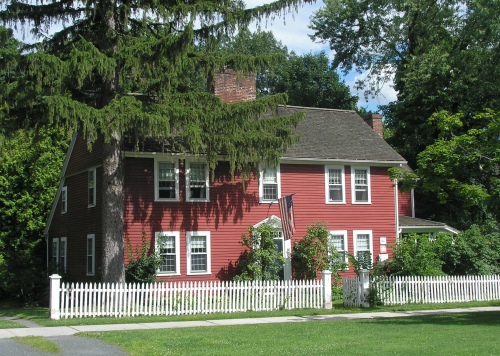
The Joshua Rice Homestead, on Elm Street in Marlborough, is a good example of how colonial houses could be expanded over the years. It’s oldest section, on the west, has a center-chimney structure, which gained a saltbox profile with the addition of a lean-to. This may have been built by Joshua Rice around 1681, or perhaps later (but still sometime before 1730), by Joshua’s cousin, Jacob Rice. The east section was added around 1800 and later an ell was constructed connecting the east end to an eighteenth century woodshed. The house remained in the Rice family into the 1870s or 1880s.

Richard Salter Storrs House (1786)

by Dan/August 29, 2009September 17, 2016/Colonial, Houses, Longmeadow

Storrs House 02

Richard Salter Storrs was the second pastor of Longmeadow’s First Congregational Church. Storrs, whose second wife, Sarah Williams, was the granddaughter of the congregation’s first pastor, Rev. Stephen Williams (one of the Deerfield captives of 1704), built his house in Longmeadow in 1786. The house remained in the Storrs family for many years and in the 1860s, Rev. Storrs granddaughter, Lucy Storrs Barber, ran a private girls’ school in the house. His grandson was Richard Salter Storrs III, minister at the Church of the Pilgrims in Brooklyn, New York. In 1907, this Rev. Storrs’ sister, Sarah Williams Storrs, left the family property in Longmeadow for use as a library (a building behind the house was used from 1916). In 1930, the Storrs House was moved to an adjacent site just to the south when a new library building was constructed (completed in 1932). At this time, the home’s original back kitchen ell was removed and not replaced. The Library continues to own the house, but in 1911, the Longmeadow Historical Society (founded in 1899) purchased the home‘s contents and offers tours of the building’s restored interiors.

Continue reading “Richard Salter Storrs House (1786)”

Arrowhead (1780)

by Dan/August 8, 2009June 29, 2013/Colonial, Houses, Pittsfield

Arrowhead 01

Arrowhead is the house in Pittsfield where Herman Malville wrote Moby Dick and other classic works. The house was built around 1780 by Captain David Bush and operated as an inn by Bush and his son. It originally had a much higher gambrel roof, but this was later removed, resulting in a lower roofline. There is a pdf file available of the house’s National Register of Historic Places Inventory nomination form. In the early nineteenth century, the house was the home of Melville’s Uncle Thomas and the author first visited the property, with its view of Mount Greylock, in 1832. In 1850, following the lead of his friend Hawthorne, who had also settled in nearby Lenox, Melville decided to move his family to the farm and they lived there until 1863. Melville named the house Arrowhead, because many arrowheads were dug up around the property during planting season. Shortly after buying Arrowhead, Melville added a side porch, after which his story “The Piazza” is named. These were productive years for Melville as a writer. During his time at Arrowhead, he wrote Moby Dick (1851), Pierre (1852), Israel Potter (1855), The Piazza Tales (1856), and The Confidence Man (1857). His story, “I and My Chimney,” has a description of the house as it appeared when Melville lived there. Not earning a living from his writing, Melville eventually returned to New York, taking a job as a customs inspector. He sold Arrowhead to his brother Allan and it remained in the Melville family until 1927. In 1975, the house was purchased by the Berkshire County Historical Society and restored to become a museum. Continue reading “Arrowhead (1780)”

Captain Simon Colton House (1734)

by Dan/August 7, 2009September 17, 2016/Colonial, Houses, Longmeadow

Old Red House on the Green

The Captain Simon Colton House is a classic saltbox house built on Longmeadow Green in 1734. The house has an ell extending to the south which was built to meet a stipulation of Capt. Colton’s second wife that she would marry him only if he made her a seperate bedroom. The house operated as a tavern around the time of the Revolutionary War. It was owned for a time by the Society for the Preservation of New England Antiquities, but was later sold with the requirement that the facade remain unchanged and that the house, known as the “Old Red House on the Green,” always be painted red. The house is featured on the Town Seal of Longmeadow.

Posts navigation

Older posts
Newer posts
Privacy Policy

Categories

  • Architectural Style (943)
    • Art Deco (9)
    • Byzantine (3)
    • Colonial (177)
    • Colonial Revival (85)
    • Craftsman (6)
    • Egyptian Revival (1)
    • Federal (190)
    • Foursquare (6)
    • Gothic (67)
    • Greek Revival (100)
    • Italianate (82)
    • Mission Revival (2)
    • Mission/Spanish Colonial (1)
    • Modern (2)
    • Neoclassical (56)
    • Octagon (3)
    • Postmodern (1)
    • Queen Anne (46)
    • Renaissance Revival (26)
    • Romanesque Revival (53)
    • Second Empire (26)
    • Shingle Style (12)
    • Stick Style (13)
    • Tudor Revival (8)
    • Vernacular (49)
    • Victorian Eclectic (15)
  • Building Type (943)
    • Apartment Buildings (8)
    • Banks (18)
    • Churches (119)
    • Collegiate (32)
    • Commercial (102)
    • Hotels (16)
    • Houses (508)
    • Industrial (23)
    • Libraries (22)
    • Lighthouses (1)
    • Military (15)
    • Monuments (1)
    • Museums (12)
    • Organizations (39)
    • Outbuildings (17)
    • Public Buildings (50)
    • Schools (23)
    • Stations (5)
    • Synagogues (1)
    • Taverns (21)
    • Theaters (9)
  • Town (943)
    • Adams (11)
    • Agawam (4)
    • Amherst (50)
    • Boston (64)
    • Boylston (6)
    • Cambridge (30)
    • Clinton (21)
    • Concord (15)
    • Cummington (1)
    • Danvers (14)
    • Deerfield (31)
    • Gloucester (18)
    • Granville (10)
    • Great Barrington (2)
    • Hadley (9)
    • Hancock (15)
    • Harvard (32)
    • Holyoke (47)
    • Lenox (5)
    • Lexington (8)
    • Longmeadow (32)
    • Marblehead (40)
    • Marlborough (4)
    • Natick (22)
    • Newton (2)
    • Northampton (68)
    • Peabody (4)
    • Pittsfield (20)
    • Salem (110)
    • Saugus (4)
    • Sheffield (4)
    • South Hadley (8)
    • Southborough (8)
    • Southwick (4)
    • Springfield (67)
    • Stockbridge (19)
    • Stow (1)
    • Sturbridge (18)
    • Sudbury (7)
    • Waltham (11)
    • Watertown (1)
    • Wayland (8)
    • West Springfield (14)
    • Westfield (46)
    • Weston (2)
    • Worcester (26)
  • Uncategorized (1)

Recent Comments

  • Wilber Blackson on South Hadley
  • Tami Speiden on Stockbridge
  • DexGuru on Stockbridge

Tags

Alcott Amherst College Asher Benjamin Back Bay Baptist Beacon Hill Big E Black Heritage Trail bowfront Bulfinch Catholic Congregational Episcopal Freedom Trail Gambrel H.H. Richardson Harvard Hawthorne Historic Deerfield Isaac Damon lit Longfellow mansard Methodist Mount Holyoke Museum Museums NPS Old Sturbridge Village PEM Revolutionary War row houses saltbox Samuel McIntire Shakers Smith College SPNEA Springfield Armory Stephen C. Earle Storrowton Underground Railroad UU Washington William Fenno Pratt Witch Trials

Meta

  • Log in
  • Entries feed
  • Comments feed
  • WordPress.org
Proudly powered by WordPress | Theme: ShowMe by NEThemes.