Historic Buildings of Massachusetts

  • About
  • Index by Town
  • CT
  • About
  • Index by Town
  • CT

Category: Colonial

Lindall-Gibbs-Osgood House (1755)
by Dan/November 20, 2010January 25, 2020/Colonial, Houses, Salem

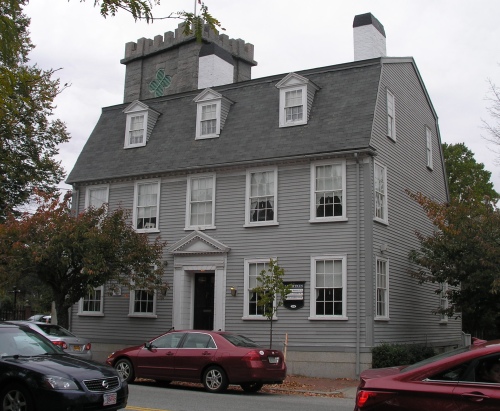
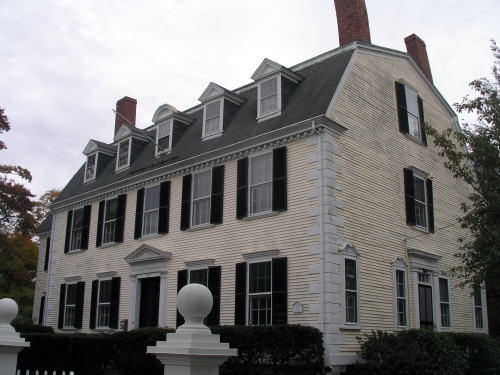
The Lindall-Gibbs-Osgood House is a gambrel-roofed residence at 314 Essex Street in Salem. Located between the “Witch House” and First Church, it was built for Mary Lindall and later had other owners, including the Gibbs family. In 1825, it was bought by Capt. William Osgood and remained in his family until was acquired by the Red Cross in the 1940s. The house continues as an office building today. According to The Colonial Architecture of Salem (1919), by Frank Cousins and Phil M. Riley, it was in this house

where Benjamin Thompson, afterward Count Rumford, commander-in-chief of the Bavarian army, lived as a boy and made some of his early experiments. Rumford ovens, invented by this eminent scientist and author, are to be found in several of the larger old mansions of Salem, a few of them even now finding occasional use.

At the age of 13, Thompson was apprenticed to John Appleton, a merchant who owned the house at the time.
Elbridge Gerry House (1742)

by Dan/November 18, 2010January 16, 2020/Colonial, Houses, Marblehead

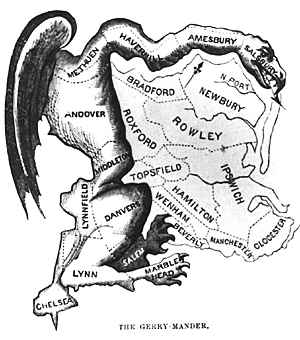
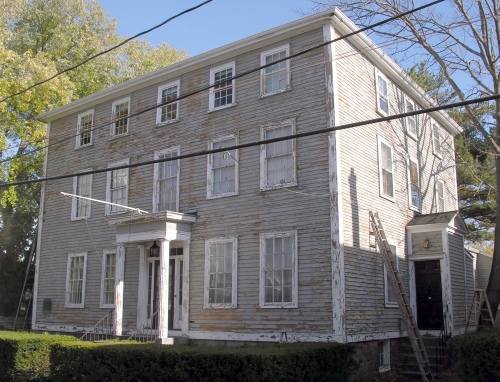
At 44 Washington Street in Marblehead, opposite the Old North Church, is a house, built sometime between 1730 and 1742, where Elbridge Gerry was born and spent his early years. Elbridge Gerry (1744-1814), a statesman and diplomat, was a signer of the Declaration of Independence and was one of three men who refused to sign the Constitution because it did not contain a Bill of Rights. Gerry later served as Governor of Massachusetts (1810-1812) and Vice-President (1813-1814) under James Madison. The process of gerrymandering, or drawing electoral districts to favor a particular party, is named for him due to a redrawing of districts in Massachusetts during his term as governor. In the 1820s, a third floor and Greek Revival entrance were added to the house.

Cabot-Endicott-Low House (1744)

by Dan/November 13, 2010January 25, 2020/Colonial, Houses, Salem

Thought to have been built sometime between 1744 and 1748, the Cabot-Endicott-Low House, at 365 Essex Street in Salem, is an important example of a high-style gambrel roof Georgian colonial residence. The house was built for Joseph Cabot, a merchant, and remained in his family until purchased by William C. Endicott in 1870. Endicott was a justice of the Massachusetts Supreme Judicial Court (1873-1882) and Secretary of War under Grover Cleveland (1885-1889). His daughter, Mary, married British prime minister Joseph Chamberlain in 1888. Endicott‘s friend, merchant and silversmith Daniel Low, owned the house from 1894 to 1919. Continue reading “Cabot-Endicott-Low House (1744)”

William Sandin House (1714)

by Dan/November 11, 2010January 22, 2020/Colonial, Houses, Marblehead

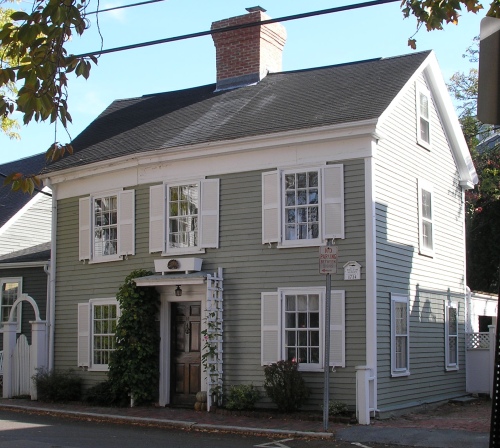
A look at the William Sandin House, built in 1714 in Marblehead, reveals an interesting circumstance: when viewing the front facade, it’s clear that the left third of the house warps at a slight angle.

Jeremiah Page House (1754)

by Dan/November 9, 2010January 18, 2020/Colonial, Danvers, Houses

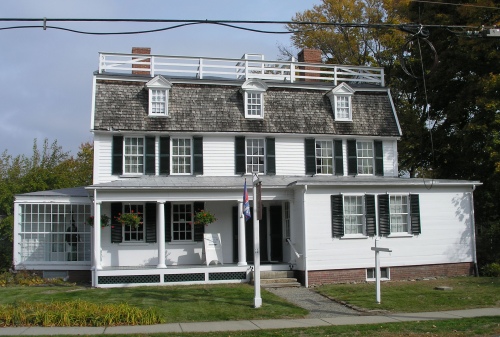
The Page House in Danvers was built in 1754 by Jeremiah Page, a brick maker, who also fought in the Revolutionary War. During the tea embargo in 1770, Page declared that “no tea would be drunk in his house.” As related in Lucy Larcom‘s poem, “A Gambrel Roof,” Page’s wife invited her lady friends to gather for tea on the roof, since it was “Upon a house is not within it.” In 1774, a room in the house was used as an office by General Thomas Gage, who was then the British military governor of Massachusetts. Jeremiah’s son, John Page, and then his granddaughter, Ann Lemist Page, later lived in the house. In 1850, a grandson of Jeremiah Page attempted to break into the Village Bank next to the house and was shot and killed by a night guard. Various additions were made in the nineteenth century. The building, as explained by Mary H. Northend in Colonial Homes and their Furnishings (1912), originally “consisted of four rooms, but these were later moved back and a new front added, the ell being replaced by a larger one.” Ann Lemist Page, who lived in the home until her death in 1913, was a pioneer in the kindergarten movement and, for a time, she ran a school in her home. In her will, she requested that the house be demolished to prevent its falling into disrepair. The Danvers Historical Society challenged the will in court and was able to purchase the property and move it from Elm Street to Page Street to serve as their headquarters.

Lafayette House (1731)

by Dan/November 6, 2010/Colonial, Houses, Marblehead

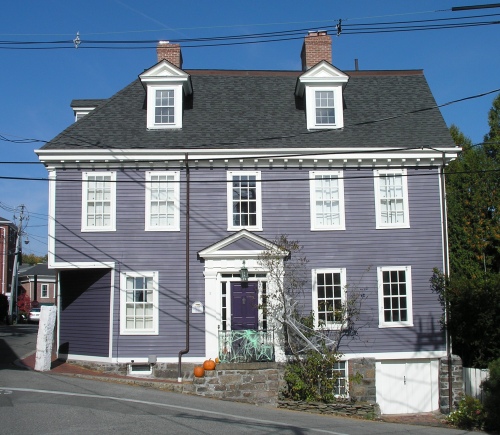
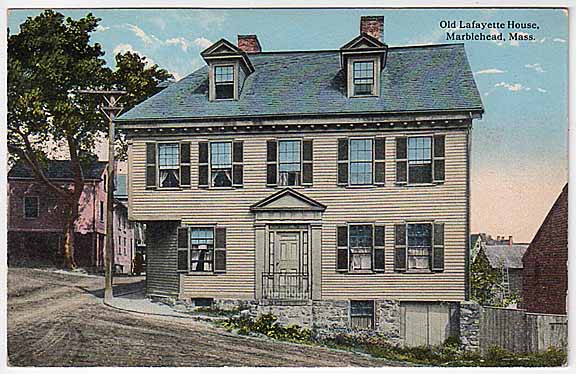
At a spot in Marblehead where five streets intersect is the c. 1731 “Lafayette House.” It acquired this name due to an often-told story that when General Lafayette visited Marblehead in 1824, his carriage was too large to pass by the house and so the corner of the building on the first floor was removed. The story is considered unlikely by modern historians and there are other possible explanations for why the house is missing a corner. One possibility is that it was done to allow large coal wagons to pass by. Another is that it was constructed that way for a retail shop entrance. Yet another idea is that it was to allow the flow of draining water and sewage. The house is also notable as being the home of Jeremiah Lee and his family from 1751 to 1768. before he built his later mansion in Marblehead.

Crowninshield-Bentley House (1727)

by Dan/November 1, 2010December 14, 2017/Colonial, Houses, Salem

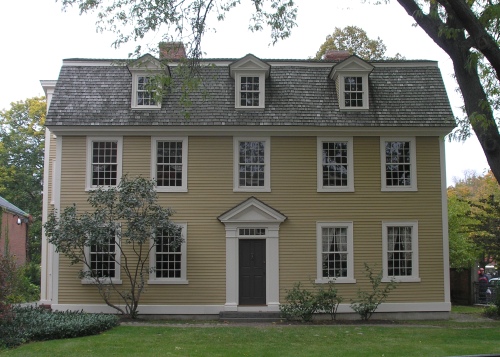
The Crowninshield-Bentley House was built in 1727 to 1730 on Essex Street in Salem. Four generations of Crowninshields lived in the house, until 1832, beginning with merchant and sea captain John Crowninshield. The building may have begun as a half-house (the east half of the house) and was enlarged by 1761, when John Crowninshield died and his widow Hannah and son Benjamin divided the property. Benjamin added a new addition in 1794, while his mother rented her half of the house out to boarders. The house is also named for Reverend William Bentley, who boarded here from 1791 to 1819, while he was pastor of East Church. Bentley was a Unitarian minister and scholar, famous for his diary. The house was sold to the Hawthorne Hotel in the 1940s and in 1959 the Hotel donated it to the Essex institute. The house‘s modern additions were then removed and it was moved to the grounds of the Essex Institute, where it was restored as a memorial to the wealthy preservationist Louise DuPont Crowninshield. The house, which is a house museum owned by the Peabody Essex Museum, has recently had an extensive restoration.

Posts navigation

Older posts
Newer posts
Privacy Policy

Categories

  • Architectural Style (943)
    • Art Deco (9)
    • Byzantine (3)
    • Colonial (177)
    • Colonial Revival (85)
    • Craftsman (6)
    • Egyptian Revival (1)
    • Federal (190)
    • Foursquare (6)
    • Gothic (67)
    • Greek Revival (100)
    • Italianate (82)
    • Mission Revival (2)
    • Mission/Spanish Colonial (1)
    • Modern (2)
    • Neoclassical (56)
    • Octagon (3)
    • Postmodern (1)
    • Queen Anne (46)
    • Renaissance Revival (26)
    • Romanesque Revival (53)
    • Second Empire (26)
    • Shingle Style (12)
    • Stick Style (13)
    • Tudor Revival (8)
    • Vernacular (49)
    • Victorian Eclectic (15)
  • Building Type (943)
    • Apartment Buildings (8)
    • Banks (18)
    • Churches (119)
    • Collegiate (32)
    • Commercial (102)
    • Hotels (16)
    • Houses (508)
    • Industrial (23)
    • Libraries (22)
    • Lighthouses (1)
    • Military (15)
    • Monuments (1)
    • Museums (12)
    • Organizations (39)
    • Outbuildings (17)
    • Public Buildings (50)
    • Schools (23)
    • Stations (5)
    • Synagogues (1)
    • Taverns (21)
    • Theaters (9)
  • Town (943)
    • Adams (11)
    • Agawam (4)
    • Amherst (50)
    • Boston (64)
    • Boylston (6)
    • Cambridge (30)
    • Clinton (21)
    • Concord (15)
    • Cummington (1)
    • Danvers (14)
    • Deerfield (31)
    • Gloucester (18)
    • Granville (10)
    • Great Barrington (2)
    • Hadley (9)
    • Hancock (15)
    • Harvard (32)
    • Holyoke (47)
    • Lenox (5)
    • Lexington (8)
    • Longmeadow (32)
    • Marblehead (40)
    • Marlborough (4)
    • Natick (22)
    • Newton (2)
    • Northampton (68)
    • Peabody (4)
    • Pittsfield (20)
    • Salem (110)
    • Saugus (4)
    • Sheffield (4)
    • South Hadley (8)
    • Southborough (8)
    • Southwick (4)
    • Springfield (67)
    • Stockbridge (19)
    • Stow (1)
    • Sturbridge (18)
    • Sudbury (7)
    • Waltham (11)
    • Watertown (1)
    • Wayland (8)
    • West Springfield (14)
    • Westfield (46)
    • Weston (2)
    • Worcester (26)
  • Uncategorized (1)

Recent Comments

  • Wilber Blackson on South Hadley
  • Tami Speiden on Stockbridge
  • DexGuru on Stockbridge

Tags

Alcott Amherst College Asher Benjamin Back Bay Baptist Beacon Hill Big E Black Heritage Trail bowfront Bulfinch Catholic Congregational Episcopal Freedom Trail Gambrel H.H. Richardson Harvard Hawthorne Historic Deerfield Isaac Damon lit Longfellow mansard Methodist Mount Holyoke Museum Museums NPS Old Sturbridge Village PEM Revolutionary War row houses saltbox Samuel McIntire Shakers Smith College SPNEA Springfield Armory Stephen C. Earle Storrowton Underground Railroad UU Washington William Fenno Pratt Witch Trials

Meta

  • Log in
  • Entries feed
  • Comments feed
  • WordPress.org
Proudly powered by WordPress | Theme: ShowMe by NEThemes.