Historic Buildings of Massachusetts

  • About
  • Index by Town
  • CT
  • About
  • Index by Town
  • CT

Category: Colonial

Old Brick Path (1729)
by Dan/December 2, 2010January 22, 2020/Colonial, Houses, Marblehead

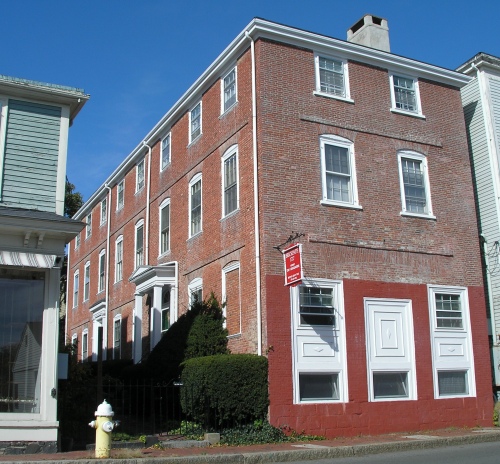
The Old Brick Path is the traditional name of an historic eighteenth-century house in Marblehead, which for many years in modern times contained a gift shop called the Brick Path. Built in 1729, it is one of the few brick colonial houses in town. It was the home and shop of Thomas Robie, a loyalist merchant, who held secret Tory meetings there during the Revolution. Robie was eventually forced to flee with his family to Nova Scotia in 1777. As explained by Samuel Roads, Jr. in his History and Traditions of Marblehead (1880):

In later years the house became the residence of Major Joseph W. Green, who for nearly thirty years was one of the most enterprising merchants in the town. A few years after the close of the War of 1812, he engaged in business with Benjamin Porter, under the firm name of Porter & Green. In a short time this firm employed fourteen vessels in the fishing trade, besides brigs and packets which were sent to New York and the West Indies. Their wharves and ware-rooms were filled with every commodity used in fitting out vessels for sea, and it is said that at one time they furnished seventy-five vessels with stores, anchors, cables, wood, and supplies of every kind necessary for a long voyage to the Banks. Through the influence of Major Green, the Grand Bank was established, and he was its first president
Clark-Morgan-Benson House (1729)

by Dan/December 1, 2010January 25, 2020/Colonial, Houses, Salem

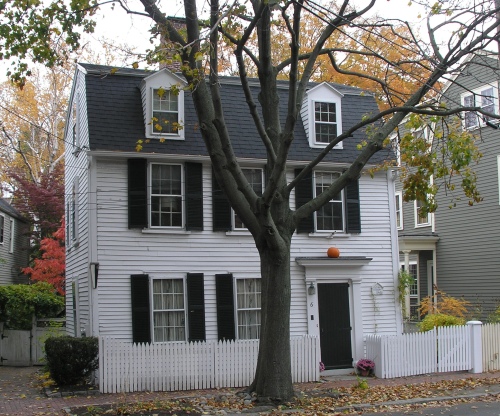
Built around 1729, replacing and reusing timbers from a previous house at the same location that had burned, the Clark-Morgan-Benson House is one of the oldest surviving buildings on Essex Street in Salem. Built by Joseph Neal, the house has been enlarged over time and has two substantial ells, forming a U-shape, the ell on the western elevation having a gambrel roof like the front facade. In the nineteenth century, the dwelling was divided between the Clark and Morgan families and was later owned, undivided, for much of the twentieth century by the Benson family.

Josiah Woodbury House (1774)

by Dan/November 30, 2010January 25, 2020/Colonial, Houses, Salem

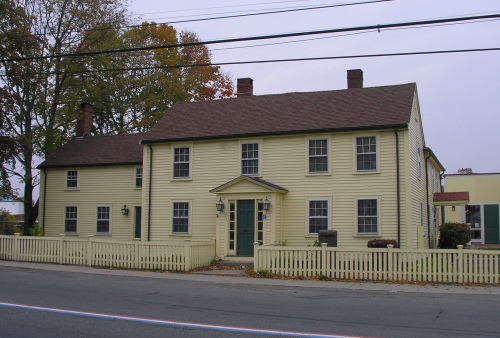
Typical of houses of its period, including in its entryway, is the Josiah Woodbury House, on Broad Street in Salem, built around 1774. Woodbury was a mason and the house stayed in his family until 1815. The house has a rear ell of a type known as a Beverly Jog.

Buffington-Goodhue-Wheatland House (1785)

by Dan/November 29, 2010January 25, 2020/Colonial, Houses, Salem

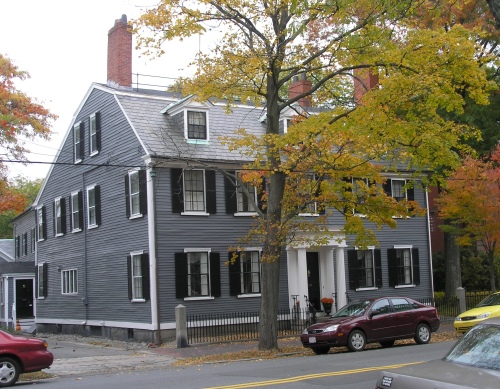
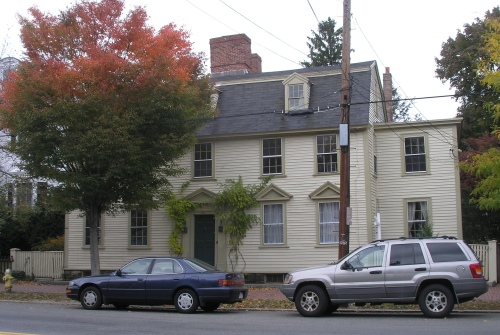
The Buffington-Goodhue-Wheatland House, at 374 Essex Street in Salem, was built around 1785 or earlier for Capt. Nehemiah Buffington, who died in 1832. It soon passed to Benjamin Goodhue, who moved the house forward to be closer to Essex Street. He also added the Greek Revival-style entrance. The house was in the Wheatland family from 1849 to early in the twentieth century.

Saugus Iron Works House (1680)

by Dan/November 28, 2010/Colonial, Houses, Saugus

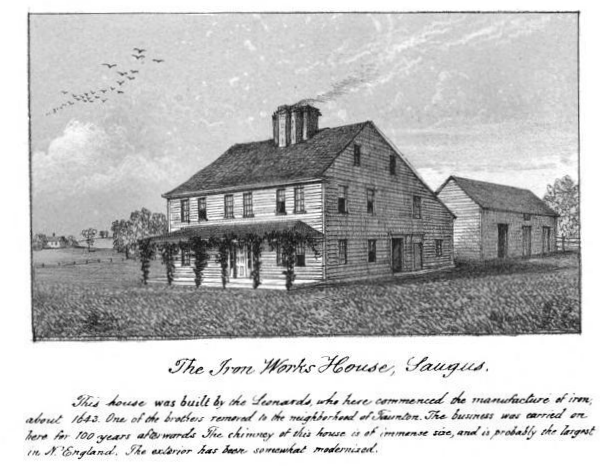
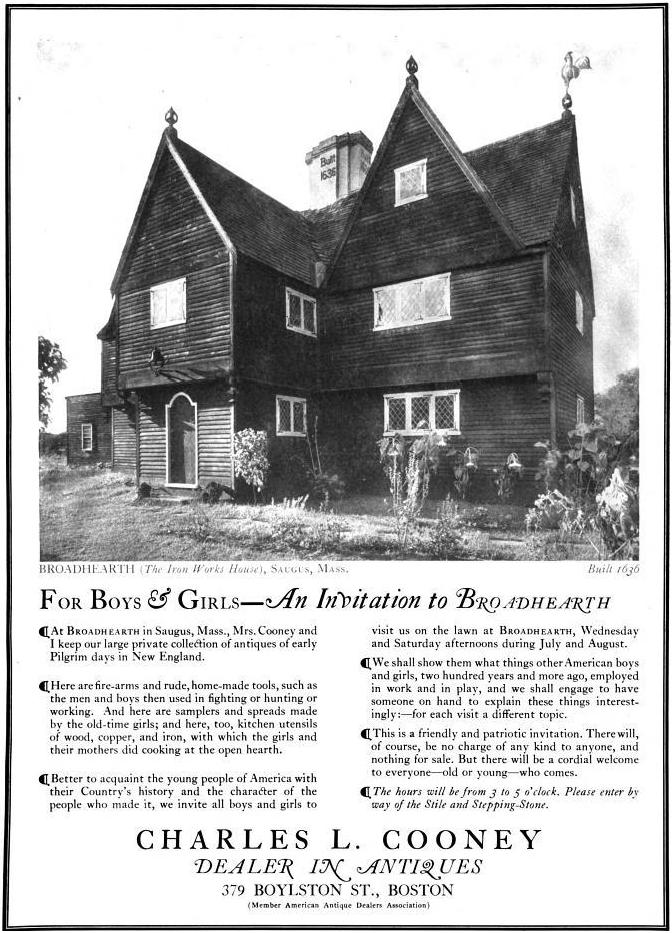
Going back to 1646, the Saugus Iron Works were the first integrated ironworks in North America. Various buildings of the Iron Works complex were reconstructed in the 1950s on their original sites and are today part of the Saugus Iron Works National Historic Site. A timber-framed seventeenth-century house, traditionally called the “Old Iron Works House,” is also located on the site. It was once believed to have been built in 1646, but is now thought to have been constructed in the 1680s, about a decade after the Iron Works ceased production in 1668. The first known resident of the house, from 1681 to 1688, was Samuel Appleton. By the early twentieth century, the house had become a tenement and had been much altered. In 1915, it was purchased by Wallace Nutting, antiquarian and entrepreneur, who hired Boston architect Henry Charles Dean to restore the house. Nutting renamed the restored house “Broadhearth” and it became part of his chain of colonial homes. As with his other properties, Nutting took photographs of his models posing in the house, which he marketed through a catalog. He soon hired a blacksmith to work at the site, but eventually decided to sell the property to an antiques dealer from Boston.

John Palmer House (1683)

by Dan/November 25, 2010January 22, 2020/Colonial, Houses, Marblehead

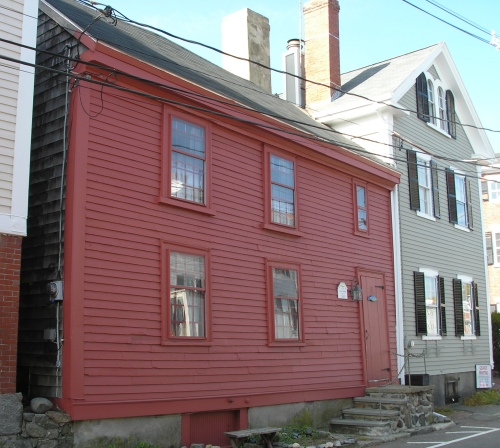
One of the oldest houses in Marblehead is the John Palmer House at 11 Hooper Street. The house was built in 1683 and has framing timbers made of English walnut, salvaged from a sailing vessel (one timber was formerly a mast and still displays rope marks). The two houses on either side immediately adjoin the Palmer House. Today, the house has sash windows, which long ago replaced the original irregularly spaced casement windows.

George Peabody House (1790)

by Dan/November 22, 2010January 17, 2020/Colonial, Houses, Peabody

Peabody, originally South Danvers, is named after George Peabody, a merchant, financier and philanthropist. He spent his early career in Baltimore and in 1837 took up residence in London, where he remained until his death in 1869. During his lifetime he was the benefactor of numerous institutions, including the Peabody Institute Library (1852), the Peabody Institute Library of Danvers (1856), the Peabody Institute of the Johns Hopkins University (1857), the Peabody Museum of Archaeology and Ethnology at Harvard University (1866), the Peabody Museum of Natural History at Yale University (1866) and the Peabody Essex Museum in Salem (1867). George Peabody was born in South Danvers in 1795 in a house his father Thomas rented and soon purchased at 205 Washington Street. Built around 1790, the house passed to George Peabody’s older brother David in 1811, who took out two mortgages on the property the following year. In 1816, George Peabody purchased the house, where his mother resided until her death in 1830. Peabody sold it two years later and it has had many owners over the years. In the twentieth century, it housed workers of the American Glue Company (later Eastman Gelatin). In 1989, the City of Peabody purchased the house and restored it to become the George Peabody House Museum.

Posts navigation

Older posts
Newer posts
Privacy Policy

Categories

  • Architectural Style (943)
    • Art Deco (9)
    • Byzantine (3)
    • Colonial (177)
    • Colonial Revival (85)
    • Craftsman (6)
    • Egyptian Revival (1)
    • Federal (190)
    • Foursquare (6)
    • Gothic (67)
    • Greek Revival (100)
    • Italianate (82)
    • Mission Revival (2)
    • Mission/Spanish Colonial (1)
    • Modern (2)
    • Neoclassical (56)
    • Octagon (3)
    • Postmodern (1)
    • Queen Anne (46)
    • Renaissance Revival (26)
    • Romanesque Revival (53)
    • Second Empire (26)
    • Shingle Style (12)
    • Stick Style (13)
    • Tudor Revival (8)
    • Vernacular (49)
    • Victorian Eclectic (15)
  • Building Type (943)
    • Apartment Buildings (8)
    • Banks (18)
    • Churches (119)
    • Collegiate (32)
    • Commercial (102)
    • Hotels (16)
    • Houses (508)
    • Industrial (23)
    • Libraries (22)
    • Lighthouses (1)
    • Military (15)
    • Monuments (1)
    • Museums (12)
    • Organizations (39)
    • Outbuildings (17)
    • Public Buildings (50)
    • Schools (23)
    • Stations (5)
    • Synagogues (1)
    • Taverns (21)
    • Theaters (9)
  • Town (943)
    • Adams (11)
    • Agawam (4)
    • Amherst (50)
    • Boston (64)
    • Boylston (6)
    • Cambridge (30)
    • Clinton (21)
    • Concord (15)
    • Cummington (1)
    • Danvers (14)
    • Deerfield (31)
    • Gloucester (18)
    • Granville (10)
    • Great Barrington (2)
    • Hadley (9)
    • Hancock (15)
    • Harvard (32)
    • Holyoke (47)
    • Lenox (5)
    • Lexington (8)
    • Longmeadow (32)
    • Marblehead (40)
    • Marlborough (4)
    • Natick (22)
    • Newton (2)
    • Northampton (68)
    • Peabody (4)
    • Pittsfield (20)
    • Salem (110)
    • Saugus (4)
    • Sheffield (4)
    • South Hadley (8)
    • Southborough (8)
    • Southwick (4)
    • Springfield (67)
    • Stockbridge (19)
    • Stow (1)
    • Sturbridge (18)
    • Sudbury (7)
    • Waltham (11)
    • Watertown (1)
    • Wayland (8)
    • West Springfield (14)
    • Westfield (46)
    • Weston (2)
    • Worcester (26)
  • Uncategorized (1)

Recent Comments

  • Wilber Blackson on South Hadley
  • Tami Speiden on Stockbridge
  • DexGuru on Stockbridge

Tags

Alcott Amherst College Asher Benjamin Back Bay Baptist Beacon Hill Big E Black Heritage Trail bowfront Bulfinch Catholic Congregational Episcopal Freedom Trail Gambrel H.H. Richardson Harvard Hawthorne Historic Deerfield Isaac Damon lit Longfellow mansard Methodist Mount Holyoke Museum Museums NPS Old Sturbridge Village PEM Revolutionary War row houses saltbox Samuel McIntire Shakers Smith College SPNEA Springfield Armory Stephen C. Earle Storrowton Underground Railroad UU Washington William Fenno Pratt Witch Trials

Meta

  • Log in
  • Entries feed
  • Comments feed
  • WordPress.org
Proudly powered by WordPress | Theme: ShowMe by NEThemes.