Historic Buildings of Massachusetts

  • About
  • Index by Town
  • CT
  • About
  • Index by Town
  • CT

Category: Commercial

Casey’s Diner (1922)
by Dan/September 3, 2010September 3, 2010/Commercial, Natick, Vernacular

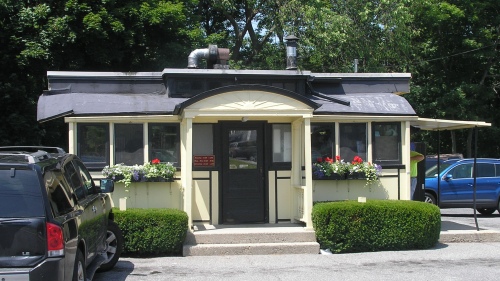
A famous Natick landmark is Casey’s Diner, famous for its steamed hot dogs. Casey’s began as a horse-drawn lunch cart on Natick Common. In 1927, Fred Casey purchased a 1922 Diner, originally located in Framingham, and brought it to Natick. The Diner, produced by the Worcester Lunch Car Company, was first on Washington Street and was moved to its current location, on South Avenue, in 1977, to make way for a bank parking lot.
Odd Fellows’ Building, Natick (1888)

by Dan/September 2, 2010/Commercial, Natick, Organizations, Romanesque Revival

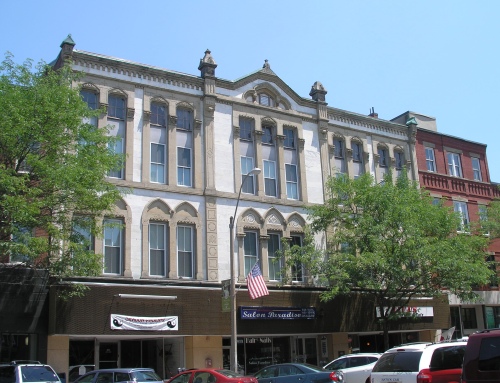
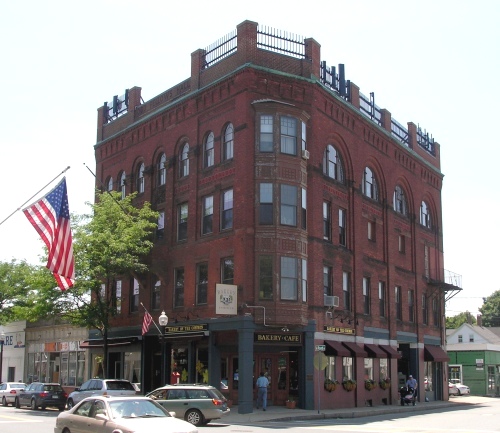
The Tackawanbait Lodge of the Independent Order of Odd Fellows in Natick was named for the town’s Native American minister, Reverend Daniel Takawambpait. Founded in 1845, the Lodge utilized the upper floors of the Odd Fellows’ Building, constructed in 1887-1888 on the corner of Main and Pond Streets off Natick’s Town Common. The Richardsonian Romanesque Odd Fellow’s Block, designed by Ernest N. Boyden of Boston, continues to have retail space on the ground floors. According to the History of Middlesex County, Vol. I (1890), “The first story on Main Street is of iron and plate-glass, while on Pond Street it is of brick and plate-glass. The remaining three stories are constructed of brick with Long Meadow sand-stone trimmings.”

Walcott Building, Natick (1888)

by Dan/September 1, 2010/Commercial, Natick, Organizations, Romanesque Revival

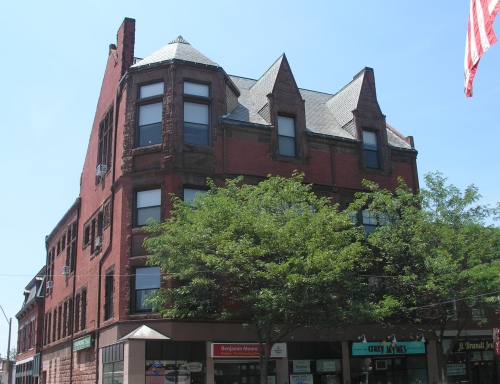
The last building to be constructed in the aftermath of the 1874 Natick fire is the Walcott Building, also known as the Desban Building, built in 1888 in the Richardsonian Romanesque style. It replaced the Walcott shoe factory on the same site, at the corner of Main and Summer Streets, which burned in 1874. Again quoting from the History of Middlesex County, Vol. I (1890):

The new block is by far the most beautiful and elaborately finished structure in Natick. The lower story on Main Street is constructed of iron and plate-glass, and on Summer street of red sandstone. The upper stories are of brick, with sandstone trimmings. The staircase to the second story is wholly of polished marble, while the flagging-stones of the two fronts are very large and costly stones from the Hudson River Valley, perfectly cut and fitted in the best possible manner. On the lower floor, at the corner, is the spacious, well-lighted and finely decorated store of Leamy & Tilton, with a large stock of new dry-goods and small wares. On the same floor is the Bay State Clothing Store of Hastings & Lowell. On the second floor are six rooms for offices, with a large hall. Above are the elegant quarters of the Red Men, comprising a room for the ladies of the order with ante-rooms.; also the large hall for the society’s gatherings, and their banqueting-hall, with tables and a kitchen and pantry, furnished with ranges and crockery. The walls throughout have been treated with fresco or beautifully-tinted paints, and the entire establishment would be deemed ornamental in any city of our land.

Clark’s Block, Natick (1874)

by Dan/August 31, 2010/Commercial, Italianate, Natick, Public Buildings

Another building constructed in the immediate aftermath of the Natick fire of 1874 is Clark’s Block on Main Street. As described in the History of Middlesex County, Vol. I (1890):

This, which is the largest business block in Natick, or in this part of the Commonwealth, stands partly upon the site of a similar but smaller structure, which was erected in 1872, only to be burned in the great fire of 1874. That block was about 100 feet in length and three stories high, while the present structure is of the same height, but 260 feet long. The latter, as was true of its predecessor, was built and is owned by Mr. Nathaniel Clark, who, after a long and useful business life, is passing the time of old age with the respect and affection of the entire community.

The chief frontage of this block is on Main Street. The lower story, which is devoted to stores, is occupied as follows: Edward Clark, grocer; E.M.Marshall, watch-maker and jeweler; W. L. Doane, boots and shoes; Qardella & Cuneo, fruits; barber; W. F. Cleland & Co., dry-goods; C. H. Whitcomb, hats and furnishing goods; Arthur W. Palmer, readymade clothing and tailor; James H. Frost, apothecary; Charles W. Ambrose, watch-maker and jeweler; W. F. Demeritt, tailor; W. H. Jones, boots and shoes; George L. Bartlett, dry-goods; Miss C. H. Travis, milliner; Daniels & Twitchell, druggists; Harrison L. Whipple, art-store, dealer in pictures and picture-frames—sixteen stores.

In the second story are the rooms of the Natick National Bank and of the Five-Cents Savings Bank (elsewhere described), of O. J. Washburn, dentist, Judge Null’s law-office and Dislrict Court-room; the offices of tax-collector, of the selectmen, of the overseers of the poor, of the assessors, of the town clerk, of the School Committee and of the chief of police ; the law-offices of James McManus, I. W. Parker, C. Q. Tirrell, G. D. Tower and L. H. Wakefield; office of Dr. William Richards; rooms of John F. Dowsley, dentist; of Miss L. M. Hart, dress-maker, Palmer’s sewing-room and four large rooms occupied by the Natick Citizen Printing and Editing Company. In the third story are four halls, the largest of which—Concert Hall—is more than 100 feet long and well furnished for an audience of 1200 or 1400. This the town uses for all town-hall purposes.

The Italianate building has been restored and rehabilitated over the years and continues to have retail space on the ground floor, with offices above.

Masonic Block, Natick (1874)

by Dan/August 30, 2010/Commercial, Gothic, Natick, Organizations

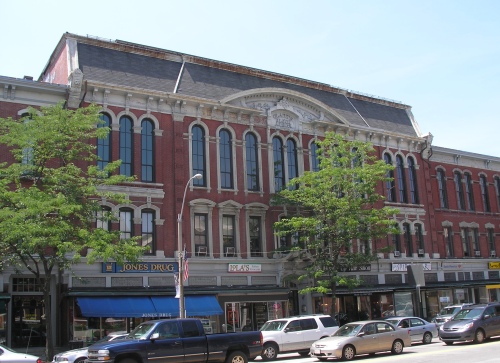
A while back, I had a week on this blog featuring buildings in South Natick. Now I’ll be featuring some buildings in downtown Natick. In 1874, a massive fire destroyed 35 buildings in the downtown. New brick and stone structures were soon built to replace the lost ones. One of the these is the Masonic Block on Main Street, constructed of Vermont marble and completed in 1874. The polychromatic High Victorian Gothic building was designed by S.S. Woodcock and has commercial space on the lower floors and rooms on the upper floors used by the Meridian Lodge, originally established in 1797 by Paul Revere. A glimpse of the building’s occupants in the late nineteenth century can be found in the History of Middlesex County, Vol. I (1890):

Masonic Brick and Marble Block.—This was erected in 1874, and belongs to the estate of the late Leonard Morse. The front is of marble, the other walls are brick. It is occupied on the lower floor by the Atlantic Tea Stores Company, Messrs. Wilde & Soule, who deal in teas, coffees and crockery; by James F. Gray, manufacturer of confectionery and keeper of fruit for sale; by Leonard P. Stone, dealer in meats and vegetables, and by Beals’ Clothing and Furnishing establishment. In the second story are Mulligan’s billiard-room, Finn’s barber-shop, Dr. Abbott’s rooms for dentistry, and Miss Mabel Morse’s musicroom. The third and fourth stories are wholly occupied for Masonic purposes.

Quincy Market (1826)

by Dan/March 24, 2010/Boston, Commercial, Greek Revival

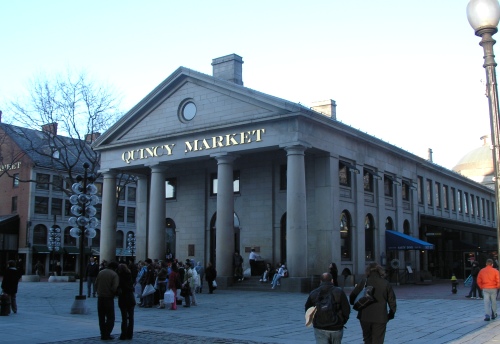
Quincy Market, which stretches 365 feet and led to the opening of six new streets when it was built in 1824-1826, was Boston’s first major project after incorporating as a city in 1822. Named for mayor Josiah Quincy, the building greatly expanded on the market space already available to Boston citizens in the adjacent Faneuil Hall. Architect Alexander Parris planned a Greek Revival style structure, with columns and pediments at each end and a central copper dome. It was the first large-scale use of granite and glass with post-and-beam construction and, when originally built, the Market was right on the harbor’s edge. Two additional long warehouse buildings flank the main structure to the north and south. Quincy Market was restored between 1976 and 1978 to become part of the shopping and dining center called Faneuil Hall Marketplace Continue reading “Quincy Market (1826)”

Winthrop Building (1894)

by Dan/March 23, 2010September 3, 2010/Boston, Commercial, Renaissance Revival

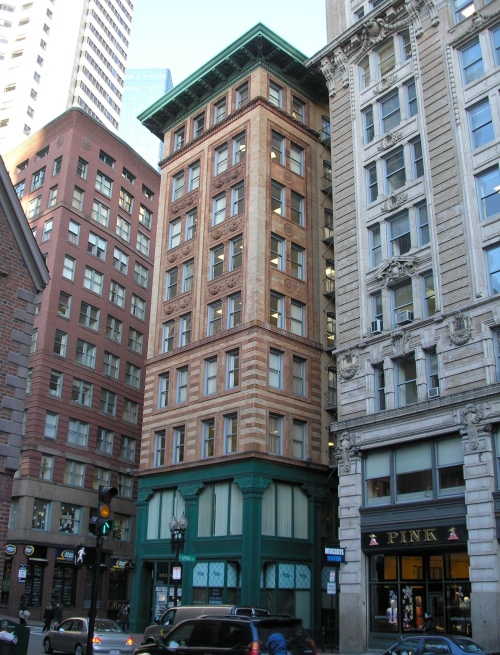
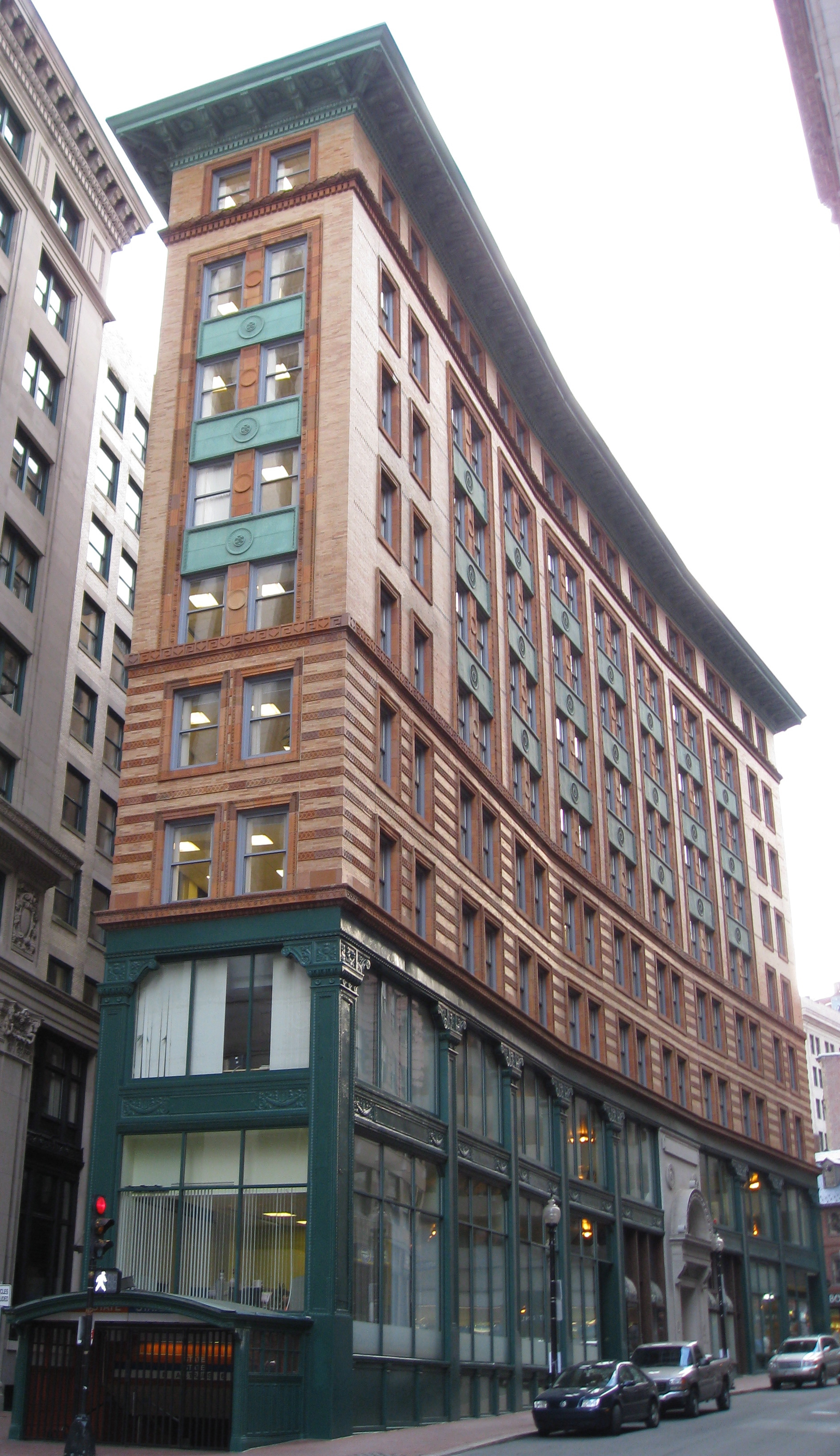
The Winthrop Building, originally known as the Carter Building, was Boston’s first steel-frame office building and led the way to later skyscrapers. Designed by Clarence H. Blackall, it was built in 1894 facing Washington Street, with its long curving side following Spring Lane, where a spring provided water to the early English settlers. The building was constructed on the 1644 site of Governor John Winthrop‘s second house in Boston.

Posts navigation

Older posts
Newer posts
Privacy Policy

Categories

  • Architectural Style (943)
    • Art Deco (9)
    • Byzantine (3)
    • Colonial (177)
    • Colonial Revival (85)
    • Craftsman (6)
    • Egyptian Revival (1)
    • Federal (190)
    • Foursquare (6)
    • Gothic (67)
    • Greek Revival (100)
    • Italianate (82)
    • Mission Revival (2)
    • Mission/Spanish Colonial (1)
    • Modern (2)
    • Neoclassical (56)
    • Octagon (3)
    • Postmodern (1)
    • Queen Anne (46)
    • Renaissance Revival (26)
    • Romanesque Revival (53)
    • Second Empire (26)
    • Shingle Style (12)
    • Stick Style (13)
    • Tudor Revival (8)
    • Vernacular (49)
    • Victorian Eclectic (15)
  • Building Type (943)
    • Apartment Buildings (8)
    • Banks (18)
    • Churches (119)
    • Collegiate (32)
    • Commercial (102)
    • Hotels (16)
    • Houses (508)
    • Industrial (23)
    • Libraries (22)
    • Lighthouses (1)
    • Military (15)
    • Monuments (1)
    • Museums (12)
    • Organizations (39)
    • Outbuildings (17)
    • Public Buildings (50)
    • Schools (23)
    • Stations (5)
    • Synagogues (1)
    • Taverns (21)
    • Theaters (9)
  • Town (943)
    • Adams (11)
    • Agawam (4)
    • Amherst (50)
    • Boston (64)
    • Boylston (6)
    • Cambridge (30)
    • Clinton (21)
    • Concord (15)
    • Cummington (1)
    • Danvers (14)
    • Deerfield (31)
    • Gloucester (18)
    • Granville (10)
    • Great Barrington (2)
    • Hadley (9)
    • Hancock (15)
    • Harvard (32)
    • Holyoke (47)
    • Lenox (5)
    • Lexington (8)
    • Longmeadow (32)
    • Marblehead (40)
    • Marlborough (4)
    • Natick (22)
    • Newton (2)
    • Northampton (68)
    • Peabody (4)
    • Pittsfield (20)
    • Salem (110)
    • Saugus (4)
    • Sheffield (4)
    • South Hadley (8)
    • Southborough (8)
    • Southwick (4)
    • Springfield (67)
    • Stockbridge (19)
    • Stow (1)
    • Sturbridge (18)
    • Sudbury (7)
    • Waltham (11)
    • Watertown (1)
    • Wayland (8)
    • West Springfield (14)
    • Westfield (46)
    • Weston (2)
    • Worcester (26)
  • Uncategorized (1)

Recent Comments

  • Wilber Blackson on South Hadley
  • Tami Speiden on Stockbridge
  • DexGuru on Stockbridge

Tags

Alcott Amherst College Asher Benjamin Back Bay Baptist Beacon Hill Big E Black Heritage Trail bowfront Bulfinch Catholic Congregational Episcopal Freedom Trail Gambrel H.H. Richardson Harvard Hawthorne Historic Deerfield Isaac Damon lit Longfellow mansard Methodist Mount Holyoke Museum Museums NPS Old Sturbridge Village PEM Revolutionary War row houses saltbox Samuel McIntire Shakers Smith College SPNEA Springfield Armory Stephen C. Earle Storrowton Underground Railroad UU Washington William Fenno Pratt Witch Trials

Meta

  • Log in
  • Entries feed
  • Comments feed
  • WordPress.org
Proudly powered by WordPress | Theme: ShowMe by NEThemes.