Historic Buildings of Massachusetts

  • About
  • Index by Town
  • CT
  • About
  • Index by Town
  • CT

Category: Commercial

Pottery, Old Sturbridge Village (1819)
by Dan/December 1, 2011January 1, 2012/Commercial, Industrial, Outbuildings, Sturbridge, Vernacular

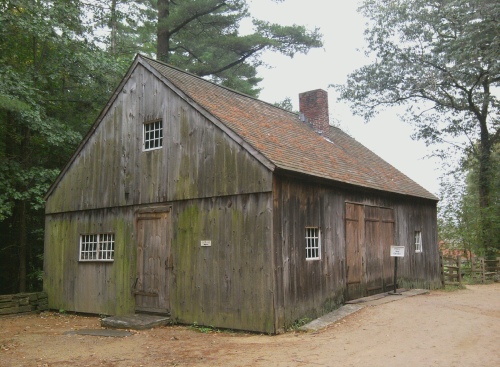
Harvey Brooks (1779-1873), of Goshen, Connecticut, began work at the age of sixteen as an apprentice potter. After 1819, he worked for himself as a rural farmer-potter, producing 26 different varieties and sizes of redware pots, pans and jugs. He had a pottery shop and an adjacent kiln, where he burned his last batch of ware in 1864, long after most other redware potters had given up practicing their craft. Brooks‘ pottery shop, built around 1819, was moved to Old Sturbridge Village in 1961 and a replica kiln was built in 1979.
Masonic Block, Northampton (1898)

by Dan/November 19, 2011November 16, 2011/Commercial, Neoclassical, Northampton, Organizations

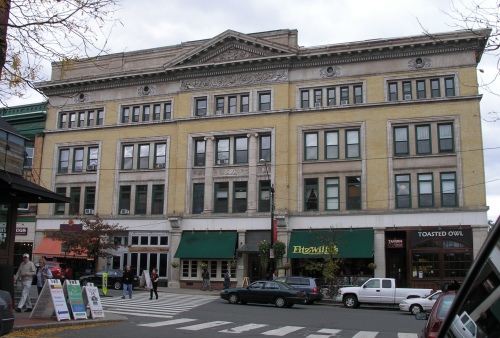
The Masonic Block, at 25 Main Street in Northampton, is a Classical Revival commercial and office structure which, given its name, no doubt also once had a Masonic Hall. Its architect was R. F. Putnam and it was built in 1898. The law office of Calvin Coolidge, who later became president, was located in the central section of the building from 1898 to 1918.

Law Office, Old Sturbridge Village (1796)

by Dan/November 17, 2011November 15, 2011/Commercial, Sturbridge, Vernacular

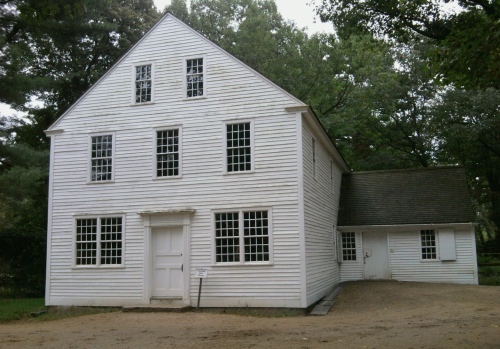
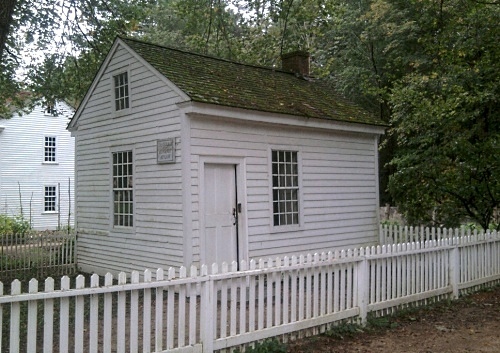
John McClellan was a lawyer in Woodstock, Connecticut, active in the first half of the nineteenth century. His law office in Woodstock, built around 1796, was acquired by Old Sturbridge Village in 1962 and was moved there in 1965.

Asa Knight Store (1838)

by Dan/September 30, 2011September 30, 2011/Commercial, Greek Revival, Sturbridge

In the early nineteenth century, Asa Knight operated a general store in the village center of Dummerston, Vermont. In 1826, Knight bought the store, the oldest section of which had been built around 1810, and added a storekeeper’s office. He further expanded the building with a new main wing in 1838-1839. The older section became an ell, attached to the new two-and-a-half story building. By the 1870s, the building ended its period as a store and remained mostly vacant and unmodernized for the next century. In 1972, it was moved to Old Sturbridge Village, restored and restocked to represent a village store of the 1830s. The earliest section, built in 1810, had been removed in 1909 and was reconstructed, based on old photographs and archaeological research.

Phoenix Row (1838)

by Dan/July 29, 2011August 8, 2011/Amherst, Commercial, Italianate

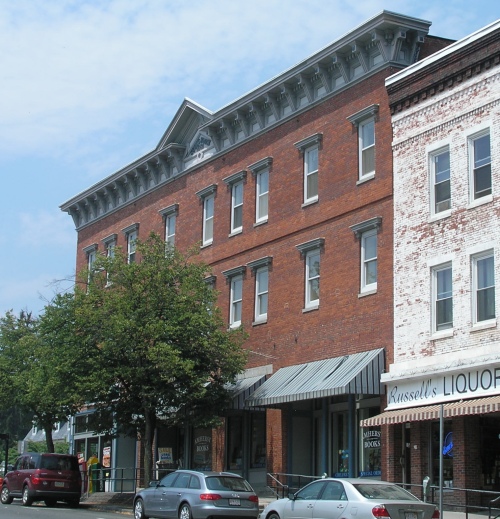
The first great fire in Amherst swept through the center of town in February 1838. Out of the ashes was built a new commercial block with the appropriate name: Phoenix Row. The building, located at 4-16 Main Street, survived another fire in 1872, which started in the outbuildings to its rear. It soon underwent renovations that significantly altered its appearance, most notably with the addition of a new flat Italianate style roof with decorative brackets and gable. Phoenix Row has survived other fires in 1883 and 1989 and continues as a business block today.

Mugford Building (1880)

by Dan/January 4, 2011/Commercial, Marblehead, Organizations, Queen Anne

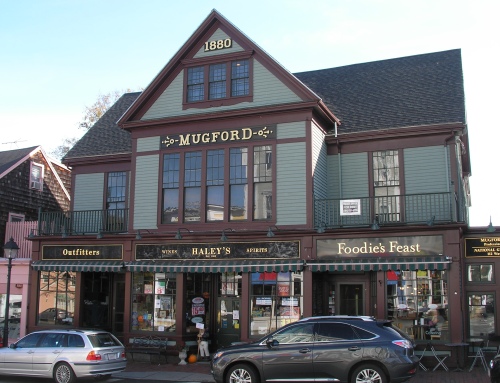
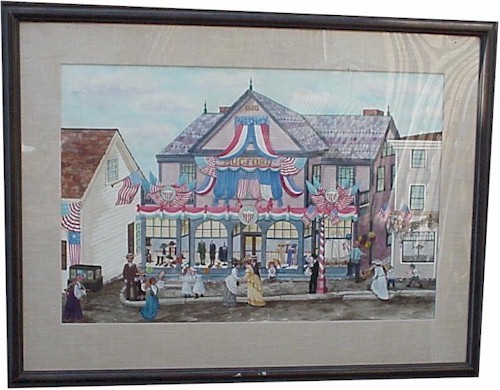
Captain James Mugford of the Continental Navy is a Marblehead hero of the American Revolution. The Mugford Association, named in honor of Capt. Mugford, built the prominent Mugford Building, on Washington Street in Marblehead, in 1880. The Association met in a hall on the second story, while the lower level of the building was used for commercial space. The Association disbanded in 1943 and the building has since had other owners. This Marblehead landmark continues to house retail shops.

J.M. Gibbons Store (1934)

by Dan/September 27, 2010September 27, 2010/Colonial Revival, Commercial, Granville

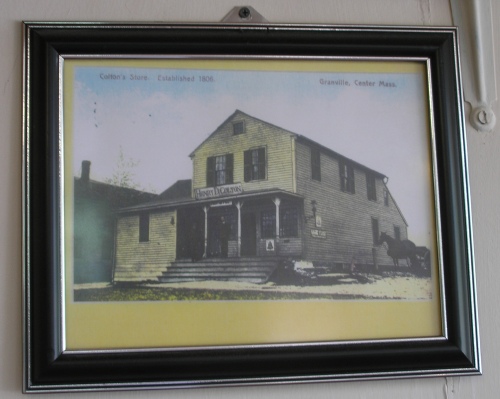
This week we’ll be looking at buildings in Granville, which is in Hampton County on the border with Connecticut. A local landmark is the Granville Country Store, famous for its cheese. John Murray Gibbons developed the recipe and aging process for what is known as Granville Cellar Aged Cheddar. At sixteen he had begun working in the Granville village store and a year later he owned the business. In 1851, he opened a new building for his store in Granville Center, which was also a post office (he served as postmaster) and had a school on the second floor. The store burned down in 1884 and was replaced by a new building. When that structure burned in 1934, it was replaced by the current Colonial Revival-style building, which has a pedimented gable and semicircular window. J.M. Gibbons Sons has had many owners over the years, but is seen by the people of Granville as “their” store.

Posts navigation

Older posts
Newer posts
Privacy Policy

Categories

  • Architectural Style (943)
    • Art Deco (9)
    • Byzantine (3)
    • Colonial (177)
    • Colonial Revival (85)
    • Craftsman (6)
    • Egyptian Revival (1)
    • Federal (190)
    • Foursquare (6)
    • Gothic (67)
    • Greek Revival (100)
    • Italianate (82)
    • Mission Revival (2)
    • Mission/Spanish Colonial (1)
    • Modern (2)
    • Neoclassical (56)
    • Octagon (3)
    • Postmodern (1)
    • Queen Anne (46)
    • Renaissance Revival (26)
    • Romanesque Revival (53)
    • Second Empire (26)
    • Shingle Style (12)
    • Stick Style (13)
    • Tudor Revival (8)
    • Vernacular (49)
    • Victorian Eclectic (15)
  • Building Type (943)
    • Apartment Buildings (8)
    • Banks (18)
    • Churches (119)
    • Collegiate (32)
    • Commercial (102)
    • Hotels (16)
    • Houses (508)
    • Industrial (23)
    • Libraries (22)
    • Lighthouses (1)
    • Military (15)
    • Monuments (1)
    • Museums (12)
    • Organizations (39)
    • Outbuildings (17)
    • Public Buildings (50)
    • Schools (23)
    • Stations (5)
    • Synagogues (1)
    • Taverns (21)
    • Theaters (9)
  • Town (943)
    • Adams (11)
    • Agawam (4)
    • Amherst (50)
    • Boston (64)
    • Boylston (6)
    • Cambridge (30)
    • Clinton (21)
    • Concord (15)
    • Cummington (1)
    • Danvers (14)
    • Deerfield (31)
    • Gloucester (18)
    • Granville (10)
    • Great Barrington (2)
    • Hadley (9)
    • Hancock (15)
    • Harvard (32)
    • Holyoke (47)
    • Lenox (5)
    • Lexington (8)
    • Longmeadow (32)
    • Marblehead (40)
    • Marlborough (4)
    • Natick (22)
    • Newton (2)
    • Northampton (68)
    • Peabody (4)
    • Pittsfield (20)
    • Salem (110)
    • Saugus (4)
    • Sheffield (4)
    • South Hadley (8)
    • Southborough (8)
    • Southwick (4)
    • Springfield (67)
    • Stockbridge (19)
    • Stow (1)
    • Sturbridge (18)
    • Sudbury (7)
    • Waltham (11)
    • Watertown (1)
    • Wayland (8)
    • West Springfield (14)
    • Westfield (46)
    • Weston (2)
    • Worcester (26)
  • Uncategorized (1)

Recent Comments

  • Wilber Blackson on South Hadley
  • Tami Speiden on Stockbridge
  • DexGuru on Stockbridge

Tags

Alcott Amherst College Asher Benjamin Back Bay Baptist Beacon Hill Big E Black Heritage Trail bowfront Bulfinch Catholic Congregational Episcopal Freedom Trail Gambrel H.H. Richardson Harvard Hawthorne Historic Deerfield Isaac Damon lit Longfellow mansard Methodist Mount Holyoke Museum Museums NPS Old Sturbridge Village PEM Revolutionary War row houses saltbox Samuel McIntire Shakers Smith College SPNEA Springfield Armory Stephen C. Earle Storrowton Underground Railroad UU Washington William Fenno Pratt Witch Trials

Meta

  • Log in
  • Entries feed
  • Comments feed
  • WordPress.org
Proudly powered by WordPress | Theme: ShowMe by NEThemes.