Historic Buildings of Massachusetts

  • About
  • Index by Town
  • CT
  • About
  • Index by Town
  • CT

Category: Gothic

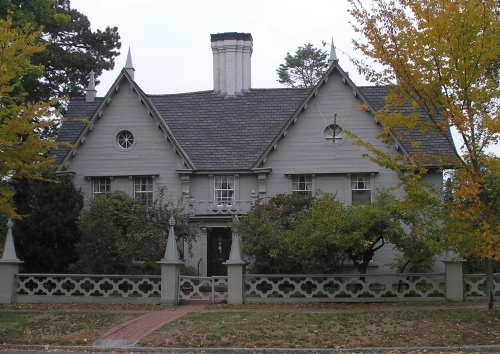
Pickering House (1651)
by Dan/December 23, 2010January 24, 2020/Colonial, Gothic, Houses, Salem

One of Salem‘s most interesting buildings is the Pickering House at 18 Broad Street, which is the oldest house in the United States continuously occupied by one family. The earliest section, on the east, was erected by carpenter John Pickering, Sr., around 1651. The house was later expanded to the west in 1671 by his son, John Pickering II, and in 1751, Deacon Timothy Pickering raised the rear lean-to to a full two stories. A two-story ell was added in 1904. The front, with the new addition of two cross gables, was adapted to the Gothic Revival style in 1841. The fence also dates to this period. The house‘s most prominent resident was Timothy Pickering, the arch-Federalist politician (serving as a cabinet member, Senator and US Representative), who had been an aide to Washington during the Revolutionary War. Boston architect Gordon Robb, who also restored the Witch House in Salem, restored the interior of the Pickering House in 1948 and it was opened to the public in 1951 by the nonprofit Pickering Foundation.
St. Peter’s Episcopal Church, Salem (1833)

by Dan/November 14, 2010November 15, 2010/Churches, Gothic, Salem

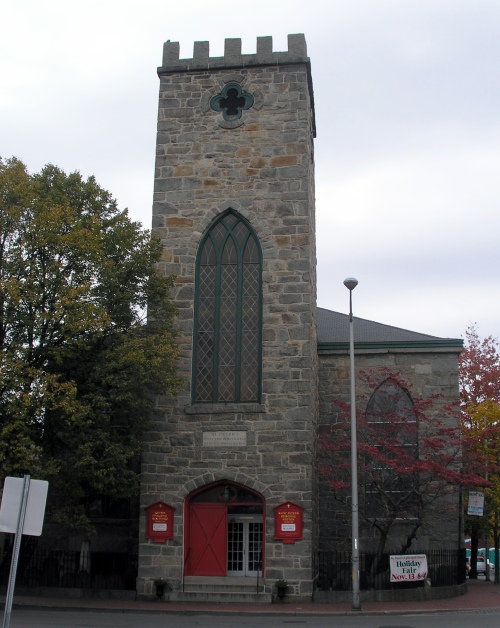
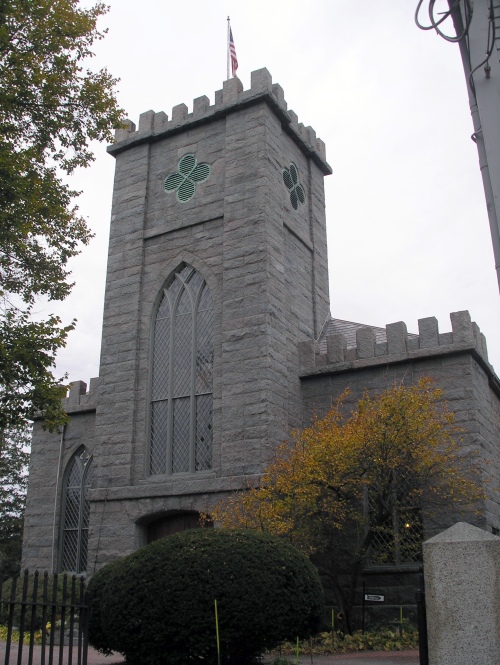
St. Peter’s Episcopal Church in Salem was established in 1733 and a wooden church was built the following year on land donated by Philip English, a wealthy merchant. English and his wife, Mary, had been accused of witchcraft during the Salem Witchcraft Trials of 1692. The original church was taken down in 1833 and replaced by the present stone church, constructed from plans by Isaiah Rogers of Boston. Like Salem’s First Church, it is a highly regarded example of a Gothic Revival stone masonry church of the early nineteenth century. It was enlarged in 1845 and a new chapel was added in 1871, built directly over the parish’s old graveyard. Some of the tombstones were incorporated into the chapel’s walls.

First Church in Salem (1836)

by Dan/November 7, 2010/Churches, Gothic, Salem

The First Church in Salem, gathered in 1629, is the oldest church in North America to be continuously governed by congregationalist polity. Until 1923, the First Church congregation used four successive buildings on the same location on Washington Street (the last, built in 1826, is now the Daniel Low Building). The congregation became Unitarian early in the nineteenth century. The congregation split into other churches over the years, most of which later merged again with First Church. East Church was established in 1718 and Barton Square Church in 1824. These two merged in 1899 to form Second Church and reunited with First Church in 1923. The former East/North Church building of 1844-1846 is now the Salem Witch Museum. North Church split from First Church in 1772. Its first meeting house, on the corner of North and Lynde Streets, was used from 1772 to 1836. The second meetinghouse, on Essex Street, was begun in 1835 and completed in 1836. It is made of Quincy granite and is considered an outstanding example of a Gothic Revival stone masonry church. Since North Church reunited with First Church in 1923, the united congregation has used the old North Church building. Continue reading “First Church in Salem (1836)”

Saugus Town Hall (1875)

by Dan/October 31, 2010October 31, 2010/Gothic, Public Buildings, Saugus

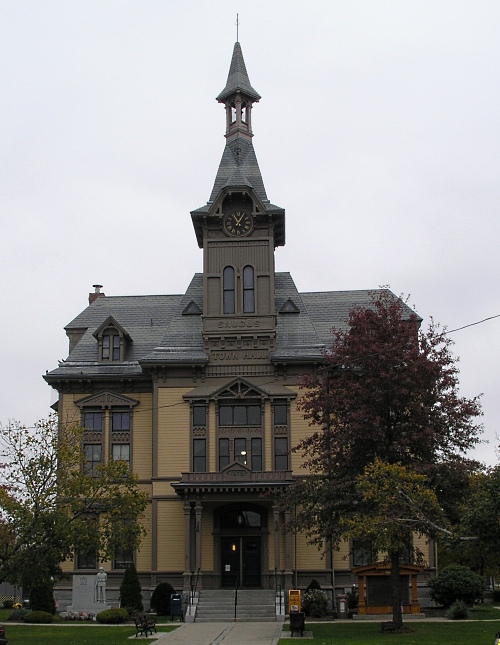
Is this a haunted mansion posted for Halloween? No, it’s the Town Hall of Saugus, built in 1875. An earlier town hall, built in 1837, is now an American Legion hall. Construction of the 1875 building put the town $50,000 in debt and was one of the reasons the neighborhood of East Saugus almost seceded to become a part of Lynn (the residents were unable to get a bill in both houses of the state legislature and the issue was dropped after the town appropriated $5,000 for laying water pipes in East Saugus). The Town Hall, which originally had the high school and library in the rear wing, was designed in the High Victorian Gothic and Stick styles by Lord & Fuller and underwent a $3 million restoration in 1998, when the building was returned to its original multi-colored, earth-toned exterior paint scheme. The Town Hall’s conference room was recently dedicated to the town’s history. There is also an organization called The Friends of Saugus town Hall.

West Granville Congregational Church (1778)

by Dan/October 3, 2010/Churches, Gothic, Granville, Greek Revival

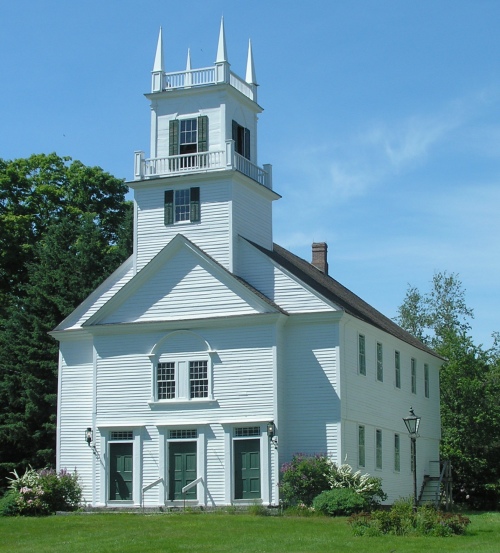
In 1778, residents of West Granville volunteered many hours and much labor to construct a Congregational church. The long distance required to travel to the meeting house in Granville Center had led the people of West Granville to decide to form their own parish, which was officially established in 1781 as the Granville’s Second Congregational Church. Around 1845, the church was remodeled so that it has a transitional Greek Revival/Gothic Revival exterior.

First Congregational Church of Natick (1876)

by Dan/September 5, 2010/Churches, Gothic, Natick

The earliest Congregational Church in Natick was founded in 1651 by John Eliot and served the Natick Praying Indians, who were settled in what is now South Natick. After the retirement in 1799 of Rev. Stephen Badger, last pastor to the Praying Indians, a new First Congregational Church was organized to the north in 1802, with construction of a meeting house having already been started in 1799, in what is now the center of Natick. As described in the History of Middlesex County, Vol. I (1890):

The congregation having again outgrown the meeting-house, this was sold to a Universalist Society, which later, becoming extinct, sold the house to the Roman Catholic denomination. This, enlarged, is the Catholic Church of the present day in the centre of Natick. The Congregational Society then erected a third meeting-house upon the site of the one removed, during the years 1853-54, which was dedicated Nov. 15th of the latter year.

Disaster struck on January 13,1874 when, again quoting from the History,

nearly all the business portion of Natick was laid in ashes, including every hall in the place and the Congregational Church, just enlarged and improved at the cost of about $13,000. This loss of the sanctuary rendered necessary the building of a temporary tabernacle, which, in a rough way, was made ready for religious and other purposes as soon as possible, at the cost of about $1700. Additional land was purchased upon the east side of the old church lot, and the erection of the present beautiful brick church edifice commenced, and so far completed that the vestries could be used for public worship April 30, 1876.

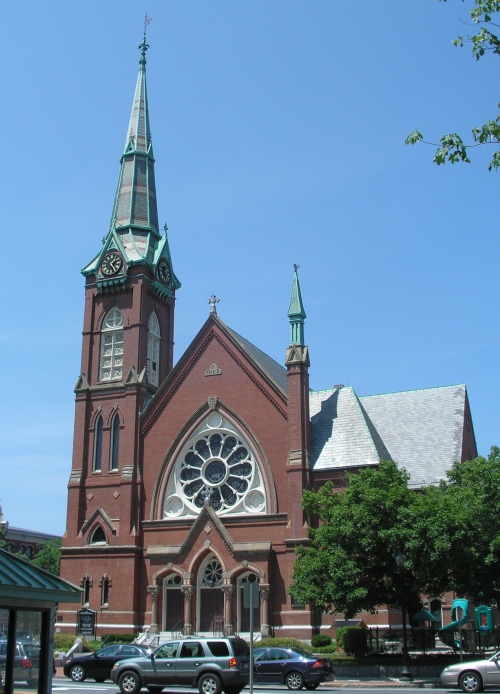
The church, built in 1875-1880 and attributed to J.B. Goodall, is an an example of High Victorian Gothic, with a distinctive polychromatic steeple.

St. Patrick’s Church, Natick (1892)

by Dan/September 4, 2010/Churches, Gothic, Natick

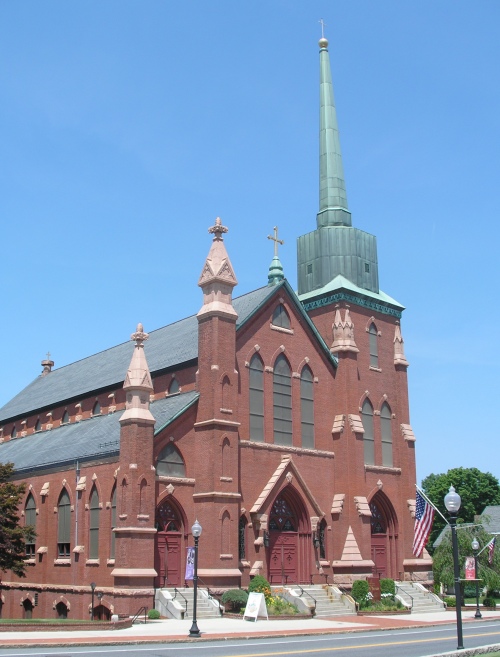
St. Patrick’s Catholic parish in Natick was established in 1856. Parishioners worshiped in local halls and private homes before the church on East Central Street was built in 1892. At some point, the original steeple was replaced by the current one, finished in tarnished copper.

Posts navigation

Older posts
Newer posts
Privacy Policy

Categories

  • Architectural Style (943)
    • Art Deco (9)
    • Byzantine (3)
    • Colonial (177)
    • Colonial Revival (85)
    • Craftsman (6)
    • Egyptian Revival (1)
    • Federal (190)
    • Foursquare (6)
    • Gothic (67)
    • Greek Revival (100)
    • Italianate (82)
    • Mission Revival (2)
    • Mission/Spanish Colonial (1)
    • Modern (2)
    • Neoclassical (56)
    • Octagon (3)
    • Postmodern (1)
    • Queen Anne (46)
    • Renaissance Revival (26)
    • Romanesque Revival (53)
    • Second Empire (26)
    • Shingle Style (12)
    • Stick Style (13)
    • Tudor Revival (8)
    • Vernacular (49)
    • Victorian Eclectic (15)
  • Building Type (943)
    • Apartment Buildings (8)
    • Banks (18)
    • Churches (119)
    • Collegiate (32)
    • Commercial (102)
    • Hotels (16)
    • Houses (508)
    • Industrial (23)
    • Libraries (22)
    • Lighthouses (1)
    • Military (15)
    • Monuments (1)
    • Museums (12)
    • Organizations (39)
    • Outbuildings (17)
    • Public Buildings (50)
    • Schools (23)
    • Stations (5)
    • Synagogues (1)
    • Taverns (21)
    • Theaters (9)
  • Town (943)
    • Adams (11)
    • Agawam (4)
    • Amherst (50)
    • Boston (64)
    • Boylston (6)
    • Cambridge (30)
    • Clinton (21)
    • Concord (15)
    • Cummington (1)
    • Danvers (14)
    • Deerfield (31)
    • Gloucester (18)
    • Granville (10)
    • Great Barrington (2)
    • Hadley (9)
    • Hancock (15)
    • Harvard (32)
    • Holyoke (47)
    • Lenox (5)
    • Lexington (8)
    • Longmeadow (32)
    • Marblehead (40)
    • Marlborough (4)
    • Natick (22)
    • Newton (2)
    • Northampton (68)
    • Peabody (4)
    • Pittsfield (20)
    • Salem (110)
    • Saugus (4)
    • Sheffield (4)
    • South Hadley (8)
    • Southborough (8)
    • Southwick (4)
    • Springfield (67)
    • Stockbridge (19)
    • Stow (1)
    • Sturbridge (18)
    • Sudbury (7)
    • Waltham (11)
    • Watertown (1)
    • Wayland (8)
    • West Springfield (14)
    • Westfield (46)
    • Weston (2)
    • Worcester (26)
  • Uncategorized (1)

Recent Comments

  • Wilber Blackson on South Hadley
  • Tami Speiden on Stockbridge
  • DexGuru on Stockbridge

Tags

Alcott Amherst College Asher Benjamin Back Bay Baptist Beacon Hill Big E Black Heritage Trail bowfront Bulfinch Catholic Congregational Episcopal Freedom Trail Gambrel H.H. Richardson Harvard Hawthorne Historic Deerfield Isaac Damon lit Longfellow mansard Methodist Mount Holyoke Museum Museums NPS Old Sturbridge Village PEM Revolutionary War row houses saltbox Samuel McIntire Shakers Smith College SPNEA Springfield Armory Stephen C. Earle Storrowton Underground Railroad UU Washington William Fenno Pratt Witch Trials

Meta

  • Log in
  • Entries feed
  • Comments feed
  • WordPress.org
Proudly powered by WordPress | Theme: ShowMe by NEThemes.