Historic Buildings of Massachusetts

  • About
  • Index by Town
  • CT
  • About
  • Index by Town
  • CT

Category: Gothic

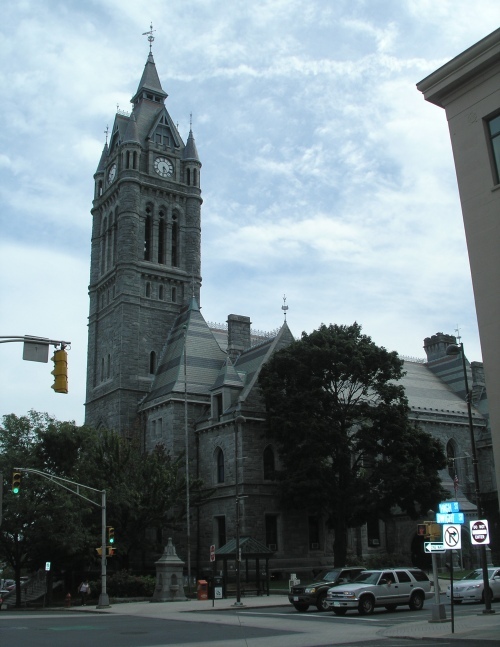
Holyoke City Hall (1876)
by Dan/January 13, 2015/Gothic, Holyoke, Public Buildings

Holyoke City Hall

The City Hall of Holyoke, located at the corner of Dwight and High Streets (536 Dwight Street), was built in 1871-1876. It was planned as the Town Hall, but Holyoke had become a city by the time it was completed. It was built with granite quarried in Monson. The building was designed by Charles B. Atwood, who utilized elements of the Gothic and Romanesque Revival styles. During construction, Because Atwood was not delivering updated drawings in a timely manner, the design work was turned over to H.F. Kilburn in 1874. An annex in the same style was completed in 1913. The building has a second-floor auditorium, called the City Hall Ballroom, that features thirteen stained glass windows designed by Samuel West of the Ecclesiastical Stained Glass Works in Boston. In recent years the painted antique glass windows had fallen into disrepair. A campaign was organized that raised funds and the windows were restored last year. Other restoration work has also been done on the building’s exterior and interior. Continue reading “Holyoke City Hall (1876)”
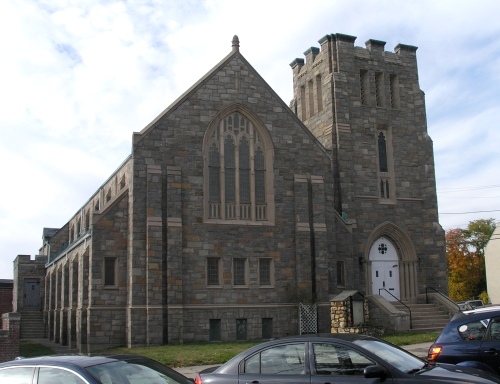
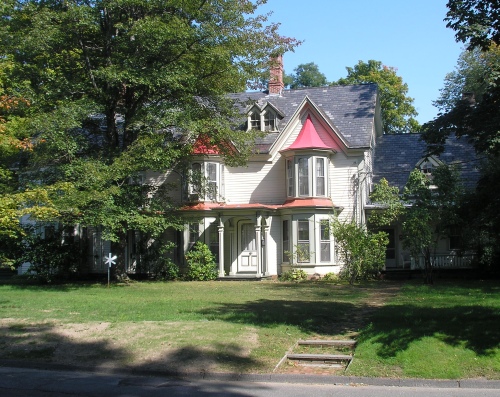
First Baptist Church, Clinton (1936)

by Dan/January 9, 2015/Churches, Clinton, Gothic

First Baptist Church, Clinton

The First Baptist Church in Clinton began in 1847, the congregation meeting in a chapel previously used by the local Congregational Church. As related in a historical sermon by Rev. Charles M. Bowers, printed in the Semi-centennial Celebration of the Incorporation of the Town of Clinton (1900):

The first year of the church had hardly ended before the poor accommodations of the chapel made it necessary to think of building a proper meeting-house, but the question of means was a fearful question. Yet the Lord gave us Alanson Chace and George Cummings to lead in generous subscriptions; others of smaller means were encouraged to follow, and the combined gifts, with contributions from neighboring churches and individuals, provided a neat and comfortable sanctuary at a cost of six thousand dollars, with a seating capacity of four hundred and fifty worshippers. This house was dedicated in 1849. In 1867, or eighteen years after, the church had so increased in numbers that a larger house seemed a necessity, and a new structure by reconstruction and addition was obtained, which, with the organ, cost about eleven thousand dollars, and gave sittings for a congregation of six hundred. The new building was dedicated in 1868.

Twenty-five more years passed away, and it seemed in the judgment of many that with a very popular and attractive preacher we should join the attractions of a still better house. Human nature takes very kindly to human nature, and our third provision for worship in less than fifty years resulted in the beautiful, commodious and well arranged house in which we are now gathered.

The 1890s church burned down in 1934 and was replaced by the current church (14 Walnut Street) in 1936.

Samuel L. Hill House (1845)

by Dan/December 17, 2014/Gothic, Houses, Northampton

Samuel L. Hill House

Samuel L. Hill was one of the founders of the Northampton Association of Education and Industry (NAEI), a nineteenth-century utopian community located in the village of Florence in Northampton. In the 1830s, S. L. Hill had worked as an overseer in a cotton factory in Willimantic, Connecticut. He came to Florence in 1841, where he became a leading citizen and established the Nonotuck Silk Company. An abolitionist, Hill actively aided slaves on the Underground Railroad. Among his other acts of philanthropy was the founding of the Florence Kindergarten, now the Hill Institute. His house, at 29-33 (or 31-35) Maple Street in Florence, was built around 1845. The south wing is the earliest section of the house, which is Arthur G. Hill, his son, also became one of Florence’s leading citizens and lived in the house until the 1920’s.

Charles and Lucretia M. Daniels House (1873)

by Dan/September 15, 2014/Gothic, Houses, Northampton

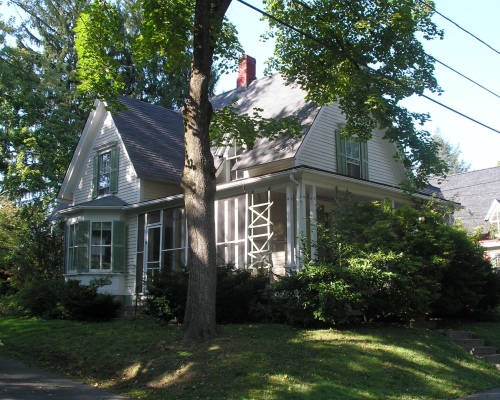
Charles and Lucretia M. Daniels House

The Gothic Revival cottage at 29 Arlington Street in Northampton was built on land acquired by Lucretia Daniels, wife of Charles Daniels, in 1873. By 1880 the couple were living in the house with their two teen-aged sons and by 1884 Lucretia was listed as a widow. She lived in the house through 1917.

Armory, Northampton (1900)

by Dan/August 12, 2014August 12, 2014/Gothic, Military, Northampton

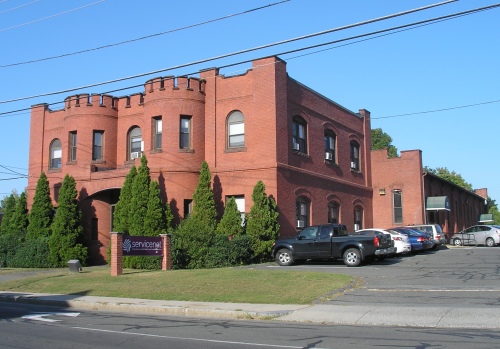
Armory, Northampton

At 131 King Street in Northampton is an armory building constructed by the city in 1899-1900 and purchased by the state in 1912. Designed by Gardner, Pyne & Gardner of Springfield, it served as constabulary headquarters and as barracks for police and military groups. It also provided a large interior space for recreational and civic events. It now houses offices.

St. Stephen’s Episcopal Church, Pittsfield (1890)

by Dan/May 4, 2014May 5, 2014/Churches, Gothic, Pittsfield

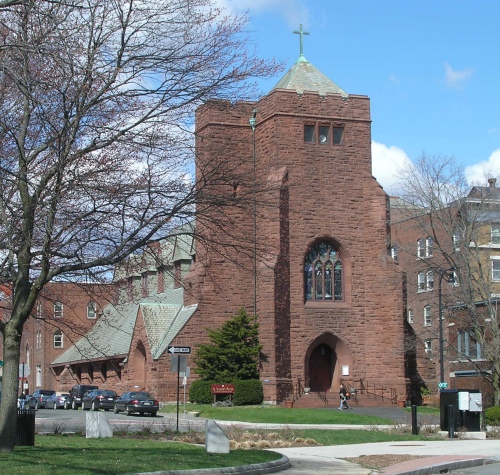
St. Stephen's Episcopal Church

The original St. Stephen’s Episcopal Church in Pittsfield was built in 1832 near to the Town Hall. When Allen Street was being opened up through its original property, the parish purchased land next door and constructed its current church in 1889-1890. Designed by Peabody & Stearns, St. Stephen’s was constructed of Longmeadow red sandstone. It’s design was no doubt influenced by the Gothic Revival style of the nearby First Congregational Church. Both churches have stained glass windows designed by Louis Comfort Tiffany and Mary Elizabeth Tillinghast. Services in the church began in 1890 and St. Stephen’s was consecrated by Rt. Rev. Phillips Brooks, Bishop of Massachusetts, on November 19, 1892. The Parish House at the rear of the church, built in 1916, was expanded in 1956. The church underwent major renovations in 1984.

Former Our Lady of Fatima Church, Worcester (1911)

by Dan/July 7, 2013/Churches, Gothic, Worcester

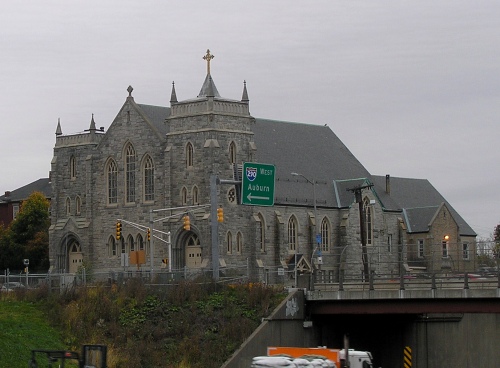
43 Belmont Street, Worcester

The church at 43 Belmont Street in Worcester was built in 1908-1911. Designed by Fuller and Delano, it was the second building used by the First Swedish Evangelical Lutheran Church, a congregation that was established in 1881. The congregation merged with two other parishes to form the new Trinity Lutheran Church in 1948 and moved to a new church on Lancaster Street in 1951. The church Belmont Street was sold to the Catholic Diocese of Worcester and became Our Lady of Fatima Church. Over the years the building suffered damage from vibrations from the nearby Interstate 290. Major repairs were made in 1999 and the bell tower at the southeast corner of the church was also removed. The parish served area Catholics until 2009, when the church was closed. It was merged with St. Bernard’s Church to form Our Lady of Providence Parish. The vacant church was in danger of being demolished, but in 2012 the Diocese sold the building to the Chinese Gospel Church of Massachusetts, which had previously been worshiping in a former A.M.E. Zion Church at 21 Belmont Street. The Chinese Gospel Church of Massachusetts also has a church in Southborough, where it was founded in the 1980s.

Posts navigation

Older posts
Newer posts
Privacy Policy

Categories

  • Architectural Style (943)
    • Art Deco (9)
    • Byzantine (3)
    • Colonial (177)
    • Colonial Revival (85)
    • Craftsman (6)
    • Egyptian Revival (1)
    • Federal (190)
    • Foursquare (6)
    • Gothic (67)
    • Greek Revival (100)
    • Italianate (82)
    • Mission Revival (2)
    • Mission/Spanish Colonial (1)
    • Modern (2)
    • Neoclassical (56)
    • Octagon (3)
    • Postmodern (1)
    • Queen Anne (46)
    • Renaissance Revival (26)
    • Romanesque Revival (53)
    • Second Empire (26)
    • Shingle Style (12)
    • Stick Style (13)
    • Tudor Revival (8)
    • Vernacular (49)
    • Victorian Eclectic (15)
  • Building Type (943)
    • Apartment Buildings (8)
    • Banks (18)
    • Churches (119)
    • Collegiate (32)
    • Commercial (102)
    • Hotels (16)
    • Houses (508)
    • Industrial (23)
    • Libraries (22)
    • Lighthouses (1)
    • Military (15)
    • Monuments (1)
    • Museums (12)
    • Organizations (39)
    • Outbuildings (17)
    • Public Buildings (50)
    • Schools (23)
    • Stations (5)
    • Synagogues (1)
    • Taverns (21)
    • Theaters (9)
  • Town (943)
    • Adams (11)
    • Agawam (4)
    • Amherst (50)
    • Boston (64)
    • Boylston (6)
    • Cambridge (30)
    • Clinton (21)
    • Concord (15)
    • Cummington (1)
    • Danvers (14)
    • Deerfield (31)
    • Gloucester (18)
    • Granville (10)
    • Great Barrington (2)
    • Hadley (9)
    • Hancock (15)
    • Harvard (32)
    • Holyoke (47)
    • Lenox (5)
    • Lexington (8)
    • Longmeadow (32)
    • Marblehead (40)
    • Marlborough (4)
    • Natick (22)
    • Newton (2)
    • Northampton (68)
    • Peabody (4)
    • Pittsfield (20)
    • Salem (110)
    • Saugus (4)
    • Sheffield (4)
    • South Hadley (8)
    • Southborough (8)
    • Southwick (4)
    • Springfield (67)
    • Stockbridge (19)
    • Stow (1)
    • Sturbridge (18)
    • Sudbury (7)
    • Waltham (11)
    • Watertown (1)
    • Wayland (8)
    • West Springfield (14)
    • Westfield (46)
    • Weston (2)
    • Worcester (26)
  • Uncategorized (1)

Recent Comments

  • Wilber Blackson on South Hadley
  • Tami Speiden on Stockbridge
  • DexGuru on Stockbridge

Tags

Alcott Amherst College Asher Benjamin Back Bay Baptist Beacon Hill Big E Black Heritage Trail bowfront Bulfinch Catholic Congregational Episcopal Freedom Trail Gambrel H.H. Richardson Harvard Hawthorne Historic Deerfield Isaac Damon lit Longfellow mansard Methodist Mount Holyoke Museum Museums NPS Old Sturbridge Village PEM Revolutionary War row houses saltbox Samuel McIntire Shakers Smith College SPNEA Springfield Armory Stephen C. Earle Storrowton Underground Railroad UU Washington William Fenno Pratt Witch Trials

Meta

  • Log in
  • Entries feed
  • Comments feed
  • WordPress.org
Proudly powered by WordPress | Theme: ShowMe by NEThemes.