Historic Buildings of Massachusetts

  • About
  • Index by Town
  • CT
  • About
  • Index by Town
  • CT

Category: Houses

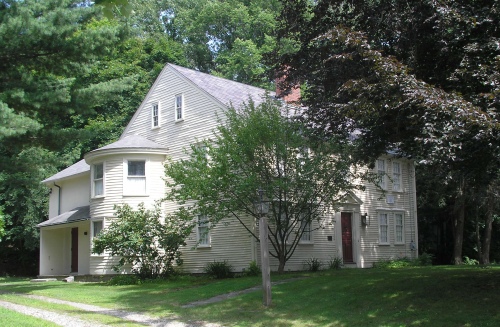
Loring Parsonage (1700)
by Dan/August 4, 2009January 18, 2020/Colonial, Houses, Sudbury

Loring Parsonage

Built around 1700, the Loring Parsonage in Sudbury Center was later the home of Reverend Israel Loring, who became the first minister to serve west of the Sudbury River, settling there in 1723. The Parsonage was later known as the Wheeler-Haynes House and Walter Haynes kept a tavern there. Today the house, which is located behind the town hall, is owned by the town, having meeting rooms and other space which is rented to a credit union.
Kirkside (1815)

by Dan/August 3, 2009/Federal, Houses, Wayland

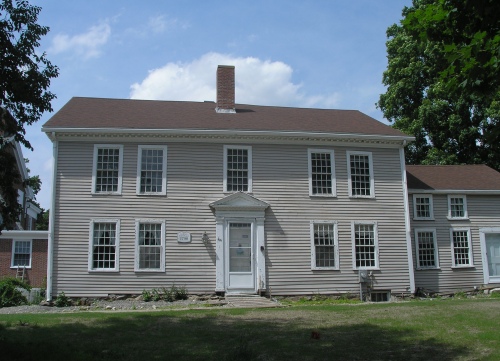
Kirkside

When Wayland’s 1725 First Parish meetinghouse was taken down, in 1814-1815, to make way for a new church, materials from the old building were used to construct a house and store just to the east. Originally known as the Old Green Store, it has a hipped roof and a second-floor meeting hall, which was used by the town from 1815 to 1845. This hall was constructed as part of the builders’ deal to get the old meetinghouse’s beams and timbers in exchange for letting the town use the hall for thirty years. In 1825, when the First Parish church was split between Calvinists and Unitarians, Rev. Lyman Beecher held a series of meetings in the hall to denounce the Unitarians. In 1849, choir members used the meeting room to rehearse the new hymn by Rev. Edmund Sears, “It Came Upon the Midnight Clear.” The house was later converted into a summer residence, named Kirkside, by William Bullard, a wealthy Cambridge banker, in 1889. He expanded and updated the house to the Colonial Revival style and placed elaborate French wallpaper in the meeting hall/ballroom. In 1920, the house was purchased by William C. Loring, an artist who taught at the Rhode Island School of Design, and his wife, Mildred Loring, an antiques dealer, who used the meeting hall as her sales room. The restoration of the house by its current owners, in 1991, was featured on the PBS television program, This Old House.

Amos and Jonas Darling House (1760)

by Dan/August 1, 2009January 19, 2020/Colonial, Houses, Marlborough

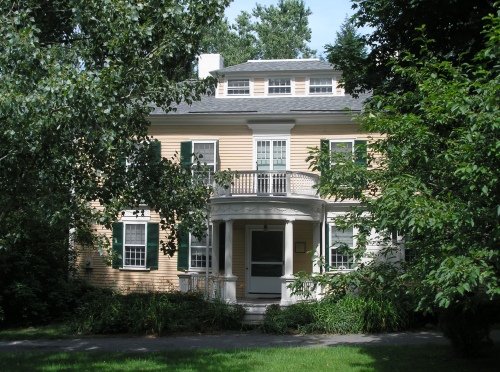
Darling house

Located not far from Wayside Inn Road (which leads to Longfellow’s Wayside Inn in Sudbury), is the Amos and Jonas Darling House, a Colonial Cape-style cottage (much added to over the years) on the Boston Post Road in Marlborough. Overlooking Hager’s Pond across the road, the house was most likely built around 1760 by Amos Darling, Sr., who came from Framingham (It may also have been built as early as 1726 and later bought by Darling). His sons were Jonas and Amos Darling, Jr. The family was associated with the nearby Hager sawmill and Amos, Jr. married Lovice Hager, daughter of Ebenezer Hager, Jr., in 1800. The house was later owned by Lovice’s cousin, Ephraim Hager. By the mid-nineteenth century, it was owned by George Jones and was known as Jones’s Tavern. The Jones property and the Hager Sawmill were acquired by Henry Ford in the 1920s, when he was developing the Wayside Inn as an historic attraction.

Horatio Coomes House (1840)

by Dan/July 29, 2009September 17, 2016/Houses, Italianate, Longmeadow

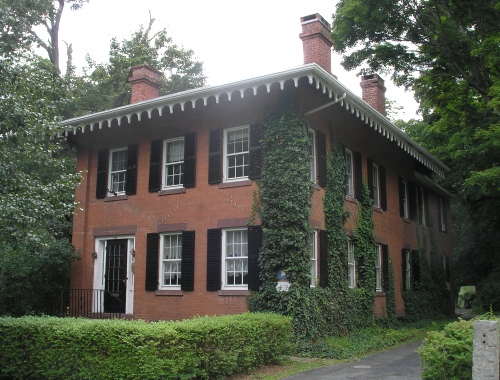
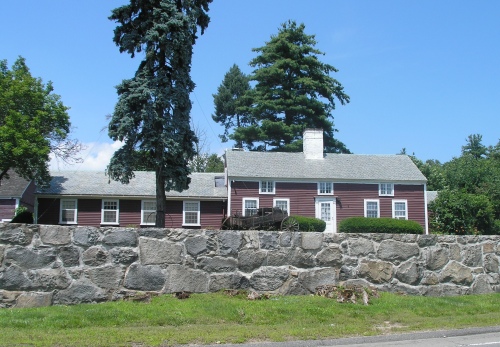
Coomes House

Having earlier lived in what is now known as the Coomes-Almquist House, around 1840 Horatio Coomes built a brick house at 918 Longmeadow Street in Longmeadow. In building this early Italianate house, Coomes undoubtedly used bricks produced in his own brickyard.

Coomes-Almquist House (1831)

by Dan/July 28, 2009September 17, 2016/Greek Revival, Houses, Longmeadow

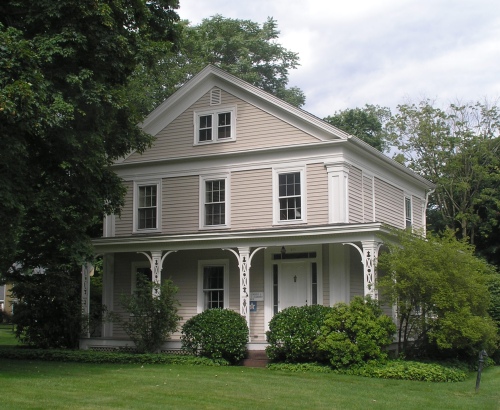
Coomes-Almquist House

The house of Horatio Coomes at the south end of Longmeadow Green was built around 1831, although parts may have been built earlier, as there were buildings on the property when it was sold to Coomes in 1826. Coomes later built another home nearby and the sold the earlier house, which is now known as the Coomes-Almquist House. Many rooms were added to the expanding house over the years.

Jonathan Harrington House (1690)

by Dan/July 24, 2009January 18, 2020/Colonial, Houses, Lexington

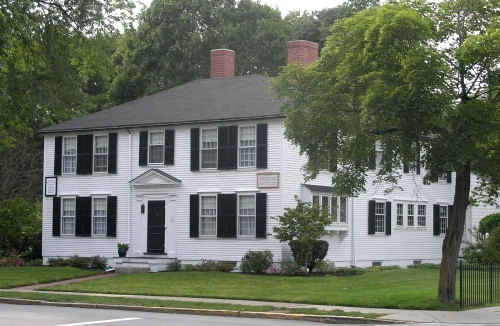
Jonathan Harrington House

The earliest parts of the Jonathan Harrington House, on Lexington Green, date back to 1690. The house‘s most famous historic association is with the Battle of Lexington, as the historic marker on the house explains: “House of Jonathan Harrington/
who wounded on the Common/ April 19, 1775/ dragged himself to the door/ and died at his wife’s feet.” From 1811 to 1828, the Harrington House was the home of John Augustus, a shoemaker, who in 1841 convinced a judge to allow a man convicted of drunkenness into his custody for rehabilitation, finding him a job and getting him to sign a pledge not to drink. Augustus followed this by offering assistance to other convicted criminals and he is now recognized as the Father of Probation in America. In 1909, pioneering historic preservationist William Sumner Appleton expressed his outrage at modernizations being made to the Harrington House during a refurbishment (possibly by new owner Leroy Sunderland Brown?) The house remains a private home.

Grout-Heard House (1740)

by Dan/July 23, 2009September 17, 2016/Colonial, Houses, Wayland

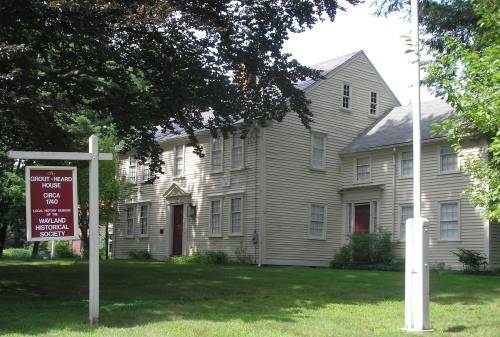
Grout-Heard House

When the Town of Wayland built a new town hall in 1878, the historic Grout-Heard House had to be moved from its original location, on Cochituate Road, to a new lot nearby. The town hall was demolished in 1958 and in 1962, the house was moved back to its original location! The house was probably built around 1740 by Jonathan Grout, descendant of an early settler of Wayland (then part of Sudbury). In 1744, he sold it to his brother-in-law, Richard Heard. The house was later sold out of the family and at the time of the Battles of Lexington and Concord housed the store of Elijah Bent. In 1787, the house was acquired by Silas Grout, a blacksmith, who operated his shop just south of the house. Silas Grout enlarged the house and updated the facade. One of his daughters, Jerusaha Grout, married Newell Heard, a shopkeeper. Their son, John Augustus Heard, was a noted photographer in the nineteenth century and his wife, Sarah Hawkes Heard, was Wayland’s librarian at the end of the century. In 1955, Raytheon Corporation bought the house and donated it to the Wayland Historical Society. Now, placed just a few feet back from its original foundation, the house is open as a museum.

Posts navigation

Older posts
Newer posts
Privacy Policy

Categories

  • Architectural Style (943)
    • Art Deco (9)
    • Byzantine (3)
    • Colonial (177)
    • Colonial Revival (85)
    • Craftsman (6)
    • Egyptian Revival (1)
    • Federal (190)
    • Foursquare (6)
    • Gothic (67)
    • Greek Revival (100)
    • Italianate (82)
    • Mission Revival (2)
    • Mission/Spanish Colonial (1)
    • Modern (2)
    • Neoclassical (56)
    • Octagon (3)
    • Postmodern (1)
    • Queen Anne (46)
    • Renaissance Revival (26)
    • Romanesque Revival (53)
    • Second Empire (26)
    • Shingle Style (12)
    • Stick Style (13)
    • Tudor Revival (8)
    • Vernacular (49)
    • Victorian Eclectic (15)
  • Building Type (943)
    • Apartment Buildings (8)
    • Banks (18)
    • Churches (119)
    • Collegiate (32)
    • Commercial (102)
    • Hotels (16)
    • Houses (508)
    • Industrial (23)
    • Libraries (22)
    • Lighthouses (1)
    • Military (15)
    • Monuments (1)
    • Museums (12)
    • Organizations (39)
    • Outbuildings (17)
    • Public Buildings (50)
    • Schools (23)
    • Stations (5)
    • Synagogues (1)
    • Taverns (21)
    • Theaters (9)
  • Town (943)
    • Adams (11)
    • Agawam (4)
    • Amherst (50)
    • Boston (64)
    • Boylston (6)
    • Cambridge (30)
    • Clinton (21)
    • Concord (15)
    • Cummington (1)
    • Danvers (14)
    • Deerfield (31)
    • Gloucester (18)
    • Granville (10)
    • Great Barrington (2)
    • Hadley (9)
    • Hancock (15)
    • Harvard (32)
    • Holyoke (47)
    • Lenox (5)
    • Lexington (8)
    • Longmeadow (32)
    • Marblehead (40)
    • Marlborough (4)
    • Natick (22)
    • Newton (2)
    • Northampton (68)
    • Peabody (4)
    • Pittsfield (20)
    • Salem (110)
    • Saugus (4)
    • Sheffield (4)
    • South Hadley (8)
    • Southborough (8)
    • Southwick (4)
    • Springfield (67)
    • Stockbridge (19)
    • Stow (1)
    • Sturbridge (18)
    • Sudbury (7)
    • Waltham (11)
    • Watertown (1)
    • Wayland (8)
    • West Springfield (14)
    • Westfield (46)
    • Weston (2)
    • Worcester (26)
  • Uncategorized (1)

Recent Comments

  • Wilber Blackson on South Hadley
  • Tami Speiden on Stockbridge
  • DexGuru on Stockbridge

Tags

Alcott Amherst College Asher Benjamin Back Bay Baptist Beacon Hill Big E Black Heritage Trail bowfront Bulfinch Catholic Congregational Episcopal Freedom Trail Gambrel H.H. Richardson Harvard Hawthorne Historic Deerfield Isaac Damon lit Longfellow mansard Methodist Mount Holyoke Museum Museums NPS Old Sturbridge Village PEM Revolutionary War row houses saltbox Samuel McIntire Shakers Smith College SPNEA Springfield Armory Stephen C. Earle Storrowton Underground Railroad UU Washington William Fenno Pratt Witch Trials

Meta

  • Log in
  • Entries feed
  • Comments feed
  • WordPress.org
Proudly powered by WordPress | Theme: ShowMe by NEThemes.