Historic Buildings of Massachusetts

  • About
  • Index by Town
  • CT
  • About
  • Index by Town
  • CT

Category: Houses

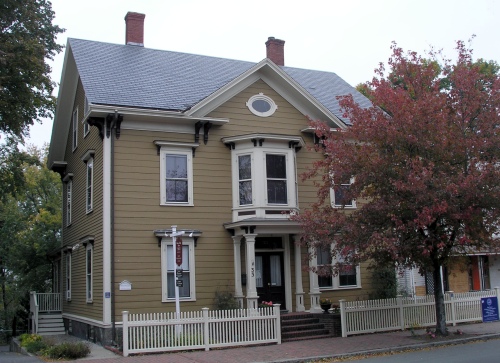
Osborne-Salata House (1860)
by Dan/March 14, 2011January 17, 2020/Houses, Italianate, Peabody

The Osborne-Salata House, at 33 Washington Street in Peabody, was constructed around 1860. This Italianate house was built for Thorndike and Sarah Daniels. It was later owned by Dennison Osborne and next served as a boarding house. The house’s last residents, from 1945-1997, were Dr. Benjamin Salata, a dentist, and wife, Celia, a music teacher. She donated the house to the Peabody Historical Society, which already owned the adjacent General Gideon Foster House. Today the Osborne-Salata House contains the Historical Society’s Elizabeth Cassidy Folk Art Museum, the Peabody Art Association Gallery and the Ruth Hill Library & Archives.
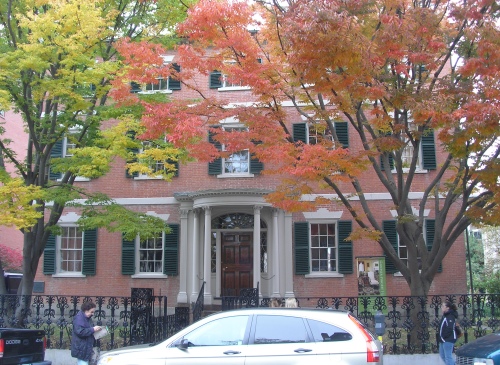
Gardner-Pingree House (1804)

by Dan/March 1, 2011January 24, 2020/Federal, Houses, Salem

The 350th post at Historic Buildings of Massachusetts is the Gardner-Pingree House in Salem, which is considered to be New England’s greatest example of a Federal-style (or Adamesque) town house. It was erected in 1804-1805 at 128 Essex Street for merchant John Gardner, Jr. and is generally considered to be the work of Samuel McIntire, who certainly did create the mansion‘s exterior ornamentation and interior wood carving. In 1811, financial difficulties forced Gardner to sell his house to Nathaniel West, who then sold it three years later to Captain Joseph White. In 1830, Capt. White was murdered in the house, an event that shook Salem and was followed by a sensational trial with a famed oration by Daniel Webster. The story would have an influence on Poe and Hawthorne. In 1834, the house was sold to David Pingree and remained in the Pingree family until 1933. The house was donated in that year to the Essex Institute, now the Peabody Essex Museum. The restored house is open to the public for tours, usually in conjunction with the museum’s nearby John Ward and Crowninshield-Bentley houses.

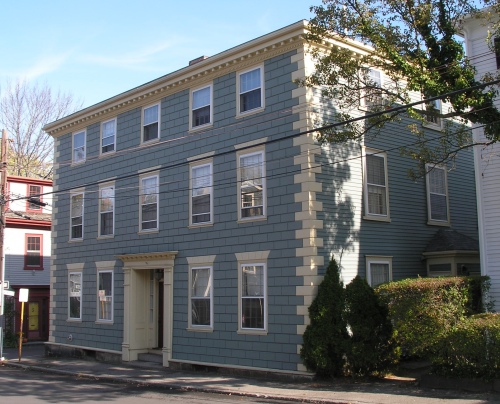
Maj. John Pedrick House (1756)

by Dan/February 26, 2011January 22, 2020/Colonial, Houses, Marblehead

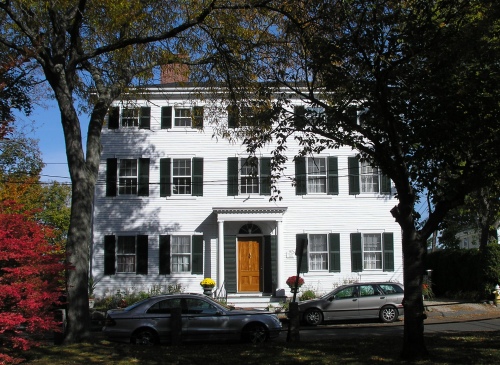
Maj. John Pedrick, a merchant and militia officer in Marblehead, built the house at 52 Washington Street in 1756. In 1770, he enlarged and remodeled the house, giving it a facade probably inspired by that of the nearby Col. Jeremiah Lee House. As described by Samuel Roads in The History and Traditions of Marblehead (1880),

His ships sailed to nearly every port in England, Spain, and the West Indies, and his transactions were with some of the largest mercantile houses of Europe. At one time, it is said, he owned twenty-five vessels engaged in the foreign trade.

The Revolutionary War, which proved so disastrous to the merchants of Marblehead, bore with especial severity upon Major Pedrick. Several of his vessels were destroyed by British cruisers in Massachusetts Bay, and many others rotted in port. But through it all he proved himself a zealous patriot, and a firm friend to his country. When his son was drafted as a soldier, he charged him not to accept a dollar from the government for his services, and provided him with money to meet his expenses. His daughters made a silk belt for their brother to wear, in which the gold and silver coins were quilted for safety.

In addition to his other losses, Major Pedrick suffered severely by the depreciation of Continental money. At a critical period of the war, he furnished the government with valuable military and naval stores, for which he was obliged to receive a large amount of paper money. In a short time this money became utterly worthless and the entire amount was lost.

Maj. Pedrick was also involved in the incident known as Leslie’s Retreat on February 26 1775. On that date, a British force under Col. Alexander Leslie landed at Marblehead and marched on Salem to destroy cannon and other arms and ammunition gathered there by the colonials. Again quoting Roads:

Suspecting the object of the expedition to be the seizure of several pieces of artillery secreted at Salem, Major John Pedrick hastened on horseback to that town, and gave the alarm at the door of the North Church. He was soon joined by a party of young men from Marblehead, and together they proceeded to the North Bridge, over which the regulars were obliged to pass.

Confronted by patriot militia at North Bridge in Salem, Col. Leslie eventually was allowed to cross on condition he advance only a short distance and then withdraw.

Maj. Pedrick’s House in Marblehead later served as an inn.

Capt. John Cross House (1804)

by Dan/February 18, 2011January 22, 2020/Federal, Houses, Marblehead

The house at 8 Washington Square in Marblehead was built in 1804 for Capt. John Cross, a mariner. Around 1886, it was the residence of Mary G. Brown, librarian at the Abbot Public Library.

Capt. Nathaniel Norden House (1686)

by Dan/February 17, 2011January 22, 2020/Colonial, Houses, Marblehead

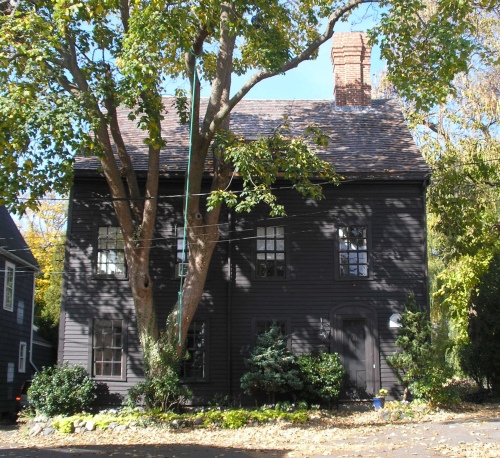
The Capt. Nathaniel Norden House, at 15 Glover Square in Marblehead, was built around 1686 with an integral lean-to. According to Eben Putnam’s Lieutenant Joshua Hewes (1913),

Capt. Nathaniel Norden of Marblehead, son of Samuel, was born 27 Nov., 1653. He was at first a mariner, and later a prosperous merchant. He was one of the selectmen of Marblehead in 1690, and that year he and Capt. Legg are asked by the General Court to explain why they have not kept better order at Marblehead. He was of the Council for Massachusetts, 1708-23.

A later resident of the house was the loyalist Ashley Bowen in the 1760s. As described by Samuel Roads in The History and Traditions of Marblehead,

Though there had been Roman Catholics in Marblehead for many years, there was no attempt to have a celebration of the mass in town until the year 1851. During that year, the Rev. Thomas Shehan, pastor of St. James Church, Salem, visited the town, and celebrated mass in the house of Mr. Dennis Donovan, on the corner of Prospect and Commercial streets. Father Shehan afterwards came to Marblehead twice a year for the purpose of hearing confessions and administering the Holy Communion, the services being held alternately at the house of Mr. Donovan and that of Mr. John Mahoney, on Glover Square [aka the Norden House].

Solomon B. Griffin House (1904)

by Dan/February 11, 2011January 21, 2020/Houses, Organizations, Springfield, Tudor Revival

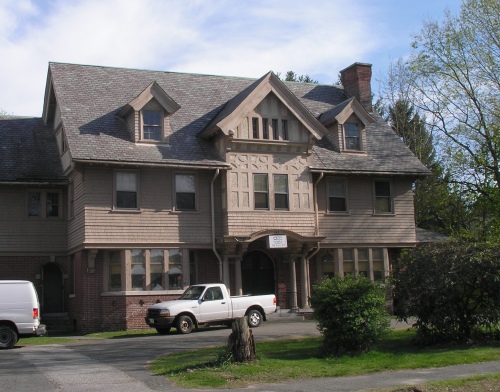
The Solomon B. Griffin House, at 185 Mill Street in Springfield, was built in 1904. It was designed by Charles E. Hamilton in the Tudor or English Revival style. Griffin was an author and managing editor of the Springfield Republican newspaper for many years. Today, the house is Amity Lodge 172 of the Independent Order of Odd Fellows.

Rev. Samuel G. Buckingham House (1875)

by Dan/February 9, 2011January 21, 2020/Houses, Springfield, Stick Style

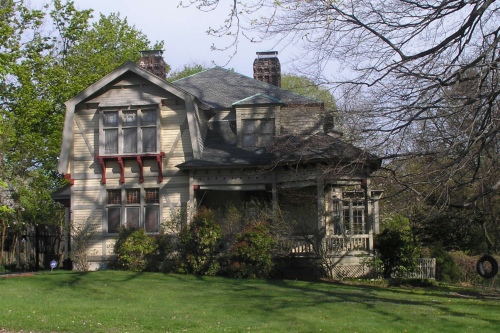
At 141 Mill Street in Springfield is a Stick-style house built in 1875. It was the home of Rev. Samuel G. Buckingham, who in 1847 had begun his forty-year tenure as pastor at South Congregational Church. Rev. Buckingham was the brother of William A. Buckingham, Governor of Connecticut during the Civil War, about whom he wrote a biography.

Posts navigation

Older posts
Newer posts
Privacy Policy

Categories

  • Architectural Style (943)
    • Art Deco (9)
    • Byzantine (3)
    • Colonial (177)
    • Colonial Revival (85)
    • Craftsman (6)
    • Egyptian Revival (1)
    • Federal (190)
    • Foursquare (6)
    • Gothic (67)
    • Greek Revival (100)
    • Italianate (82)
    • Mission Revival (2)
    • Mission/Spanish Colonial (1)
    • Modern (2)
    • Neoclassical (56)
    • Octagon (3)
    • Postmodern (1)
    • Queen Anne (46)
    • Renaissance Revival (26)
    • Romanesque Revival (53)
    • Second Empire (26)
    • Shingle Style (12)
    • Stick Style (13)
    • Tudor Revival (8)
    • Vernacular (49)
    • Victorian Eclectic (15)
  • Building Type (943)
    • Apartment Buildings (8)
    • Banks (18)
    • Churches (119)
    • Collegiate (32)
    • Commercial (102)
    • Hotels (16)
    • Houses (508)
    • Industrial (23)
    • Libraries (22)
    • Lighthouses (1)
    • Military (15)
    • Monuments (1)
    • Museums (12)
    • Organizations (39)
    • Outbuildings (17)
    • Public Buildings (50)
    • Schools (23)
    • Stations (5)
    • Synagogues (1)
    • Taverns (21)
    • Theaters (9)
  • Town (943)
    • Adams (11)
    • Agawam (4)
    • Amherst (50)
    • Boston (64)
    • Boylston (6)
    • Cambridge (30)
    • Clinton (21)
    • Concord (15)
    • Cummington (1)
    • Danvers (14)
    • Deerfield (31)
    • Gloucester (18)
    • Granville (10)
    • Great Barrington (2)
    • Hadley (9)
    • Hancock (15)
    • Harvard (32)
    • Holyoke (47)
    • Lenox (5)
    • Lexington (8)
    • Longmeadow (32)
    • Marblehead (40)
    • Marlborough (4)
    • Natick (22)
    • Newton (2)
    • Northampton (68)
    • Peabody (4)
    • Pittsfield (20)
    • Salem (110)
    • Saugus (4)
    • Sheffield (4)
    • South Hadley (8)
    • Southborough (8)
    • Southwick (4)
    • Springfield (67)
    • Stockbridge (19)
    • Stow (1)
    • Sturbridge (18)
    • Sudbury (7)
    • Waltham (11)
    • Watertown (1)
    • Wayland (8)
    • West Springfield (14)
    • Westfield (46)
    • Weston (2)
    • Worcester (26)
  • Uncategorized (1)

Recent Comments

  • Wilber Blackson on South Hadley
  • Tami Speiden on Stockbridge
  • DexGuru on Stockbridge

Tags

Alcott Amherst College Asher Benjamin Back Bay Baptist Beacon Hill Big E Black Heritage Trail bowfront Bulfinch Catholic Congregational Episcopal Freedom Trail Gambrel H.H. Richardson Harvard Hawthorne Historic Deerfield Isaac Damon lit Longfellow mansard Methodist Mount Holyoke Museum Museums NPS Old Sturbridge Village PEM Revolutionary War row houses saltbox Samuel McIntire Shakers Smith College SPNEA Springfield Armory Stephen C. Earle Storrowton Underground Railroad UU Washington William Fenno Pratt Witch Trials

Meta

  • Log in
  • Entries feed
  • Comments feed
  • WordPress.org
Proudly powered by WordPress | Theme: ShowMe by NEThemes.