Historic Buildings of Massachusetts

  • About
  • Index by Town
  • CT
  • About
  • Index by Town
  • CT

Category: Houses

Theodore Sedgwick House (1761)
by Dan/January 23, 2020/Colonial, Greek Revival, Houses, Sheffield

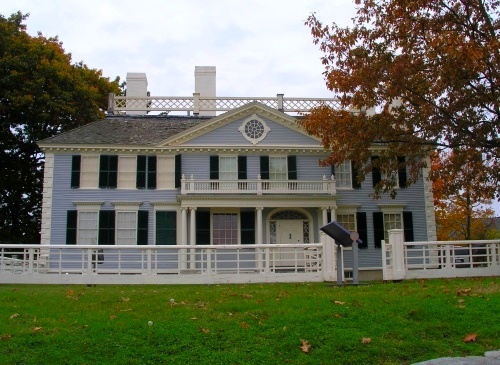
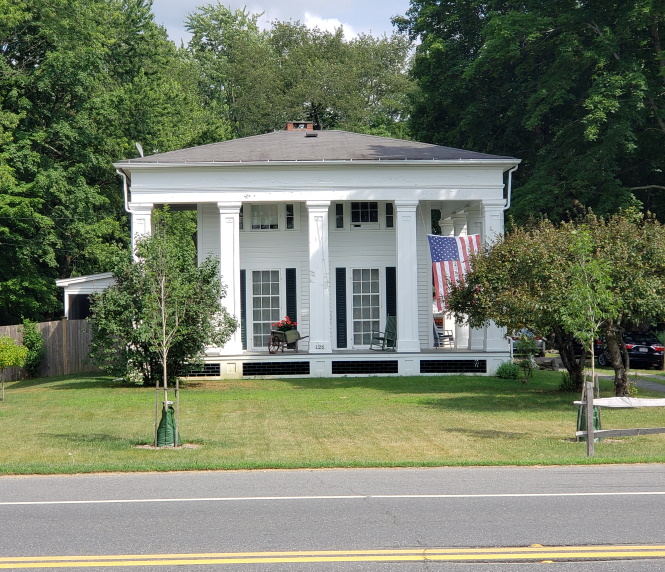
Although it now has a nineteenth-century Greek Revival appearance with eleven columns, the house at 126 Main Street in Sheffield dates back to 1761. In the 1760s, the house was rented by Dr. Lemuel Barnard, a physician who was one of the signers of the Sheffield Declaration, which was drawn up at the home of John Ashley in 1773. Seen as a predecessor of the Declaration of Independence, the Sheffield Declaration (or Sheffield Resolves) was a list of grievances against the British government and an outline of the basic rights of citizens. In 1768, David Ingersoll sold the house to Theodore Sedgwick, a Sheffield lawyer (born in West Hartford, Connecticut) who had written the text of the Sheffield Declaration. In 1781, he and Tapping Reeve represented Mum Bett, an enslaved woman at the house of John Ashley, who sued for her freedom under the Massachusetts constitution of 1780, part of which stated that “All men are born free and equal.” She won her freedom and took the name Elizabeth Freeman. Sedgwick was a delegate to the Continental Congress and would go on to serve as in the U.S. House and Senate. He was the forth Speaker of the House of Representatives (1799-1801) and served on the Massachusetts Supreme Court from 1802 until his death in 1813. In 1785, he sold the house at 126 Main Street to Elisha Lee, also an attorney, who was appointed the first postmaster of Sheffield in 1784.
Herbert J. Frink House (1885)

by Dan/December 28, 2016December 28, 2016/Holyoke, Houses, Queen Anne, Shingle Style

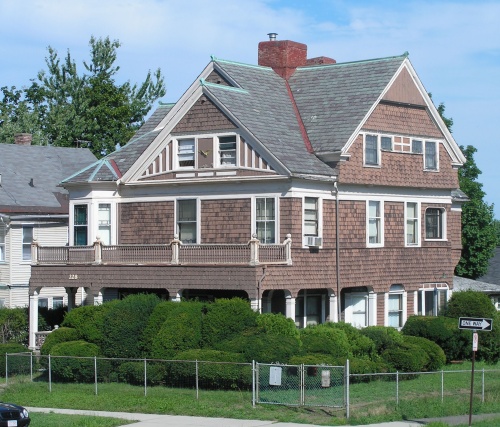
Herbert J. Frink was an agent and later president and treasurer of the Holyoke Machine Company, president of the Peoples Savings Bank and a director of the Hadley Falls National Bank. He had patents for a calendar-roll, an adjustable bearing box and a wood-pulp grinder. Frink lived in the house at 228 Pine Street in Holyoke. It remained in his family into the early 1960s.

Firtion Adams Funeral Home (1920)

by Dan/December 26, 2016December 26, 2016/Craftsman, Houses, Mission/Spanish Colonial, Westfield

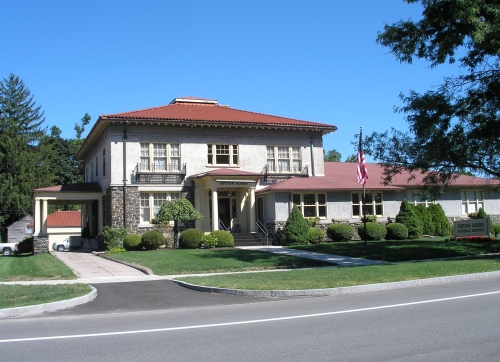
The Firtion Adams Funeral Home in Westfield is located in a distinctive craftsman/Spanish eclectic-style house located at 76 Broad Street. The house was erected c. 1920.

Capt. John Bancroft House (1755)

by Dan/December 8, 2016/Colonial, Houses, Westfield

Capt. John Bancroft House

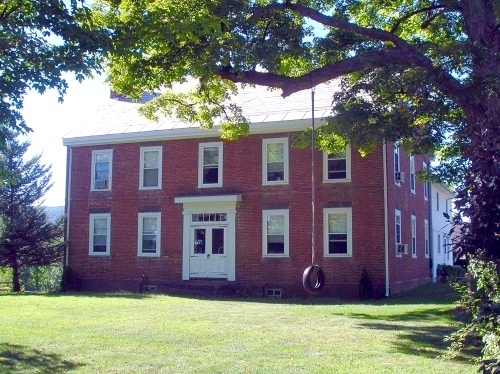
John Bancroft, who was a captain in the French and Indian War, built the brick house that still stands at 530 Pochassic Street in Westfield. Rev. John H. Lockwood, in his Westfield and Its Historic Influences (1922), writes of

Capt. John Bancroft who, in 1755, built in Pochassic what was probably the second brick house in the present Hampden County, the old Day house in West Springfield dating from 1754. The Bancroft house was by far the more massive and pretentious of the two and is still a notable mansion. Captain John, its builder, was a prosperous farmer, owning slaves, like a few of his fellow townsmen of the time. He was very proud of his elegant mansion. A tale, which may be pure romance founded on his well known characteristics, has come down to our time, somewhat as follows: He was wont to sit within his commodious domicile and watch for passers by in order to gloat over their envious glances. One day, while thus engaged, he called out to one on the road, “Did you think that you had reached paradise?” Quickly came the stunning response, “Yes! I did think so, until I saw the devil looking out of the window.” Sic transit gloria mundi!

In 1776, during the Revolutionary War, Capt. Bancroft’s name was published on a list of those considered “enemies of their country” and the Committee of Correspondence and Safety confined him within the limits of his farm. He regained some of his status after the War, but research long after his death revealed that he had been selling secrets to the British throughout the Revolution.

Dwight Kellogg House (1825)

by Dan/December 3, 2016December 3, 2016/Greek Revival, Houses, Westfield

Kellogg House

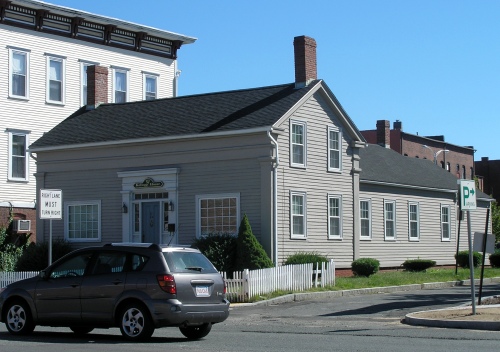
The house at 14 Franklin Street in Westfield was built in 1825 for Wareham Sackett by Ephraim Crary. It passed to Sackett’s daughter, Henrietta, who married Capt. George Whipple. Their daughter, Julia, married Dwight Kellogg, for whose name the house was afterward known. The house is now used for offices and is in a commercial area.

George H. Perry House (1873)

by Dan/December 3, 2016/Holyoke, Houses, Italianate

214 Maple St., Holyoke

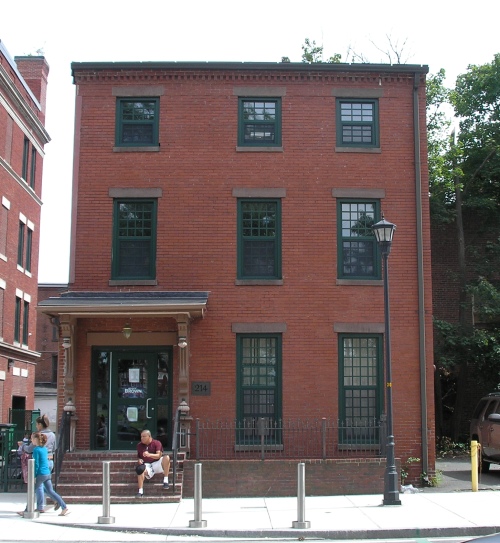
The building at 214 Maple Street in Holyoke was built around 1873 and was part of a block belonging to the Whiting Paper Company. By 1887 it was the residence of George H. Perry, a foreman of Parsons Paper Company. Alden Press purchased the building in 1917 and built a rear addition. As noted in The American Printer of April 5, 1917:

Alden Press Moves and Enlarges

The Alden Press of Holyoke, of which Edward S. Alden is president, has purchased the three-story building at 214 Maple Street. The firm took possession of the building some months ago and has spent a large sum in equipping it as a first-class printing plant. The Artisan, a labor weekly, is published here and there is a job department also. Among new equipment have been added a rotary press, monotype machine and two job presses.

Salisbury Mansion (1772)

by Dan/September 17, 2016September 17, 2016/Colonial, Houses, Worcester

Salisbury Mansion

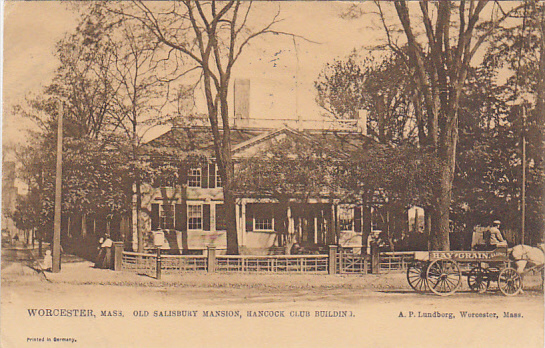
The Salisbury Mansion in Worcester was built in 1772 by merchant Stephen Salisbury to serve as both a residence and a store. The latter, where Salisbury sold imported goods, was closed down and converted to residential use in 1820. After Salisbury’s widow, Elizabeth Tuckerman Salisbury, died in 1851 the house was used as a rental property. In later years the house served as the Hancock Club, a gentleman’s social club. The mansion was originally located at Lincoln Square, which by the early twentieth century had become an industrialized area. In 1929 the mansion was willed to the American Antiquarian Society, which three years later transferred ownership to Worcester Art Museum. The house was moved to its current address at 40 Highland Street to make way for the Lincoln Square Boys Club. The Museum sold the mansion in 1950 to the Worcester Employment Society for use as a craft center. When that group later sought to tear down the building, concerned citizens formed the Salisbury Mansion Associates in 1955 and three years later purchased it. After sharing use of the mansion with the Worcester Girl Scouts Council for many years, the Associates restored the house, which in 1984 opened as Worcester’s first historic house museum. The following year the Associates merged with the Worcester Historical Museum, which now operates the historic site.

Posts navigation

Older posts
Newer posts
Privacy Policy

Categories

  • Architectural Style (943)
    • Art Deco (9)
    • Byzantine (3)
    • Colonial (177)
    • Colonial Revival (85)
    • Craftsman (6)
    • Egyptian Revival (1)
    • Federal (190)
    • Foursquare (6)
    • Gothic (67)
    • Greek Revival (100)
    • Italianate (82)
    • Mission Revival (2)
    • Mission/Spanish Colonial (1)
    • Modern (2)
    • Neoclassical (56)
    • Octagon (3)
    • Postmodern (1)
    • Queen Anne (46)
    • Renaissance Revival (26)
    • Romanesque Revival (53)
    • Second Empire (26)
    • Shingle Style (12)
    • Stick Style (13)
    • Tudor Revival (8)
    • Vernacular (49)
    • Victorian Eclectic (15)
  • Building Type (943)
    • Apartment Buildings (8)
    • Banks (18)
    • Churches (119)
    • Collegiate (32)
    • Commercial (102)
    • Hotels (16)
    • Houses (508)
    • Industrial (23)
    • Libraries (22)
    • Lighthouses (1)
    • Military (15)
    • Monuments (1)
    • Museums (12)
    • Organizations (39)
    • Outbuildings (17)
    • Public Buildings (50)
    • Schools (23)
    • Stations (5)
    • Synagogues (1)
    • Taverns (21)
    • Theaters (9)
  • Town (943)
    • Adams (11)
    • Agawam (4)
    • Amherst (50)
    • Boston (64)
    • Boylston (6)
    • Cambridge (30)
    • Clinton (21)
    • Concord (15)
    • Cummington (1)
    • Danvers (14)
    • Deerfield (31)
    • Gloucester (18)
    • Granville (10)
    • Great Barrington (2)
    • Hadley (9)
    • Hancock (15)
    • Harvard (32)
    • Holyoke (47)
    • Lenox (5)
    • Lexington (8)
    • Longmeadow (32)
    • Marblehead (40)
    • Marlborough (4)
    • Natick (22)
    • Newton (2)
    • Northampton (68)
    • Peabody (4)
    • Pittsfield (20)
    • Salem (110)
    • Saugus (4)
    • Sheffield (4)
    • South Hadley (8)
    • Southborough (8)
    • Southwick (4)
    • Springfield (67)
    • Stockbridge (19)
    • Stow (1)
    • Sturbridge (18)
    • Sudbury (7)
    • Waltham (11)
    • Watertown (1)
    • Wayland (8)
    • West Springfield (14)
    • Westfield (46)
    • Weston (2)
    • Worcester (26)
  • Uncategorized (1)

Recent Comments

  • Wilber Blackson on South Hadley
  • Tami Speiden on Stockbridge
  • DexGuru on Stockbridge

Tags

Alcott Amherst College Asher Benjamin Back Bay Baptist Beacon Hill Big E Black Heritage Trail bowfront Bulfinch Catholic Congregational Episcopal Freedom Trail Gambrel H.H. Richardson Harvard Hawthorne Historic Deerfield Isaac Damon lit Longfellow mansard Methodist Mount Holyoke Museum Museums NPS Old Sturbridge Village PEM Revolutionary War row houses saltbox Samuel McIntire Shakers Smith College SPNEA Springfield Armory Stephen C. Earle Storrowton Underground Railroad UU Washington William Fenno Pratt Witch Trials

Meta

  • Log in
  • Entries feed
  • Comments feed
  • WordPress.org
Proudly powered by WordPress | Theme: ShowMe by NEThemes.