Historic Buildings of Massachusetts

  • About
  • Index by Town
  • CT
  • About
  • Index by Town
  • CT

Category: Houses

Mark H. Newman House (1853)
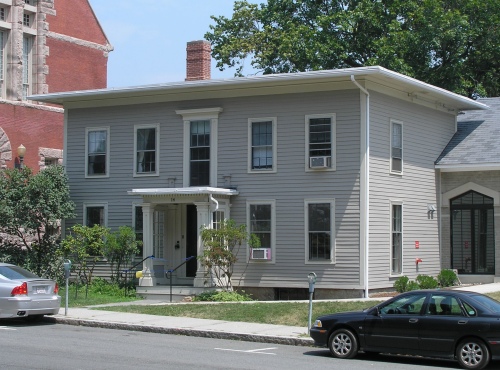
by Dan/August 1, 2011August 1, 2011/Amherst, Houses, Italianate

Built around 1850-1853, the Rectory of Grace Episcopal Church in Amherst was originally the home of bookseller Mark H. Newman. The rectory was later attached to the church by an extension. This extension was recently replaced by an entirely new link between the rectory and church. For many years, in front of the rectory and Grace Church, stood a large Japanese katsura tree, which became an Amherst landmark. It was brought as a seed or seedling from Japan by William S. Clark, founder of the Massachusetts Agricultural College (now the University of Massachusetts Amherst), and planted in 1877. Dr. Frederick Tuckerman once said that if the rectory ever caught on fire, the tree should be saved even if the building had to be sacrificed. The tree suffered from dangerous rot and was taken down several years ago.
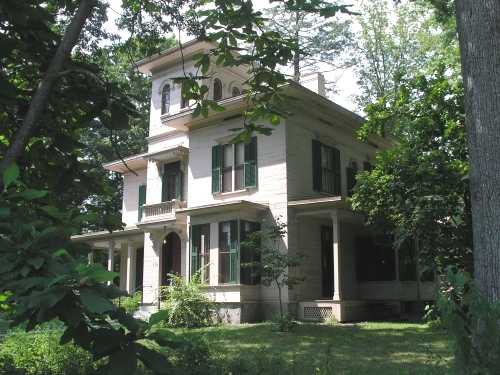
The Evergreens (1856)

by Dan/July 29, 2011December 1, 2011/Amherst, Houses, Italianate

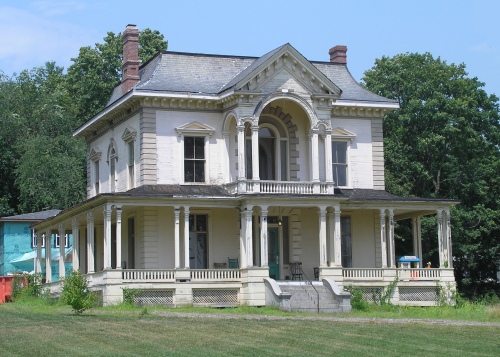
The Evergreens is a house in Amherst built in 1856 by Edward Dickinson for his his son, William Austin Dickinson, who had just married Susan Huntington Gilbert. Austin Dickinson was a lawyer and succeeded his father as treasurer of Amherst College, serving from 1874 until his death in 1895. He is also known for his longtime affair with Mabel Loomis Todd, who would edit early collections of poetry written by Austin’s sister, Emily Dickinson. The Italianate-style Evergreens, designed by Northampton architect William Fenno Pratt, was built next to the Dickinson Homestead, where Emily resided with her sister, Lavinia. The Evergreens became a social and cultural center in the town. After Austin and Sarah Dickinson died (the latter in 1913), the house was lived in and preserved by their daughter, Martha Dickinson Bianchi (died 1943), who left the house to her secretary, Alfred Leete Hampson, stipulating in her will that if Hampson and his family chose not to live in the house, it should be torn down. Hampson’s widow, Mary Landis Hampson, made arrangements in her own will to preserve the house under a trust for public use. Since 2003, it has been owned by Amherst College and, along with the Emily Dickinson Homestead, forms part of the Emily Dickinson Museum.

Lysander H. Allen House (1886)

by Dan/July 28, 2011July 29, 2011/Amherst, Houses, Stick Style

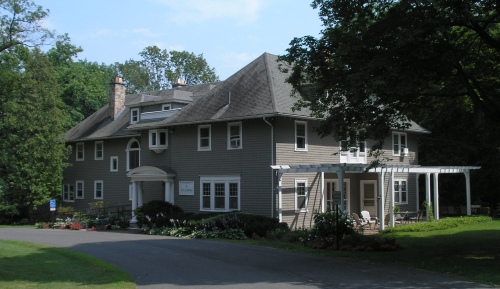
Lysander H. Allen, a wire goods manufacturer, built his house, at 599 Main Street in Amherst, in 1886. In later years it was the home of his son, Harry Allen, who taught at Amherst College. The house, which is a notable example of the stick style of architecture, was the winner of the 1991 Amherst Historical Commission‘s Preservation Award. It is now a bed & breakfast known as the Allen House Inn.

Helen Hunt Jackson House (1830)

by Dan/July 28, 2011/Amherst, Greek Revival, Houses

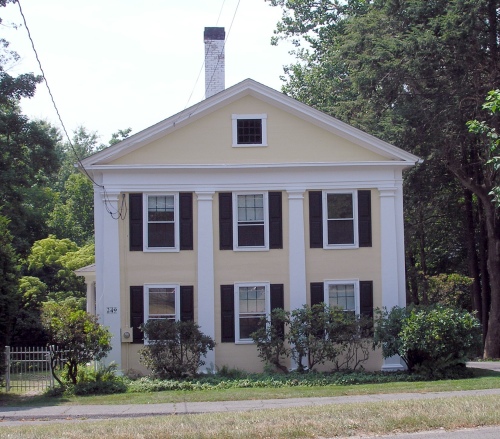
Helen Hunt Jackson, the author of many books and poems, was born Helen Maria Fiske in Amherst in 1830 in a Greek Revival house, built the same year at 249 South Pleasant Street. Her father, Nathan Fiske, was a minister and a professor of Language and Philosophy at Amherst College. A contemporary and classmate of Emily Dickinson, Helen Hunt Jackson was educated at the Ipswich Female Seminary and at the Abbott Brothers’ School in New York City. She was married twice, lost two sons and lived later in life in Colorado. An activist who denounced the treatment of Native Americans by the U.S. government, she detailed the history of broken treaties and called for reform in her book, A Century of Dishonor (1881). Inspired by Harriet Beecher Stowe’s Uncle Tom’s Cabin, she also addressed the issue of the federal government’s mistreatment of Native Americans in her novel, Ramona (1884). Her birthplace was later acquired by Amherst College and is now a private residence.

Henry F. Hills House (1863)

by Dan/July 26, 2011October 20, 2012/Amherst, Houses, Italianate, Second Empire

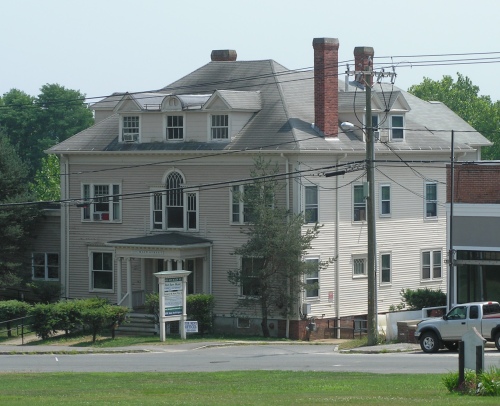
The Henry F. Hills House (pdf) is a striking mansion at 360 Main Street, recently renumbered as 38 Gray Street, in Amherst. It was designed by William Fenno Pratt of Northampton and was built in 1862-1863 for Henry Francis Hills, next to the lot where his father, Leonard M. Hills would soon also build a house by the same architect. Father and son owned a factory complex near the railroad depot that made palm leaf hats. Henry Hills succeeded his father as president of the company in 1877. After Hills’ death in 1924, the house, which had been built as a wedding gift for his bride Adelaide Spenser of South Manchester, Connecticut, was next occupied by his daughter, Susan C. Hills Skillings, who lived there until her death 1968. From 1976 to 2007, the property was owned by the Amherst Boys and Girls Club. It was then sold to a developer, who has restored (pdf) the house and three other historic houses that had been moved to new lots on the former Hills property: the Chapin-Ward House, the Potwine House and the Tuttle Farmhouse.

Baxter Marsh House (1896)

by Dan/July 26, 2011/Amherst, Colonial Revival, Houses

Baxter Marsh was a carpenter in Greenfield, who settled with his wife, Jane H. Ware Marsh, in Amherst in 1873. He built several houses in town and in 1896 he probably was the builder of his own large Georgian Revival home on Main Street. Rooms were rented out to instructors working at nearby Amherst College including, from 1918 to 1920, Robert Frost. Another tenant was literature professor John Erskine, who included reminiscences of his residence in the Marsh House in his book, The Memory of Certain Persons (1947). The Baxters’ son, Edward Baxter Marsh, attended Amherst and later continued to reside in his own house in town. The house was later used by the Amherst Record and in 1989 it was moved from 109 to 401 Main Street to make way for the new Police Department building.

The Dell (1907)

by Dan/July 25, 2011July 30, 2011/Amherst, Colonial Revival, Houses

The Dell is a Colonial Revival house at 97 Spring Street in Amherst. It was built in 1907 for the Churchill family and, from 1950 to 1958, was the home of author Howard R. Garis (1873-1962). He was the author of the Uncle Wiggily stories, which he began writing in 1910. Garis also wrote the first 37 Tom Swift books and other stories under the name Victor Appleton, a house pseudonym used by the Stratemeyer Syndicate. Today the Dell is used as the offices of Five Colleges, Incorporated.

Posts navigation

Older posts
Newer posts
Privacy Policy

Categories

  • Architectural Style (943)
    • Art Deco (9)
    • Byzantine (3)
    • Colonial (177)
    • Colonial Revival (85)
    • Craftsman (6)
    • Egyptian Revival (1)
    • Federal (190)
    • Foursquare (6)
    • Gothic (67)
    • Greek Revival (100)
    • Italianate (82)
    • Mission Revival (2)
    • Mission/Spanish Colonial (1)
    • Modern (2)
    • Neoclassical (56)
    • Octagon (3)
    • Postmodern (1)
    • Queen Anne (46)
    • Renaissance Revival (26)
    • Romanesque Revival (53)
    • Second Empire (26)
    • Shingle Style (12)
    • Stick Style (13)
    • Tudor Revival (8)
    • Vernacular (49)
    • Victorian Eclectic (15)
  • Building Type (943)
    • Apartment Buildings (8)
    • Banks (18)
    • Churches (119)
    • Collegiate (32)
    • Commercial (102)
    • Hotels (16)
    • Houses (508)
    • Industrial (23)
    • Libraries (22)
    • Lighthouses (1)
    • Military (15)
    • Monuments (1)
    • Museums (12)
    • Organizations (39)
    • Outbuildings (17)
    • Public Buildings (50)
    • Schools (23)
    • Stations (5)
    • Synagogues (1)
    • Taverns (21)
    • Theaters (9)
  • Town (943)
    • Adams (11)
    • Agawam (4)
    • Amherst (50)
    • Boston (64)
    • Boylston (6)
    • Cambridge (30)
    • Clinton (21)
    • Concord (15)
    • Cummington (1)
    • Danvers (14)
    • Deerfield (31)
    • Gloucester (18)
    • Granville (10)
    • Great Barrington (2)
    • Hadley (9)
    • Hancock (15)
    • Harvard (32)
    • Holyoke (47)
    • Lenox (5)
    • Lexington (8)
    • Longmeadow (32)
    • Marblehead (40)
    • Marlborough (4)
    • Natick (22)
    • Newton (2)
    • Northampton (68)
    • Peabody (4)
    • Pittsfield (20)
    • Salem (110)
    • Saugus (4)
    • Sheffield (4)
    • South Hadley (8)
    • Southborough (8)
    • Southwick (4)
    • Springfield (67)
    • Stockbridge (19)
    • Stow (1)
    • Sturbridge (18)
    • Sudbury (7)
    • Waltham (11)
    • Watertown (1)
    • Wayland (8)
    • West Springfield (14)
    • Westfield (46)
    • Weston (2)
    • Worcester (26)
  • Uncategorized (1)

Recent Comments

  • Wilber Blackson on South Hadley
  • Tami Speiden on Stockbridge
  • DexGuru on Stockbridge

Tags

Alcott Amherst College Asher Benjamin Back Bay Baptist Beacon Hill Big E Black Heritage Trail bowfront Bulfinch Catholic Congregational Episcopal Freedom Trail Gambrel H.H. Richardson Harvard Hawthorne Historic Deerfield Isaac Damon lit Longfellow mansard Methodist Mount Holyoke Museum Museums NPS Old Sturbridge Village PEM Revolutionary War row houses saltbox Samuel McIntire Shakers Smith College SPNEA Springfield Armory Stephen C. Earle Storrowton Underground Railroad UU Washington William Fenno Pratt Witch Trials

Meta

  • Log in
  • Entries feed
  • Comments feed
  • WordPress.org
Proudly powered by WordPress | Theme: ShowMe by NEThemes.