Historic Buildings of Massachusetts

  • About
  • Index by Town
  • CT
  • About
  • Index by Town
  • CT

Category: Houses

Dodge-Shreve House (1817)
by Dan/December 9, 2011December 9, 2011/Federal, Houses, Salem

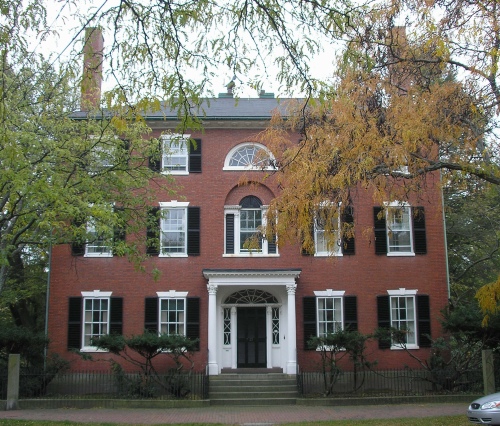
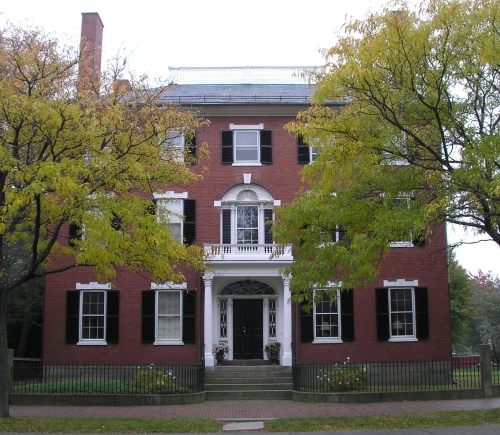
One of Chestnut Street in Salem‘s most celebrated architectural achievements is the Dodge-Shreve House. Sometimes dated to 1817, but also to 1822-1825, the house, at 29 Chestnut Street, was built for merchant Pickering Dodge by master builder David Lord. It is similar in size and layout to the nearby Pickman-Shreve-Little House, but is a later example of the Federal-style with a greater variety of decorative details. The Dodge-Shreve House has been owned by the Phillips, Peirce, Allen, Cabot and Shreve families.
Ichabod Tucker House (1800)

by Dan/December 8, 2011/Greek Revival, Houses, Salem

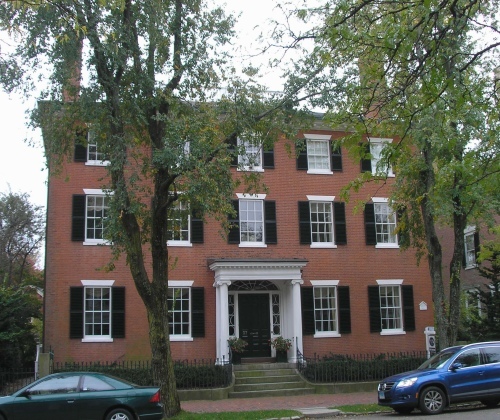
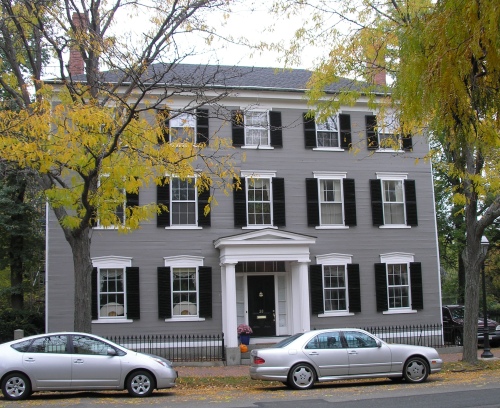
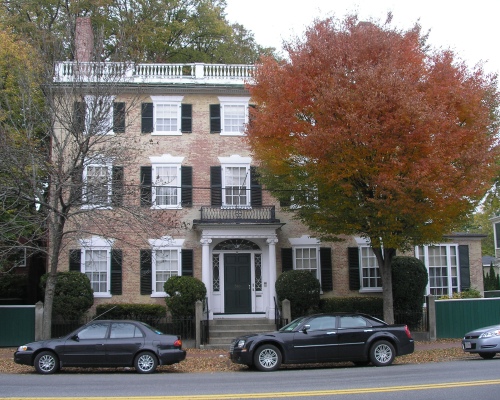
Although the earliest part of the house dates to 1800 (making it the second residence to be built on the street), the Greek Revival facade of 28 Chestnut Street in Salem was constructed during a remodeling in 1846. The house was built for Ichabod Tucker, clerk of the courts of Salem, and was later occupied by the Cole and Wilson families.

Sprague-Peabody-Silsbee House (1807)

by Dan/December 7, 2011/Federal, Houses, Salem

Upper Essex Street in Salem’s most impressive three-story brick Federal-style house is the Sprague-Peabody-Silsbee House at 380 Essex Street. It was built about 1807 by Joseph Sprague, Jr.; was sold to Joseph Peabody in 1822 and occupied by his son Francis; and was owned by the Silsbee family from 1840 to 1901. The house, which has been enlarged and remodeled over the years, has interior carving attributed to Samuel McIntire.

Pickman-Shreve-Little House (1819)

by Dan/December 6, 2011/Federal, Houses, Salem

One of Salem‘s best examples of Federal-style architecture is the Pickman-Shreve-Little House at 27 Chestnut Street. It was constructed about 1819 by master builder Jabez Smith for Dudley L. Pickman. One of Salem’s wealthiest merchants, Pickman was a partner in the firm Devereux, Pickman & Silsbee and served as a state senator. The house was in his family until 1865 and was then owned, from 1872 to 1898, by Benjamin Shreve, a founder of the Boston jewelers Shreve, Crump, & Low, which is still in business. After Shreve‘s death, the house was then home to David Mason Little, a naval architect and photographer. He published a collection of his yacht photography in 1883 called Instantaneous Marine Studies. David M. Little also served as mayor of Salem in 1900 and was the last Collector of Customs at Salem, from 1903 until the office was abolished in 1913.

George Nichols House (1816)

by Dan/December 5, 2011/Federal, Houses, Salem

The house at 37 Chestnut Street in Salem was erected by master builder Jabez Smith in 1816-1817 for sea captain and merchant George Nichols. The house was also owned, from 1827 to 1845, by David Pingree and William A. Landers.

M. M. French House (1848)

by Dan/December 2, 2011/Greek Revival, Houses, Northampton

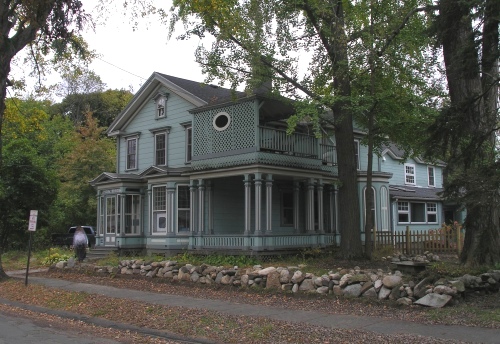
In 1847, Marvin Marcy French (1820-1896) was one of the first people to acquire a plot of land on the newly opened Pomeroy Terrace in Northampton. The original section of his house, 44 Pomeroy Terrace, was built in 1848. The house is architecturally notable for the extensive additions made to the structure for Mr. French in 1870 by architect William F. Pratt, who may or may not have designed the earlier part of the house. In an 1883-4 Directory, M.M. French is listed as a vice-president of the Northampton Institution for Savings.

Dr. S. H. Spaulding House (1829)

by Dan/November 30, 2011/Greek Revival, Houses, Natick

Dr. Stephen Hodgman Spaulding (1787-1866) was born in Chelmsford and studied three years at the Harvard Medical School. As described in the History of Middlesex County, Vol. III (1890):

He commenced practice in Littleton, Mass., remained a few years, then removed to Dublin, New Hampshire, where he secured an excellent and lucrative practice. After a few years he found that the severity of the winters, and the almost impassable state of the roads—being obliged to travel with snowshoes without any regard to boundary lines or fences —was telling upon his health, and this decided him to accept an invitation to settle in South Natick, Mass., where again he succeeded in building up an extensive practice.
In about 1841 he removed to Newton Upper Falls, and associated himself with his son-in-law, Dr. Samuel S. Whitney, who had married his only child, Sarah W. Spalding, in general practice. In 1843 his house and stable were burned. He then settled in Reading, Mass., and continued in practice there for several years. Later in life, after an active practice of thirty years, he retired, and removing back to South Natick, made that his home till he died. In his last years he was a great sufferer from disease. He was a member of the Unitarian Church and Parish of South Natick, and the large number at his funeral attested the respect and esteem of his towns-people.

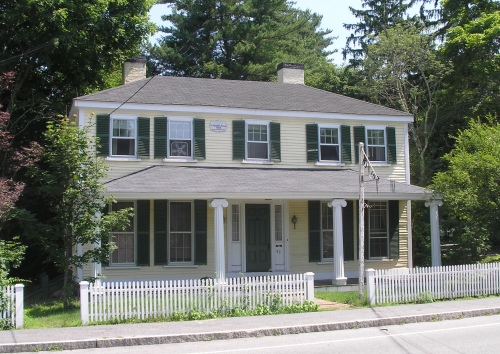
His 1829 hipped-roof house is at 42 Eliot Street in South Natick.

Posts navigation

Older posts
Newer posts
Privacy Policy

Categories

  • Architectural Style (943)
    • Art Deco (9)
    • Byzantine (3)
    • Colonial (177)
    • Colonial Revival (85)
    • Craftsman (6)
    • Egyptian Revival (1)
    • Federal (190)
    • Foursquare (6)
    • Gothic (67)
    • Greek Revival (100)
    • Italianate (82)
    • Mission Revival (2)
    • Mission/Spanish Colonial (1)
    • Modern (2)
    • Neoclassical (56)
    • Octagon (3)
    • Postmodern (1)
    • Queen Anne (46)
    • Renaissance Revival (26)
    • Romanesque Revival (53)
    • Second Empire (26)
    • Shingle Style (12)
    • Stick Style (13)
    • Tudor Revival (8)
    • Vernacular (49)
    • Victorian Eclectic (15)
  • Building Type (943)
    • Apartment Buildings (8)
    • Banks (18)
    • Churches (119)
    • Collegiate (32)
    • Commercial (102)
    • Hotels (16)
    • Houses (508)
    • Industrial (23)
    • Libraries (22)
    • Lighthouses (1)
    • Military (15)
    • Monuments (1)
    • Museums (12)
    • Organizations (39)
    • Outbuildings (17)
    • Public Buildings (50)
    • Schools (23)
    • Stations (5)
    • Synagogues (1)
    • Taverns (21)
    • Theaters (9)
  • Town (943)
    • Adams (11)
    • Agawam (4)
    • Amherst (50)
    • Boston (64)
    • Boylston (6)
    • Cambridge (30)
    • Clinton (21)
    • Concord (15)
    • Cummington (1)
    • Danvers (14)
    • Deerfield (31)
    • Gloucester (18)
    • Granville (10)
    • Great Barrington (2)
    • Hadley (9)
    • Hancock (15)
    • Harvard (32)
    • Holyoke (47)
    • Lenox (5)
    • Lexington (8)
    • Longmeadow (32)
    • Marblehead (40)
    • Marlborough (4)
    • Natick (22)
    • Newton (2)
    • Northampton (68)
    • Peabody (4)
    • Pittsfield (20)
    • Salem (110)
    • Saugus (4)
    • Sheffield (4)
    • South Hadley (8)
    • Southborough (8)
    • Southwick (4)
    • Springfield (67)
    • Stockbridge (19)
    • Stow (1)
    • Sturbridge (18)
    • Sudbury (7)
    • Waltham (11)
    • Watertown (1)
    • Wayland (8)
    • West Springfield (14)
    • Westfield (46)
    • Weston (2)
    • Worcester (26)
  • Uncategorized (1)

Recent Comments

  • Wilber Blackson on South Hadley
  • Tami Speiden on Stockbridge
  • DexGuru on Stockbridge

Tags

Alcott Amherst College Asher Benjamin Back Bay Baptist Beacon Hill Big E Black Heritage Trail bowfront Bulfinch Catholic Congregational Episcopal Freedom Trail Gambrel H.H. Richardson Harvard Hawthorne Historic Deerfield Isaac Damon lit Longfellow mansard Methodist Mount Holyoke Museum Museums NPS Old Sturbridge Village PEM Revolutionary War row houses saltbox Samuel McIntire Shakers Smith College SPNEA Springfield Armory Stephen C. Earle Storrowton Underground Railroad UU Washington William Fenno Pratt Witch Trials

Meta

  • Log in
  • Entries feed
  • Comments feed
  • WordPress.org
Proudly powered by WordPress | Theme: ShowMe by NEThemes.