Historic Buildings of Massachusetts

  • About
  • Index by Town
  • CT
  • About
  • Index by Town
  • CT

Category: Houses

Henry L. Williams House (1846)
by Dan/August 18, 2012August 18, 2012/Greek Revival, Houses, Italianate, Salem

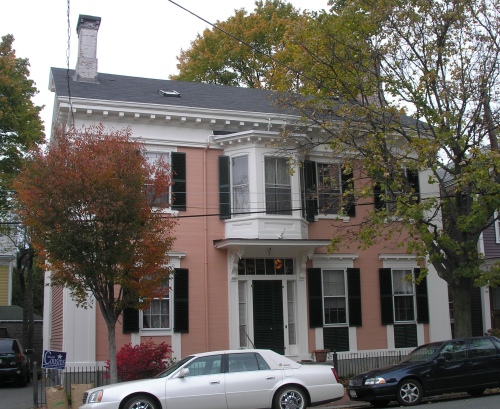
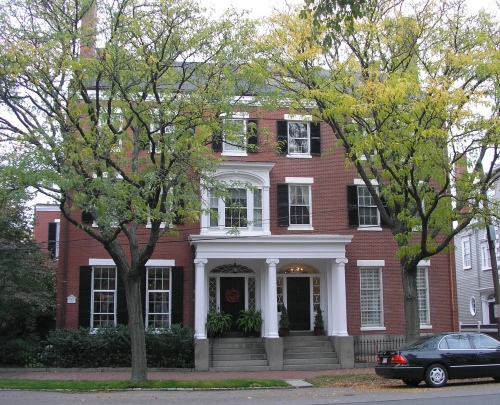
The house at 342 Essex Street in Salem, designed by Gridley J.F. Bryant, combines Greek Revival and Italianate elements. It was built in 1846 for Henry Laurens Williams, a partner in the merchant firm of Williams and Daland and president of the Five Cents Savings Bank. He served as mayor of Salem in 1875-1876.
Gregg-Stone House (1829)

by Dan/August 18, 2012August 26, 2012/Federal, Houses, Salem

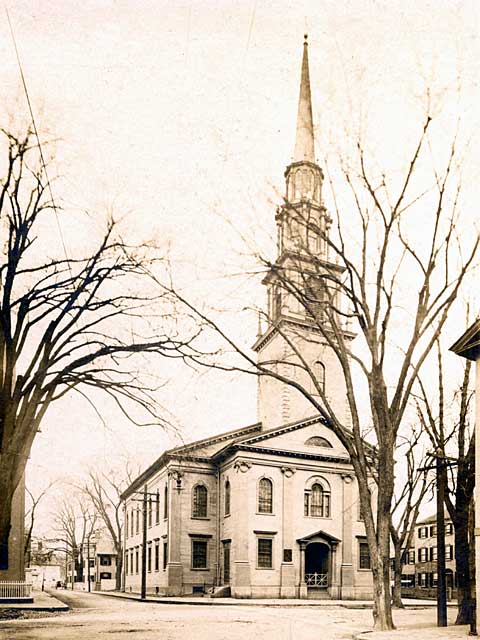
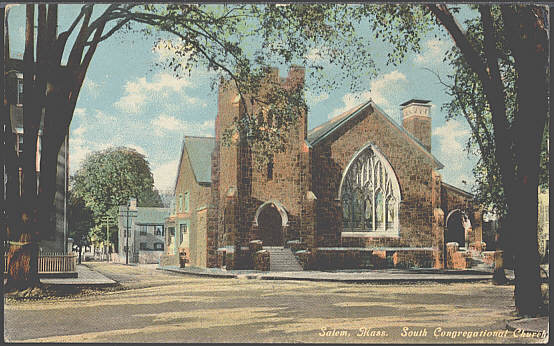
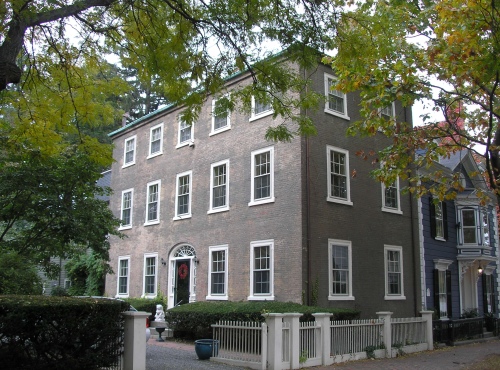
The house at 8 Chestnut Street in Salem began as a one-story brick store, built by Daniel Gregg in 1805. In 1825, the property was acquired by Deacon John Stone, who added two additional stories. Stone, who was a wealthy distiller, built the houses at 5 and 7 Chestnut Street as rooming houses, while he resided at 8 Chestnut Street. As described by Frank Cousins and Phil M. Riley in The Colonial Architecture of Salem (1919), “Its chief distinctions lie in its doorway of graceful simplicity and the unusual gambrel-roofed wing of wood at the rear end. Unlike most brick houses of importance in Salem […] its windows boast no lintels, but have molded architrave frames of wood let into the reveals of the brickwork.” The house was later the residence of Capt. Daniel H. Mansfield, Rev. Edwin C. Bolles and architect William G. Rantoul. The garden next to the house was once the site of South Church, built in 1803-1804 and designed by Samuel McIntire. It was destroyed in a fire in 1903 and was replaced by a Gothic Revival-style church, which was lost in the mid-twentieth century.

Thompson/West Double House (1845)

by Dan/August 6, 2012/Federal, Greek Revival, Houses, Salem

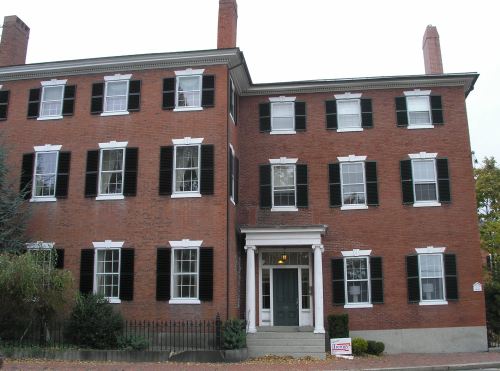
The double house at at 38-40 Chestnut Street in Salem was built in about 1845 and architecturally represents the transition from the Federal to the Greek Revival style. The original resident of the west half of the house (until 1859) was Rev. James W. Thompson, while the other half was the residence of Captain Nathaniel West, Sr. As described in History of the Military Company of the Massachusetts, Now Called the Ancient and Honorable Artillery Company of Massachusetts. 1637-1888, Vol. III.-1822-1865 (1898), by Olver Ayer Roberts:

Rev. James W. Thompson, D. D., of Salem, delivered the Artillery Election sermon of 1833. He was a son of Rev. James Thompson, D. D., of Barre, Mass., and was born in that town Dec. 13, 1805. He graduated at Brown University in 1827, and at the Theological School of Harvard University in 1831. Prior to his graduation he was ordained to the Christian ministry. He settled first in Natick. An invitation to settle over the Independent Congregation Society, in Barton Square, Salem, was accepted by him, and he was installed March 7, 1832. He remained in this ministry twenty-seven years, and resigned March 7, 1859. He left Salem, and accepted an invitation to the Third or Jamaica Plain Parish Church, in 1859, where he continued as sole or senior pastor until his decease, which occurred Sept. 24, 1881. The funeral services were held in the Unitarian Church at Jamaica Plain, and his remains were buried in Salem.

The eastern half of the double house was later home to Joseph B. Andrews, mayor of Salem in 1854-1856. As described in Historical Sketch of Salem, 1626-1879 (1879), by Charles S. Osgood and H.M. Batchelder:

Joseph Andrews served as mayor in 1854-55. He was born in Salem Dec. 10, 1808, and died in Boston Feb. 8, 1869. He was captain of the Salem Light Infantry and brigadier-general of tho State militia, which position he held in 1861, at the opening of the Rebellion. He commanded at Fort Warren, in Boston harbor, and had charge of the State troops sent to that station prior to their departure for the seat of war, and until it ceased to be used for that purpose. He was a bank official.

Captain John B. Silsbee owned the western half of the house in the late 1850’s and 1860’s. The bay window above the left entrance is an early twentieth-century addition.

White-Silsbee/Hodges-Mott House (1811)

by Dan/August 1, 2012August 1, 2012/Federal, Houses, Salem

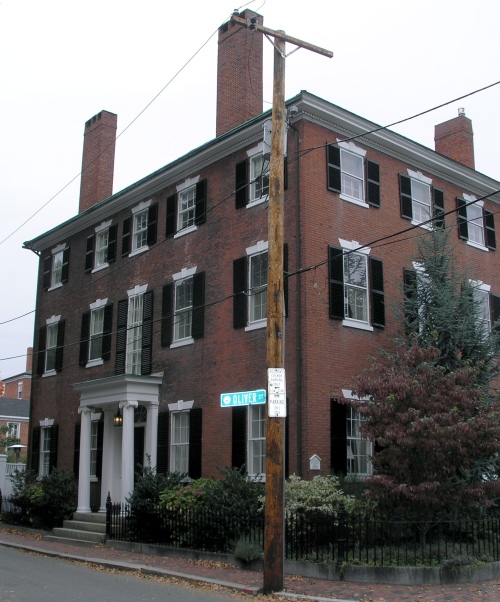
A double house with an unusual layout, the White-Silsbee/Hodges-Mott House is at 33-35 Washington Square North in Salem, between Oliver and Winter Streets. The section on the west, or left, side was built first, c.1811, by Joshua Upham for Joseph White, Jr., whose brother Stephen lived next door. The house was sold by Joseph’s widow, Eliza, to the Silsbee family, whom owned it until 1880. The attached house on the east, or right, side was built c. 1840 for the Misses Hannah and Betsy Hodges and was purchased by John N. Mott in 1871. Both halves of the house were later owned by the Clark family in the twentieth century.

White-Lord House (1811)

by Dan/July 17, 2012/Federal, Houses, Salem

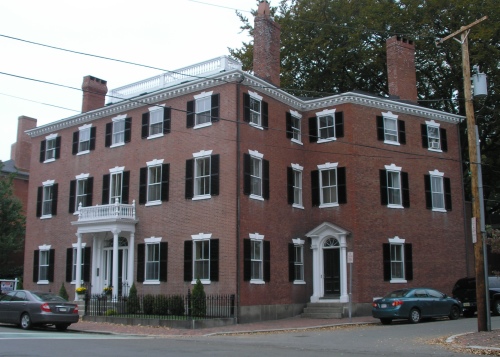
The Federal-period mansion at 31 Washington Square in Salem was built in about 1811 for Stephen White. It was also the home of merchants John W. Rogers (from 1831 to 1844) and Thomas P. Pingree (from 1844 to 1858). Later owned by members of the Lord family and known as the White-Lord House, the mansion has a ell with an elaborate second entrance to the house facing Salem Common.

John T. Hilton House (1826)

by Dan/July 17, 2012/Boston, Federal, Houses

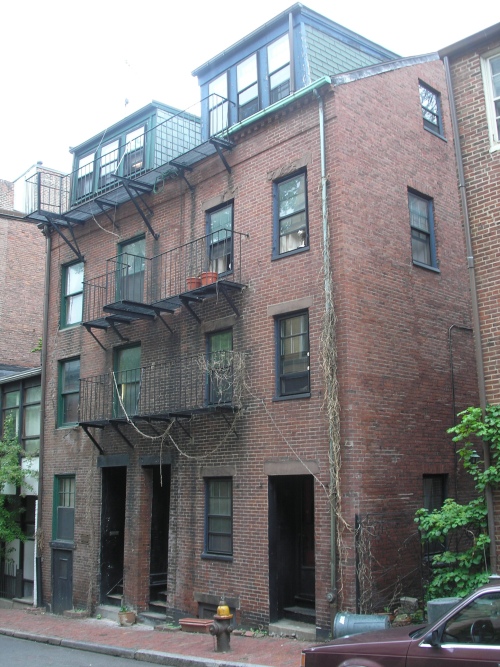
The house at 73 Joy Street in Beacon Hill in Boston was built in 1825-1826 for black hairdresser and musician John B. Holmes. The house is named for John Telemachus Hilton (1801-1864) (pdf), also a hairdresser, who was a Grand Master of the Prince Hall Masonic Lodge, a founder of the Massachusetts General Colored Association, a member of the Boston Vigilance Committee and on the Board of Managers of the Anti-Slavery Society. Hilton only briefly lived in the house, which is also associated with the brothers, Anthony F. Clark (who lived there) and Jonas W. Clark (who used it as a rental property). The house is also one of several boardinghouses owned by John R. Taylor, who is known to have assisted fugitive slaves. [For more info, see this Document]

William Oakes House (1878)

by Dan/July 4, 2012/Houses, Natick, Queen Anne

The house at 43 Eliot Street in South Natick was built in in 1878 for William Oakes. It is believed to occupy the site of an apple orchard planted for Rev. Oliver Peabody by the Natick Praying Indians.

Posts navigation

Older posts
Newer posts
Privacy Policy

Categories

  • Architectural Style (943)
    • Art Deco (9)
    • Byzantine (3)
    • Colonial (177)
    • Colonial Revival (85)
    • Craftsman (6)
    • Egyptian Revival (1)
    • Federal (190)
    • Foursquare (6)
    • Gothic (67)
    • Greek Revival (100)
    • Italianate (82)
    • Mission Revival (2)
    • Mission/Spanish Colonial (1)
    • Modern (2)
    • Neoclassical (56)
    • Octagon (3)
    • Postmodern (1)
    • Queen Anne (46)
    • Renaissance Revival (26)
    • Romanesque Revival (53)
    • Second Empire (26)
    • Shingle Style (12)
    • Stick Style (13)
    • Tudor Revival (8)
    • Vernacular (49)
    • Victorian Eclectic (15)
  • Building Type (943)
    • Apartment Buildings (8)
    • Banks (18)
    • Churches (119)
    • Collegiate (32)
    • Commercial (102)
    • Hotels (16)
    • Houses (508)
    • Industrial (23)
    • Libraries (22)
    • Lighthouses (1)
    • Military (15)
    • Monuments (1)
    • Museums (12)
    • Organizations (39)
    • Outbuildings (17)
    • Public Buildings (50)
    • Schools (23)
    • Stations (5)
    • Synagogues (1)
    • Taverns (21)
    • Theaters (9)
  • Town (943)
    • Adams (11)
    • Agawam (4)
    • Amherst (50)
    • Boston (64)
    • Boylston (6)
    • Cambridge (30)
    • Clinton (21)
    • Concord (15)
    • Cummington (1)
    • Danvers (14)
    • Deerfield (31)
    • Gloucester (18)
    • Granville (10)
    • Great Barrington (2)
    • Hadley (9)
    • Hancock (15)
    • Harvard (32)
    • Holyoke (47)
    • Lenox (5)
    • Lexington (8)
    • Longmeadow (32)
    • Marblehead (40)
    • Marlborough (4)
    • Natick (22)
    • Newton (2)
    • Northampton (68)
    • Peabody (4)
    • Pittsfield (20)
    • Salem (110)
    • Saugus (4)
    • Sheffield (4)
    • South Hadley (8)
    • Southborough (8)
    • Southwick (4)
    • Springfield (67)
    • Stockbridge (19)
    • Stow (1)
    • Sturbridge (18)
    • Sudbury (7)
    • Waltham (11)
    • Watertown (1)
    • Wayland (8)
    • West Springfield (14)
    • Westfield (46)
    • Weston (2)
    • Worcester (26)
  • Uncategorized (1)

Recent Comments

  • Wilber Blackson on South Hadley
  • Tami Speiden on Stockbridge
  • DexGuru on Stockbridge

Tags

Alcott Amherst College Asher Benjamin Back Bay Baptist Beacon Hill Big E Black Heritage Trail bowfront Bulfinch Catholic Congregational Episcopal Freedom Trail Gambrel H.H. Richardson Harvard Hawthorne Historic Deerfield Isaac Damon lit Longfellow mansard Methodist Mount Holyoke Museum Museums NPS Old Sturbridge Village PEM Revolutionary War row houses saltbox Samuel McIntire Shakers Smith College SPNEA Springfield Armory Stephen C. Earle Storrowton Underground Railroad UU Washington William Fenno Pratt Witch Trials

Meta

  • Log in
  • Entries feed
  • Comments feed
  • WordPress.org
Proudly powered by WordPress | Theme: ShowMe by NEThemes.