Historic Buildings of Massachusetts

  • About
  • Index by Town
  • CT
  • About
  • Index by Town
  • CT

Category: Italianate

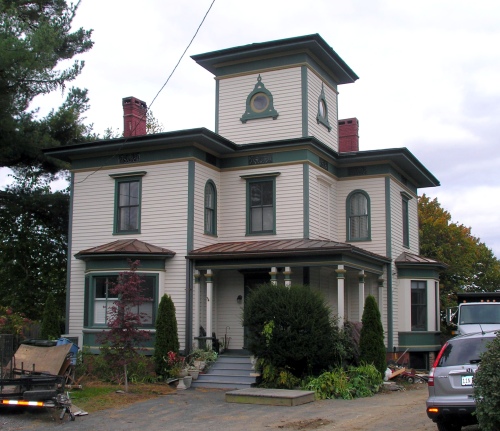
109 Bridge Street, Northampton (1875)
by Dan/December 14, 2011/Houses, Italianate, Northampton

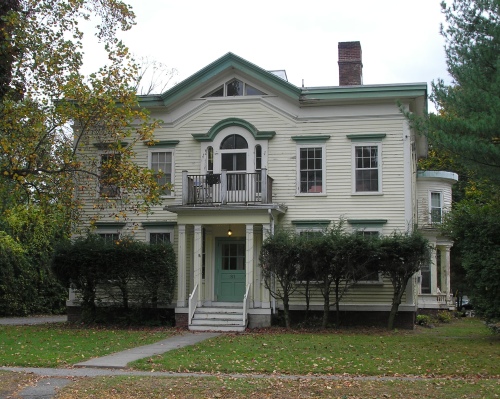
The house at 109 Bridge Street in Northampton is a fine example of an Italianate-style residence. It resembles an earlier Italianate house, designed by William F. Pratt and built in 1856 on nearby Pomeroy Terrace [the William Lawrence House, which burned down in 1982], but the Bridge Street house dates to much later, around 1875.
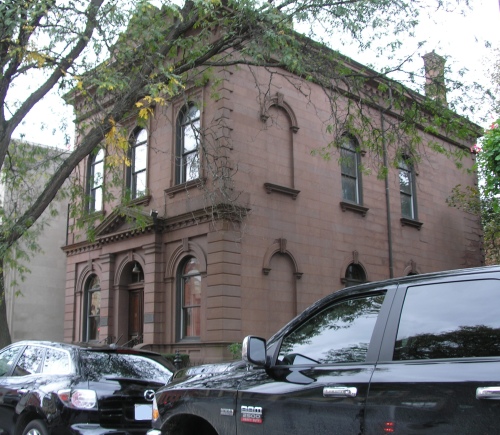
Smith Charities (1851)

by Dan/December 4, 2011/Italianate, Northampton, Organizations

At 51 Main Street in Northampton is an 1851 sandstone Italianate building designed by William Fenno Pratt. The building is home to Smith Charities, an organization which aids indigent children and women. As explained in the American Journal of Education, Vol. 27, No. 7, (July 1877):

This large and comprehensive system or charities was founded by Oliver Smith, Esq., of Hatfield, who died Dec. 22, 1845. His estate was valued, at the time of his death, at $370,000. In his will, he directed that a board of trustees should be constituted in the following manner: The towns of Northampton, Hadley, Hatfield, Amherst, and Williamsburg, in Hampshire County, and Deerfield, Greenfield, and Whately, in Franklin County, shall choose at each annual meeting a person who shall be called an elector. The electors were to choose three persons who should constitute a board of trustees, who were to have the control and management of all the funds.

Some of Smith’s heirs contested his will, resulting in a trial in July 1847. As the above article relates, “Two days were occupied in the trial, Rufus Choate arguing the case for the heirs-at-law, and Daniel Webster for the will. The courthouse was crowded to overflowing, and ladders were put up to the windows, so eager were the people to see and hear the great orators.” As described in Early Northampton (1914):

The heirs—among them Austin Smith (a nephew of Oliver Smith and a brother of Sophia Smith, founder of Smith College)—wished to break the will, claiming that while the law required three competent witnesses to such a document, only two of the witnesses of the Oliver Smith will were in fit condition to sign it. Oliver Smith, another of the heirs, also a nephew of Oliver Smith, Sr., and executor of the will, determined, against his own interests, to uphold it, and engaged Daniel Webster, with Judge Forbes as junior counsel. Charles Delano was also retained—the latter two being Northampton lawyers. Webster, by his remarkable personality and brilliancy, and by his judicious handling of the witnesses, gained the case, in spite of the utmost efforts of his able antagonist, Mr. Choate.

74 Bridge Street, Northampton (1866)

by Dan/November 28, 2011/Houses, Italianate, Northampton

Designed by William F. Pratt, the house at 74 Bridge Street in Northampton was built in 1866 as the First Parish parsonage. It was later owned by the Shepard, Parsons and Damon families and was an inn. Today, it is the Historic College Inn of Northampton.

Stebbins-Lathrop House (1790)

by Dan/November 12, 2011November 11, 2011/Houses, Italianate, Northampton

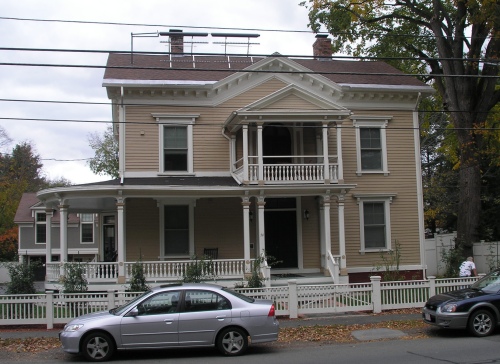
The house at 81 Bridge Street in Northampton was built in 1790 by Asahel Wright and was sold to James Bull in 1809. It was later owned by a physician, Dr. Daniel Stebbins. Through his correspondence with missionaries in China, Dr. Stebbins was one of the earliest people in the area to import silkworm eggs in 1842. Stebbins had 12 acres of mulberry trees behind his home and he and his daughters fed the leaves to the worms. Dr. Stebbins brought a silk weaver from Lyons, France to weave his family’s silk. After Dr. Stebbins’ death in 1859, his daughter Clarissa resided in the house with her husband, Henry Lathrop. They hired the architect William F. Pratt to redesign the originally Federal-style house in the fashionable Italianate style, an altered appearance it maintains today.

Elizabeth Avery Talmadge House (1858)

by Dan/October 25, 2011/Houses, Italianate, Westfield

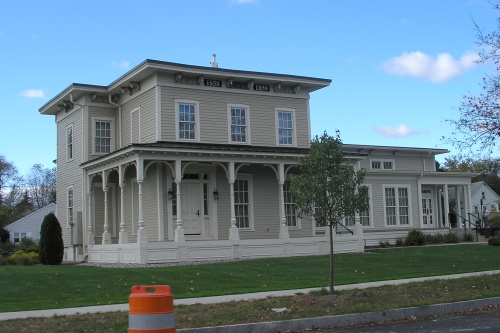
In 2007, the former residence at 85 Broad Street in Westfield began conversion into a branch of the Easthampton Savings Bank, earning an Historical Preservation Award for Adaptive Reuse in 2009. The Historical Commission website and a newspaper article from that year call the building the Elizabeth Avery Talmadge House and date it to the early twentieth century (c.1910). The house, though, is in the Italianate style, which was popular decades earlier and also has the dates 1858 and 1859 prominently displayed on the roof cornice. Additionally, Elizabeth Avery Talmadge, for whom the house was named, had died in 1904. Elisha Talmadge, her husband, however died in 1858, which further supports a construction date for a house named for his widow in 1858-1859.

Barrett Hall, Amherst College (1860)

by Dan/September 9, 2011/Amherst, Collegiate, Greek Revival, Italianate

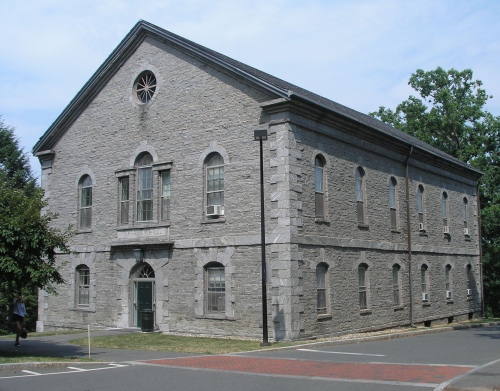
Barrett Hall, on the campus of Amherst College, was built as Barrett Gymnasium in 1859-1860. Amherst College had the first department of Physical Education in the country. Constructed of Pelham granite, the gymnasium was designed by Boston architect Charles E. Parkes and was named for Dr. Benjamin Barrett of Northampton, who made the largest financial contribution towards building and fully equipping it. The building served as a gym until Pratt Gymnasium was built in 1883. In 1907, Barrett Hall was converted to become the home of the modern languages department.

Morgan Hall, Amherst College (1853)

by Dan/September 6, 2011/Amherst, Collegiate, Italianate

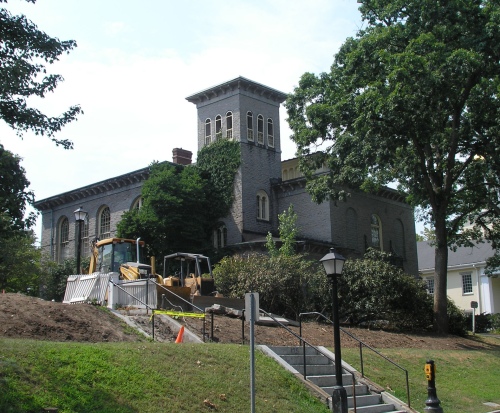
Morgan Hall, on South Pleasant Street in Amherst, was built in 1852-1853 and was Amherst College’s first library building. Designed by Henry Sykes, it was the campus’ first building made of stone. It was expanded in 1882-1883, at which time the building was officially named for New York Banker, Henry T. Morgan. Melvil Dewey served as Acting Librarian from 1874 to 1877, during which time he applied his decimal library classification system to the college’s collection. William Isaac Fletcher, Librarian from 1883 to 1911, was a nationally known bibliographer, educator and author of Public Libraries in America (1894). With the construction of the Converse Memorial Library in 1917, Morgan Hall was converted to classroom nd administrative use (it houses several college departments). In 1960, Astronomy Department’s Bassett Planetarium was installed, the gift of Preston Rogers Bassett. On the lower floor of Morgan Hall is a cannon from the 1862 Civil War Battle of New Bern, North Carolina. It is a memorial to President William A. Stearns‘ son Frazar Stearns, who was killed in the battle.

Posts navigation

Older posts
Newer posts
Privacy Policy

Categories

  • Architectural Style (943)
    • Art Deco (9)
    • Byzantine (3)
    • Colonial (177)
    • Colonial Revival (85)
    • Craftsman (6)
    • Egyptian Revival (1)
    • Federal (190)
    • Foursquare (6)
    • Gothic (67)
    • Greek Revival (100)
    • Italianate (82)
    • Mission Revival (2)
    • Mission/Spanish Colonial (1)
    • Modern (2)
    • Neoclassical (56)
    • Octagon (3)
    • Postmodern (1)
    • Queen Anne (46)
    • Renaissance Revival (26)
    • Romanesque Revival (53)
    • Second Empire (26)
    • Shingle Style (12)
    • Stick Style (13)
    • Tudor Revival (8)
    • Vernacular (49)
    • Victorian Eclectic (15)
  • Building Type (943)
    • Apartment Buildings (8)
    • Banks (18)
    • Churches (119)
    • Collegiate (32)
    • Commercial (102)
    • Hotels (16)
    • Houses (508)
    • Industrial (23)
    • Libraries (22)
    • Lighthouses (1)
    • Military (15)
    • Monuments (1)
    • Museums (12)
    • Organizations (39)
    • Outbuildings (17)
    • Public Buildings (50)
    • Schools (23)
    • Stations (5)
    • Synagogues (1)
    • Taverns (21)
    • Theaters (9)
  • Town (943)
    • Adams (11)
    • Agawam (4)
    • Amherst (50)
    • Boston (64)
    • Boylston (6)
    • Cambridge (30)
    • Clinton (21)
    • Concord (15)
    • Cummington (1)
    • Danvers (14)
    • Deerfield (31)
    • Gloucester (18)
    • Granville (10)
    • Great Barrington (2)
    • Hadley (9)
    • Hancock (15)
    • Harvard (32)
    • Holyoke (47)
    • Lenox (5)
    • Lexington (8)
    • Longmeadow (32)
    • Marblehead (40)
    • Marlborough (4)
    • Natick (22)
    • Newton (2)
    • Northampton (68)
    • Peabody (4)
    • Pittsfield (20)
    • Salem (110)
    • Saugus (4)
    • Sheffield (4)
    • South Hadley (8)
    • Southborough (8)
    • Southwick (4)
    • Springfield (67)
    • Stockbridge (19)
    • Stow (1)
    • Sturbridge (18)
    • Sudbury (7)
    • Waltham (11)
    • Watertown (1)
    • Wayland (8)
    • West Springfield (14)
    • Westfield (46)
    • Weston (2)
    • Worcester (26)
  • Uncategorized (1)

Recent Comments

  • Wilber Blackson on South Hadley
  • Tami Speiden on Stockbridge
  • DexGuru on Stockbridge

Tags

Alcott Amherst College Asher Benjamin Back Bay Baptist Beacon Hill Big E Black Heritage Trail bowfront Bulfinch Catholic Congregational Episcopal Freedom Trail Gambrel H.H. Richardson Harvard Hawthorne Historic Deerfield Isaac Damon lit Longfellow mansard Methodist Mount Holyoke Museum Museums NPS Old Sturbridge Village PEM Revolutionary War row houses saltbox Samuel McIntire Shakers Smith College SPNEA Springfield Armory Stephen C. Earle Storrowton Underground Railroad UU Washington William Fenno Pratt Witch Trials

Meta

  • Log in
  • Entries feed
  • Comments feed
  • WordPress.org
Proudly powered by WordPress | Theme: ShowMe by NEThemes.