Historic Buildings of Massachusetts

  • About
  • Index by Town
  • CT
  • About
  • Index by Town
  • CT

Category: Italianate

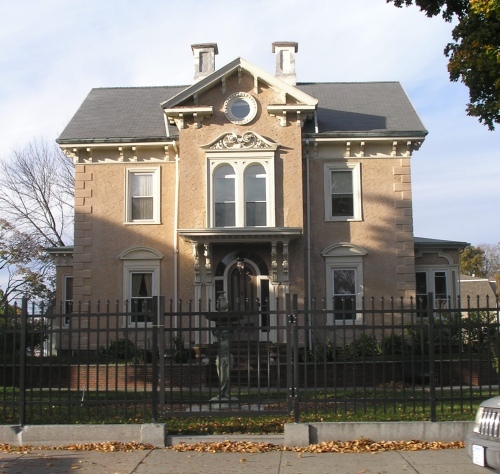
Dr. Royal S. Warren House (1851)
by Dan/November 9, 2012/Houses, Italianate, Waltham

The house at 519 Main Street in Waltham was built between 1851 and 1853 by Royal S. Warren.

According to Vol. III of the History of Middlesex County, Massachusetts, with Biographical Sketches of Many of its Pioneers and Prominent Men (1890):

Royal S. Warren, M.D., was born in Alstead, N. H., in 1822, and received his degree from Harvard in 1846. He settled in Waltham in 1847, and commanded a large practice, till, in 1865, he met with a railroad accident from no fault of his. While crossing the Fitchburg Railroad at Moody Street he was run into and terribly injured. He was confined to his house for about a year, and barely escaped with his life. He was permanently disabled. In 1868 and 1869 he represented Waltham in the Legislature. He also served on the School Committee. He removed to Colorado Springs, Colorado, in 1880, where he has since resided.

After Dr. Warren moved in 1880, the house was owned by his in-laws, who rented it. By 1915, the house was acquired by St. Peter’s School and then served as St. Joseph’s Parish Rectory. The parish was closed in 2004.
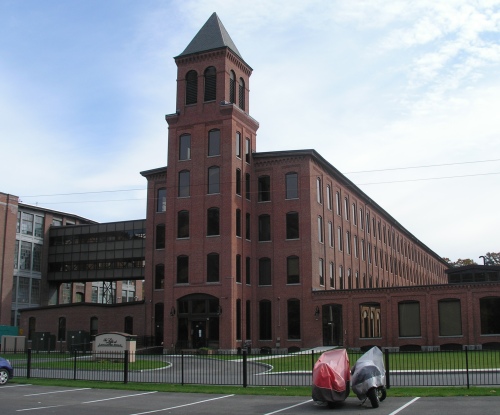
Lancaster Mills Company, Mill No.7 (1870)

by Dan/November 1, 2012October 29, 2012/Clinton, Industrial, Italianate

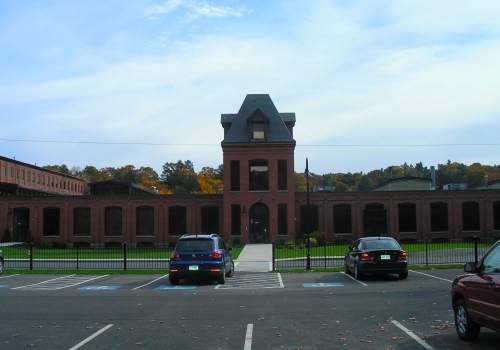
Erastus and Horatio Bigelow ended their involvement in the management of the Lancaster Mills Company in Clinton (producers of gingham cloth) in 1849. The new manager, Franklin Forbes, oversaw the erection of new buildings, including Mill No. 7 (Carding Mill, also labeled in 1929 as Ring Spinning), which was built between 1857 and 1870. It has a six-story tower added c. 1879-1898. Mill No. 7 is connected to Mill No. 1. The mills closed in 1931. For several decades the buildings were owned by Colonial Press and then were used by other companies. Recently, they have been renovated as condominiums, the Lofts at Lancaster Mills. Continue reading “Lancaster Mills Company, Mill No.7 (1870)”

Lancaster Mills Company, Mill No.1 (1844)

by Dan/November 1, 2012October 29, 2012/Clinton, Industrial, Italianate

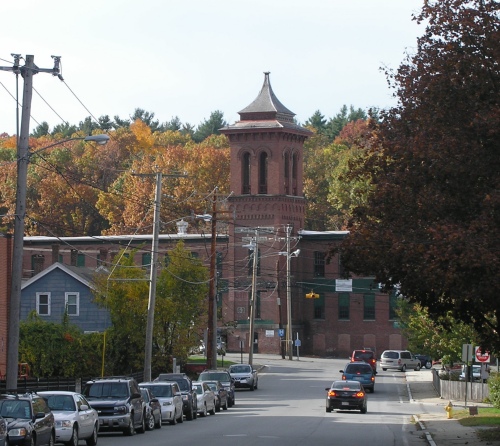
The brothers, Erastus and Horatio Bigelow, whose carpet company built the mills in Clinton discussed in my last two posts, were also founders of the Lancaster Mills Company, which produced checked gingham textiles. In the early 1840s, Erastus Bigelow had developed a power loom to mechanize the production of cotton checked cloth. In 1844, the Lancaster Mills Company was established and it soon built a complex of mill buildings at the head of the Wachusett Reservoir on a site bounded to the south and west by the Nashua River. The complex is dominated by the massive Mill No. 1 (Weaving Mill), which is only one-story high, but covers a large area. It was originally a single immense room, lighted by skylights. It was built in 1844-1849 and was expanded to the north in 1879-1898, when the current entrance, below a two-story brick tower with a pyramidal roof, was constructed. The image above depicts that later entrance. The building is notable as an early example of a large-scale industrial building designed to house a horizontal manufacturing process. In 1899, it became the first textile mill to be powered entirely by electric generators. The Lancaster Mills Company was the nation’s largest producer of gingham cloth. In later years, the Lancaster Mills buildings became part of the sprawling campus of Colonial Press. In 2011, part of the complex was renovated to become the Lofts at Lancaster Mills. Continue reading “Lancaster Mills Company, Mill No.1 (1844)”

Bigelow Carpet Mill (1886)

by Dan/November 1, 2012October 29, 2012/Clinton, Industrial, Italianate, Romanesque Revival

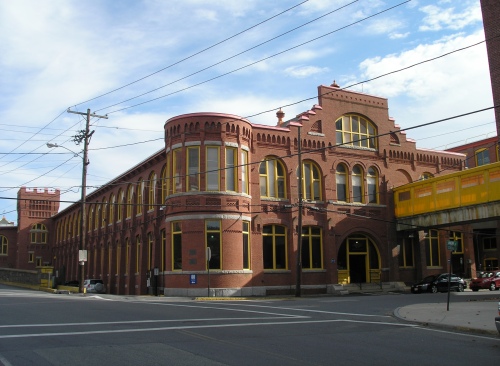
The Bigelow brothers, Erastus and Horatio, had established the Bigelow Carpet Company in 1854. A number of mill buildings were constructed along Union Street in Clinton the 1850s. The company grew rapidly and soon constructed another group of woolen mills along Main Street in 1864-1866. After the death of Erastus Bigelow in 1879, the company continued to expand and soon developed the property on Union Street, constructing a new mill building and rebuilding the earlier structures to create an architecturally unified complex. After the mill closed in 1932, these buildings were used as a warehouse and were partially vacant. In the 1970s, the Nylon Products Company (Nypro) rehabilitated the structures for their own manufacturing use.

The building pictured above was built in 1886. The tower to the rear, on the left side of the picture, is part of another building, which is attached to the 1886 building. It was originally constructed in 1855 and was rebuilt in 1885. Continue reading “Bigelow Carpet Mill (1886)”

Bigelow Carpet Company Woolen Mill (1864)

by Dan/November 1, 2012October 29, 2012/Clinton, Industrial, Italianate

In 1837, two brothers arrived in Clinton and soon established the Clinton Company, which manufactured cotton, woolen and silk goods. Erastus Bigelow (1814-1879) was a mechanical genius and self-educated inventor who created a series of power looms that were the world’s first machines for weaving carpets. His brother, Horatio N. Bigelow (1812-1868), was the company’s business manager and a civic leader in the development of Clinton, which grew rapidly as industry expanded in town. The brothers went on to incorporate the Bigelow Carpet Company in 1854. The new company purchased the old property of the Clinton Company in 1863, which included an earlier mill (c. 1810) where the brothers had started their operations in Clinton. The company initiated a major building program, constructing new mills on the property, including the building pictured above, which has an elaborate five-story tower. It was built in 1864-1866, as a wool spinning and carpet weaving mill. Continue reading “Bigelow Carpet Company Woolen Mill (1864)”

Noah Strong House (1873)

by Dan/October 26, 2012/Houses, Italianate, Organizations, Victorian Eclectic, Westfield

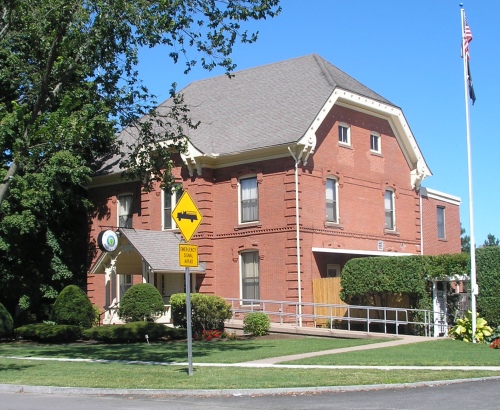
The house at 38 Broad Street in Westfield was built in 1873 by Noah Strong, a local contractor. The architecture of the house reflects an amalgam of styles. The town purchased the house in 1909 to use it as a vocational school. For Westfield’s 250th Anniversary celebration in 1919, the building was used for “The Hostess House and Loan Exhibit,” under the direction of the art committee of the Women’s Club of Westfield. According to The History of the Celebration of the Two Hundred and Fiftieth Anniversary of the Incorporation of the Town of Westfield Massachusetts, August 31, September 1, 2, 5, 1919:

Here tea was served every day to thousands of guests, who were received by hostesses in quaint, old costumes.

The rooms of the house were arranged for the occasion in a colonial style with many antiques, early portraits and family heirlooms on display. A “Museum Room” featured relics of past wars, including the recently concluded First World War. In 1920, American Legion Post 124 began leasing the building from the city and purchased it in 1962. The second floor was made into a meeting hall in 1928.

First Congregational Church of Westfield (1860)

by Dan/October 14, 2012December 28, 2016/Churches, Italianate, Westfield

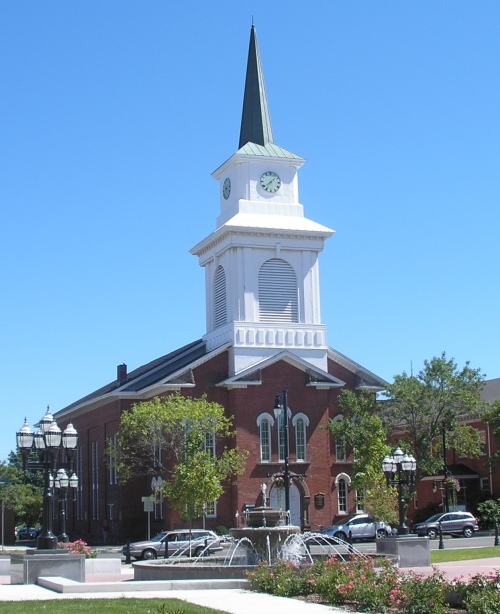
The First Congregational Church of Westfield, located on Broad Street across from Westfield Green, is an impressive Italianate edifice. It is the church’s fourth meeting house. The first was built around 1673 and the second around 1720. The latter building burned in 1803 and was replaced in 1805 by a new meeting house, called the Bulfinch Church because of its Charles Bulfinch-derived design. According to Vol. 2 of Lockwood’s Westfield and its Historic Influences (1922):

The old Bulfinch church building was purchased by Hon. William G. Bates, moved to a lot back of its old location, and, the steeple having been taken down, used for carriage making and other purposes for many years, until destroyed by fire.

The present church building was erected in 1860, with L. F. Thayer as architect and George Green as builder. The efficient work of the latter was so highly appreciated when completed that the society voted him a gift of $500.

The original steeple was damaged in a windstorm on February 27, 1886, when it was torn off and crashed into the church. It was replaced by an extremely elaborate second steeple, which was in turn replaced by the current steeple, erected in 1962. Continue reading “First Congregational Church of Westfield (1860)”

Posts navigation

Older posts
Newer posts
Privacy Policy

Categories

  • Architectural Style (943)
    • Art Deco (9)
    • Byzantine (3)
    • Colonial (177)
    • Colonial Revival (85)
    • Craftsman (6)
    • Egyptian Revival (1)
    • Federal (190)
    • Foursquare (6)
    • Gothic (67)
    • Greek Revival (100)
    • Italianate (82)
    • Mission Revival (2)
    • Mission/Spanish Colonial (1)
    • Modern (2)
    • Neoclassical (56)
    • Octagon (3)
    • Postmodern (1)
    • Queen Anne (46)
    • Renaissance Revival (26)
    • Romanesque Revival (53)
    • Second Empire (26)
    • Shingle Style (12)
    • Stick Style (13)
    • Tudor Revival (8)
    • Vernacular (49)
    • Victorian Eclectic (15)
  • Building Type (943)
    • Apartment Buildings (8)
    • Banks (18)
    • Churches (119)
    • Collegiate (32)
    • Commercial (102)
    • Hotels (16)
    • Houses (508)
    • Industrial (23)
    • Libraries (22)
    • Lighthouses (1)
    • Military (15)
    • Monuments (1)
    • Museums (12)
    • Organizations (39)
    • Outbuildings (17)
    • Public Buildings (50)
    • Schools (23)
    • Stations (5)
    • Synagogues (1)
    • Taverns (21)
    • Theaters (9)
  • Town (943)
    • Adams (11)
    • Agawam (4)
    • Amherst (50)
    • Boston (64)
    • Boylston (6)
    • Cambridge (30)
    • Clinton (21)
    • Concord (15)
    • Cummington (1)
    • Danvers (14)
    • Deerfield (31)
    • Gloucester (18)
    • Granville (10)
    • Great Barrington (2)
    • Hadley (9)
    • Hancock (15)
    • Harvard (32)
    • Holyoke (47)
    • Lenox (5)
    • Lexington (8)
    • Longmeadow (32)
    • Marblehead (40)
    • Marlborough (4)
    • Natick (22)
    • Newton (2)
    • Northampton (68)
    • Peabody (4)
    • Pittsfield (20)
    • Salem (110)
    • Saugus (4)
    • Sheffield (4)
    • South Hadley (8)
    • Southborough (8)
    • Southwick (4)
    • Springfield (67)
    • Stockbridge (19)
    • Stow (1)
    • Sturbridge (18)
    • Sudbury (7)
    • Waltham (11)
    • Watertown (1)
    • Wayland (8)
    • West Springfield (14)
    • Westfield (46)
    • Weston (2)
    • Worcester (26)
  • Uncategorized (1)

Recent Comments

  • Wilber Blackson on South Hadley
  • Tami Speiden on Stockbridge
  • DexGuru on Stockbridge

Tags

Alcott Amherst College Asher Benjamin Back Bay Baptist Beacon Hill Big E Black Heritage Trail bowfront Bulfinch Catholic Congregational Episcopal Freedom Trail Gambrel H.H. Richardson Harvard Hawthorne Historic Deerfield Isaac Damon lit Longfellow mansard Methodist Mount Holyoke Museum Museums NPS Old Sturbridge Village PEM Revolutionary War row houses saltbox Samuel McIntire Shakers Smith College SPNEA Springfield Armory Stephen C. Earle Storrowton Underground Railroad UU Washington William Fenno Pratt Witch Trials

Meta

  • Log in
  • Entries feed
  • Comments feed
  • WordPress.org
Proudly powered by WordPress | Theme: ShowMe by NEThemes.