Historic Buildings of Massachusetts

  • About
  • Index by Town
  • CT
  • About
  • Index by Town
  • CT

Category: Italianate

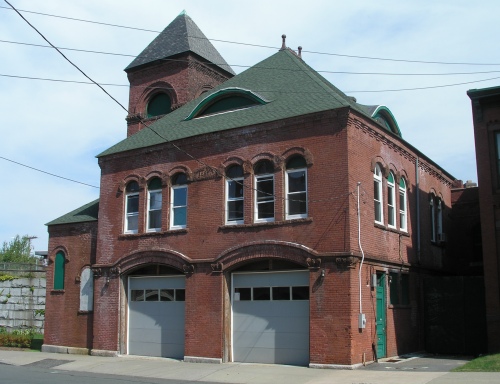
Mt. Tom Engine House (1887)
by Dan/August 12, 2015August 12, 2015/Holyoke, Italianate, Organizations, Public Buildings

Mt. Tom Hose Company

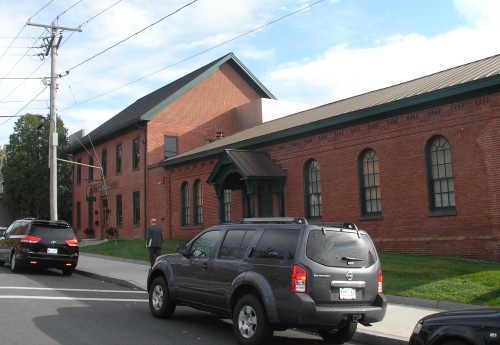
At 2 Canal Street in Holyoke is the fire station built in 1887 for the Mt. Tom Hose Company, No. 1, the city’s first volunteer fire-fighting force, which had been established in 1851. The building was later known as Fire Station No. 4.
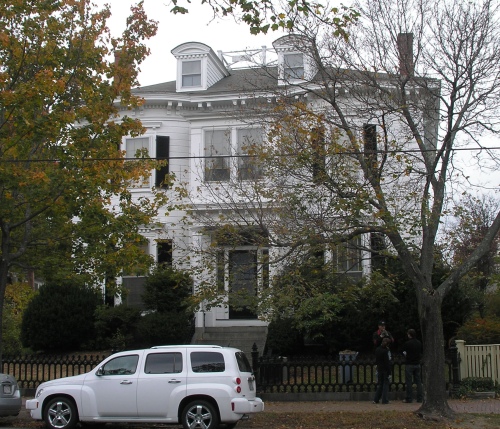
Emery S. Johnson House (1853)

by Dan/August 2, 2015August 2, 2015/Houses, Italianate, Salem

Emery S. Johnson House

Emery S. Johnson was a Salem merchant and shipmaster. An Italianate house was erected for him at 360 Essex Street in Salem in 1853. The house was deigned by Salem architects William H. Emmerton and Joseph C. Foster.

Parks Building (1873)

by Dan/May 21, 2015May 21, 2015/Commercial, Italianate, Westfield

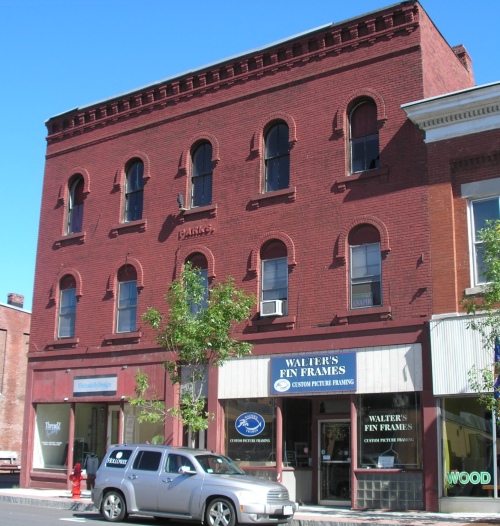
Parks Building (1873)

Oren B. Parks operated a grocery store in Westfield and became a successful businessman and civic leader in the late nineteenth century. He played a major role in developing the Northside section of Westfield. Around 1873 he built the three-story commercial building at 57-59 North Elm Street to accommodate his expanding business.

Museum of Russian Icons (1853, 1859, 2006)

by Dan/January 28, 2015/Clinton, Commercial, Industrial, Italianate, Museums, Organizations, Victorian Eclectic

Museum of Russian Icons

The building at 203 Union Street in Clinton was constructed in 1853 to house the Bigelow Mechanics Institute. This institution was founded in 1846. As described in History of the Origin of the Town of Clinton, Massachusetts, 1653-1865 (1896), by Andrew E. Ford:

April 14, 1846, a petition was made to a justice of peace by H. N. Bigelow, J. R. Stewart, L. F. Bancroft, J. B. Parker, Sanborn Worthen, A. S. Carleton and G. H. Kendall, representing that those gentlemen were “desirous of forming an association for the purpose of mutual improvement and for the further purpose of extending improvement to and throughout the village in which they reside, and the neighborhood with which they are more immediately connected, by sustaining courses of lectures upon the sciences and their connection with the mechanical arts, by sustaining, if their means shall allow it, a school for scientific instruction and education in those branches more immediately connected with their employment, and the collection of a library, a reading room and a repository of ‘models and drawings of useful machines and mechanical inventions.” In answer to this petition, a warrant was issued for a meeting for the purpose of organizing an association with these ends in view.

[. . .] The preamble of the constitution presented and adopted offers a broader basis of organization than was suggested in the petition, namely: “In order to promote our mutual improvement in literature, science and the mechanical arts; —to diffuse a taste for literary, scientific and mechanical pursuits in the community in which we reside;—and to develop the social, moral and intellectual natures with which we arc endowed by one Creator.”

The society took the name “The Bigelow Mechanics’ Institute in Clintonville.” E. B. Bigelow, in whose honor this name had been assumed, in addition to other donations, gave to the society as a recognition of his esteem, the valuable air pump, now used by the Clinton High School, and two hundred dollars to be used for the good of the Institute. A fee of five dollars was charged for membership, and some forty men joined.

At various times, from 1853 to 1873, the Institute also rented out space in the building to the postal service, to the Town of Clinton for its armory and to local businesses. Next door to the Institute, the building at 195 Union Street was built in 1859 to serve as Horatio N. Bigelow‘s private office. The brothers, Horatio N. and Erastus B. Bigelow developed Clinton as an industrial community.

In 1873, the Bigelow Mechanics Institute disbanded and its library was donated to the town to become the Bigelow Free Public Library. The Institute’s old building became a tenement. The adjacent building, H. N. Bigelow’s former office, served as the the Second District Court of Eastern Worcester County from 1886 to 1972, and its basement was the Clinton Police Station until 1969. Both buildings later served as law offices. In recent years the complex has undergone an extensive transformation to house the Museum of Russian Icons, founded in 2006 by art collector and industrialist Gordon B. Lankton. A contemporary, aluminum-clad addition to the museum was constructed in 2008.

Berkshire County Courthouse (1871)

by Dan/August 5, 2014August 5, 2014/Italianate, Pittsfield, Public Buildings

Berkshire County Courthouse

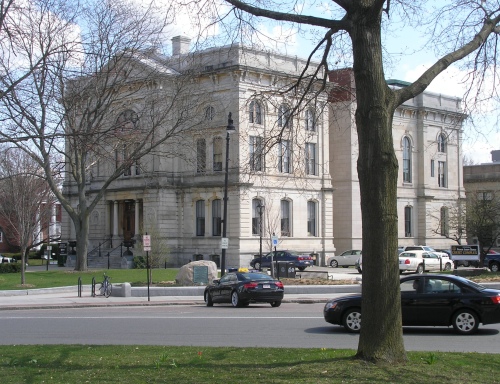
The Berkshire County Courthouse, located at 76 East Street in Pittsfield, was built circa 1868-1871, after the county seat was moved from Lenox in 1868. Constructed of local white marble, the building has been occupied since September, 1871.

Old Draper Hotel (1871)

by Dan/May 7, 2014May 7, 2014/Commercial, Hotels, Italianate, Northampton

Old Draper Hotel

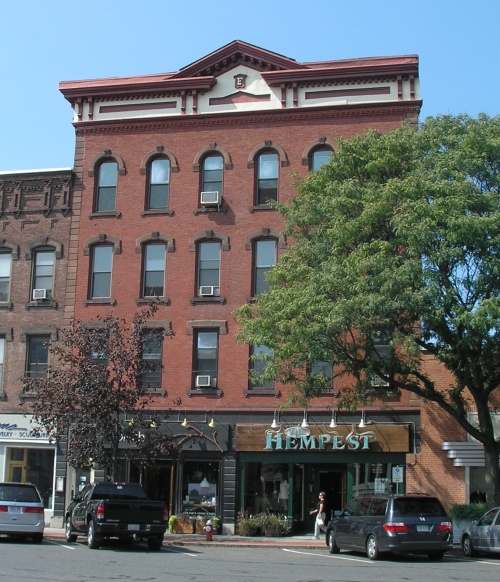
The Warner House, also known as the Warner Tavern or Warner’s Coffee House, was for years the most popular public house in Northampton. After it was destroyed by fire in 1870, a new building, planned by J.M. Miner, was constructed on its former location on Main Street. Called the Fitch Hotel, it consisted of a central block flanked by two wings. Only the westernmost wing survives today. It features an “F” monogram in the center of the roof pediment of the façade. The hotel, located at 179 Main Street, later became the Draper Hotel. The hotel is described in an article (“Industrial Northampton”) that appeared in Western New England (Vol. I, No. 11, October, 1911):

Northampton is unusually well-equiped, for a city of its size, with high-class hotels and restaurants. The Draper, the most prominent hotel in Northampton, is favorably known throughout the country as a result of its entertaining well the people from almost everywhere who are drawn to Northampton by college exercises and by business affairs. The Draper compares favorably in quality with hotels in large cities. The rathskeller is particularly well known among men who have occasion to visit Northampton. The hotel aims to provide its patrons with whatever they wish and to its excellent dining room and rathskeller has recently been added a “self-service” restaurant and lunch room where one may get a wholesome meal in a short time and at small cost. The Draper offers both American and European rates.

Clark Block, Worcester (1854)

by Dan/November 6, 2013November 6, 2013/Commercial, Italianate, Worcester

Clark Block

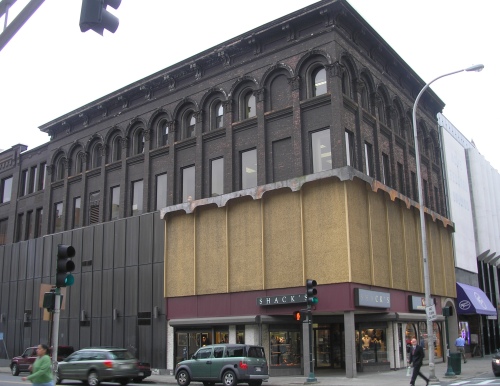
The Clark Block, located at 401-409 Main Street in Worcester (not to be confused with the Clark Building at 492 Main Street, which does not survive today), was built in 1854 for William Clark to plans by Elbridge Boyden. For many years it remained one of the grandest buildings in the city, housing many institutions and businesses. In the 1850s, the adjacent Richmond and Piper Blocks were constructed. J.H. Walker acquired the Clark Block in 1884 and built an addition on the Mechanics Street side of the building. The Clark Block originally had a facade of thirteen bays along Main Street, but six of these (as well as the adjoining Richmond and Piper Blocks) have been covered over. The first two floors of the remaining bays have also been covered, leaving only part of the original facade visible.

Posts navigation

Older posts
Newer posts
Privacy Policy

Categories

  • Architectural Style (943)
    • Art Deco (9)
    • Byzantine (3)
    • Colonial (177)
    • Colonial Revival (85)
    • Craftsman (6)
    • Egyptian Revival (1)
    • Federal (190)
    • Foursquare (6)
    • Gothic (67)
    • Greek Revival (100)
    • Italianate (82)
    • Mission Revival (2)
    • Mission/Spanish Colonial (1)
    • Modern (2)
    • Neoclassical (56)
    • Octagon (3)
    • Postmodern (1)
    • Queen Anne (46)
    • Renaissance Revival (26)
    • Romanesque Revival (53)
    • Second Empire (26)
    • Shingle Style (12)
    • Stick Style (13)
    • Tudor Revival (8)
    • Vernacular (49)
    • Victorian Eclectic (15)
  • Building Type (943)
    • Apartment Buildings (8)
    • Banks (18)
    • Churches (119)
    • Collegiate (32)
    • Commercial (102)
    • Hotels (16)
    • Houses (508)
    • Industrial (23)
    • Libraries (22)
    • Lighthouses (1)
    • Military (15)
    • Monuments (1)
    • Museums (12)
    • Organizations (39)
    • Outbuildings (17)
    • Public Buildings (50)
    • Schools (23)
    • Stations (5)
    • Synagogues (1)
    • Taverns (21)
    • Theaters (9)
  • Town (943)
    • Adams (11)
    • Agawam (4)
    • Amherst (50)
    • Boston (64)
    • Boylston (6)
    • Cambridge (30)
    • Clinton (21)
    • Concord (15)
    • Cummington (1)
    • Danvers (14)
    • Deerfield (31)
    • Gloucester (18)
    • Granville (10)
    • Great Barrington (2)
    • Hadley (9)
    • Hancock (15)
    • Harvard (32)
    • Holyoke (47)
    • Lenox (5)
    • Lexington (8)
    • Longmeadow (32)
    • Marblehead (40)
    • Marlborough (4)
    • Natick (22)
    • Newton (2)
    • Northampton (68)
    • Peabody (4)
    • Pittsfield (20)
    • Salem (110)
    • Saugus (4)
    • Sheffield (4)
    • South Hadley (8)
    • Southborough (8)
    • Southwick (4)
    • Springfield (67)
    • Stockbridge (19)
    • Stow (1)
    • Sturbridge (18)
    • Sudbury (7)
    • Waltham (11)
    • Watertown (1)
    • Wayland (8)
    • West Springfield (14)
    • Westfield (46)
    • Weston (2)
    • Worcester (26)
  • Uncategorized (1)

Recent Comments

  • Wilber Blackson on South Hadley
  • Tami Speiden on Stockbridge
  • DexGuru on Stockbridge

Tags

Alcott Amherst College Asher Benjamin Back Bay Baptist Beacon Hill Big E Black Heritage Trail bowfront Bulfinch Catholic Congregational Episcopal Freedom Trail Gambrel H.H. Richardson Harvard Hawthorne Historic Deerfield Isaac Damon lit Longfellow mansard Methodist Mount Holyoke Museum Museums NPS Old Sturbridge Village PEM Revolutionary War row houses saltbox Samuel McIntire Shakers Smith College SPNEA Springfield Armory Stephen C. Earle Storrowton Underground Railroad UU Washington William Fenno Pratt Witch Trials

Meta

  • Log in
  • Entries feed
  • Comments feed
  • WordPress.org
Proudly powered by WordPress | Theme: ShowMe by NEThemes.