Historic Buildings of Massachusetts

  • About
  • Index by Town
  • CT
  • About
  • Index by Town
  • CT

Category: Second Empire

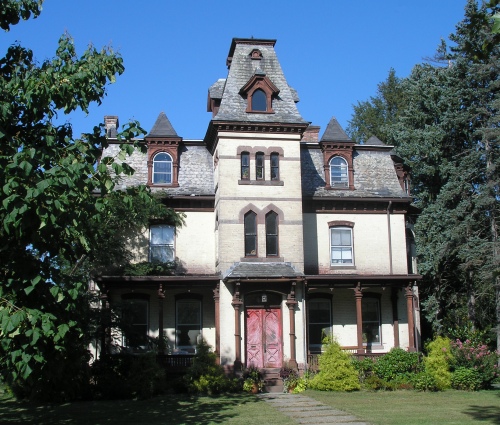
E. N. Childs House (1868)
by Dan/June 4, 2013/Houses, Second Empire, Worcester

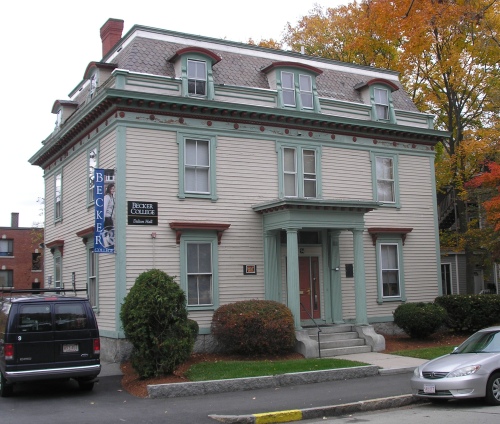
E. N. Childs House

The E. N. Childs House is a French Second Empire-style house at 54 West Street in Worcester. It was constructed circa 1868. Childs was a boot manufacturer. As related in Charles G. Washburn’s Industrial Worcester (1917):

In 1853 E. N. Childs came to Worcester from Millbury, and engaged in business with Albert Gould for one year. In 1854 Albert S. Brown became a partner. They did business as Childs & Brown until 1857, when Mr. Brown retired, and A. G. Walker was admitted under the firm of E. N. Childs & Co. In 1862 Mr. Walker retired and Mr. Childs continued under the same firm name until 1881. During the preceding few years his sons were interested with him in the business.

The house is now owned by Becker College. In the past it was a dormitory, but now it houses the Maintenance offices.
Holyoke Water Power Company Office (1875)

by Dan/October 19, 2012October 19, 2012/Commercial, Holyoke, Industrial, Second Empire

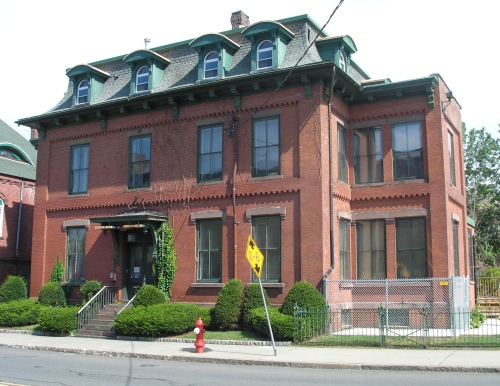
The building at 1 Canal Street in Holyoke was built in the early 1870s to serve as an office for the Holyoke Water Power Company. Incorporated in 1859, the company took control of the property of the Hadley Falls Company, which had first begun construction of the dam and canal system that powered Holyoke’s industries. Originally a one-story structure, between 1875 and 1885 the building’s bellcast mansard roof with dormer windows was raised and a second level added. A number of additions were made to the building in later years to serve the company’s expanding operations.

Citizens’ Hall (1870)

by Dan/October 17, 2012/Public Buildings, Schools, Second Empire, Stockbridge

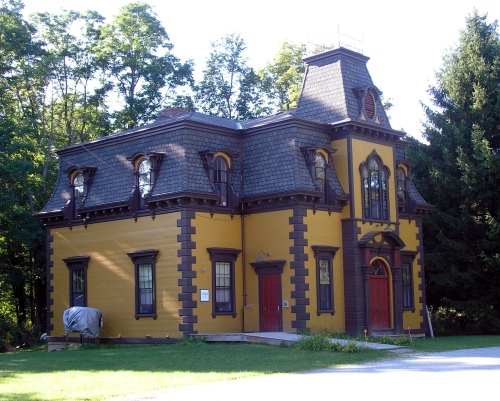
Citizens’ Hall is a mansard-roofed Second Empire building located in the former industrial village of Curtisville, now called Interlaken, in the town of Stockbridge. Designed by Charles T. Rathburn, Citizens’ Hall was built in 1870 as a district schoolhouse, with a public meeting hall on the second floor. Used less frequently as a meeting place after the town’s district schools were consolidated, the building was restored in the 1970s by Old Curtisville, Inc. (pdf). IS183, a non-profit community art school founded in 1991, leased Citizens’ Hall before merging with Old Curtisville, Inc. in 2005. As the building‘s new owners, IS183 completed exterior repairs in May, 2009.

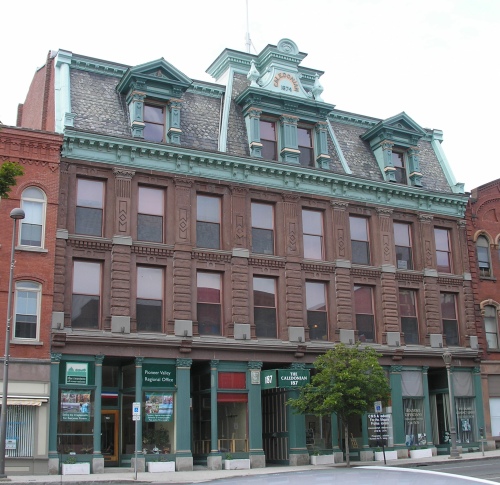
Caledonian Building (1874)

by Dan/October 10, 2012/Commercial, Holyoke, Organizations, Second Empire

The Caledonian Building, located at 185-193 High Street in Holyoke, was built in 1874 as the Crafts Block by Roswell P. Crafts, a businessman who served as mayor of Holyoke. The eclectic building combines a French Second Empire Mansard roof, two floors fronted in brownstone and a ground level that utilizes cast iron pieces purchased from the Architectural Iron Works of New York. Starting in 1879, the Caledonian Benefit Club, a group of Scots immigrants, used the building’s fourth-floor concert hall for their meetings. In 1907, the Club purchased the building from the Crafts estate.

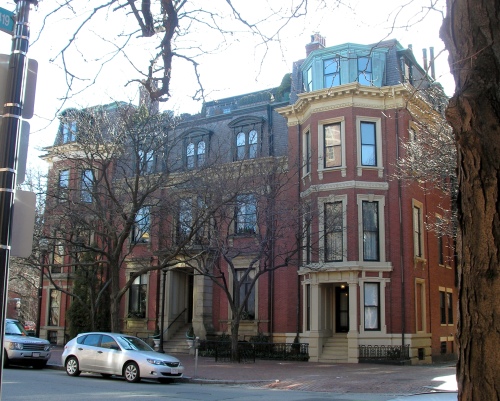
326-328 Dartmouth Street, Boston (1871)

by Dan/September 23, 2012/Boston, Houses, Second Empire

The Cushing-Endicott House, at 163 Marlborough Street in Boston, is considered one of the Back Bay‘s greatest architectural achievements. Designed in the French Academic Style, it was built in 1871 of brick, with Nova Scotia sandstone trim, for Thomas F. Cushing by the firm of Snell and Gregerson. The house later served as the home of William C. Endicott, secretary of war under President Grover Cleveland. In 1903, John Singer Sargent used one of the bedrooms as his studio. The house is now divided into condominiums. The house is joined to two neighboring houses, one with an interesting T-shape interior plan, which are located around the corner at 326–328 Dartmouth Street and have a similar architectural style.

W.T. Clement House (1860)

by Dan/September 19, 2012/Houses, Northampton, Second Empire

In 1860-1861, Northampton manufacturer W.T. Clement built a brick house at what is now 289 Elm Street. In 1879, he sold the house to A.S. Wood, who hired architect William Fenno Pratt to make improvements to building in the form of mansard roofs and a tower.

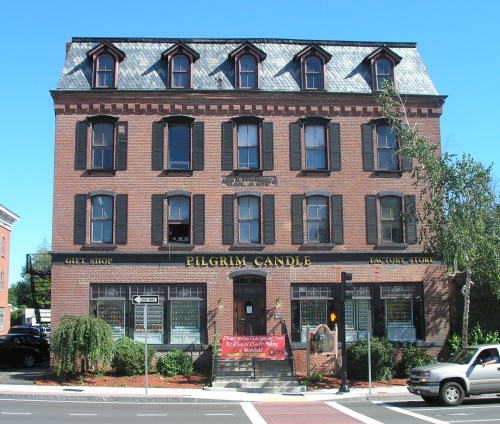
Buschmann’s Block (1873)

by Dan/September 7, 2012/Commercial, Second Empire, Westfield

John C. Buschmann emigrated from Germany to the United States in 1852 and moved from Feeding Hills to Westfield in 1857. He established a wholesale tobacco business in 1860 and soon built the Railroad House Hotel (later replaced by the Bismarck Hotel) in Depot Square in Westfield. In 1873, he built Buschmann’s Block at 36 Union Avenue in Dept Square. He used the building as a warehouse and offices for his tobacco and other businesses, which included coal, wood and ice. Buschmann’s Block later became a whip manufacturing plant, a furniture store and then a flower shop. In 1995, the building became home to Pilgrim Candle, which expanded to include the Bismarck Hotel building next door in 2001.

Posts navigation

Older posts
Newer posts
Privacy Policy

Categories

  • Architectural Style (943)
    • Art Deco (9)
    • Byzantine (3)
    • Colonial (177)
    • Colonial Revival (85)
    • Craftsman (6)
    • Egyptian Revival (1)
    • Federal (190)
    • Foursquare (6)
    • Gothic (67)
    • Greek Revival (100)
    • Italianate (82)
    • Mission Revival (2)
    • Mission/Spanish Colonial (1)
    • Modern (2)
    • Neoclassical (56)
    • Octagon (3)
    • Postmodern (1)
    • Queen Anne (46)
    • Renaissance Revival (26)
    • Romanesque Revival (53)
    • Second Empire (26)
    • Shingle Style (12)
    • Stick Style (13)
    • Tudor Revival (8)
    • Vernacular (49)
    • Victorian Eclectic (15)
  • Building Type (943)
    • Apartment Buildings (8)
    • Banks (18)
    • Churches (119)
    • Collegiate (32)
    • Commercial (102)
    • Hotels (16)
    • Houses (508)
    • Industrial (23)
    • Libraries (22)
    • Lighthouses (1)
    • Military (15)
    • Monuments (1)
    • Museums (12)
    • Organizations (39)
    • Outbuildings (17)
    • Public Buildings (50)
    • Schools (23)
    • Stations (5)
    • Synagogues (1)
    • Taverns (21)
    • Theaters (9)
  • Town (943)
    • Adams (11)
    • Agawam (4)
    • Amherst (50)
    • Boston (64)
    • Boylston (6)
    • Cambridge (30)
    • Clinton (21)
    • Concord (15)
    • Cummington (1)
    • Danvers (14)
    • Deerfield (31)
    • Gloucester (18)
    • Granville (10)
    • Great Barrington (2)
    • Hadley (9)
    • Hancock (15)
    • Harvard (32)
    • Holyoke (47)
    • Lenox (5)
    • Lexington (8)
    • Longmeadow (32)
    • Marblehead (40)
    • Marlborough (4)
    • Natick (22)
    • Newton (2)
    • Northampton (68)
    • Peabody (4)
    • Pittsfield (20)
    • Salem (110)
    • Saugus (4)
    • Sheffield (4)
    • South Hadley (8)
    • Southborough (8)
    • Southwick (4)
    • Springfield (67)
    • Stockbridge (19)
    • Stow (1)
    • Sturbridge (18)
    • Sudbury (7)
    • Waltham (11)
    • Watertown (1)
    • Wayland (8)
    • West Springfield (14)
    • Westfield (46)
    • Weston (2)
    • Worcester (26)
  • Uncategorized (1)

Recent Comments

  • Wilber Blackson on South Hadley
  • Tami Speiden on Stockbridge
  • DexGuru on Stockbridge

Tags

Alcott Amherst College Asher Benjamin Back Bay Baptist Beacon Hill Big E Black Heritage Trail bowfront Bulfinch Catholic Congregational Episcopal Freedom Trail Gambrel H.H. Richardson Harvard Hawthorne Historic Deerfield Isaac Damon lit Longfellow mansard Methodist Mount Holyoke Museum Museums NPS Old Sturbridge Village PEM Revolutionary War row houses saltbox Samuel McIntire Shakers Smith College SPNEA Springfield Armory Stephen C. Earle Storrowton Underground Railroad UU Washington William Fenno Pratt Witch Trials

Meta

  • Log in
  • Entries feed
  • Comments feed
  • WordPress.org
Proudly powered by WordPress | Theme: ShowMe by NEThemes.