Historic Buildings of Massachusetts

  • About
  • Index by Town
  • CT
  • About
  • Index by Town
  • CT

Category: Romanesque Revival

Odd Fellows’ Building, Natick (1888)
by Dan/September 2, 2010/Commercial, Natick, Organizations, Romanesque Revival

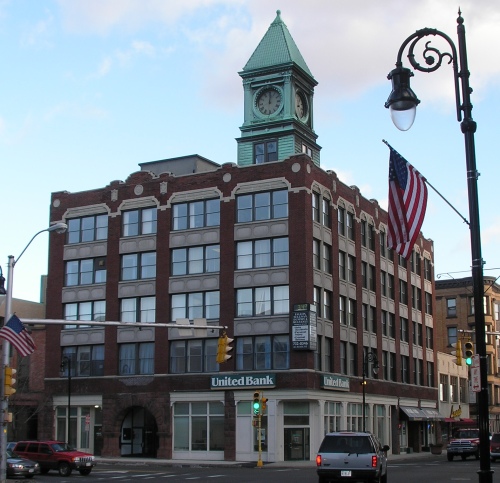
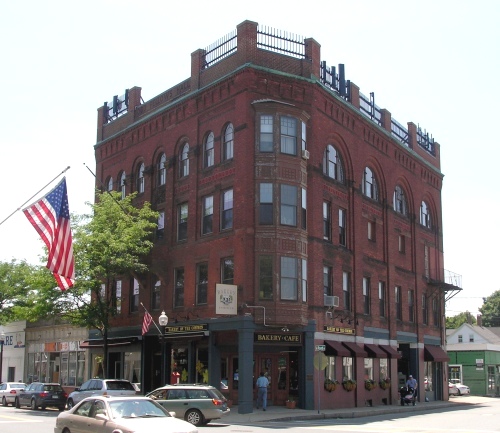
The Tackawanbait Lodge of the Independent Order of Odd Fellows in Natick was named for the town’s Native American minister, Reverend Daniel Takawambpait. Founded in 1845, the Lodge utilized the upper floors of the Odd Fellows’ Building, constructed in 1887-1888 on the corner of Main and Pond Streets off Natick’s Town Common. The Richardsonian Romanesque Odd Fellow’s Block, designed by Ernest N. Boyden of Boston, continues to have retail space on the ground floors. According to the History of Middlesex County, Vol. I (1890), “The first story on Main Street is of iron and plate-glass, while on Pond Street it is of brick and plate-glass. The remaining three stories are constructed of brick with Long Meadow sand-stone trimmings.”
Walcott Building, Natick (1888)

by Dan/September 1, 2010/Commercial, Natick, Organizations, Romanesque Revival

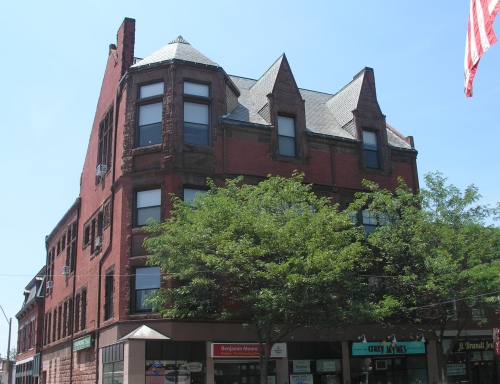
The last building to be constructed in the aftermath of the 1874 Natick fire is the Walcott Building, also known as the Desban Building, built in 1888 in the Richardsonian Romanesque style. It replaced the Walcott shoe factory on the same site, at the corner of Main and Summer Streets, which burned in 1874. Again quoting from the History of Middlesex County, Vol. I (1890):

The new block is by far the most beautiful and elaborately finished structure in Natick. The lower story on Main Street is constructed of iron and plate-glass, and on Summer street of red sandstone. The upper stories are of brick, with sandstone trimmings. The staircase to the second story is wholly of polished marble, while the flagging-stones of the two fronts are very large and costly stones from the Hudson River Valley, perfectly cut and fitted in the best possible manner. On the lower floor, at the corner, is the spacious, well-lighted and finely decorated store of Leamy & Tilton, with a large stock of new dry-goods and small wares. On the same floor is the Bay State Clothing Store of Hastings & Lowell. On the second floor are six rooms for offices, with a large hall. Above are the elegant quarters of the Red Men, comprising a room for the ladies of the order with ante-rooms.; also the large hall for the society’s gatherings, and their banqueting-hall, with tables and a kitchen and pantry, furnished with ranges and crockery. The walls throughout have been treated with fresco or beautifully-tinted paints, and the entire establishment would be deemed ornamental in any city of our land.

Granville Public Library (1902)

by Dan/June 3, 2010June 3, 2010/Granville, Libraries, Romanesque Revival

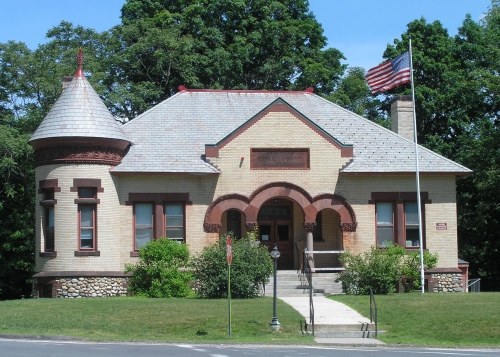
The libraries designed by Hartford architect George Keller are considered by some to be the high points of his career. Like the libraries he had designed earlier for the Connecticut communities of Norfolk (1888) and Ansonia (1892), Keller’s plan for the Granville Public Library is in the Richardsonian Romanesque style. The building, which opened in 1902, features a rubble foundation, yellow brick construction with red sandstone, round tower and slate hip roof. Keller may have been influenced by the design of the library in Shelton, Connecticut, designed by Charles T. Beardsley, which also used yellow brick and was in turn influenced by Keller’s Ansonia Library. The Granville Library was founded after Milton B. Whitney of Westville, originally from Granville, donated $5,000, a sum which was added to by donations solicited by the women of the Granville Literary Club.

North Congregational Church, Springfield (1873)

by Dan/July 27, 2009January 22, 2020/Churches, Romanesque Revival, Springfield

Hispanic Baptist Church

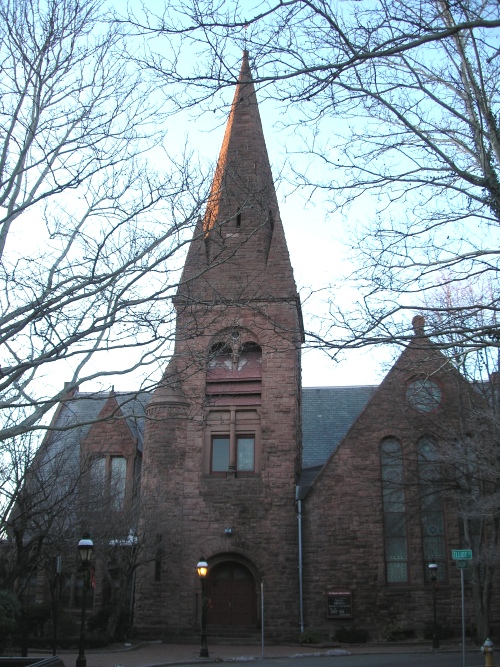
In 1868, H.H. Richardson won a commission to design the North Congregational Church in Springfield. Originally intended to be built where the congregation’s preceding church building was located, the plans for construction did not go through until a new site had been purchased, on the corner of Salem and Mattoon Streets in 1871, and the initial plan had been revised. Built in 1872 to 1873, the church was constructed of red Longmeadow sandstone and was one of Richardson‘s first works in the Romanesque style. The North Congregational Society disbanded in 1935 and the church was sold and renamed Grace Baptist Church. It is now called the Hispanic Baptist Church. UPDATE: The church was later called the Cristian Biblical Church and then Iglesia Apostolica Renovacion. The building was for sale in 2019.

Stonehurst, the Robert Treat Paine Estate (1886)

by Dan/July 16, 2009December 30, 2012/Houses, Romanesque Revival, Second Empire, Shingle Style, Victorian Eclectic, Waltham

Stonehurst

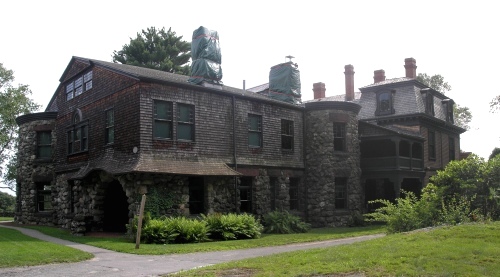
Stonehurst was the country house of Robert Treat Paine, Jr., a lawyer, housing reformer and great grandson of a signer of the Declaration of Independence. Located in Waltham, the earliest part of the house was a Second Empire building, designed by Gridley James Fox Bryant and constructed in 1866 for Paine and his wife, Lydia Lyman Paine. This house was moved to a new site atop a ridge and a large addition in the Shingle style was designed by the architect H.H. Richardson. Begun in 1884, the project was almost complete when Richardson died in 1886. In collaboration with Richardson was the great landscape architect, Frederick Law Olmsted. The organic relationship of the completed house and the landscape is a notable feature of what is considered to be an architectural masterpiece. The estate was given to the City of Waltham and is open to the public.

Old Masonic Building, Springfield (1893)

by Dan/February 10, 2009January 21, 2020/Commercial, Organizations, Romanesque Revival, Springfield

masonic-building.jpg

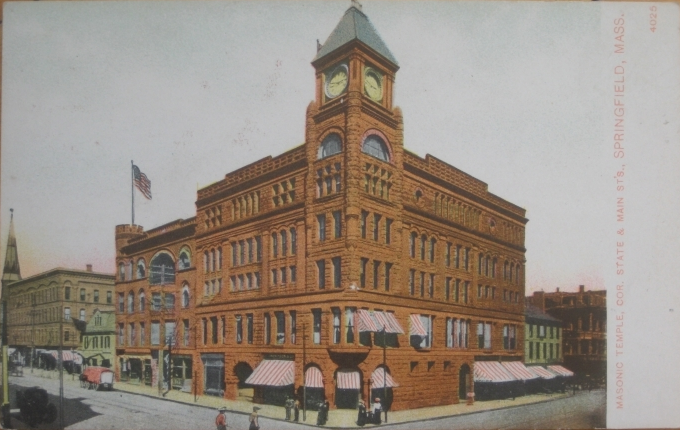
The old Masonic Building, at the corner of Main and State Streets in Springfield was perhaps built around 1893, as a volume entitled, Masonic Building, Springfield, Mass, “Authority of Committee on Dedication,” was published that year. The building once had a brownstone facade in the Richardsonian Romanesque style which has since been completely removed. A new Masonic Temple building on State Street was built in the Classical Revival style in 1924.

Hampden County Courthouse (1874)

by Dan/February 7, 2009December 30, 2012/Public Buildings, Romanesque Revival, Springfield

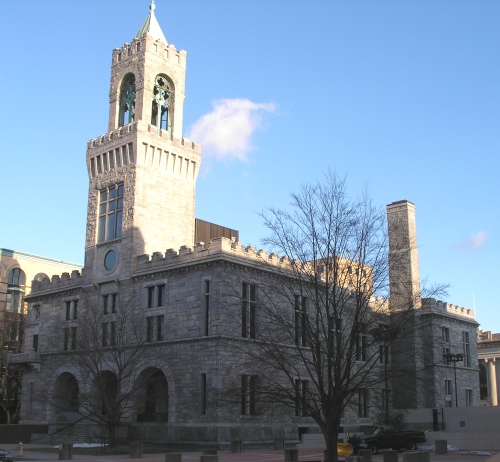
Built between 1871 and 1874, the Hampden County Courthouse was designed by H.H. Richardson and represents a stage in the development of his distinctive style. Located on Elm Street in Springfield, the structure replaced an earlier courthouse of 1822. In the 1860s, the county commissioners had resisted popular pressure to construct a new courthouse, but when the commissioners were threatened with an indictment in 1869 for not safekeeping deeds and public records in fireproof rooms, they relented and a new building was constructed. Between 1908 and 1912, a large addition was built, designed by the firm of Richardson’s successors, Shepley, Rutan and Coolidge.

Posts navigation

Older posts
Newer posts
Privacy Policy

Categories

  • Architectural Style (943)
    • Art Deco (9)
    • Byzantine (3)
    • Colonial (177)
    • Colonial Revival (85)
    • Craftsman (6)
    • Egyptian Revival (1)
    • Federal (190)
    • Foursquare (6)
    • Gothic (67)
    • Greek Revival (100)
    • Italianate (82)
    • Mission Revival (2)
    • Mission/Spanish Colonial (1)
    • Modern (2)
    • Neoclassical (56)
    • Octagon (3)
    • Postmodern (1)
    • Queen Anne (46)
    • Renaissance Revival (26)
    • Romanesque Revival (53)
    • Second Empire (26)
    • Shingle Style (12)
    • Stick Style (13)
    • Tudor Revival (8)
    • Vernacular (49)
    • Victorian Eclectic (15)
  • Building Type (943)
    • Apartment Buildings (8)
    • Banks (18)
    • Churches (119)
    • Collegiate (32)
    • Commercial (102)
    • Hotels (16)
    • Houses (508)
    • Industrial (23)
    • Libraries (22)
    • Lighthouses (1)
    • Military (15)
    • Monuments (1)
    • Museums (12)
    • Organizations (39)
    • Outbuildings (17)
    • Public Buildings (50)
    • Schools (23)
    • Stations (5)
    • Synagogues (1)
    • Taverns (21)
    • Theaters (9)
  • Town (943)
    • Adams (11)
    • Agawam (4)
    • Amherst (50)
    • Boston (64)
    • Boylston (6)
    • Cambridge (30)
    • Clinton (21)
    • Concord (15)
    • Cummington (1)
    • Danvers (14)
    • Deerfield (31)
    • Gloucester (18)
    • Granville (10)
    • Great Barrington (2)
    • Hadley (9)
    • Hancock (15)
    • Harvard (32)
    • Holyoke (47)
    • Lenox (5)
    • Lexington (8)
    • Longmeadow (32)
    • Marblehead (40)
    • Marlborough (4)
    • Natick (22)
    • Newton (2)
    • Northampton (68)
    • Peabody (4)
    • Pittsfield (20)
    • Salem (110)
    • Saugus (4)
    • Sheffield (4)
    • South Hadley (8)
    • Southborough (8)
    • Southwick (4)
    • Springfield (67)
    • Stockbridge (19)
    • Stow (1)
    • Sturbridge (18)
    • Sudbury (7)
    • Waltham (11)
    • Watertown (1)
    • Wayland (8)
    • West Springfield (14)
    • Westfield (46)
    • Weston (2)
    • Worcester (26)
  • Uncategorized (1)

Recent Comments

  • Wilber Blackson on South Hadley
  • Tami Speiden on Stockbridge
  • DexGuru on Stockbridge

Tags

Alcott Amherst College Asher Benjamin Back Bay Baptist Beacon Hill Big E Black Heritage Trail bowfront Bulfinch Catholic Congregational Episcopal Freedom Trail Gambrel H.H. Richardson Harvard Hawthorne Historic Deerfield Isaac Damon lit Longfellow mansard Methodist Mount Holyoke Museum Museums NPS Old Sturbridge Village PEM Revolutionary War row houses saltbox Samuel McIntire Shakers Smith College SPNEA Springfield Armory Stephen C. Earle Storrowton Underground Railroad UU Washington William Fenno Pratt Witch Trials

Meta

  • Log in
  • Entries feed
  • Comments feed
  • WordPress.org
Proudly powered by WordPress | Theme: ShowMe by NEThemes.