Historic Buildings of Massachusetts

  • About
  • Index by Town
  • CT
  • About
  • Index by Town
  • CT

Category: Federal

Silas Hastings Tavern (1818)
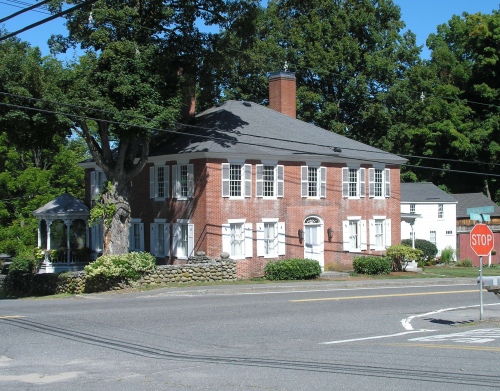
by Dan/October 17, 2013/Boylston, Federal, Taverns

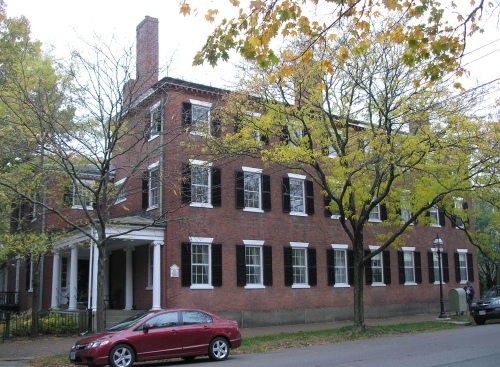
Silas Hastings Tavern

At 701 Main Street, near the town Common in Boylston, is a Federal-style building, believed to have been constructed with bricks made at the Boylston brickyard of Captain John Howe. The building, which has a large ball-room on the second floor, was built in 1818 by Silas Hastings (1780-1833), who operated it as an inn and tavern until his death. The tavern was then run by Hastings’ son-in-law, Elmer Loring, until his death in 1839. After that time, it ceased to be used as a tavern. It was sold by Loring’s widow, Mary-Martha Hastings Loring, (they had married in 1827) to Captain John Andrews in 1844.
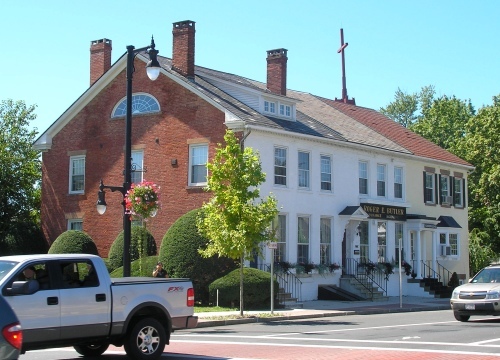
Morgan Block (1820)

by Dan/September 12, 2013September 12, 2013/Commercial, Federal, Westfield

Morgan Block, Westfield

The Morgan Block, 3-7 Court Street in Westfield, was built c. 1817-1820 by Major Archippus Morgan (1772-1857). Morgan operated a general store on the premises with his partner Martin Cowles and rented additional space for other shops. The YMCA’s first hall in Westfield opened in the building in 1866 (it was here for only three years). Sarah Morgan Way made alterations to the building later in the nineteenth century, adding the bay windows, dormer windows and entry door surrounds. The Morgan Block today houses various professional service offices.

Abbott Tavern (1800)

by Dan/September 9, 2013September 9, 2013/Boylston, Federal, Taverns

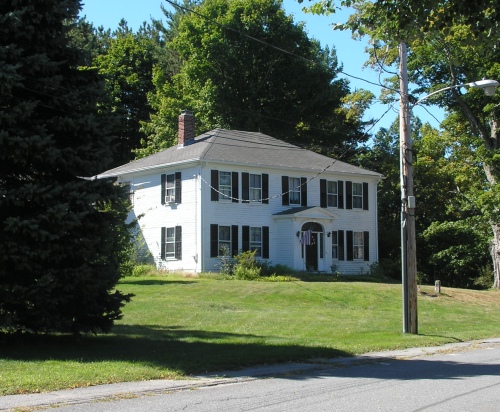
Abbott Tavern, Boylston

The building at 4 Church Street in Boylston, known as the Abbott Tavern or the Christian House, was built c. 1800 and perhaps has portions built earlier. The property was acquired in 1803 by Capt. Jason Abbott (1772-1843), who operated a tavern there from 1806 to 1809. He later became a blacksmith. Squire Aaron White (1771-1846) acquired the property between 1809 and 1812 and either rebuilt or, more likely, just remodeled the existing tavern to become his mansion house. His wife, Mary Avery White (1778-1860), was an abolitionist and a prolific diarist and letter-writer. Charles Bray of Boston, a building contractor, bought the building in 1863 and also remodeled it. In 1963, it was acquired by the First Congregational Church of Boylston for use as offices and meeting rooms. Continue reading “Abbott Tavern (1800)”

Daniel Dickinson House (1780)

by Dan/August 12, 2013/Federal, Hadley, Houses

Daniel Dickinson House

The first occupant of the house at 25 West Street in Hadley was Daniel Dickinson. He had married in 1779 and the house was built soon after. He also started a tannery that was continued by his son and grandson. Eliakim Smith, a local builder, worked on a shop & addition. The house remained in the Dickinson family until 1905.

Old Town Hall, Pittsfield (1832)

by Dan/July 3, 2013/Federal, Pittsfield, Public Buildings

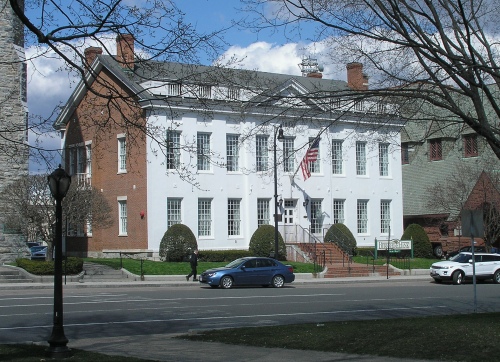
Old Town Hall, Pittsfield

The Old Town Hall of Pittsfield is a Federal-style brick structure located at 43 East Street. An earlier Town House had stood near here, where St. Stephen’s Episcopal Church stands today. The construction of the church in 1832 had led to the building of what is now the Old Town Hall, as related in J. E. A. Smith’s The History of Pittsfield, (Berkshire County,) Massachusetts, From the year 1800 to the year 1876 (1876):

In December, 1831, the Sun stated that the wardens had already contracted for a building of stone in the Gothic style, to be commenced in the following spring. From what the editors had heard, the Sun was “disposed to think that it would contribute much to the beauty of the village.” A difficulty, however, arose at the very outset. It was the desire of Mr. Newton and his associates, that the church should stand, where it was afterwards built, upon what is now the corner of Park place and School street; and they offered the town five hundred dollars for a lot of sufficient size at that point. But the site was already occupied in part by the town-house, in which the Central school-district claimed an interest by virtue of its occupancy of its lower story for a school-room. For this, and other reasons, Lemuel Pomeroy and other citizens, averse to change in the old order of things, opposed the sale, and the proposition was rejected by the town.

Upon this Mr. Newton announced his determination to erect the church on a portion of the grounds attached to his own residence, and adjoining that of Mr. Pomeroy. And here, in the spring of 1832, the contractors began to collect stone and other material. The danger of a chronic and bitter neighborhood feud was imminent; but it was happily avoided by a compromise offered by Mr. Pomeroy, who proposed that the difficulty should be surmounted by the erection of a new town-hall, and the purchase by St. Stephen’s parish, of the school-district’s interest in the old building.

Lemuel Pomeroy paid for the building of the new Town Hall, reserving the basement for his own use. His heirs sold their rights in the building to the town in 1882. The front and back facades of the Old Town Hall are stuccoed and scored at the corners to resemble quoining (masonry blocks at the corner of a wall). The building served as Town Hall from 1832 to 1891 and then as City Hall until 1968. Municipal offices then moved to the former Post Office building. In 1969-1970 the Old Town Hall was renovated to become a bank branch and offices.

Saunders-Saltonstall-Tuckerman Double House (1810)

by Dan/May 24, 2013/Federal, Houses, Salem

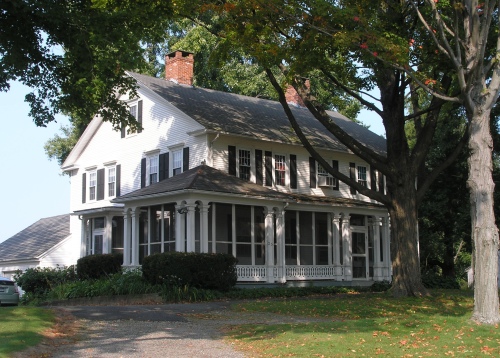
Saunders-Saltonstall-Tuckerman House

Thomas Saunders, who lived at 39 Chestnut Street in Salem, built a double house next door, at 41-43 Chestnut Street, in 1810-1811. It was a gift to his two daughters, Caroline (1793-1882) and Mary Elizabeth (1788-1858), who married two Saltonstall brothers. The western half was the home of Nathaniel (1784-1838) and Caroline’s family until 1880, after which it was owned by Charles Saunders into the twentieth century. Until 1851, the eastern half was home to Mary Elizabeth and her husband, Leverett Saltonstall (1783-1845), who was Salem’s first mayor, serving from 1836 to 1838. It was then home to the Tuckerman family until the end of the century. The porch on the western side is believed to be original, while the two-story wing and the porch on the eastern side date from 1838.

Brick Dwelling, Hancock Shaker Village (1830)

by Dan/May 7, 2013June 21, 2013/Apartment Buildings, Federal, Hancock, Houses, Outbuildings

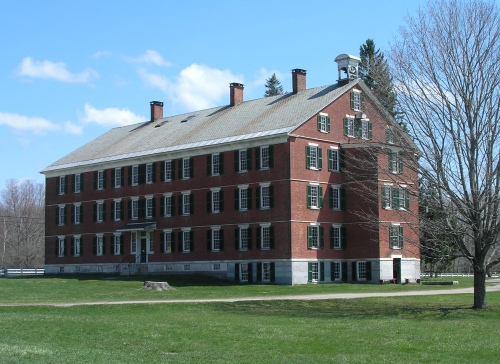
Brick Dwelling

The Brick Dwelling at Hancock Shaker Village replaced two earlier dwelling structures, dating to the 1790s. The Brick Dwelling was built in 1830-1831 and was designed by Elder William Deming. The building’s basement was used for the kitchen and food storage and the first floor contained various waiting rooms, with the large dining room and the meeting room at opposite ends. The upper floors contained the separated brethren and sisters retiring rooms (Elders and Eldresses retiring rooms were on the second floor). The restored Brick Dwelling can be visited as part of the Hancock Shaker Village museum.

Continue reading “Brick Dwelling, Hancock Shaker Village (1830)”

Posts navigation

Older posts
Newer posts
Privacy Policy

Categories

  • Architectural Style (943)
    • Art Deco (9)
    • Byzantine (3)
    • Colonial (177)
    • Colonial Revival (85)
    • Craftsman (6)
    • Egyptian Revival (1)
    • Federal (190)
    • Foursquare (6)
    • Gothic (67)
    • Greek Revival (100)
    • Italianate (82)
    • Mission Revival (2)
    • Mission/Spanish Colonial (1)
    • Modern (2)
    • Neoclassical (56)
    • Octagon (3)
    • Postmodern (1)
    • Queen Anne (46)
    • Renaissance Revival (26)
    • Romanesque Revival (53)
    • Second Empire (26)
    • Shingle Style (12)
    • Stick Style (13)
    • Tudor Revival (8)
    • Vernacular (49)
    • Victorian Eclectic (15)
  • Building Type (943)
    • Apartment Buildings (8)
    • Banks (18)
    • Churches (119)
    • Collegiate (32)
    • Commercial (102)
    • Hotels (16)
    • Houses (508)
    • Industrial (23)
    • Libraries (22)
    • Lighthouses (1)
    • Military (15)
    • Monuments (1)
    • Museums (12)
    • Organizations (39)
    • Outbuildings (17)
    • Public Buildings (50)
    • Schools (23)
    • Stations (5)
    • Synagogues (1)
    • Taverns (21)
    • Theaters (9)
  • Town (943)
    • Adams (11)
    • Agawam (4)
    • Amherst (50)
    • Boston (64)
    • Boylston (6)
    • Cambridge (30)
    • Clinton (21)
    • Concord (15)
    • Cummington (1)
    • Danvers (14)
    • Deerfield (31)
    • Gloucester (18)
    • Granville (10)
    • Great Barrington (2)
    • Hadley (9)
    • Hancock (15)
    • Harvard (32)
    • Holyoke (47)
    • Lenox (5)
    • Lexington (8)
    • Longmeadow (32)
    • Marblehead (40)
    • Marlborough (4)
    • Natick (22)
    • Newton (2)
    • Northampton (68)
    • Peabody (4)
    • Pittsfield (20)
    • Salem (110)
    • Saugus (4)
    • Sheffield (4)
    • South Hadley (8)
    • Southborough (8)
    • Southwick (4)
    • Springfield (67)
    • Stockbridge (19)
    • Stow (1)
    • Sturbridge (18)
    • Sudbury (7)
    • Waltham (11)
    • Watertown (1)
    • Wayland (8)
    • West Springfield (14)
    • Westfield (46)
    • Weston (2)
    • Worcester (26)
  • Uncategorized (1)

Recent Comments

  • Wilber Blackson on South Hadley
  • Tami Speiden on Stockbridge
  • DexGuru on Stockbridge

Tags

Alcott Amherst College Asher Benjamin Back Bay Baptist Beacon Hill Big E Black Heritage Trail bowfront Bulfinch Catholic Congregational Episcopal Freedom Trail Gambrel H.H. Richardson Harvard Hawthorne Historic Deerfield Isaac Damon lit Longfellow mansard Methodist Mount Holyoke Museum Museums NPS Old Sturbridge Village PEM Revolutionary War row houses saltbox Samuel McIntire Shakers Smith College SPNEA Springfield Armory Stephen C. Earle Storrowton Underground Railroad UU Washington William Fenno Pratt Witch Trials

Meta

  • Log in
  • Entries feed
  • Comments feed
  • WordPress.org
Proudly powered by WordPress | Theme: ShowMe by NEThemes.