Historic Buildings of Massachusetts

  • About
  • Index by Town
  • CT
  • About
  • Index by Town
  • CT

Category: Federal

Morgan-Way House (1817)
by Dan/May 16, 2014May 16, 2014/Federal, Houses, Westfield

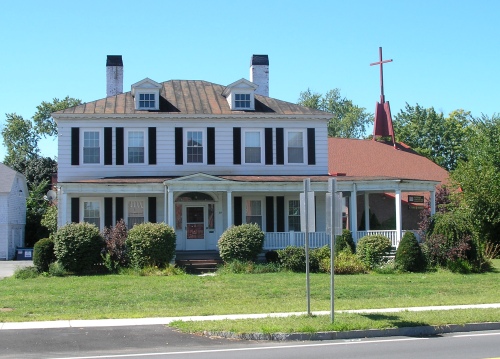
Morgan-Way House

Once thought to have been built in the 1780s by John Phelps, the house at 29 Broad Street in Westfield was actually built circa 1820 (perhaps as early as 1817) by Major Archippus Morgan (1772-1857), a merchant from Pittsfield. He also built the Morgan Block in Westfield. After Morgan‘s death in 1857, his widow, Parmelia Taylor Morgan, lived in the house until her death in 1867. The Way family owned the house from 1883 until 1944, when it was converted for use as a funeral home by Stanley and Donald Healey. In 1914, John T. Way had removed the house’s roof balustrade and added metal roofing, two dormer windows and a front porch. Continue reading “Morgan-Way House (1817)”
Reuben Whitcomb House & Store (1825)

by Dan/April 1, 2014/Colonial Revival, Commercial, Federal, Harvard, Houses

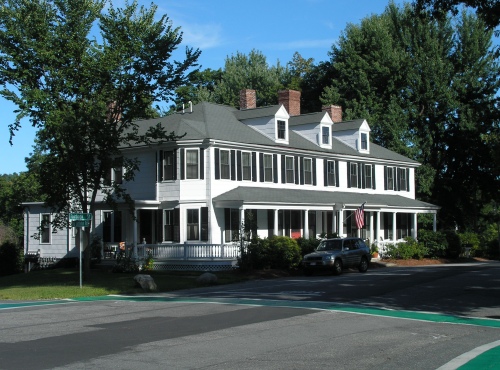
11 Fairbank St., Harvard

The house at 11 Fairbank Street in Harvard was built between 1823 and 1831 by Reuben Whitcomb, who used it as both a residence (the south section) and a store (the north section). Whitcomb’s widow sold the building in 1865 to Alfred Farwell, who continued its use as a residence/store. For some years, the store section had been used by Gale and Dickson, owners of the town’s General Store, first for storing grain and then as a roller skating rink! In 1895, W.P. Farwell converted the former store area into a two-family residence. In 1946, Rachel and John McTigue bought the house from Gertrude Farwell Sawyer and restored the building to become the Harvard Inn, which had eight rooms for guests, three dining rooms and two sitting rooms. The Inn was converted to apartments in 1953 and from 1993 to 2012 served as affordable housing for the elderly.

Joseph G. Harwood House (1800)

by Dan/February 4, 2014/Federal, Harvard, Houses

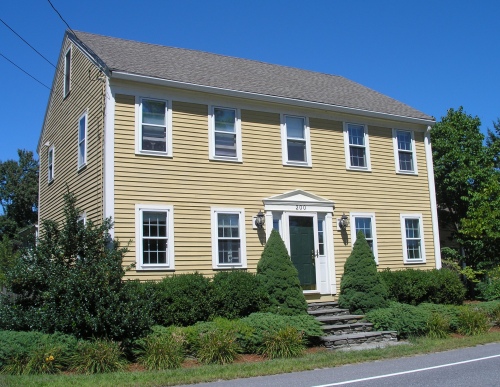
Joseph G. Harwood House

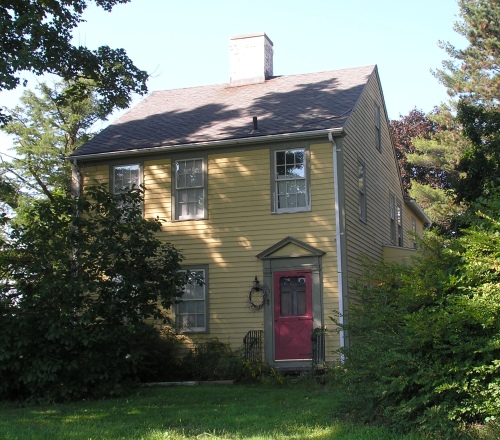
In the late eighteenth-century, a farming community developed along Still River Road in Harvard. The house at 200 Still River Road was built around 1800 by Joseph G. Harwood, who had obtained a license to sell alcohol. Around 1850 the house was acquired by William F. Bateman, who was postmaster of Still River (also a librarian). His widow, Louisa H. Bateman, took over his postmaster duties after his death in 1877. In the 1890s, the house was acquired by Amos H. Keyes and in 1907 by Arthur Hunter, an engineer with the Boston & Albany railroad. It was then owned by F. S. Savage, Sr., author of Memoirs of Old Harvard Days (1924). Savage also sold real estate. For many years it was a double house with a long garage addition on the northeast side. It has since been converted to a single-family home, with a new front entry molding and the old addition shortened.

Ross Farm (1800)

by Dan/February 2, 2014/Federal, Houses, Northampton

Ross Farm

The farmhouse at 123 Meadow Street in the Florence section of Northampton was built c. 1830 by Theodore Burt, or perhaps c. 1800 by his father, Gaius Burt, who had purchased the farm in 1798. Samuel Whitmarsh, a pioneer of silk cultivation in Northampton, purchased the property in 1835. Whitmarsh’s Northampton Silk Company ceased operation in 1840 owing to a decline in the industry and heavy debt. The property was acquired abolitionist Samuel Hill in 1841 to become part of the utopian community called the Northampton Association of Education and Industry (founded in 1842). Hill, who was active in the Underground Railroad, lived in the house, which is the only surviving NAEI building left today. In 1849, Hill sold the farm to Abel Ross. He lived in the house with his nephew, Austin Ross, who eventually bought the property himself in 1857. Austin Ross also used the house as a station on the Underground Railroad. The property is now called Freedom Farm.

Allen-Osgood-Huntington Triple House (1828)

by Dan/December 27, 2013/Federal, Houses, Salem

Allen-Osgood-Huntington Triple House

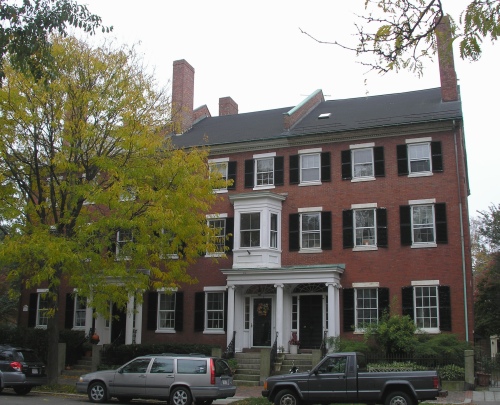
For my 101st Salem post I present the Allen-Osgood-Huntington Triple House, located at 31-33-35 Chestnut Street in Salem. It was begun in 1828-1829 by Pickering Dodge and completed after 1833 by his son-in-law, John Fiske Allen, a horticulturalist who lived in No. 31. As described in Fisk Cousins and Phil M. Riley’s The Colonial Architecture of Salem (1919):

there, in 1853, for the first time in New England, [Allen] grew and brought to flower in his greenhouse the Victoria regia, the great water lily of the Amazon, from seed obtained of Caleb Cope, of Philadelphia. The following season Mr. Allen enlarged his greenhouse and tank and obtained more seed from England, including that of the Amaryllis, Nelumbium and other tropical species of lilies which thrived and formed a rare collection much admired by many visitors. Mr. Allen published the results of his observations on the Victoria regia in a beautiful folio volume, finely illustrated by W. Sharpe from specimens grown in Salem. . . . Previous to Mr. Allen’s occupancy the house was for a time the home of Nathaniel Silsbee, United States senator from 1826 to 1835.

The middle house (No. 33) had various owners, including Captain Charles M. Endicott of the ship Friendship. In a famous incident that occurred in 1831, the ship was captured by Malays off the coast of Sumatra and then retaken in a fierce battle. In 1864, the house was purchased by George P. Osgood, whose family remained there until the 1940s. The bay window on this middle house is a Victorian-era addition. The house at the western end (No. 35) was home to three mayors of Salem: Charles W. Upham (served 1852-1853), who wrote the classic work Salem Witchcraft (1867), Asahel Huntington (served 1853-1854) and his son, Arthur L. Huntington (served 1885).

Captain William Saunders House (1805)

by Dan/December 4, 2013December 4, 2013/Colonial Revival, Federal, Houses, Salem

39 Chestnut Street, Salem

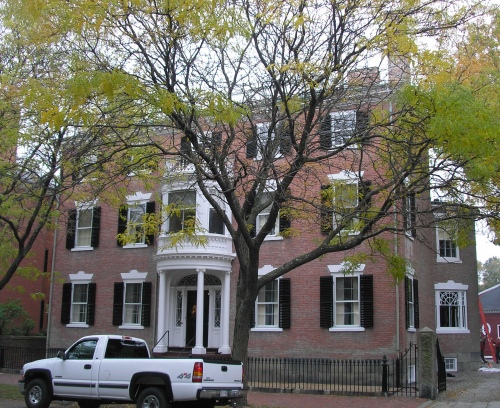
The house at 39 Chestnut Street in Salem was built in 1805 for Captain Thomas Saunders. It was the first of the great brick Federal-style houses to be constructed on a street famed for its architecture. In 1893 the house was remodeled in the Colonial Revival style by architect Arthur Little for owner William G. Barker. The central bay window on the second floor above the original entryway was added at that time.

Phelps-Hedges House (1815)

by Dan/November 21, 2013/Federal, Houses, Westfield

Phelps-Hedges House

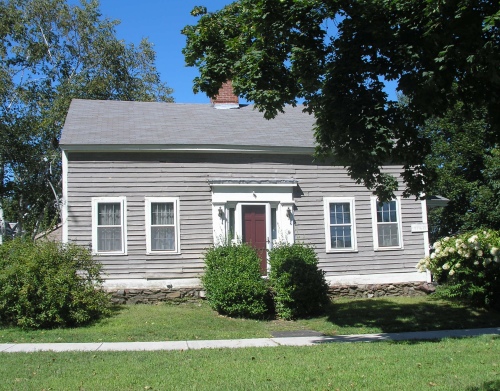
The house at 9 West Silver Street in Westfield was probably built between 1811 and 1821 (c. 1815) by Aaron Phelps, who sold it in the latter year to Joseph Hedges. It remained in the Hedges family for most of the nineteenth century. From 1939 to 1969, J. Rex Adams owned the house and made some interior alterations.

Posts navigation

Older posts
Newer posts
Privacy Policy

Categories

  • Architectural Style (943)
    • Art Deco (9)
    • Byzantine (3)
    • Colonial (177)
    • Colonial Revival (85)
    • Craftsman (6)
    • Egyptian Revival (1)
    • Federal (190)
    • Foursquare (6)
    • Gothic (67)
    • Greek Revival (100)
    • Italianate (82)
    • Mission Revival (2)
    • Mission/Spanish Colonial (1)
    • Modern (2)
    • Neoclassical (56)
    • Octagon (3)
    • Postmodern (1)
    • Queen Anne (46)
    • Renaissance Revival (26)
    • Romanesque Revival (53)
    • Second Empire (26)
    • Shingle Style (12)
    • Stick Style (13)
    • Tudor Revival (8)
    • Vernacular (49)
    • Victorian Eclectic (15)
  • Building Type (943)
    • Apartment Buildings (8)
    • Banks (18)
    • Churches (119)
    • Collegiate (32)
    • Commercial (102)
    • Hotels (16)
    • Houses (508)
    • Industrial (23)
    • Libraries (22)
    • Lighthouses (1)
    • Military (15)
    • Monuments (1)
    • Museums (12)
    • Organizations (39)
    • Outbuildings (17)
    • Public Buildings (50)
    • Schools (23)
    • Stations (5)
    • Synagogues (1)
    • Taverns (21)
    • Theaters (9)
  • Town (943)
    • Adams (11)
    • Agawam (4)
    • Amherst (50)
    • Boston (64)
    • Boylston (6)
    • Cambridge (30)
    • Clinton (21)
    • Concord (15)
    • Cummington (1)
    • Danvers (14)
    • Deerfield (31)
    • Gloucester (18)
    • Granville (10)
    • Great Barrington (2)
    • Hadley (9)
    • Hancock (15)
    • Harvard (32)
    • Holyoke (47)
    • Lenox (5)
    • Lexington (8)
    • Longmeadow (32)
    • Marblehead (40)
    • Marlborough (4)
    • Natick (22)
    • Newton (2)
    • Northampton (68)
    • Peabody (4)
    • Pittsfield (20)
    • Salem (110)
    • Saugus (4)
    • Sheffield (4)
    • South Hadley (8)
    • Southborough (8)
    • Southwick (4)
    • Springfield (67)
    • Stockbridge (19)
    • Stow (1)
    • Sturbridge (18)
    • Sudbury (7)
    • Waltham (11)
    • Watertown (1)
    • Wayland (8)
    • West Springfield (14)
    • Westfield (46)
    • Weston (2)
    • Worcester (26)
  • Uncategorized (1)

Recent Comments

  • Wilber Blackson on South Hadley
  • Tami Speiden on Stockbridge
  • DexGuru on Stockbridge

Tags

Alcott Amherst College Asher Benjamin Back Bay Baptist Beacon Hill Big E Black Heritage Trail bowfront Bulfinch Catholic Congregational Episcopal Freedom Trail Gambrel H.H. Richardson Harvard Hawthorne Historic Deerfield Isaac Damon lit Longfellow mansard Methodist Mount Holyoke Museum Museums NPS Old Sturbridge Village PEM Revolutionary War row houses saltbox Samuel McIntire Shakers Smith College SPNEA Springfield Armory Stephen C. Earle Storrowton Underground Railroad UU Washington William Fenno Pratt Witch Trials

Meta

  • Log in
  • Entries feed
  • Comments feed
  • WordPress.org
Proudly powered by WordPress | Theme: ShowMe by NEThemes.