Historic Buildings of Massachusetts

  • About
  • Index by Town
  • CT
  • About
  • Index by Town
  • CT

Category: Federal

Massachusetts State House (1798)
by Dan/December 19, 2008October 20, 2009/Boston, Federal, Public Buildings

mass-state-house.jpg

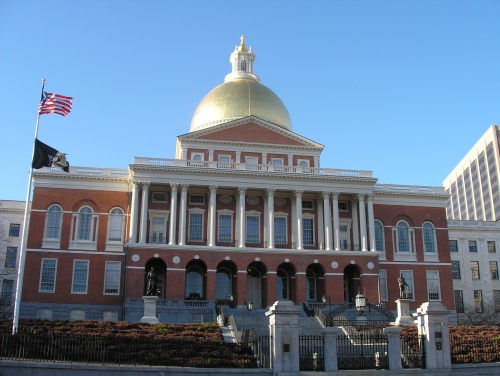
The Massachusetts State Capitol building in Boston, designed by Charles Bulfinch, was completed in 1798. The government of Massachusetts had previously used the Old State House, so the current building is sometimes called the New State House. It was built on Beacon Hill, on land once owned by John Hancock. The site on Beacon Hill was lowered 50 feet for the construction, with the excavated dirt being used as landfill. Bulfinch modeled his design on William Chambers‘s Somerset House and James Wyatt‘s Pantheon, both in London. The capitol building‘s dome was originally made of wood, which soon leaked. In 1802, it was covered with copper by Paul Revere’s company. Originally painted gray, to resemble stone, it was later painted yellow and, in 1874, gilded with gold. It was most recently regilded in 1997. The building was expanded with the addition of a yellow brick annex in 1895 and the two massive marble wings, on each side, in 1914 and 1917. The State House underwent a restoration in 2000. Today, this important structure, which Oliver Wendell Holmes once called, “the hub of the solar system,” is open to the public for tours.
Benjamin W. Crowninshield House (1812)

by Dan/December 16, 2008September 17, 2016/Federal, Houses, Salem

benjamin-crowninshield-house.jpg

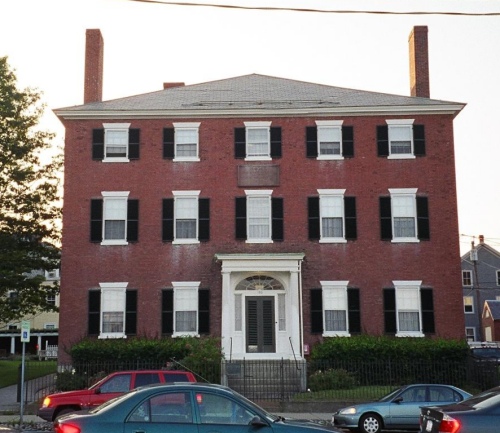
Built 1810-1812 on Derby Street in Salem, the Benjamin W. Crowninshield House may be based on a plan by Samuel McIntire, but completed after his death by his son, Samuel Field McIntire. Benjamin Williams Crowninshield was a congressman and Secretary of the Navy (1815-1818) under presidents Madison and Monroe, the latter of whom once stayed in the house. Brigader General James Miller, a hero of the War of 1812, lived in the house while he was serving as collector at the Custom House next door from 1825 to 1829. The house’s Greek Revival front porch was added after 1820 and the building was expanded in the rear in 1906 and 1916. The house has been used, as noted on a panel on the front facade, as a “Home for Aged Women presented by Robert Brookhouse in 1861”

Simon Forrester House (1790)

by Dan/December 15, 2008September 17, 2016/Federal, Houses, Salem

simon-forrester-house.jpg

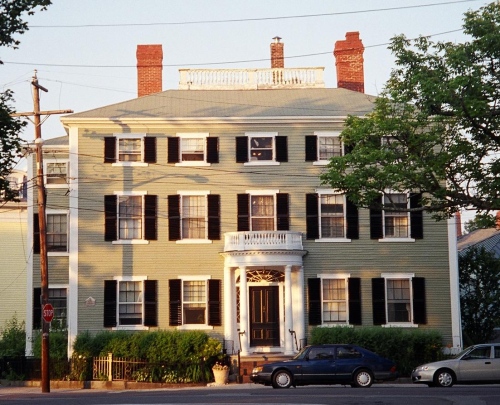
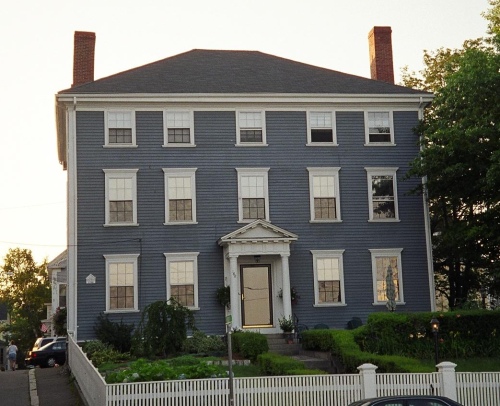
In 1791, Capt. Simon Forrester acquired an unfinished house on Derby Street in Salem. The three-story hipped-roof house has been attributed to Samuel McIntire and the east parlor mantelpiece, carved by McIntire, is now in the Peabody Essex Museum. Forrester was a Irish born ship captain, brought to America by Capt. Daniel Hathorne, the grandfather of Nathaniel Hawthorne (Forrester is mentioned in The Scarlet Letter). Forrester married Capt. Hathorne’s daughter and became wealthy during the Revolutionary War. Many of the house‘s architectural details were removed or altered after the First World War, but more recently the house has been restored to a more original appearance.

North Center School (1810)

by Dan/December 6, 2008April 7, 2009/Federal, Schools, West Springfield

north-center-school.jpg

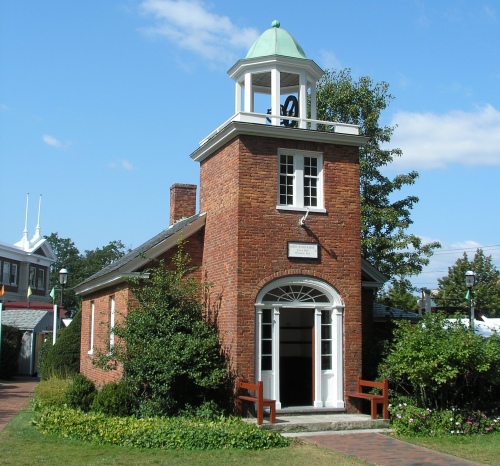
Built around 1810 in the Federal style, the North Center School is a one-room schoolhouse that originally stood in Whately. It was moved to the Eastern States Exposition grounds to become part of Storrowton. The entryway of the building was modified to resemble one in the Federal style, as seen on a schoolhouse in Vergennes, Vermont (since moved to the Shelburne Museum), by Storrowtown’s benefactor, Helen O. Storrow.

Clifford Crowninshield House (1806)

by Dan/November 27, 2008September 17, 2016/Federal, Houses, Salem

clifford-crowninshield-house.jpg

Designed by the famous builder and wood carver, Samuel McIntire, the Clifford Crowninshield House is an impressive Federal style mansion on the southeast corner of Salem Common. The house was built 1804-1806 for the merchant, Clifford Crowninsheld, who died in 1809. In 1802, the Minerva, a ship owned by Crowninshield and Nathaniel West, was the first Salem vessel to circumnavigate the globe. The house was next occupied by Crowninshield’s sister, Sarah, and her husband, James Devereux. In 1799, Devereux was captain of the Franklin when it became the first American vessel to trade with Japan. Devereux returned from Nagasaki with a variety of items, some of which are now in the Peabody Essex Museum in Salem. On June 23, 1800, Rev. William Bentley visited Devereux’s (earlier) house in Salem, where the captain “exhibited such things as engaged his attention,” including “Stone Tables, Tea Tables, Servers, Knife Cases, Small Cabinets,” and paintings. Bentley observed that the “stuffed gowns, which on both sides silk, are filled with a very fine cotton, were luxuries.” The house was later inherited by Devereux’s daughter, Abigail, who had married Captain William Dean Waters. In 1892, the Crowninshield-Devereux-Waters House was altered by its then owner, Zina Goodell, a successful Salem businessman, who had begun as a blacksmith and machinist. Before 1892, the house had been like many such Federal structures in Salem, in which, according to The Colonial Architecture of Salem, by Frank Cousins and Phil M. Riley, “a wing extended to one side of the main house along the street, instead of an L projecting from the rear, and thus by greatly elongating the oblong arrangement reduced in a measure the apparent height of a three-story structure.” Goodell, not finding the “ell” “good,” moved it from the side to the rear of the house, “about doubling the depth of the building.” He also moved the house closer to the corner of Forrester Street (the house’s address is on Washington Square East).

William Hickling Prescott House (1808)

by Dan/November 24, 2008September 17, 2016/Boston, Federal, Houses

prescott-house.jpg

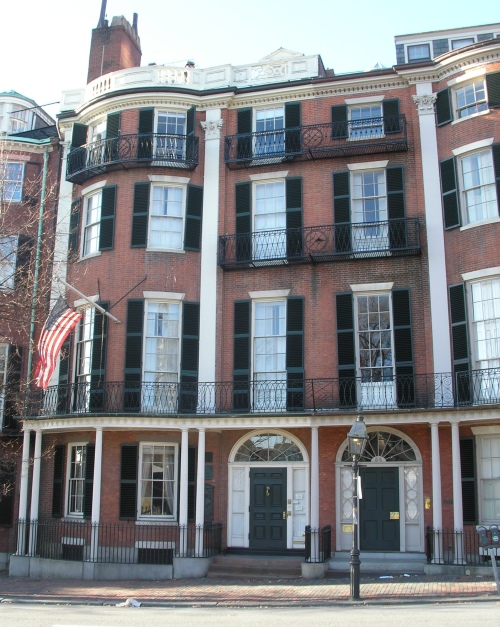
William Hickling Prescott was an important nineteenth century historian who is best known for his works, History of the Conquest of Mexico (1843) and History of the Conquest of Peru (1847). The latter work was written in a house that Prescott lived in on Beacon Street in Boston from 1845 to 1859. The 1808 house (on the left in the photo above) was designed by Asher Benjamin and features Greek design motifs and a Federal style doorway. William Makepeace Thackeray, a friend of Prescott, visited the house. Thackeray was as inspired to write his novel, The Virginians (1859), after seeing two crossed swords displayed in the home, one belonging to Prescott‘s grandfather (Col. William Prescott) and one by Prescott’s wife’s father (Capt. John Linzee), each on opposing sides at the Battle of Bunker Hill. The Prescott House is now a museum and the headquarters of the National Society of the Colonial Dames of America in the Commonwealth of Massachusetts.

Francis Parkman House (1830)

by Dan/November 22, 2008September 17, 2016/Boston, Federal, Houses

francis-parkman-house.jpg

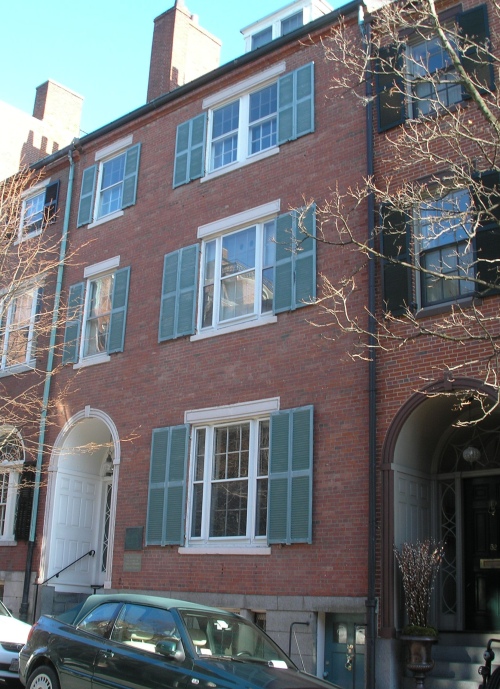
Francis Parkman was one of nineteenth century America’s most noted historians. His first book, The Oregon Trail (1849), became a classic and he went on to write his multi-volume epic, France and England in North America. From 1865 until his death in 1893, Francis Parkman resided at a house at 50 Chestnut Street on Boston’s Beacon Hill. It is one of several houses built sometime in the late 1820s or 1830s by Cornelius Coolidge.

Here’s an additional photo and a list of Parkman‘s works (with links to Google Books) which, although dated in many ways, are considered to be significant literary works: Continue reading “Francis Parkman House (1830)”

Posts navigation

Older posts
Newer posts
Privacy Policy

Categories

  • Architectural Style (943)
    • Art Deco (9)
    • Byzantine (3)
    • Colonial (177)
    • Colonial Revival (85)
    • Craftsman (6)
    • Egyptian Revival (1)
    • Federal (190)
    • Foursquare (6)
    • Gothic (67)
    • Greek Revival (100)
    • Italianate (82)
    • Mission Revival (2)
    • Mission/Spanish Colonial (1)
    • Modern (2)
    • Neoclassical (56)
    • Octagon (3)
    • Postmodern (1)
    • Queen Anne (46)
    • Renaissance Revival (26)
    • Romanesque Revival (53)
    • Second Empire (26)
    • Shingle Style (12)
    • Stick Style (13)
    • Tudor Revival (8)
    • Vernacular (49)
    • Victorian Eclectic (15)
  • Building Type (943)
    • Apartment Buildings (8)
    • Banks (18)
    • Churches (119)
    • Collegiate (32)
    • Commercial (102)
    • Hotels (16)
    • Houses (508)
    • Industrial (23)
    • Libraries (22)
    • Lighthouses (1)
    • Military (15)
    • Monuments (1)
    • Museums (12)
    • Organizations (39)
    • Outbuildings (17)
    • Public Buildings (50)
    • Schools (23)
    • Stations (5)
    • Synagogues (1)
    • Taverns (21)
    • Theaters (9)
  • Town (943)
    • Adams (11)
    • Agawam (4)
    • Amherst (50)
    • Boston (64)
    • Boylston (6)
    • Cambridge (30)
    • Clinton (21)
    • Concord (15)
    • Cummington (1)
    • Danvers (14)
    • Deerfield (31)
    • Gloucester (18)
    • Granville (10)
    • Great Barrington (2)
    • Hadley (9)
    • Hancock (15)
    • Harvard (32)
    • Holyoke (47)
    • Lenox (5)
    • Lexington (8)
    • Longmeadow (32)
    • Marblehead (40)
    • Marlborough (4)
    • Natick (22)
    • Newton (2)
    • Northampton (68)
    • Peabody (4)
    • Pittsfield (20)
    • Salem (110)
    • Saugus (4)
    • Sheffield (4)
    • South Hadley (8)
    • Southborough (8)
    • Southwick (4)
    • Springfield (67)
    • Stockbridge (19)
    • Stow (1)
    • Sturbridge (18)
    • Sudbury (7)
    • Waltham (11)
    • Watertown (1)
    • Wayland (8)
    • West Springfield (14)
    • Westfield (46)
    • Weston (2)
    • Worcester (26)
  • Uncategorized (1)

Recent Comments

  • Wilber Blackson on South Hadley
  • Tami Speiden on Stockbridge
  • DexGuru on Stockbridge

Tags

Alcott Amherst College Asher Benjamin Back Bay Baptist Beacon Hill Big E Black Heritage Trail bowfront Bulfinch Catholic Congregational Episcopal Freedom Trail Gambrel H.H. Richardson Harvard Hawthorne Historic Deerfield Isaac Damon lit Longfellow mansard Methodist Mount Holyoke Museum Museums NPS Old Sturbridge Village PEM Revolutionary War row houses saltbox Samuel McIntire Shakers Smith College SPNEA Springfield Armory Stephen C. Earle Storrowton Underground Railroad UU Washington William Fenno Pratt Witch Trials

Meta

  • Log in
  • Entries feed
  • Comments feed
  • WordPress.org
Proudly powered by WordPress | Theme: ShowMe by NEThemes.