Historic Buildings of Massachusetts

  • About
  • Index by Town
  • CT
  • About
  • Index by Town
  • CT

Category: Federal

Asa Stebbins House (1799)
by Dan/February 2, 2009September 17, 2016/Deerfield, Federal, Houses

stebbins-house.jpg

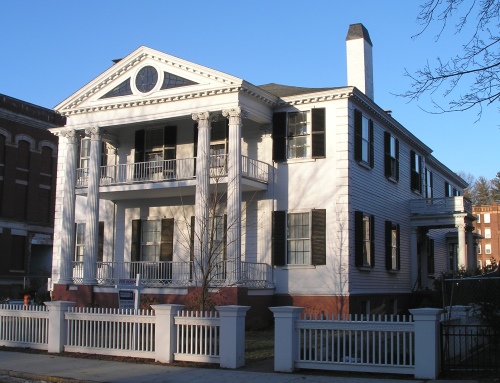
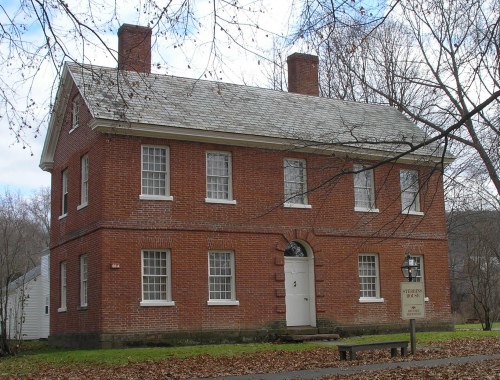
The Federal-style Asa Stebbins House, now one of the museum houses of Historic Deerfield, was built in 1799 and was the first brick house in Franklin county. Stebbins, a wealthy farmer and mill owner, was on the building committees for two other brick structures: the original building of Deerfield Academy (now the Memorial Hall Museum) and the town’s “brick church“. He was also a town selectman and state representative and built and decorated his house in the popular Federal style. Inside, the house has French scenic wallpaper by Joseph Dufour depicting the voyages of Captain Cook.
Park Street Church (1809)

by Dan/January 23, 2009January 23, 2009/Boston, Churches, Federal

park-street-church.jpg

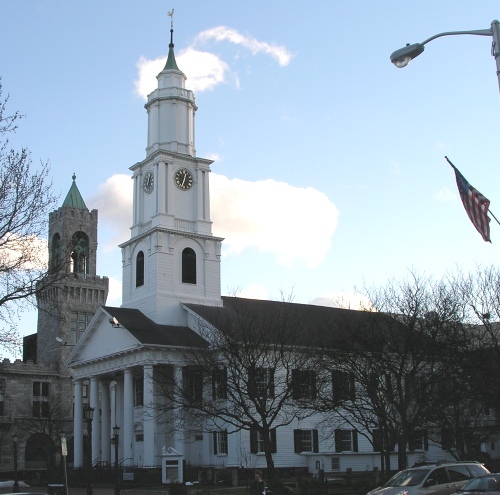
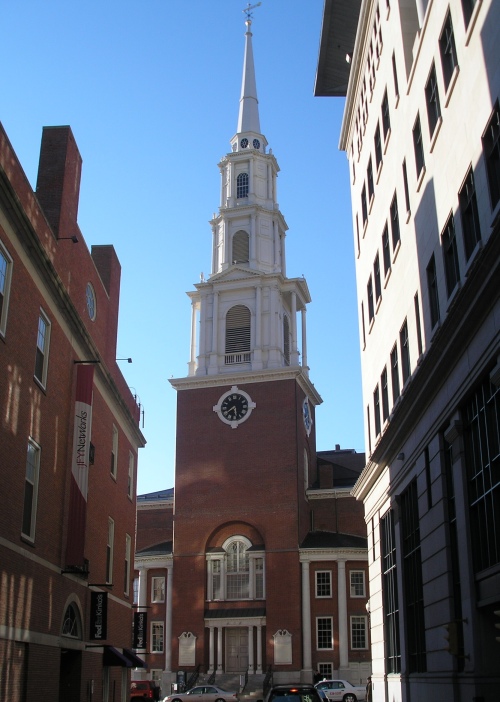
Boston’s Park Street Church was built in 1809-1810 on the site of the 1738 town granary (the Old Granary Burying Ground is next door). The church‘s architect, Peter Banner, adapted the steeple from a design by Sir Christopher Wren. Solomon Willard carved the wooden capitals of the front columns. Either because of the “fire and brimstone” sermons of its Congregational preachers or the fact that gunpowder was stored in its basement during the War of 1812, the corner of Tremont and Park Streets, where the church is located, came to be known as “Brimstone Corner.” The church has had many firsts: the first Sunday School in America was founded here in 1817; the first missionaries to be sent to Hawaii started from here in 1819; the first prison aid society was founded here in 1824; William Lloyd Garrison made his first public anti-slavery speech here in 1829; and Samuel Francis Smith’s hymn, America (“My Country ‘Tis of Thee“) was sung for the first time on the church‘s steeps by Park Street’s Children’s Choir in 1831. Park Street Church is on Boston’s Freedom Trail.

20 Pinckney Street, Boston (1852)

by Dan/January 10, 2009June 29, 2013/Boston, Federal, Houses

20-pinckney-street.jpg

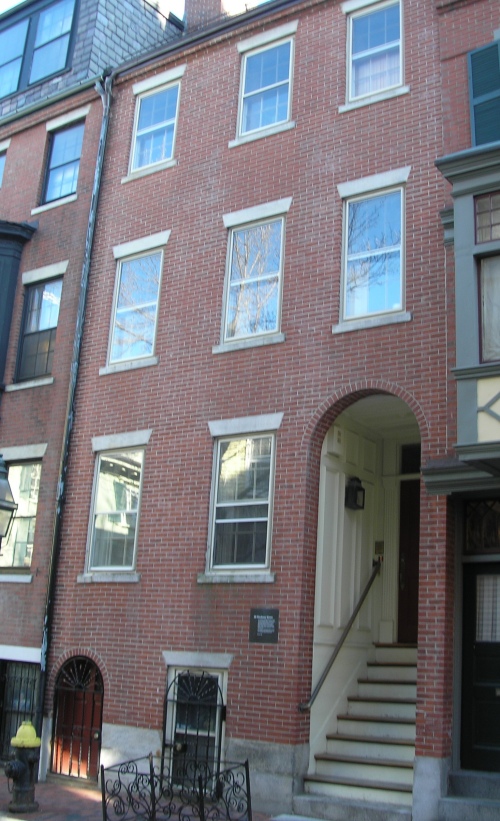
The house at 20 Pinckney Street on Boston’s Beacon Hill is listed in some online sources as having been built in 1860, but it must have been built sometime before 1852, because from 1852 to 1855, it was the home of Bronson Alcott and his family. Louisa May Alcott’s room was on the house‘s third floor. While living here, Louisa’s first story was published, “The Rival Painters: a Tale of Rome” in 1852 and her first book, Flower Fables (1854). Later, after Louisa May Alcott became a successful writer, she lived in nearby Louisburg Square, looking after her father.

Henry Alexander, Jr. House (1811)

by Dan/January 5, 2009January 21, 2020/Federal, Houses, Springfield

alexander-house.jpg

The Alexander House in Springfield was originally built at the corner of Elliott and State Streets in 1811 for James Byers. The design of the house has been attributed to Asher Benjamin and it was built by Simon Sanborn, Springfield’s master builder of the first half of the nineteenth century, who designed many of the city’s old mansions. In 1820, Byers sold the house to Colonel Israel E. Trask, who also owned a plantation in Mississippi. The artist, Chester Harding, briefly lived in the house from 1830 to 1832, as did the railroad superintendent General James Barnes, in 1839. After Trask’s death, in 1835, his family occupied the house until 1862, when it was sold to Henry Alexander, Jr. In that year, Alexander became mayor of Springfield and he resided in the house until his death in 1878. In 1874, he moved the house to a new location nearby on State Street. The house was acquired by the SPNEA (Historic New England) in 1939, and moved again in 2004 to Elliott Street to make way for the construction of a new federal courthouse. The house will be sold, with perpetual preservation restrictions to protect its architectural features.

Byers Block (1835)

by Dan/January 2, 2009January 7, 2009/Commercial, Federal, Springfield

byers-block.jpg

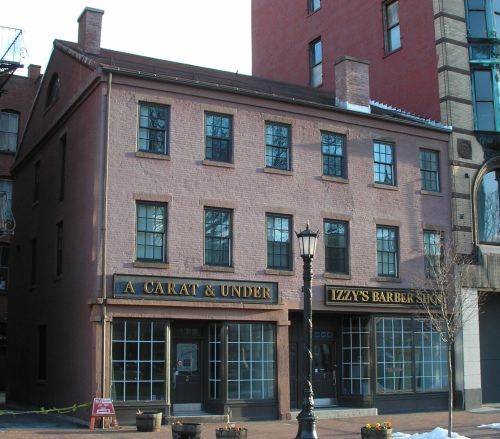
The Byers block, on Elm Street off Court Square in Springfield, is the city’s earliest surviving commercial block. Built by Simon Sanborn for James Byers, it is a three story building, transitional in style between the Federal and Greek Revival. It is typical of early nineteenth century commercial buildings that had shops on the first floor with residential space above. A 1903 article, which originally appeared in the Springfield Republican, celebrated the Byers block as a “famous little building” that “has afforded offices for many prominent men,” including lawyers and politicians, and for “being the home of some of the city’s most successful business enterprises.” The prominent men included Gideon Welles, Lincoln’s Secretary of the Navy, George Ashmun, a lawyer and statesman who gave the speech nominating Abraham Lincoln in 1860, and George Bancroft, the historian and statesman. The building is now part of the Court Square Redevelopment Project.

Old First Church, Springfield (1819)

by Dan/January 1, 2009September 9, 2012/Churches, Federal, Springfield

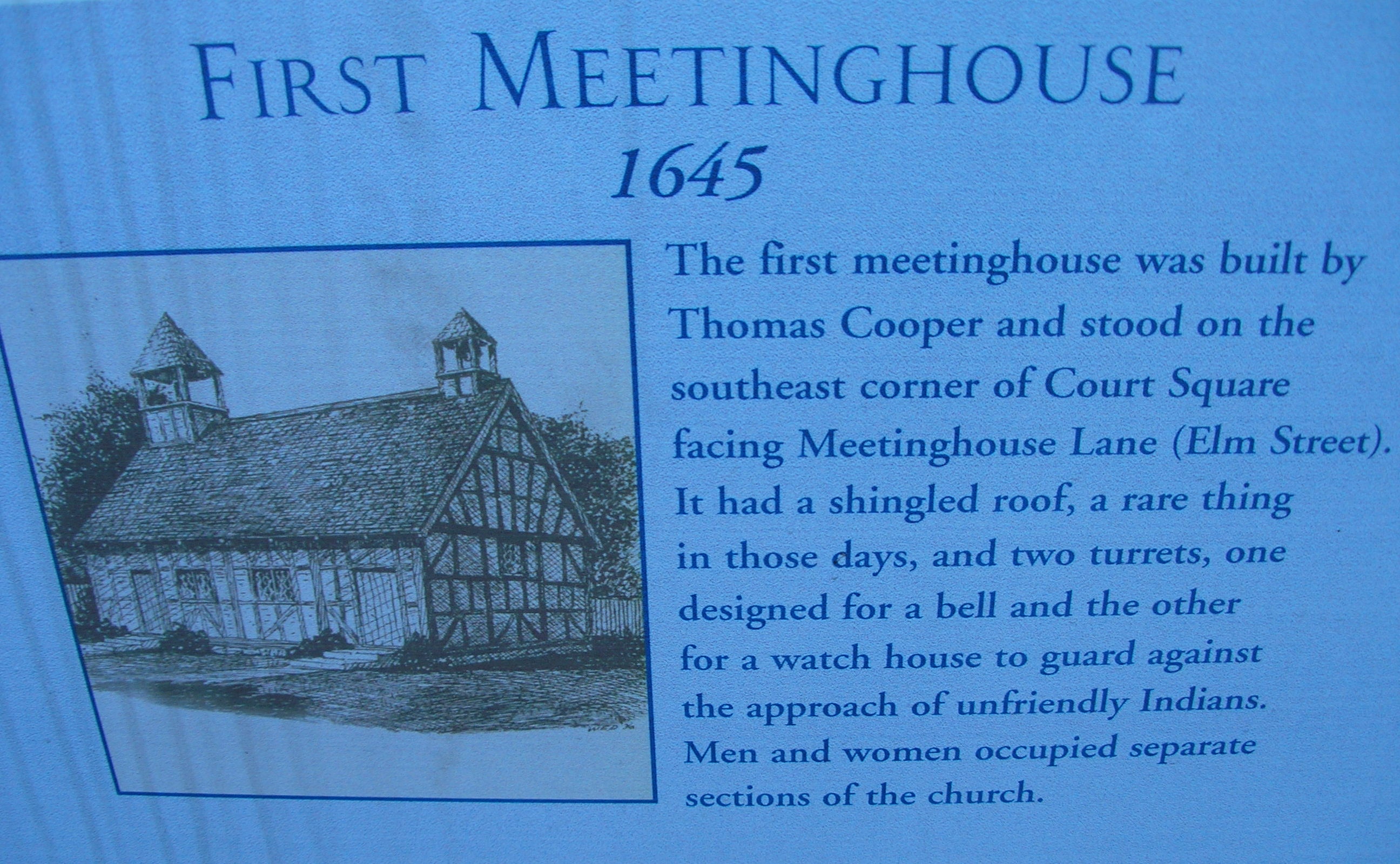
The first Puritan settlers arrived in Springfield from Roxbury in 1636 and organized their church congregation in 1637, with George Moxon as their first minister. The first meetinghouse was built on the southeast corner of Court Square in 1645. It had a shingled roof and two turrets, one used for a bell and the other to guard against attacks by Indians. The second meeting house replaced the first in 1677. The third church building, built in 1752, had a steeple with a clock and a Rooster weathervane, one of three shipped to the colonies in 1750 (the other two went to First Church in Newburyport and South Church in Boston). The weathervane continued to be used on the fourth church building, built in 1819. The church’s most recent organ, built in 1958, was restored in 1997. The First Congregational Church continued to be used for services until the end of 2007, when declining membership led to the closure of the church and the disbanding of the congregation. In March, the city purchased the church, weathervane and organ, but many were concerned when the congregation auctioned off a number of historic items in April. The congregation eventually repurchased the valuable items and donated them to the Springfield Museums Association.

First Congregational Church of Hadley (1808)

by Dan/December 27, 2008February 20, 2009/Churches, Federal, Hadley

hadley-congregational-church.jpg

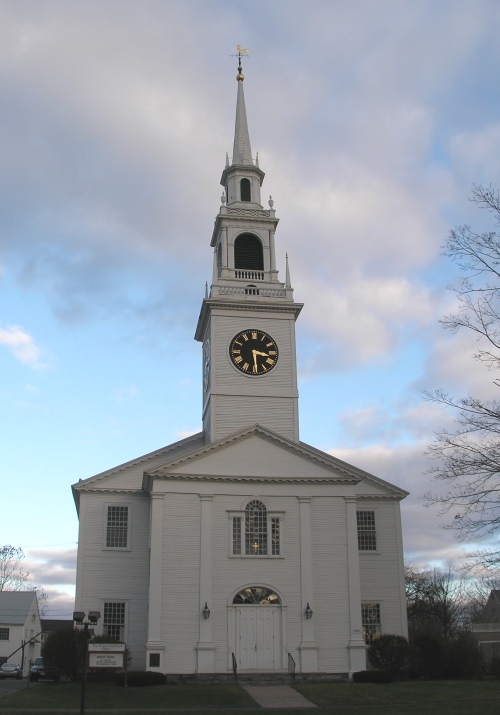
The current meeting house of the First Congregational Church of Hadley, on Middle Street, was built in 1808. The congregation dates back to 1659. The original meeting house was not built right away: although the town had planned to construct it in 1661, work did not begin until 1663 and it took seven years to complete. “Probably during this time meetings were held in the home of some leading church member.” By 1713, “The little old first edifice was falling in pieces,” and the Town decided to build a new church, completed in 1714. This was later replaced by the current building at the same location.

Posts navigation

Older posts
Newer posts
Privacy Policy

Categories

  • Architectural Style (943)
    • Art Deco (9)
    • Byzantine (3)
    • Colonial (177)
    • Colonial Revival (85)
    • Craftsman (6)
    • Egyptian Revival (1)
    • Federal (190)
    • Foursquare (6)
    • Gothic (67)
    • Greek Revival (100)
    • Italianate (82)
    • Mission Revival (2)
    • Mission/Spanish Colonial (1)
    • Modern (2)
    • Neoclassical (56)
    • Octagon (3)
    • Postmodern (1)
    • Queen Anne (46)
    • Renaissance Revival (26)
    • Romanesque Revival (53)
    • Second Empire (26)
    • Shingle Style (12)
    • Stick Style (13)
    • Tudor Revival (8)
    • Vernacular (49)
    • Victorian Eclectic (15)
  • Building Type (943)
    • Apartment Buildings (8)
    • Banks (18)
    • Churches (119)
    • Collegiate (32)
    • Commercial (102)
    • Hotels (16)
    • Houses (508)
    • Industrial (23)
    • Libraries (22)
    • Lighthouses (1)
    • Military (15)
    • Monuments (1)
    • Museums (12)
    • Organizations (39)
    • Outbuildings (17)
    • Public Buildings (50)
    • Schools (23)
    • Stations (5)
    • Synagogues (1)
    • Taverns (21)
    • Theaters (9)
  • Town (943)
    • Adams (11)
    • Agawam (4)
    • Amherst (50)
    • Boston (64)
    • Boylston (6)
    • Cambridge (30)
    • Clinton (21)
    • Concord (15)
    • Cummington (1)
    • Danvers (14)
    • Deerfield (31)
    • Gloucester (18)
    • Granville (10)
    • Great Barrington (2)
    • Hadley (9)
    • Hancock (15)
    • Harvard (32)
    • Holyoke (47)
    • Lenox (5)
    • Lexington (8)
    • Longmeadow (32)
    • Marblehead (40)
    • Marlborough (4)
    • Natick (22)
    • Newton (2)
    • Northampton (68)
    • Peabody (4)
    • Pittsfield (20)
    • Salem (110)
    • Saugus (4)
    • Sheffield (4)
    • South Hadley (8)
    • Southborough (8)
    • Southwick (4)
    • Springfield (67)
    • Stockbridge (19)
    • Stow (1)
    • Sturbridge (18)
    • Sudbury (7)
    • Waltham (11)
    • Watertown (1)
    • Wayland (8)
    • West Springfield (14)
    • Westfield (46)
    • Weston (2)
    • Worcester (26)
  • Uncategorized (1)

Recent Comments

  • Wilber Blackson on South Hadley
  • Tami Speiden on Stockbridge
  • DexGuru on Stockbridge

Tags

Alcott Amherst College Asher Benjamin Back Bay Baptist Beacon Hill Big E Black Heritage Trail bowfront Bulfinch Catholic Congregational Episcopal Freedom Trail Gambrel H.H. Richardson Harvard Hawthorne Historic Deerfield Isaac Damon lit Longfellow mansard Methodist Mount Holyoke Museum Museums NPS Old Sturbridge Village PEM Revolutionary War row houses saltbox Samuel McIntire Shakers Smith College SPNEA Springfield Armory Stephen C. Earle Storrowton Underground Railroad UU Washington William Fenno Pratt Witch Trials

Meta

  • Log in
  • Entries feed
  • Comments feed
  • WordPress.org
Proudly powered by WordPress | Theme: ShowMe by NEThemes.