Historic Buildings of Massachusetts

  • About
  • Index by Town
  • CT
  • About
  • Index by Town
  • CT

Category: Federal

Joseph Story House (1811)
by Dan/January 17, 2011January 24, 2020/Federal, Houses, Salem

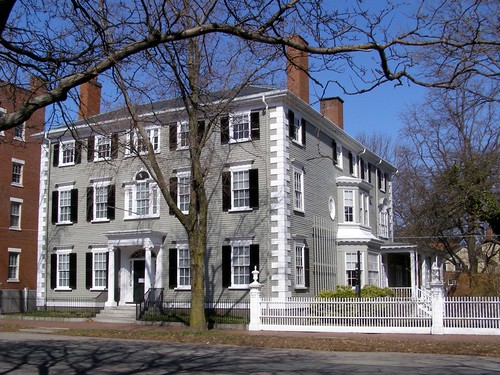
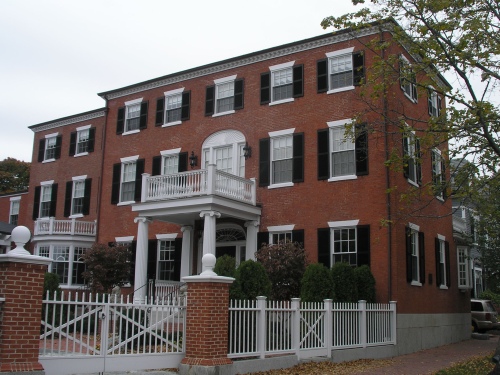
Joseph Story (1779-1845) was a lawyer and jurist who served on the Supreme Court of the United States from 1811 to 1845. He was also the author of a famous work of Commentaries on the Constitution of the United States. Story’s house, at 26 Winter Street in Salem, was constructed in 1811 by the builder Joshua Upham. Story’s son, the poet and sculptor, William Wetmore Story, was born in the house in 1819. The current entry porch and the side wing with bay window were added in the early twentieth century by owner George C. Vaughn, president of the Salem Safe Deposit & Trust Company. In 2006, artist Kathleen Ward-Salem, who was raised in the Story House, sold the residence to lawyer Neil Chayet, who has renovated the house, making it energy-efficient and environmentally friendly. The Story House has recently been LEED-certified.
Williams-Peabody-Rantoul House (1805)

by Dan/January 14, 2011January 24, 2020/Federal, Houses, Salem

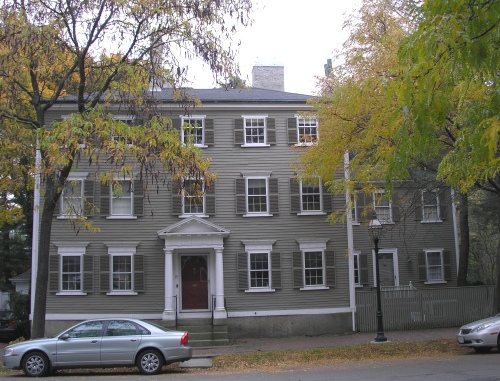
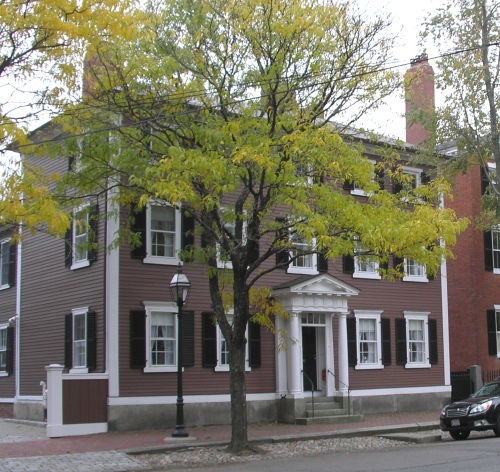
In 1805, Israel Williams, a Salem merchant, purchased an unfinished house at 19 Chestnut Street, begun by President Grover Cleveland’s great-uncle, Rev. Charles Cleveland. Williams was the first captain of the Salem East Indiaman Friendship, launched in 1797. He soon completed the house, which remained in his family until 1857. As explained in Cousins and Riley’s The Colonial Architecture of Salem, “Of broad street frontage but no great depth, this is one of the many three-story wood houses of this period that are oblong rather than square and depend on a two-story L in the rear for several rooms.” The house was next owned by merchant Henry W. Peabody until 1905 and then by architect William G. Rantoul from 1907 to 1939. Rantoul restored the house, adding the entryway (copied from the nearby Towne House), window frames and a balustrade along the roof (since removed).

Ezekiel Savage House (1808)

by Dan/January 12, 2011January 24, 2020/Federal, Houses, Salem

The life of Ezekiel Savage, Esq. is described as follows in “Old Boston Families, Number Three, The Savage Family,” by Lawrence Park, in The New England Historical and Genealogical Register, Vol. LXVII (October 1913):

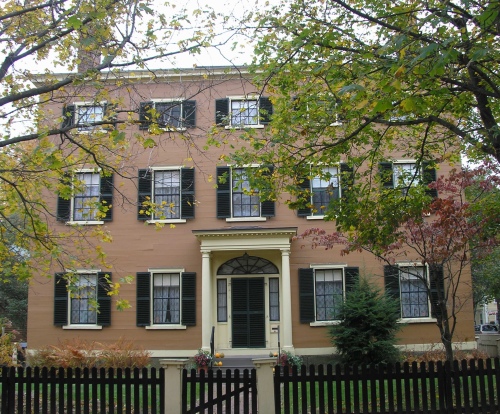
born in Boston 17 Oct. 1760, lived with his mother (who became a widow about two months after his birth) in Boston until shortly after his fifth birthday, when his mother, having married again, removed to Milton, Mass., where Ezekiel lived until he entered Harvard College in 1774. After graduating at Harvard in 1778 he began to study for the ministry with Rev. William Smith of Weymouth, Mass, but it does not appear that he was ever settled as a minister over any parish, and owing to ill health he abandoned this profession about the time of his first marriage (1783). In 1783 he was a merchant of Boston, in partnership with his half-brother Habijah […], but this partnership was soon dissolved, for Ezekiel Savage early in 1784 removed to Salem, where he continued to reside uniil about 1788, when he returned to Boston. In 1789 he was a ” shopkeeper” on Fish Street, with a house on Fleet Street, and in 1791 and in 1793 he was called “tobacconist.” In 1794 he returned to Salem, where as ” Squire Savage” he was well known as a civil magistrate for many years. On 22 Feb. 1800 he delivered at St. Peter’s Church, Salem, “An Eulogy on General Washington,” which was published at Salem in 1800 by Joshua Gushing. In 1812—14 he represented Salem in the General Court. His office was on Essex Street, and he lived not far away, in an old, two-story, gambrel-roofed house, until 1808, when he moved into a new house on the corner of Broad and Hathorne Streets, where he died 22 June 1837. He is buried in a tomb in the Broad Street Burying-Ground, Salem.

His Federal-style house still stands at 29 Broad Street in Salem.

Stephen Phillips House (1821)

by Dan/January 10, 2011January 24, 2020/Federal, Houses, Salem

In 1800, Captain Nathaniel West and his wife Elizabeth, daughter of Elias Hasket Derby, hired Samuel McIntire to design a country estate in Danvers. They later divorced and Elizabeth retained the house, but Capt. West eventually inherited a third of the building. In 1821, he transported his three rooms by ox sled to Chestnut Street in Salem, where they formed the core of his new Federal-style mansion. The West family sold the house in 1863 to Malvina Tabitha Ward, who ran a boarding house and school in the residence. In 1875, the house was sold to Annie B. Webb and in 1911, Anna Wheatland Phillips and her husband, Stephen Willard Phillips, bought the house. By that time the house had been expanded and much altered over the years in various architectural styles. Anna and Stephen W. Philips hired architect William Rantoul to remodel the house to reflect its origins in the Federal style. Stephen W. Philips, who was born in Hawaii, collected Oceanic art. His father, Stephen Henry Phillips, had served as Attorney General for the Kingdom of Hawaii from 1866 to 1873. Stephen W. and Anna Phillips’s son, Stephen Phillips, who died in 1971, had wanted his childhood home to become a museum. In 1973, his wife, Betty, established the Stephen Phillips Memorial Charitable Trust for Historic Preservation, which opened the house to the public. Since 2006, the house has been owned by Historic New England. The property also includes the carriage house, which contains the family’s collection of carriages and automobiles.

Hamilton Hall (1805)

by Dan/January 3, 2011January 3, 2011/Federal, Organizations, Salem

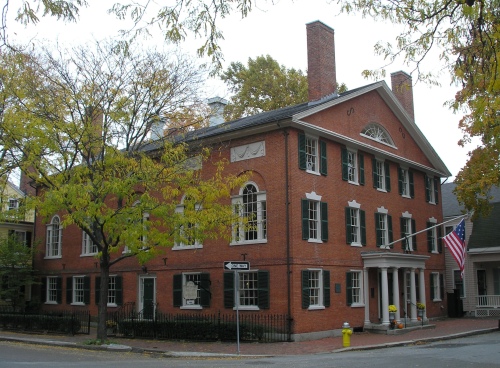
Happy New Year!!! Our first building of the new year is Hamilton Hall in Salem, named in honor of Alexander Hamilton. A three-story brick Federal-style building, designed by Samuel McIntire and built from 1805 to 1807 on Chestnut Street at Cambridge Street, Hamilton Hall was built as a gathering place and hall for functions held by Salem’s wealthy Federalist elite. A particularly notable event was the visit by the Marquis de Lafayette in 1824. With its ballroom, Hamilton Hall is still used for social and cultural events, including being rented for weddings. The west end of the building was completed in 1824 and the Greek Revival entrance was installed in 1845.

Amos and Solomon Towne House (1804)

by Dan/December 29, 2010January 24, 2020/Federal, Houses, Salem

One of the earliest Federal-style mansions on Chestnut Street in Salem was built in 1804 for two brothers, a schoolmaster and a ship-master, Amos and Solomon Towne. Notable for its fine entrance porch, the house was jointly owned until Amos sold his half in 1807. Solomon sold the house to merchant James King in 1821. While Amos still occupied the house, there was “a school for misses” held there where Sarah Gould taught “reading, English, grammar, geography, embroidery, tambouring, needlework in its various branches, drawing, painting and paper fancy work.” The house has been expanded on the sides and to the rear by later owners.

Gideon Tucker House (1809)

by Dan/December 24, 2010January 24, 2020/Federal, Houses, Salem

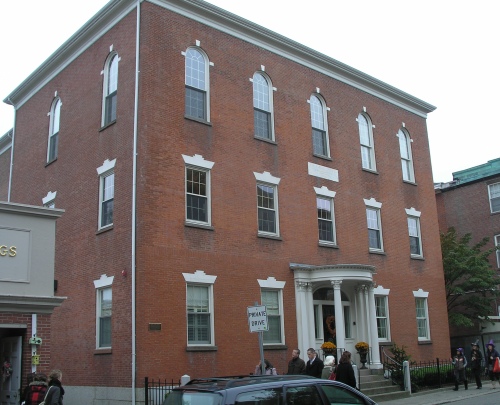
The Gideon Tucker House, also known as the Tucker-Rice House, is at 129 Essex Street in Salem. It was built in 1808-1809 for Gideon Tucker who, according to Old Time Ships of Salem (1917):

was born March 7, 1778, and built and occupied the house on Essex street opposite the Essex Institute. He was clerk for Joseph Peabody and afterwards a partner in that noted shipping firm, which he left to establish a business of his own. He died February 18, 1861. “A venerable man of exact habits and strict integrity.”

Tucker’s house, designed by Samuel McIntire, once looked very similar to the McIntire-designed Gardner-Pingree House across the street, but the Tucker House was significantly altered in 1910. As described in Cousins and Riley’s Colonial Architecture of Salem (1919):

Because of their spaciousness and large number of rooms, the three-story square houses of brick built during the early nineteenth century lend themselves admirably to adaptation as semi-public institutions, and several splendid old mansions have been so utilized. Thus in 1896 the Father Mathew Catholic Total Abstinence Society, organized in 1875, purchased the Tucker-Rice house at Number 129 Essex Street for its headquarters, and considerably remodeled it. […] Much of the handsome interior wood trim remains, but the splendid elliptical porch, one of the best proportioned in Salem, was removed to the garden of the Essex lnstitute for preservation, where it may now be seen with a contemporary three-piece door from the Rogers house on Essex Street and glasswork of attractive pattern.

In more recent times, the house has been converted for use as condominiums.

Posts navigation

Older posts
Newer posts
Privacy Policy

Categories

  • Architectural Style (943)
    • Art Deco (9)
    • Byzantine (3)
    • Colonial (177)
    • Colonial Revival (85)
    • Craftsman (6)
    • Egyptian Revival (1)
    • Federal (190)
    • Foursquare (6)
    • Gothic (67)
    • Greek Revival (100)
    • Italianate (82)
    • Mission Revival (2)
    • Mission/Spanish Colonial (1)
    • Modern (2)
    • Neoclassical (56)
    • Octagon (3)
    • Postmodern (1)
    • Queen Anne (46)
    • Renaissance Revival (26)
    • Romanesque Revival (53)
    • Second Empire (26)
    • Shingle Style (12)
    • Stick Style (13)
    • Tudor Revival (8)
    • Vernacular (49)
    • Victorian Eclectic (15)
  • Building Type (943)
    • Apartment Buildings (8)
    • Banks (18)
    • Churches (119)
    • Collegiate (32)
    • Commercial (102)
    • Hotels (16)
    • Houses (508)
    • Industrial (23)
    • Libraries (22)
    • Lighthouses (1)
    • Military (15)
    • Monuments (1)
    • Museums (12)
    • Organizations (39)
    • Outbuildings (17)
    • Public Buildings (50)
    • Schools (23)
    • Stations (5)
    • Synagogues (1)
    • Taverns (21)
    • Theaters (9)
  • Town (943)
    • Adams (11)
    • Agawam (4)
    • Amherst (50)
    • Boston (64)
    • Boylston (6)
    • Cambridge (30)
    • Clinton (21)
    • Concord (15)
    • Cummington (1)
    • Danvers (14)
    • Deerfield (31)
    • Gloucester (18)
    • Granville (10)
    • Great Barrington (2)
    • Hadley (9)
    • Hancock (15)
    • Harvard (32)
    • Holyoke (47)
    • Lenox (5)
    • Lexington (8)
    • Longmeadow (32)
    • Marblehead (40)
    • Marlborough (4)
    • Natick (22)
    • Newton (2)
    • Northampton (68)
    • Peabody (4)
    • Pittsfield (20)
    • Salem (110)
    • Saugus (4)
    • Sheffield (4)
    • South Hadley (8)
    • Southborough (8)
    • Southwick (4)
    • Springfield (67)
    • Stockbridge (19)
    • Stow (1)
    • Sturbridge (18)
    • Sudbury (7)
    • Waltham (11)
    • Watertown (1)
    • Wayland (8)
    • West Springfield (14)
    • Westfield (46)
    • Weston (2)
    • Worcester (26)
  • Uncategorized (1)

Recent Comments

  • Wilber Blackson on South Hadley
  • Tami Speiden on Stockbridge
  • DexGuru on Stockbridge

Tags

Alcott Amherst College Asher Benjamin Back Bay Baptist Beacon Hill Big E Black Heritage Trail bowfront Bulfinch Catholic Congregational Episcopal Freedom Trail Gambrel H.H. Richardson Harvard Hawthorne Historic Deerfield Isaac Damon lit Longfellow mansard Methodist Mount Holyoke Museum Museums NPS Old Sturbridge Village PEM Revolutionary War row houses saltbox Samuel McIntire Shakers Smith College SPNEA Springfield Armory Stephen C. Earle Storrowton Underground Railroad UU Washington William Fenno Pratt Witch Trials

Meta

  • Log in
  • Entries feed
  • Comments feed
  • WordPress.org
Proudly powered by WordPress | Theme: ShowMe by NEThemes.