Historic Buildings of Massachusetts

  • About
  • Index by Town
  • CT
  • About
  • Index by Town
  • CT

Category: Federal

Gardner-Pingree House (1804)
by Dan/March 1, 2011January 24, 2020/Federal, Houses, Salem

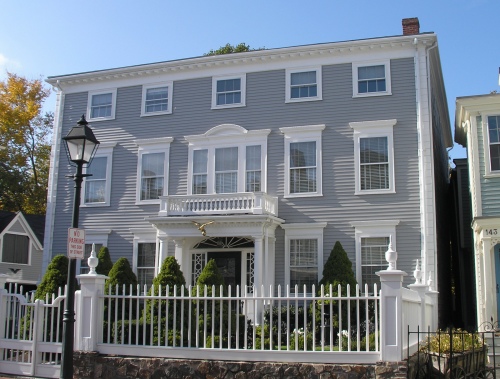
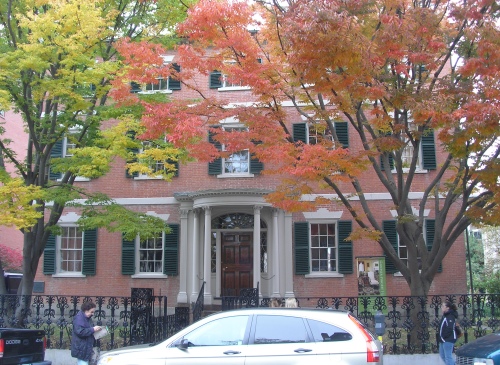
The 350th post at Historic Buildings of Massachusetts is the Gardner-Pingree House in Salem, which is considered to be New England’s greatest example of a Federal-style (or Adamesque) town house. It was erected in 1804-1805 at 128 Essex Street for merchant John Gardner, Jr. and is generally considered to be the work of Samuel McIntire, who certainly did create the mansion‘s exterior ornamentation and interior wood carving. In 1811, financial difficulties forced Gardner to sell his house to Nathaniel West, who then sold it three years later to Captain Joseph White. In 1830, Capt. White was murdered in the house, an event that shook Salem and was followed by a sensational trial with a famed oration by Daniel Webster. The story would have an influence on Poe and Hawthorne. In 1834, the house was sold to David Pingree and remained in the Pingree family until 1933. The house was donated in that year to the Essex Institute, now the Peabody Essex Museum. The restored house is open to the public for tours, usually in conjunction with the museum’s nearby John Ward and Crowninshield-Bentley houses.
Abiel Smith School (1835)

by Dan/February 20, 2011/Boston, Federal, Schools

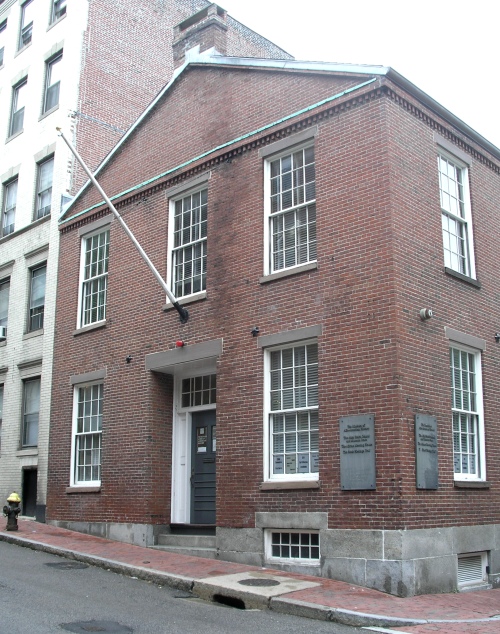
In 1798, members of Boston’s black comunity organized a grammar school that met in in the home of Primus Hall, the son of Prince Hall, a community leader whose petitions to allow black children into the city’s school system had long been denied. The school moved to the African Meeting House on Beacon Hill in 1808 and received financial upport frm the city after 1812. In the 1820s, the city finally established two schools for black children. Abiel Smith was a white businessman who died in 1815 and left $4,000 for the education of African American children in Boston. Part of this bequest was used to build the Abiel Smith School, completed in 1834 and dedicated the following year on Belknap Street, now called Joy Street, near the African Meeting House. In 1849, most African-American parents in Boston withdraw their children from the Abiel Smith School to protest the segregation of schools in the city. In 1855, the Massachusetts legislature outlawed segregation and the Abiel Smith School was closed. The building was then used to store school furniture and after 1887 as the headquarters for black Civil War veterans. The restored building is now part of the Museum of African American History. The school is also on Boston’s Black Heritage Trail.

Capt. John Cross House (1804)

by Dan/February 18, 2011January 22, 2020/Federal, Houses, Marblehead

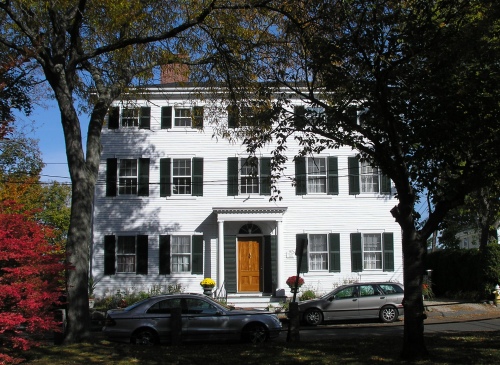
The house at 8 Washington Square in Marblehead was built in 1804 for Capt. John Cross, a mariner. Around 1886, it was the residence of Mary G. Brown, librarian at the Abbot Public Library.

Old West Church, Boston (1806)

by Dan/February 13, 2011/Boston, Churches, Federal

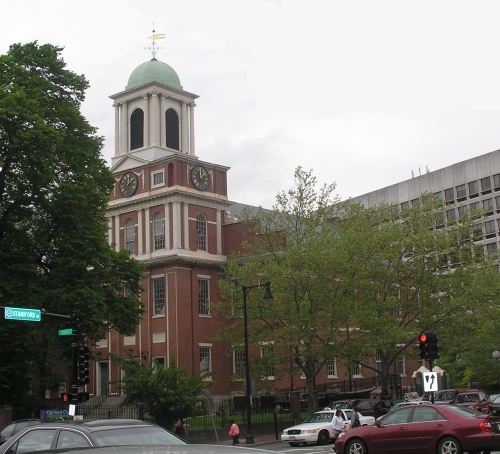
The original Old West Church in Boston was a wood-frame building, built in 1737. It was used as barracks by British soldiers during the occupation of Boston, but they soon razed the structure in 1775 due to concerns that supporters of the Revolution were sending signals to Cambridge from its steeple. The church was finally rebuilt in 1806. It was designed by Asher Benjamin and has similarities to his earlier Charles Street Meeting House of 1804. Originally a Congregationalist church, Old West Church was deeded to the City of Boston in 1894 to serve as the West End Library. The church remained a library until 1962, when a new library was built. Since 1964, Old West Church has been home to a Methodist congregation.

Nathaniel Hooper Mansion (1754)

by Dan/January 28, 2011January 22, 2020/Colonial, Federal, Houses, Marblehead

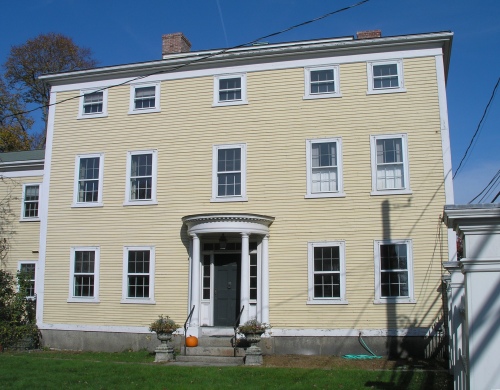
In 1801, Nathaniel Hooper, son of Robert Hooper and brother of Capt. John Hooper, purchased a parcel of land at the foot of Washington Street in Marblehead. A c. 1754 house was already on the property, which Hooper expanded into a Federal-style mansion. According to the Hooper Genealogy (1908), Nathaniel Hooper (1770-1825), “made public profession of his faith in Christ, his Saviour, in 1811, uniting with the Congregational church of Marblehead [the Hoopers had traditionally been Episcopalians]; became a deacon of the church, a man of large generosity and of much public spirit. He was known among the fishermen as ‘The Oracle,’ being very helpful in settling controversies. He represented the town at the General Court 1813-15 and 1822; was a member of the [Massachusetts Constitutional] Convention of 1820.” The Nathaniel Hooper Mansion, at 147 Washington Street, was later owned by the members of Fabens family of Salem. It was acquired by its current owners in 1983 and has been restored.

Capt. John Hooper House (1800)

by Dan/January 27, 2011January 22, 2020/Federal, Houses, Marblehead

Capt. John Hooper was a son of Robert Hooper and Mary (Polly) Ingalls. In 1811, his father deeded John land on Washington Street in Marblehead near his own house. This land included a house built in 1790, but this was replaced around 1815 (or as early as 1800) by John Hooper’s Federal-style mansion at 187 Washington Street. According to the Hooper Genealogy (1908), “He was known at the beginning of the century as ‘John Hooper, 4th;’ the term changed as he grew older. He was a man of great business energy and shrewdness, combined with much regard for equity and public spirit; amassed a large fortune for those days. Was president of the Marblehead Bank a long time. He built the handsome colonial mansion known as ‘The Hooper House,’ on the northern side of the Square, fronting the Common. He represented the town in the General Court 1819-1821.”

Rev. T.M. Cooley House (1801)

by Dan/January 18, 2011January 18, 2020/Federal, Granville, Houses

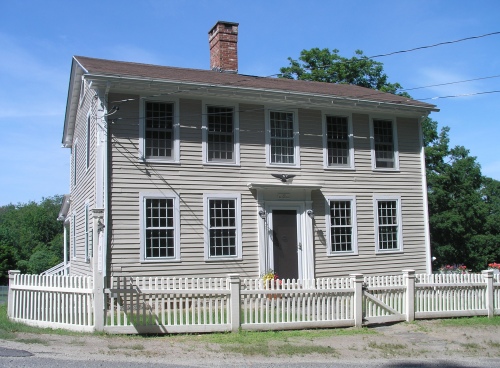
Rev. Timothy Mather Cooley became the minister of Granville’s Congregational Church in 1805. In 1798 and 1799, he led a religious revival in the town, where he had grown up and lived all his life. He described the revival in an article for the Connecticut Evangelical Magazine of January 1802. In 1845, a jubilee was held in Granville, celebrating Cooley’s fifty years there as pastor. A number of his sermons were published during his lifetime and Rev. Cooley also wrote Sketches of the Churches and Pastors in Hampden County, Mass. (1854). After he died in 1859, at the age of 83, Lydia Huntley Sigourney wrote a memorial poem. The Rev. T.M. Cooley House in Granville Center was built in 1801.

Posts navigation

Older posts
Newer posts
Privacy Policy

Categories

  • Architectural Style (943)
    • Art Deco (9)
    • Byzantine (3)
    • Colonial (177)
    • Colonial Revival (85)
    • Craftsman (6)
    • Egyptian Revival (1)
    • Federal (190)
    • Foursquare (6)
    • Gothic (67)
    • Greek Revival (100)
    • Italianate (82)
    • Mission Revival (2)
    • Mission/Spanish Colonial (1)
    • Modern (2)
    • Neoclassical (56)
    • Octagon (3)
    • Postmodern (1)
    • Queen Anne (46)
    • Renaissance Revival (26)
    • Romanesque Revival (53)
    • Second Empire (26)
    • Shingle Style (12)
    • Stick Style (13)
    • Tudor Revival (8)
    • Vernacular (49)
    • Victorian Eclectic (15)
  • Building Type (943)
    • Apartment Buildings (8)
    • Banks (18)
    • Churches (119)
    • Collegiate (32)
    • Commercial (102)
    • Hotels (16)
    • Houses (508)
    • Industrial (23)
    • Libraries (22)
    • Lighthouses (1)
    • Military (15)
    • Monuments (1)
    • Museums (12)
    • Organizations (39)
    • Outbuildings (17)
    • Public Buildings (50)
    • Schools (23)
    • Stations (5)
    • Synagogues (1)
    • Taverns (21)
    • Theaters (9)
  • Town (943)
    • Adams (11)
    • Agawam (4)
    • Amherst (50)
    • Boston (64)
    • Boylston (6)
    • Cambridge (30)
    • Clinton (21)
    • Concord (15)
    • Cummington (1)
    • Danvers (14)
    • Deerfield (31)
    • Gloucester (18)
    • Granville (10)
    • Great Barrington (2)
    • Hadley (9)
    • Hancock (15)
    • Harvard (32)
    • Holyoke (47)
    • Lenox (5)
    • Lexington (8)
    • Longmeadow (32)
    • Marblehead (40)
    • Marlborough (4)
    • Natick (22)
    • Newton (2)
    • Northampton (68)
    • Peabody (4)
    • Pittsfield (20)
    • Salem (110)
    • Saugus (4)
    • Sheffield (4)
    • South Hadley (8)
    • Southborough (8)
    • Southwick (4)
    • Springfield (67)
    • Stockbridge (19)
    • Stow (1)
    • Sturbridge (18)
    • Sudbury (7)
    • Waltham (11)
    • Watertown (1)
    • Wayland (8)
    • West Springfield (14)
    • Westfield (46)
    • Weston (2)
    • Worcester (26)
  • Uncategorized (1)

Recent Comments

  • Wilber Blackson on South Hadley
  • Tami Speiden on Stockbridge
  • DexGuru on Stockbridge

Tags

Alcott Amherst College Asher Benjamin Back Bay Baptist Beacon Hill Big E Black Heritage Trail bowfront Bulfinch Catholic Congregational Episcopal Freedom Trail Gambrel H.H. Richardson Harvard Hawthorne Historic Deerfield Isaac Damon lit Longfellow mansard Methodist Mount Holyoke Museum Museums NPS Old Sturbridge Village PEM Revolutionary War row houses saltbox Samuel McIntire Shakers Smith College SPNEA Springfield Armory Stephen C. Earle Storrowton Underground Railroad UU Washington William Fenno Pratt Witch Trials

Meta

  • Log in
  • Entries feed
  • Comments feed
  • WordPress.org
Proudly powered by WordPress | Theme: ShowMe by NEThemes.