Historic Buildings of Massachusetts

  • About
  • Index by Town
  • CT
  • About
  • Index by Town
  • CT

Category: Boston

Haberstroh Building (1886)
by Dan/January 26, 2009June 12, 2011/Boston, Commercial, Houses, Renaissance Revival

haberstroh-building.jpg

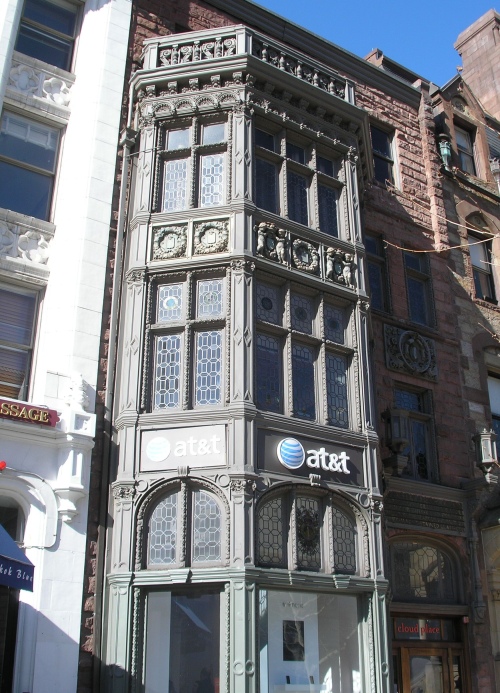
The Haberstroh Building, at 647 Boylston Street in Boston, next to the New Old South Church, was originally a house, built in 1886. From 1888 to 1902, it was the home of Dr. Edward Newton Whittier, a Civil War recipient of the Congressional Medal of Honor, who worked at Harvard Medical School. The house became a business and in 1905, Albert Haberstroh, of the Boston firm of L. Haberstoh & Son, added the four-story bay, which has elaborate copper ornamentation, designed by Haberstroh and done by the Van Noorden sheet metal company.
Ames Building (1889)

by Dan/January 25, 2009/Boston, Commercial, Romanesque Revival

ames-building.jpg

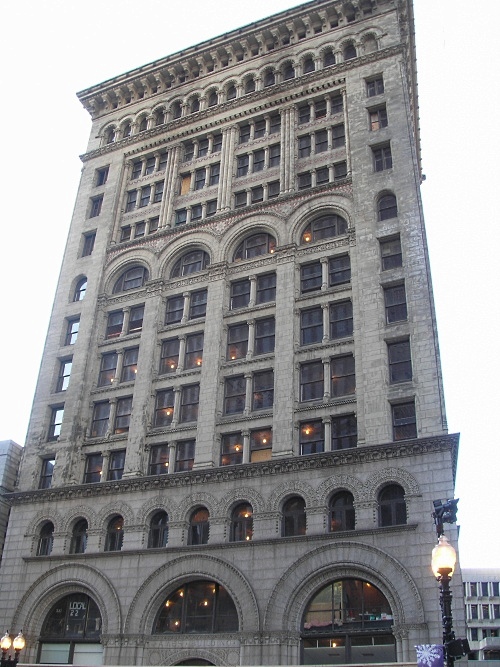
The Ames Building, at 1 Court Street and Washington Mall in Boston, was built in 1889 (although interior work was not completed until 1893) and is considered to be Boston’s first skyscraper. For a number of years the 13-story building dominated the city’s skyline. The building was designed in the Richardsonian Romanesque style by the successors of H. H. Richardson: the firm of Shepley, Rutan and Coolidge. It is the second tallest masonry bearing-wall structure (9 feet thick at the base) in the world. The building, left unoccupied for eight years, is now being renovated by Tishman Construction Corporation of New York to become a luxury hotel.

King’s Chapel, Boston (1749)

by Dan/January 24, 2009March 24, 2009/Boston, Churches, Colonial

kings-chapel.jpg

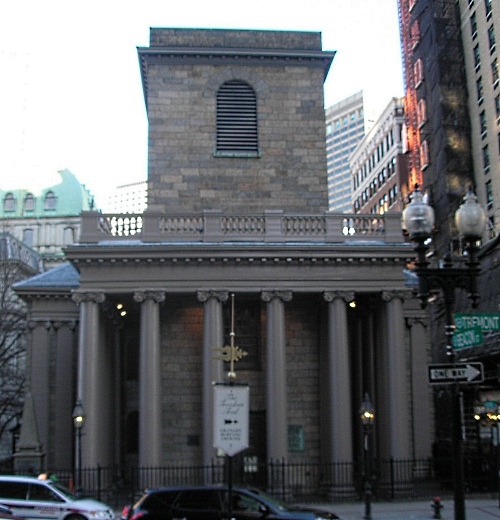
King’s Chapel, originally founded to serve British officers, was the first Anglican church in Puritan Boston. The Chapel‘s first building was a wood structure, built in 1686 on land that had been part of the town’s oldest burying ground. The current Chapel, built of Quincy granite, was constructed around the old one in 1749-1754 (the dismantled remains of the old church were then removed through the windows). The architect was Peter Harrison, of Newport, RI, considered to be America’s “first architect,” who modeled the Georgian-style building on those designed by James Gibbs in England, like St. Martin in the Fields in London, except the steeple of King’s Chapel was never built due to a lack of funds. When the British evacuated Boston during the Revolutionary War, there were few Anglican families remaining in town. James Freeman, a lay reader, became minister in 1783 and led Stone Chapel (as King’s Chapel had come to be called) to become America’s first Unitarian church in 1789 (although the congregation continued to follow a liturgy based on the Book of Common Prayer). That same year, George Washington attended an oratorio at the Chapel intended to raise funds for the construction of a portico of wood Ionic columns, painted to resemble stone. When the Chapel’s bell cracked in 1814, it was recast by Paul Revere. Both the Chapel and the adjacent King’s Chapel Burying Ground are on the Boston Freedom Trail.

Park Street Church (1809)

by Dan/January 23, 2009January 23, 2009/Boston, Churches, Federal

park-street-church.jpg

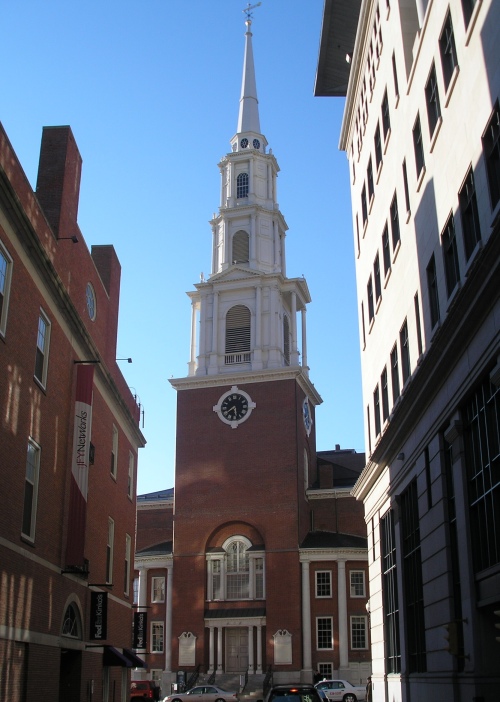
Boston’s Park Street Church was built in 1809-1810 on the site of the 1738 town granary (the Old Granary Burying Ground is next door). The church‘s architect, Peter Banner, adapted the steeple from a design by Sir Christopher Wren. Solomon Willard carved the wooden capitals of the front columns. Either because of the “fire and brimstone” sermons of its Congregational preachers or the fact that gunpowder was stored in its basement during the War of 1812, the corner of Tremont and Park Streets, where the church is located, came to be known as “Brimstone Corner.” The church has had many firsts: the first Sunday School in America was founded here in 1817; the first missionaries to be sent to Hawaii started from here in 1819; the first prison aid society was founded here in 1824; William Lloyd Garrison made his first public anti-slavery speech here in 1829; and Samuel Francis Smith’s hymn, America (“My Country ‘Tis of Thee“) was sung for the first time on the church‘s steeps by Park Street’s Children’s Choir in 1831. Park Street Church is on Boston’s Freedom Trail.

20 Pinckney Street, Boston (1852)

by Dan/January 10, 2009June 29, 2013/Boston, Federal, Houses

20-pinckney-street.jpg

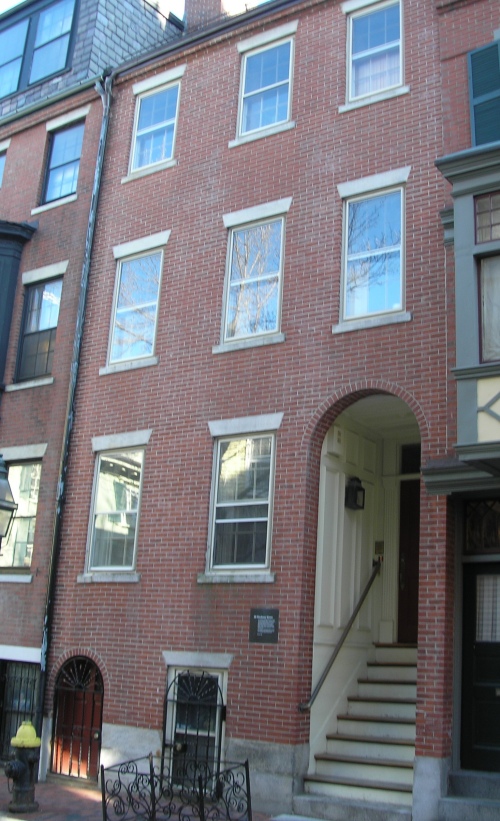
The house at 20 Pinckney Street on Boston’s Beacon Hill is listed in some online sources as having been built in 1860, but it must have been built sometime before 1852, because from 1852 to 1855, it was the home of Bronson Alcott and his family. Louisa May Alcott’s room was on the house‘s third floor. While living here, Louisa’s first story was published, “The Rival Painters: a Tale of Rome” in 1852 and her first book, Flower Fables (1854). Later, after Louisa May Alcott became a successful writer, she lived in nearby Louisburg Square, looking after her father.

William Ellery Channing House (1835)

by Dan/January 9, 2009September 17, 2016/Boston, Greek Revival, Houses

83-mt-vernon-street.jpg

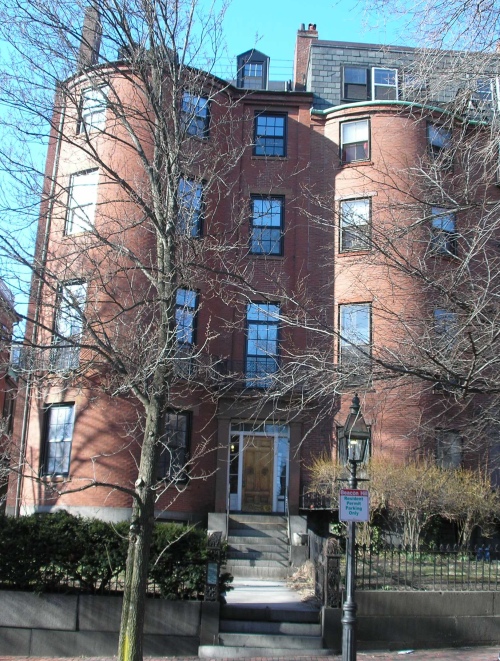
Dr. William Ellery Channing was a leading Unitarian preacher and theologian, who was minister of the Federal Street Church in Boston from 1830-1842. Asher Benjamin designed the 1835 house at 83 Mount Vernon Street, on Boston’s Beacon Hill, where Channing and his family lived from 1835 until his death in 1842. Among the distinguished visitors at the house was Charles Dickens, who had breakfast with Channing in 1842. Dr. Channing’s nephew was William Ellery Channing, the Transcendentalist poet.

Massachusetts State House (1798)

by Dan/December 19, 2008October 20, 2009/Boston, Federal, Public Buildings

mass-state-house.jpg

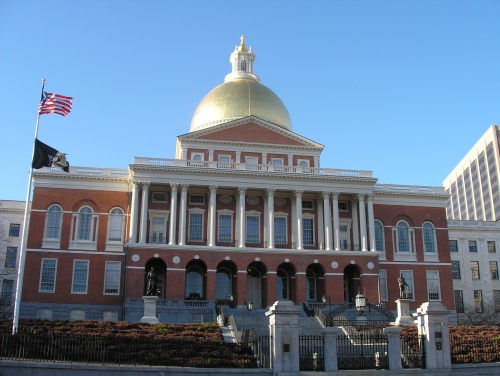
The Massachusetts State Capitol building in Boston, designed by Charles Bulfinch, was completed in 1798. The government of Massachusetts had previously used the Old State House, so the current building is sometimes called the New State House. It was built on Beacon Hill, on land once owned by John Hancock. The site on Beacon Hill was lowered 50 feet for the construction, with the excavated dirt being used as landfill. Bulfinch modeled his design on William Chambers‘s Somerset House and James Wyatt‘s Pantheon, both in London. The capitol building‘s dome was originally made of wood, which soon leaked. In 1802, it was covered with copper by Paul Revere’s company. Originally painted gray, to resemble stone, it was later painted yellow and, in 1874, gilded with gold. It was most recently regilded in 1997. The building was expanded with the addition of a yellow brick annex in 1895 and the two massive marble wings, on each side, in 1914 and 1917. The State House underwent a restoration in 2000. Today, this important structure, which Oliver Wendell Holmes once called, “the hub of the solar system,” is open to the public for tours.

Posts navigation

Older posts
Newer posts
Privacy Policy

Categories

  • Architectural Style (943)
    • Art Deco (9)
    • Byzantine (3)
    • Colonial (177)
    • Colonial Revival (85)
    • Craftsman (6)
    • Egyptian Revival (1)
    • Federal (190)
    • Foursquare (6)
    • Gothic (67)
    • Greek Revival (100)
    • Italianate (82)
    • Mission Revival (2)
    • Mission/Spanish Colonial (1)
    • Modern (2)
    • Neoclassical (56)
    • Octagon (3)
    • Postmodern (1)
    • Queen Anne (46)
    • Renaissance Revival (26)
    • Romanesque Revival (53)
    • Second Empire (26)
    • Shingle Style (12)
    • Stick Style (13)
    • Tudor Revival (8)
    • Vernacular (49)
    • Victorian Eclectic (15)
  • Building Type (943)
    • Apartment Buildings (8)
    • Banks (18)
    • Churches (119)
    • Collegiate (32)
    • Commercial (102)
    • Hotels (16)
    • Houses (508)
    • Industrial (23)
    • Libraries (22)
    • Lighthouses (1)
    • Military (15)
    • Monuments (1)
    • Museums (12)
    • Organizations (39)
    • Outbuildings (17)
    • Public Buildings (50)
    • Schools (23)
    • Stations (5)
    • Synagogues (1)
    • Taverns (21)
    • Theaters (9)
  • Town (943)
    • Adams (11)
    • Agawam (4)
    • Amherst (50)
    • Boston (64)
    • Boylston (6)
    • Cambridge (30)
    • Clinton (21)
    • Concord (15)
    • Cummington (1)
    • Danvers (14)
    • Deerfield (31)
    • Gloucester (18)
    • Granville (10)
    • Great Barrington (2)
    • Hadley (9)
    • Hancock (15)
    • Harvard (32)
    • Holyoke (47)
    • Lenox (5)
    • Lexington (8)
    • Longmeadow (32)
    • Marblehead (40)
    • Marlborough (4)
    • Natick (22)
    • Newton (2)
    • Northampton (68)
    • Peabody (4)
    • Pittsfield (20)
    • Salem (110)
    • Saugus (4)
    • Sheffield (4)
    • South Hadley (8)
    • Southborough (8)
    • Southwick (4)
    • Springfield (67)
    • Stockbridge (19)
    • Stow (1)
    • Sturbridge (18)
    • Sudbury (7)
    • Waltham (11)
    • Watertown (1)
    • Wayland (8)
    • West Springfield (14)
    • Westfield (46)
    • Weston (2)
    • Worcester (26)
  • Uncategorized (1)

Recent Comments

  • Wilber Blackson on South Hadley
  • Tami Speiden on Stockbridge
  • DexGuru on Stockbridge

Tags

Alcott Amherst College Asher Benjamin Back Bay Baptist Beacon Hill Big E Black Heritage Trail bowfront Bulfinch Catholic Congregational Episcopal Freedom Trail Gambrel H.H. Richardson Harvard Hawthorne Historic Deerfield Isaac Damon lit Longfellow mansard Methodist Mount Holyoke Museum Museums NPS Old Sturbridge Village PEM Revolutionary War row houses saltbox Samuel McIntire Shakers Smith College SPNEA Springfield Armory Stephen C. Earle Storrowton Underground Railroad UU Washington William Fenno Pratt Witch Trials

Meta

  • Log in
  • Entries feed
  • Comments feed
  • WordPress.org
Proudly powered by WordPress | Theme: ShowMe by NEThemes.