Historic Buildings of Massachusetts

  • About
  • Index by Town
  • CT
  • About
  • Index by Town
  • CT

Category: Cambridge

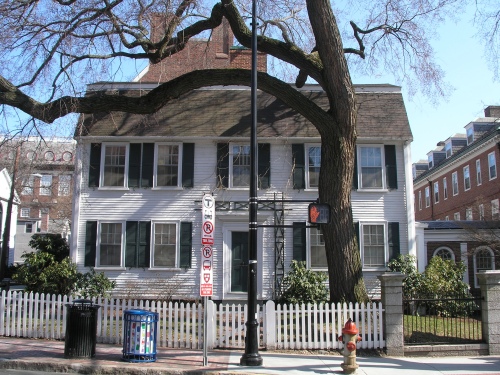
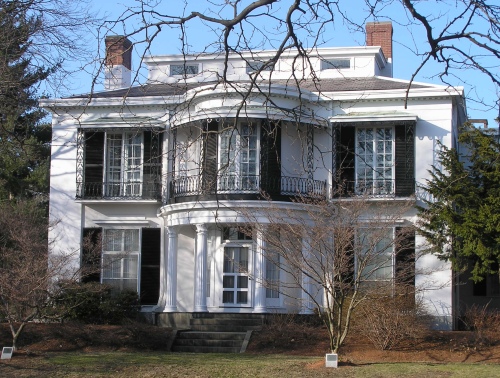
Oliver Hastings House (1844)
by Dan/February 11, 2009September 17, 2016/Cambridge, Greek Revival, Houses

oliver-hastings.jpg

Oliver Hastings was a nineteenth century architect-builder, who designed his own home on Brattle Street in Cambridge. Built in 1844 in the Greek Revival style, the Hastings House was sold in 1888 to William Lawrence. Lawrence was a professor and dean of the nearby Episcopal Theological School and later became Bishop of Massachusetts. The house was acquired by the school (now the Episcopal Divinity School) in 1924.
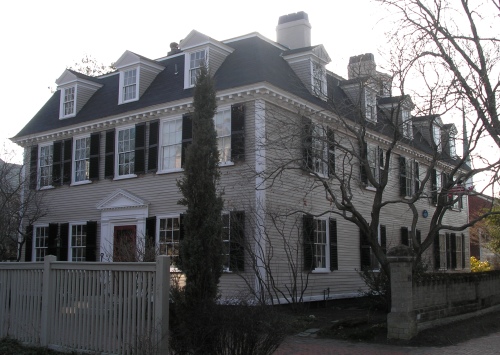
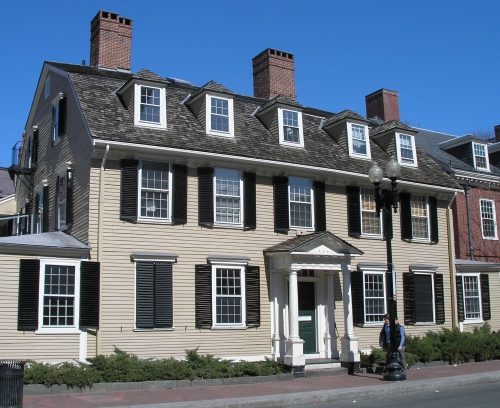
Henry Vassall House (1746)

by Dan/December 1, 2008/Cambridge, Colonial, Houses

henry-vassall-house.jpg

The oldest part of the Henry Vassall House, on Brattle Street in Cambridge, may date to as early as 1636, although the date usually given today is 1746. In that year, the property was sold by John Vassall Sr., who had purchased it in 1737, to his younger brother Henry Vassall. John Vassall’s son, Maj. John Vassall, built the nearby Vassall-Craigie-Longfellow House. Henry Vassall was a loyalist at the time of the Revolutionary War and the Vassall House is one of several homes belonging to loyalists along the section of Brattle Street known as Tory Row. These homes were either sold by their owners or seized during the Revolution. Vassall had died in 1769 and in 1775, his widow, Penelope Royall Vassall, fled to Boston and then to her estates in Antigua. According to the Historic Guide to Cambridge (1907):

“Just before sailing Madam Vassall petitioned the Provincial Congress, then sitting at Watertown, that she might be allowed to take with her some of her effects. Congress permitted her to take anything that she wanted except “provisions and her medicine chest.” The estate was not confiscated, as it belonged to a widow who had taken no active part against the patriots.”

The Continental Army at the time had only one other medicine chest besides the one in the Vassall House. “From these two all the regimental surgeons had to supply their needs. The fact that the medicines were here, and that there were twenty available rooms, besides halls and out-houses, may have been the reason that this house became the medical headquarters.” In 1775, Dr. Benjamin Church, who was effectively the first Surgeon General of the U.S. Army, was found to be sending secret letters to the British Commander, General Thomas Gage. Convicted of “communicating with the enemy,” Dr. Church was held for a time in the Vassall House as a prisoner. The house has remained a private home, with a number of alterations and additions being made to it over the years.

Harvard Hall (1766)

by Dan/October 7, 2008/Cambridge, Collegiate, Colonial

harvard-hall.jpg

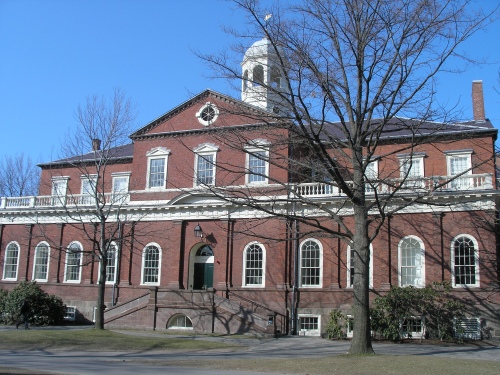
The first building to be called Harvard Hall was completed in Cambridge in 1642 and is more commonly known as Harvard College or the Old College. This structure eventually collapsed in the 1670s. The next Harvard Hall was built in Harvard Yard between 1672 and 1682. This building was destroyed in a fire in 1764. A new Harvard Hall, often called the second Harvard Hall, designed by Sir Francis Bernard, was built in 1766 at the same location as its predecessor. This building first divided the Yard into two quadrangles. Substantial additions have been made over the years: the original building was augmented with a central pavilion in 1842 and two wings on either side of the pavilion in 1870.

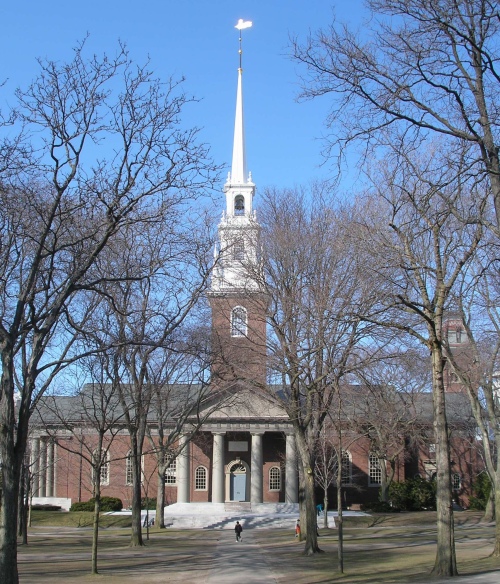
Memorial Church, Harvard (1931)

by Dan/July 29, 2008/Cambridge, Churches, Collegiate, Colonial Revival

memorial-church.jpg

Built to face the massive Widener Library across Harvard Yard, Memorial Church was built in 1931-2 and dedicated on Armistice Day 1932 in honor of those who died in World War I. Memorials to Harvard students who died in later wars have since been added inside the church. Memorial Church was designed in the Georgian Revival style by the architectural firm of Coolidge Shepley Bulfinch and Abbot.

John Hicks House (1762)

by Dan/July 25, 2008January 20, 2020/Cambridge, Colonial, Houses

john-hicks-house.jpg

Originally located on Dunster and Winthrop in Cambridge, the 1762 John Hicks House was later moved to its current address on John F. Kennedy Street to become the library of Harvard University‘s Kirkland House. A historic marker in front of the house explains that it was the home of John Hicks, who was killed by British soldiers in 1775. He was killed near the junction of North avenue and Spruce Street by the retreating British on April 19, 1775. The marker also indicates that the house was used by General Putnam as his office during the Revolutionary War. In 1773, the house was purchased by John Foxcroft. A car crashed into the house in 2006.

Benjamin Wadsworth House (1726)

by Dan/June 8, 2008September 17, 2016/Cambridge, Colonial, Houses

benjamin-wadsworth-house.jpg

In 1726, a house was constructed on Massachusetts Avenue in Cambridge, on the site where Harvard’s earliest building, the Peyntree House, had stood. It was first occupied by Harvard’s fourth president, Benjamin Wadsworth, his family and two slaves. After Wadsworth, it would serve as the home of eight other presidents, until 1849, when president Jared Sparks chose to reside in his own Cambridge home. During the Revolutionary War, the house was Washington’s first headquarters when he came to command the army during the siege of Boston in 1775. Do to its state of disrepair at the time, Washington soon moved to other quarters. Over the years, the house would serve as lodging for visiting ministers and student boarders (including Ralph Waldo Emerson). The building now houses the Office of the University Marshal and other offices. The Wadsworth House lost its front yard when Massachusetts Avenue was widened. Today it is the second oldest of Harvard’s surviving buildings, after Massachusetts Hall.

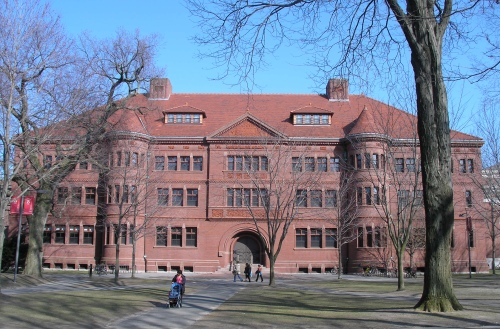
Sever Hall, Harvard (1880)

by Dan/May 12, 2008December 30, 2012/Cambridge, Collegiate, Romanesque Revival

sever-hall.jpg

Sever Hall, on the campus of Harvard University in Cambridge, is one of the most important buildings designed by the architect H.H. Richardson. Constructed between 1878 and 1880 in Richardson’s Romanesque style, Sever Hall is notable for its brickwork, which features 100,000 bricks on the exterior elevations and elaborate brick carving. Red mortar was used originally to join the bricks. The facade also has Longmeadow brownstone and a varied placement of windows. The massive structure is linked to the neighboring eighteenth century buildings of Harvard Yard through the use of brick, the greater regularity of the design and the central pediments on the east and west facades. Sever Hall, an academic building consisting of both large and small classrooms, was recently restored and the upper floors contain the film program of Harvard’s Department of Visual and Environmental Studies.

Posts navigation

Older posts
Newer posts
Privacy Policy

Categories

  • Architectural Style (943)
    • Art Deco (9)
    • Byzantine (3)
    • Colonial (177)
    • Colonial Revival (85)
    • Craftsman (6)
    • Egyptian Revival (1)
    • Federal (190)
    • Foursquare (6)
    • Gothic (67)
    • Greek Revival (100)
    • Italianate (82)
    • Mission Revival (2)
    • Mission/Spanish Colonial (1)
    • Modern (2)
    • Neoclassical (56)
    • Octagon (3)
    • Postmodern (1)
    • Queen Anne (46)
    • Renaissance Revival (26)
    • Romanesque Revival (53)
    • Second Empire (26)
    • Shingle Style (12)
    • Stick Style (13)
    • Tudor Revival (8)
    • Vernacular (49)
    • Victorian Eclectic (15)
  • Building Type (943)
    • Apartment Buildings (8)
    • Banks (18)
    • Churches (119)
    • Collegiate (32)
    • Commercial (102)
    • Hotels (16)
    • Houses (508)
    • Industrial (23)
    • Libraries (22)
    • Lighthouses (1)
    • Military (15)
    • Monuments (1)
    • Museums (12)
    • Organizations (39)
    • Outbuildings (17)
    • Public Buildings (50)
    • Schools (23)
    • Stations (5)
    • Synagogues (1)
    • Taverns (21)
    • Theaters (9)
  • Town (943)
    • Adams (11)
    • Agawam (4)
    • Amherst (50)
    • Boston (64)
    • Boylston (6)
    • Cambridge (30)
    • Clinton (21)
    • Concord (15)
    • Cummington (1)
    • Danvers (14)
    • Deerfield (31)
    • Gloucester (18)
    • Granville (10)
    • Great Barrington (2)
    • Hadley (9)
    • Hancock (15)
    • Harvard (32)
    • Holyoke (47)
    • Lenox (5)
    • Lexington (8)
    • Longmeadow (32)
    • Marblehead (40)
    • Marlborough (4)
    • Natick (22)
    • Newton (2)
    • Northampton (68)
    • Peabody (4)
    • Pittsfield (20)
    • Salem (110)
    • Saugus (4)
    • Sheffield (4)
    • South Hadley (8)
    • Southborough (8)
    • Southwick (4)
    • Springfield (67)
    • Stockbridge (19)
    • Stow (1)
    • Sturbridge (18)
    • Sudbury (7)
    • Waltham (11)
    • Watertown (1)
    • Wayland (8)
    • West Springfield (14)
    • Westfield (46)
    • Weston (2)
    • Worcester (26)
  • Uncategorized (1)

Recent Comments

  • Wilber Blackson on South Hadley
  • Tami Speiden on Stockbridge
  • DexGuru on Stockbridge

Tags

Alcott Amherst College Asher Benjamin Back Bay Baptist Beacon Hill Big E Black Heritage Trail bowfront Bulfinch Catholic Congregational Episcopal Freedom Trail Gambrel H.H. Richardson Harvard Hawthorne Historic Deerfield Isaac Damon lit Longfellow mansard Methodist Mount Holyoke Museum Museums NPS Old Sturbridge Village PEM Revolutionary War row houses saltbox Samuel McIntire Shakers Smith College SPNEA Springfield Armory Stephen C. Earle Storrowton Underground Railroad UU Washington William Fenno Pratt Witch Trials

Meta

  • Log in
  • Entries feed
  • Comments feed
  • WordPress.org
Proudly powered by WordPress | Theme: ShowMe by NEThemes.