Historic Buildings of Massachusetts

  • About
  • Index by Town
  • CT
  • About
  • Index by Town
  • CT

Category: Town

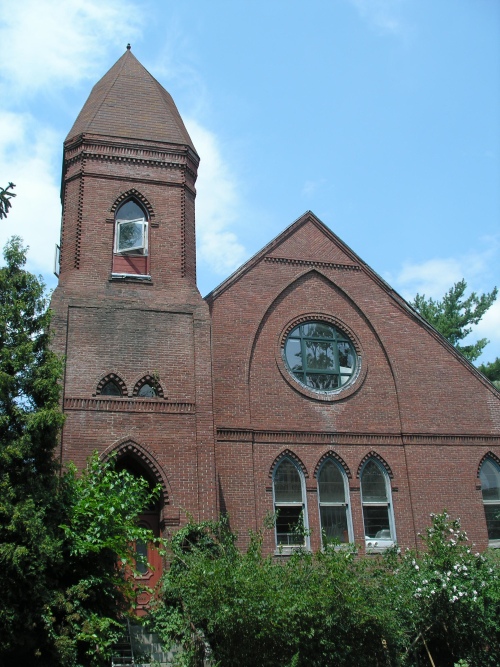
Wesley Methodist Church, Amherst (1878)
by Dan/July 31, 2011July 31, 2011/Amherst, Churches, Gothic

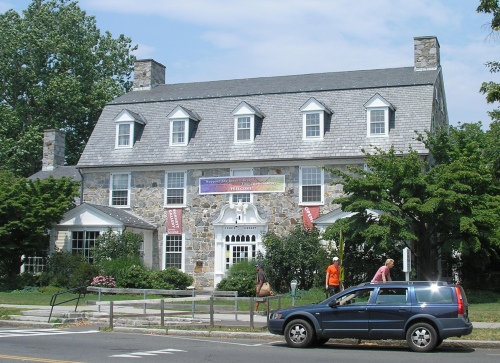
In 1972, architect Tullio Inglese and his wife Judith rescued the old Wesley Chapel, at 592 Main Street in Amherst, and converted it into their home and studio. Today, the former church houses the offices of TIA Architects and the Nacul Center for Ecological Architecture. According to The History of the Town of Amherst, Massachusetts (1896):

The Methodist church at Amherst center was organized in 1868 as a branch of the church at North Amherst. It was composed, in part, of members of the latter organization, together with a few members from the church in Pelham. It was organized as a separate society in August, 1875, when the first quarterly conference was held.

A church was soon constructed:

The cornerstone of the church was laid. Oct. 17. 1878, and the work progressed so rapidly that services were held in the vestry, Jan. 26, 1879. In 1880, a committee was appointed to superintend the building of sheds on the church lot. In 1886, the grounds about the church were graded and improved. A bell was procured in 1887.

The United Methodist Church serving Amherst is now located at 98 North Maple in Hadley.
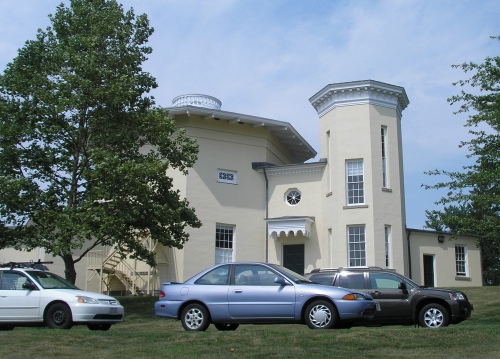
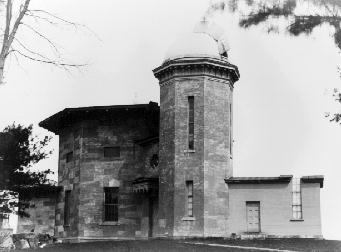
Octagon at Amherst College (1847)

by Dan/July 30, 2011July 4, 2012/Amherst, Collegiate, Octagon

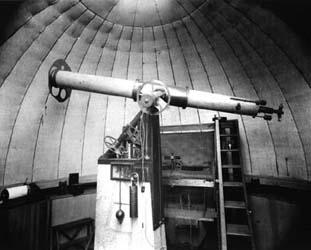
A distinctive building on the campus of Amherst College is the Octagon. Built in 1847-1848 and designed by Henry A Sykes, its wood exterior walls were covered in stucco, originally scored and painted to resemble large blocks. College president Edward Hitchcock requested that the building have an octagon shape, a decision that was initially controversial. The Octagon originally housed the Woods Cabinet, the College’s scientific collection, and the Lawrence Observatory. The attached octagonal tower contained the observatory telescope. An 1855 addition housed a geology lecture room and a galley for the College’s Assyrian reliefs. After a new observatory was built in 1905, the Octagon housed other departments. In 1934-1935, the second floor of the Woods Cabinet was remodeled by architect James Kellum Smith as a meeting room, known as the Babbott Room.

Jones Library, Amherst (1928)

by Dan/July 30, 2011December 1, 2011/Amherst, Colonial Revival, Libraries

Jones Library, 43 Amity Street in Amherst, was begun in 1927 and dedicated in 1928. An earlier library had been located in the town hall. The Jones Library, named for its benefactor, Samuel Minot Jones, was incorporated in 1919. From 1921 to 1926, the library rented rooms in the Amherst House, which stood at the corner of South Pleasant and Amity Streets. After the Amherst House burned down in 1926, the library briefly moved its operations into the Whipple House on North Pleasant Street, until the current library building, built of Pelham field stone, was completed. The Jones Library has notable collections of material relating to Emily Dickinson and Robert Frost.

The Evergreens (1856)

by Dan/July 29, 2011December 1, 2011/Amherst, Houses, Italianate

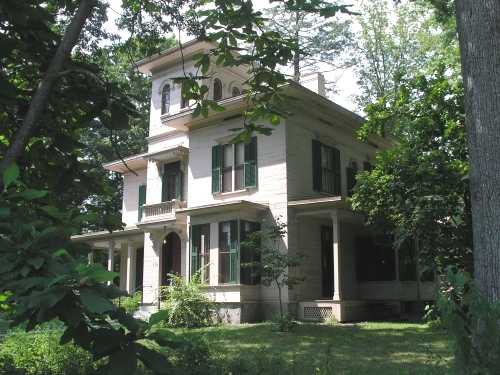
The Evergreens is a house in Amherst built in 1856 by Edward Dickinson for his his son, William Austin Dickinson, who had just married Susan Huntington Gilbert. Austin Dickinson was a lawyer and succeeded his father as treasurer of Amherst College, serving from 1874 until his death in 1895. He is also known for his longtime affair with Mabel Loomis Todd, who would edit early collections of poetry written by Austin’s sister, Emily Dickinson. The Italianate-style Evergreens, designed by Northampton architect William Fenno Pratt, was built next to the Dickinson Homestead, where Emily resided with her sister, Lavinia. The Evergreens became a social and cultural center in the town. After Austin and Sarah Dickinson died (the latter in 1913), the house was lived in and preserved by their daughter, Martha Dickinson Bianchi (died 1943), who left the house to her secretary, Alfred Leete Hampson, stipulating in her will that if Hampson and his family chose not to live in the house, it should be torn down. Hampson’s widow, Mary Landis Hampson, made arrangements in her own will to preserve the house under a trust for public use. Since 2003, it has been owned by Amherst College and, along with the Emily Dickinson Homestead, forms part of the Emily Dickinson Museum.

Phoenix Row (1838)

by Dan/July 29, 2011August 8, 2011/Amherst, Commercial, Italianate

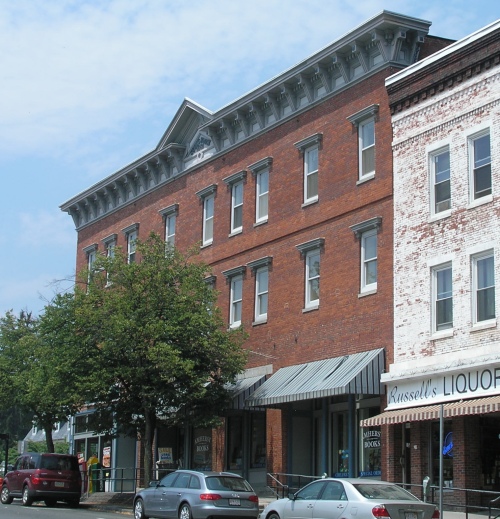
The first great fire in Amherst swept through the center of town in February 1838. Out of the ashes was built a new commercial block with the appropriate name: Phoenix Row. The building, located at 4-16 Main Street, survived another fire in 1872, which started in the outbuildings to its rear. It soon underwent renovations that significantly altered its appearance, most notably with the addition of a new flat Italianate style roof with decorative brackets and gable. Phoenix Row has survived other fires in 1883 and 1989 and continues as a business block today.

Lysander H. Allen House (1886)

by Dan/July 28, 2011July 29, 2011/Amherst, Houses, Stick Style

Lysander H. Allen, a wire goods manufacturer, built his house, at 599 Main Street in Amherst, in 1886. In later years it was the home of his son, Harry Allen, who taught at Amherst College. The house, which is a notable example of the stick style of architecture, was the winner of the 1991 Amherst Historical Commission‘s Preservation Award. It is now a bed & breakfast known as the Allen House Inn.

Helen Hunt Jackson House (1830)

by Dan/July 28, 2011/Amherst, Greek Revival, Houses

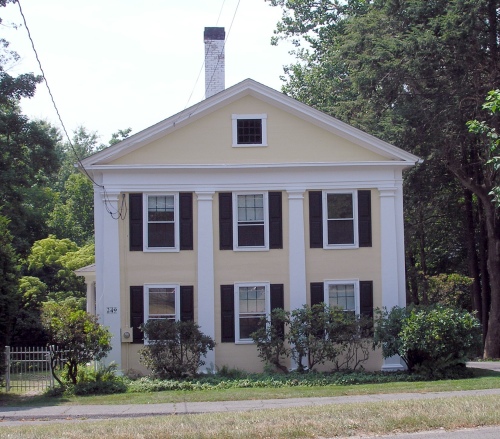
Helen Hunt Jackson, the author of many books and poems, was born Helen Maria Fiske in Amherst in 1830 in a Greek Revival house, built the same year at 249 South Pleasant Street. Her father, Nathan Fiske, was a minister and a professor of Language and Philosophy at Amherst College. A contemporary and classmate of Emily Dickinson, Helen Hunt Jackson was educated at the Ipswich Female Seminary and at the Abbott Brothers’ School in New York City. She was married twice, lost two sons and lived later in life in Colorado. An activist who denounced the treatment of Native Americans by the U.S. government, she detailed the history of broken treaties and called for reform in her book, A Century of Dishonor (1881). Inspired by Harriet Beecher Stowe’s Uncle Tom’s Cabin, she also addressed the issue of the federal government’s mistreatment of Native Americans in her novel, Ramona (1884). Her birthplace was later acquired by Amherst College and is now a private residence.

Posts navigation

Older posts
Newer posts
Privacy Policy

Categories

  • Architectural Style (943)
    • Art Deco (9)
    • Byzantine (3)
    • Colonial (177)
    • Colonial Revival (85)
    • Craftsman (6)
    • Egyptian Revival (1)
    • Federal (190)
    • Foursquare (6)
    • Gothic (67)
    • Greek Revival (100)
    • Italianate (82)
    • Mission Revival (2)
    • Mission/Spanish Colonial (1)
    • Modern (2)
    • Neoclassical (56)
    • Octagon (3)
    • Postmodern (1)
    • Queen Anne (46)
    • Renaissance Revival (26)
    • Romanesque Revival (53)
    • Second Empire (26)
    • Shingle Style (12)
    • Stick Style (13)
    • Tudor Revival (8)
    • Vernacular (49)
    • Victorian Eclectic (15)
  • Building Type (943)
    • Apartment Buildings (8)
    • Banks (18)
    • Churches (119)
    • Collegiate (32)
    • Commercial (102)
    • Hotels (16)
    • Houses (508)
    • Industrial (23)
    • Libraries (22)
    • Lighthouses (1)
    • Military (15)
    • Monuments (1)
    • Museums (12)
    • Organizations (39)
    • Outbuildings (17)
    • Public Buildings (50)
    • Schools (23)
    • Stations (5)
    • Synagogues (1)
    • Taverns (21)
    • Theaters (9)
  • Town (943)
    • Adams (11)
    • Agawam (4)
    • Amherst (50)
    • Boston (64)
    • Boylston (6)
    • Cambridge (30)
    • Clinton (21)
    • Concord (15)
    • Cummington (1)
    • Danvers (14)
    • Deerfield (31)
    • Gloucester (18)
    • Granville (10)
    • Great Barrington (2)
    • Hadley (9)
    • Hancock (15)
    • Harvard (32)
    • Holyoke (47)
    • Lenox (5)
    • Lexington (8)
    • Longmeadow (32)
    • Marblehead (40)
    • Marlborough (4)
    • Natick (22)
    • Newton (2)
    • Northampton (68)
    • Peabody (4)
    • Pittsfield (20)
    • Salem (110)
    • Saugus (4)
    • Sheffield (4)
    • South Hadley (8)
    • Southborough (8)
    • Southwick (4)
    • Springfield (67)
    • Stockbridge (19)
    • Stow (1)
    • Sturbridge (18)
    • Sudbury (7)
    • Waltham (11)
    • Watertown (1)
    • Wayland (8)
    • West Springfield (14)
    • Westfield (46)
    • Weston (2)
    • Worcester (26)
  • Uncategorized (1)

Recent Comments

  • Wilber Blackson on South Hadley
  • Tami Speiden on Stockbridge
  • DexGuru on Stockbridge

Tags

Alcott Amherst College Asher Benjamin Back Bay Baptist Beacon Hill Big E Black Heritage Trail bowfront Bulfinch Catholic Congregational Episcopal Freedom Trail Gambrel H.H. Richardson Harvard Hawthorne Historic Deerfield Isaac Damon lit Longfellow mansard Methodist Mount Holyoke Museum Museums NPS Old Sturbridge Village PEM Revolutionary War row houses saltbox Samuel McIntire Shakers Smith College SPNEA Springfield Armory Stephen C. Earle Storrowton Underground Railroad UU Washington William Fenno Pratt Witch Trials

Meta

  • Log in
  • Entries feed
  • Comments feed
  • WordPress.org
Proudly powered by WordPress | Theme: ShowMe by NEThemes.