Historic Buildings of Massachusetts

  • About
  • Index by Town
  • CT
  • About
  • Index by Town
  • CT

Category: Town

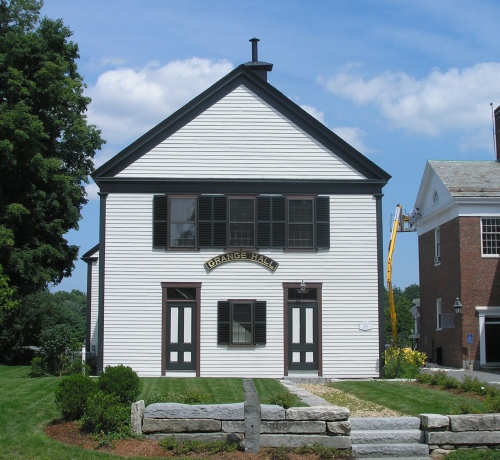
Sudbury Grange Hall (1846)
by Dan/August 26, 2009August 26, 2009/Organizations, Schools, Sudbury, Vernacular

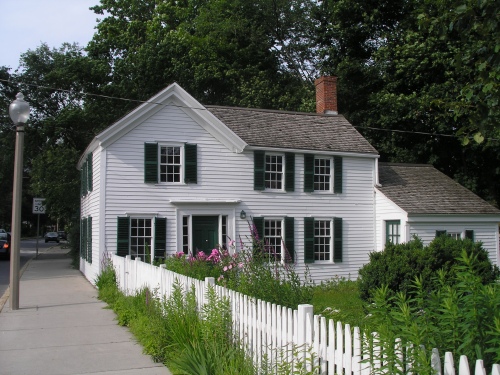
Sudbury Grange Hall

In 1846, the same year Sudbury’s original Town Hall (rebuilt in 1932) was constructed, a schoolhouse was built on the southeast corner of Sudbury Common. The structure was later raised to two-stories. The building, later moved to its current location next to the Town Hall, served as a school until 1890, when it was sold to the Sudbury Grange. In 2006, the building was acquired by the Sudbury Foundation and has been restored and modernized, with a new rear addition. The first floor is now the Foundation’s offices and the second floor is used by the Sudbury Grange and as a public meeting space by the town.
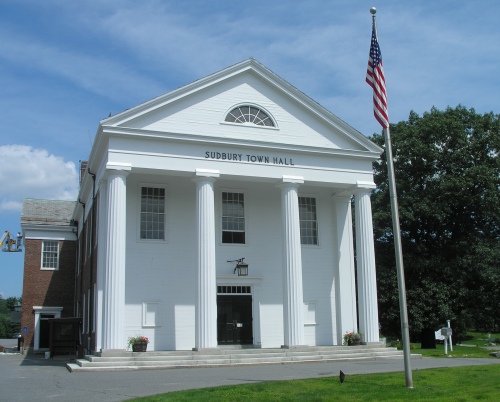
Sudbury Town Hall (1932)

by Dan/August 26, 2009August 26, 2009/Greek Revival, Public Buildings, Sudbury

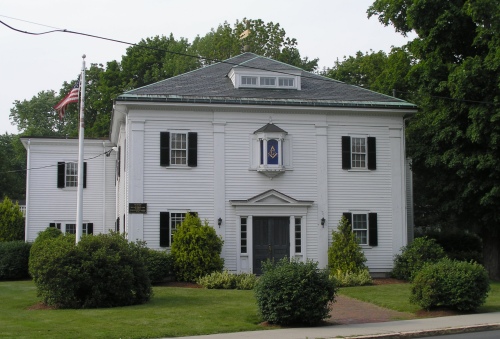
Sudbury Town Hall

Sudbury‘s original Greek Revival-style Town Hall, built in 1846, stood in Sudbury Center until it was destroyed by fire in 1930. A new building, following the same design but enlarged to plans by Charles H. Way, a Sudbury architect, was built in 1932. The Sudbury Historical Society is located on the Town Hall’s upper floor.

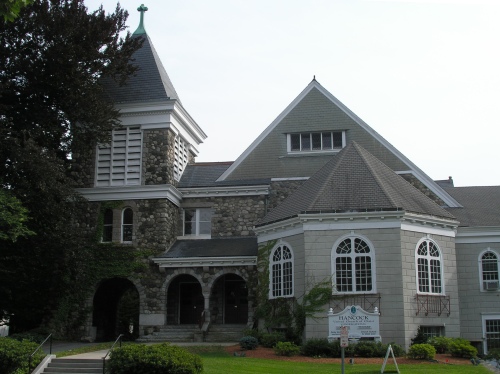
Hancock United Church of Christ (1893)

by Dan/August 17, 2009January 18, 2020/Churches, Craftsman, Lexington, Queen Anne, Shingle Style

Hancock Church

In 1819, the First Congregational Society of Lexington became Unitarian. The minority of Trinitarian Congregationalists attended the local Baptist church for a time, but in 1868 formed the Hancock Congregational Society. The Congregation occupied the old Lexington Academy building until 1893, when the current Hancock Congregational Church was built. The church, designed by Paine and Lewis, features both Shingle Style siding and fieldstone walls. Many additions have been made over the years, including a new stuccoed wing in 1951.

Lexington Masonic Building (1822)

by Dan/August 17, 2009November 26, 2016/Greek Revival, Lexington, Organizations, Schools

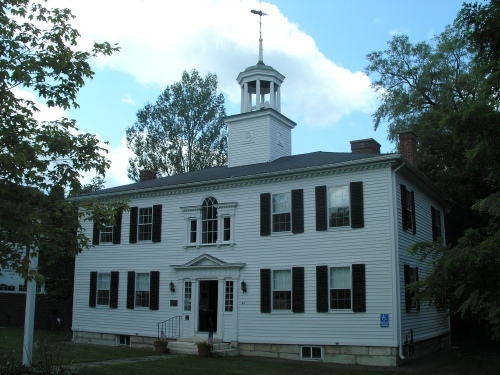
Lexington Academy

Opposite the Battle Green in Lexington is the Lexington Masonic Building. It was originally built in 1822 to house the Lexington Academy, which only lasted eleven years. From 1835 to 1837, it was used for the Lexington Manual Labor Seminary, an early trade school, and in 1839 the building was taken over by the state to become the first Normal School in America. A school for the training of teachers, it was established by Horace Mann, who chose Rev. Cyrus Pierce to run it. This educational experiment proved successful and soon moved to larger quarters, first to Newton in 1844 and then to Framingham in 1853. The building was later used for tenements and a grocery store. It served as the Hancock Congregational Church from 1868 to 1893. The former school became a Masonic Lodge in 1917.

Garrity House (1856)

by Dan/August 17, 2009September 17, 2016/Houses, Lexington, Vernacular

Garrity House

A complex of several farm buildings once surrounded the Buckman Tavern in Lexington. The only ones to survive today are a Federal-style carriage house and the adjacent Garrity House. Built in the first half of the nineteenth century, the Garrity House is privately owned today, although the Town maintains the grounds through a land lease and preservation agreement.

Lenox Academy (1803)

by Dan/August 11, 2009September 10, 2012/Federal, Lenox, Schools

Lenox Academy was built in 1803, on Main Street in Lenox. According to Rev. Raymond DeWitt Mallary, in Lenox and the Berkshire Highlands (1902), wrote:

To be a graduate of Lenox Academy was not only a distinction, it was a passport to any college, and often to the sophomore class of a higher institution of learning. The papers of the day within a radius of a hundred miles refer to this preparatory school with glowing commendation. Its pupils came from widely separated portions of the country and the fame of its examinations, which were of unusual rigidity, attracted visitors from long distances, who repaired to their homes to spread the report of them. The tuition was very moderate, —$7 a term of fourteen weeks; and board reached the not exorbitant sum of “$1.25 to $1.50 per week in good families.” The tradition has survived that one pupil (long a distinguished educator and only lately deceased) ” lived like a dandy because he had rooms at the hotel, for which he paid $2 per week.” Lenox Academy flourished until 1866.

The building housed various schools until the 1920s and was saved from demolition in 1947 when the town took it over. It housed various public organizations and today it is the headquarters of the Lenox Historical Society, which operates the Museum of Lenox History.

Ventfort Hall (1891)

by Dan/August 10, 2009/Houses, Lenox, Tudor Revival

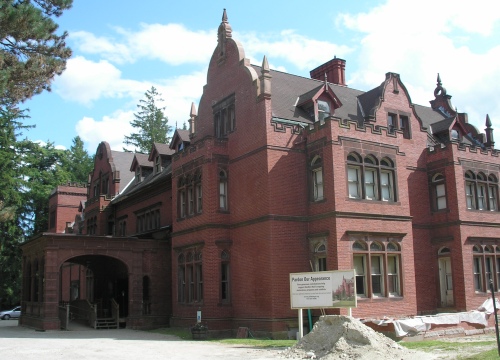
Ventfort Hall

Ventfort Hall, a Gilded Age mansion in Lenox, was built in 1891 by George Morgan and his wife, Sarah, the sister of J. Pierpont Morgan. The house was designed in the Elizabethan Revival style by the Boston architectural firm of Rotch & Tilden. The name of Venfort Hall is from vent fort, or “strong wind.” The house stands on the site once occupied by the Italianate villa owned by the Haggerty family. Annie Haggerty married Col. Robert Gould Shaw, who commanded the famous black regiment, the 54th Massachusetts, in the Civil War. After the Morgans died, the house passed through various renters and owners, eventually serving as a dormitory for Tanglewood students, a hotel, a summer ballet camp and housing for a religious community. In danger of being demolished, the Ventfort Hall Association (VHA) purchased the house in 1997, restoring it and opening it for tours and exhibits. The mansion appeared as the orphanage in the film The Cider House Rules (1998).

Posts navigation

Older posts
Newer posts
Privacy Policy

Categories

  • Architectural Style (943)
    • Art Deco (9)
    • Byzantine (3)
    • Colonial (177)
    • Colonial Revival (85)
    • Craftsman (6)
    • Egyptian Revival (1)
    • Federal (190)
    • Foursquare (6)
    • Gothic (67)
    • Greek Revival (100)
    • Italianate (82)
    • Mission Revival (2)
    • Mission/Spanish Colonial (1)
    • Modern (2)
    • Neoclassical (56)
    • Octagon (3)
    • Postmodern (1)
    • Queen Anne (46)
    • Renaissance Revival (26)
    • Romanesque Revival (53)
    • Second Empire (26)
    • Shingle Style (12)
    • Stick Style (13)
    • Tudor Revival (8)
    • Vernacular (49)
    • Victorian Eclectic (15)
  • Building Type (943)
    • Apartment Buildings (8)
    • Banks (18)
    • Churches (119)
    • Collegiate (32)
    • Commercial (102)
    • Hotels (16)
    • Houses (508)
    • Industrial (23)
    • Libraries (22)
    • Lighthouses (1)
    • Military (15)
    • Monuments (1)
    • Museums (12)
    • Organizations (39)
    • Outbuildings (17)
    • Public Buildings (50)
    • Schools (23)
    • Stations (5)
    • Synagogues (1)
    • Taverns (21)
    • Theaters (9)
  • Town (943)
    • Adams (11)
    • Agawam (4)
    • Amherst (50)
    • Boston (64)
    • Boylston (6)
    • Cambridge (30)
    • Clinton (21)
    • Concord (15)
    • Cummington (1)
    • Danvers (14)
    • Deerfield (31)
    • Gloucester (18)
    • Granville (10)
    • Great Barrington (2)
    • Hadley (9)
    • Hancock (15)
    • Harvard (32)
    • Holyoke (47)
    • Lenox (5)
    • Lexington (8)
    • Longmeadow (32)
    • Marblehead (40)
    • Marlborough (4)
    • Natick (22)
    • Newton (2)
    • Northampton (68)
    • Peabody (4)
    • Pittsfield (20)
    • Salem (110)
    • Saugus (4)
    • Sheffield (4)
    • South Hadley (8)
    • Southborough (8)
    • Southwick (4)
    • Springfield (67)
    • Stockbridge (19)
    • Stow (1)
    • Sturbridge (18)
    • Sudbury (7)
    • Waltham (11)
    • Watertown (1)
    • Wayland (8)
    • West Springfield (14)
    • Westfield (46)
    • Weston (2)
    • Worcester (26)
  • Uncategorized (1)

Recent Comments

  • Wilber Blackson on South Hadley
  • Tami Speiden on Stockbridge
  • DexGuru on Stockbridge

Tags

Alcott Amherst College Asher Benjamin Back Bay Baptist Beacon Hill Big E Black Heritage Trail bowfront Bulfinch Catholic Congregational Episcopal Freedom Trail Gambrel H.H. Richardson Harvard Hawthorne Historic Deerfield Isaac Damon lit Longfellow mansard Methodist Mount Holyoke Museum Museums NPS Old Sturbridge Village PEM Revolutionary War row houses saltbox Samuel McIntire Shakers Smith College SPNEA Springfield Armory Stephen C. Earle Storrowton Underground Railroad UU Washington William Fenno Pratt Witch Trials

Meta

  • Log in
  • Entries feed
  • Comments feed
  • WordPress.org
Proudly powered by WordPress | Theme: ShowMe by NEThemes.