Historic Buildings of Massachusetts

  • About
  • Index by Town
  • CT
  • About
  • Index by Town
  • CT

Category: Building Type

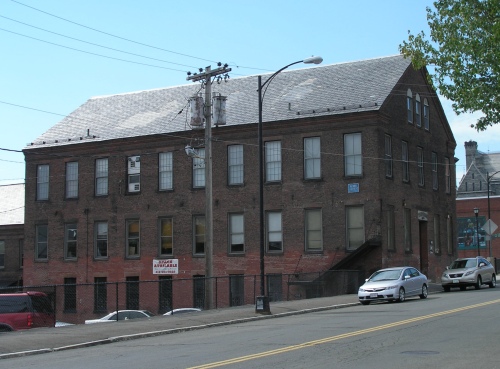
Wauregan Paper Company (1879)
by Dan/June 6, 2014/Greek Revival, Holyoke, Industrial

Wauregan Hall

Located at 418-420 Dwight Street, between the first and second level canals in Holyoke, is an old mill building constructed by James H. Newton in 1879. Newton had purchased the land from his brothers, David H. and John C. Newton, in 1871. The Newton family established many industrial concerns in Holyoke. The Wauregan Paper Company purchased the mill from Newton in 1880 and used it to produce book papers. In 1899, the company was incorporated into the American Writing Paper Company. The building, known as Wauregan Hall, continued to be used over the years for light manufacturing. It was acquired in 2009 by three artists from San Francisco who have plans to transform it into a European-style in-door market for artisanal food producers. Continue reading “Wauregan Paper Company (1879)”
John Mycall House (1798)

by Dan/May 29, 2014/Federal, Harvard, Houses

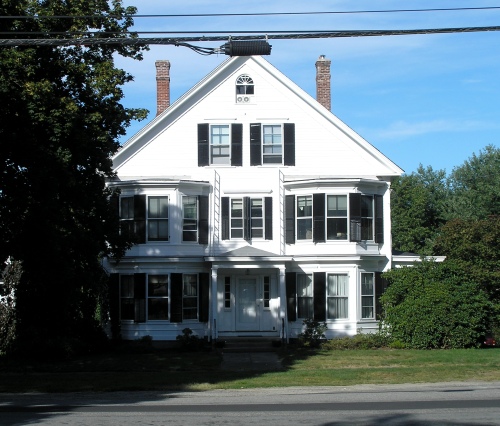
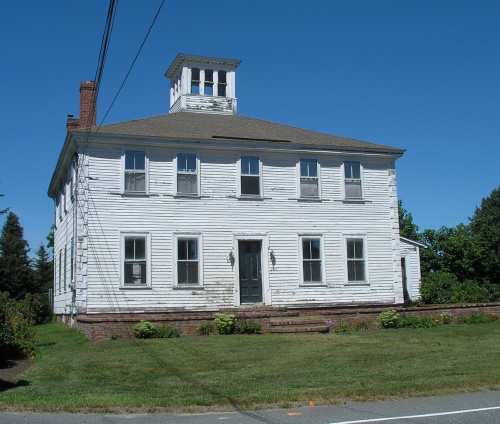
John Mycall House

Stephen Cleverly began constructing the hip-roofed house at 204 Still River Road in Harvard in the early 1790s. As described in the History of the Town of Harvard, Vol. II (1894), by Henry S. Nourse:

Stephen Cleverly, an eccentric genius, son of Dr. John Cleverly, succeeded [the merchant John] Munroe [at Still River] at the close of the Revolution, but his business career was brief and unfortunate. He began the erection of the large dwelling well known as the Mycall or Jerome Gardner house, but his enterprise ended in financial trouble, and he removed to Lancaster with his father. Thereafter he indulged his taste for strong drink, became besotted and insane, and died at the age of seventy-two, A. D. 1832, in the alms-house. He was an educated man, had a talent for rhyming, and in his later years was wont to wander about, half-tipsy, repeating whenever he could find listeners certain scurrilous verses of his own composition, in which he satirized his fellow- men and scoffed at the world in general.

Cleverly’s creditors sold his unfinished house to John Mycall in 1798. Originally from Worcester, England, John Mycall (1757-1840) had emigrated to Newburyport in 1775, where he was editor of the Essex Journal from 1780 to 1790. Mycall operated a retail shop in the rear ell of his house in Harvard. Again quoting from Nourse:

Of John Mycall, when publisher at Newburyport, the following story has been more than once printed. The sheriff had been a regular subscriber to the Journal for a long time, but failed to pay the bills presented to him, save in profuse promises. One day, being urgently pressed for the amount due, the sheriff with his usual earnest manner, said: “Mr. Mycall, you shall have your money tomorrow, if I am alive; you may be certain I am a corpse if you are not paid in full.” When the sheriff began reading the next issue of the paper he was astounded to find staring him in the face the formal announcement of the “sudden death of Philip Bagley, Esq, Sheriff of Essex County,” followed by a flattering obituary, which closed with the sentence: “Alas! Sheriff Bagley had one grave fault—he neglected to pay the printer.” He threw down the sheet in a rage and rushed out to contradict the report. He met several acquaintances, but no one seemed at all surprised to see him in his usual vigor, until he entered the printing office. The publisher put on a look of grave astonishment, ejaculating: “Why, Mr. Sheriff, I thought you a corpse.” “Who told you so?” asked the angry official. “Why, you yourself were my authority”— and he recalled the solemn promise. The sheriff drew his wallet, paid the bill, and demanded that the statement be contradicted in the next week’s Journal. “O,” said Mycall, “that isn’t at all necessary; the notice was printed in but one copy of the Journal; that one sent to you.”

[In 1808] Squire Mycall became entangled in some litigation with Joseph Stone, shook Harvard dust from his feet and returned to Newburyport, where he died.

Mycall’s Harvard property was sold to Jerome Gardner, a merchant and prominent citizen who held a number of local offices. After the Civil War, the house served for a time as a summer hotel, run by Merrick Puffer. In the mid-nineteenth century, the house’s original center chimney was removed and replaced by an Italianate cupola.

Ebenezer Clark House (1730)

by Dan/May 22, 2014/Colonial, Houses, Northampton

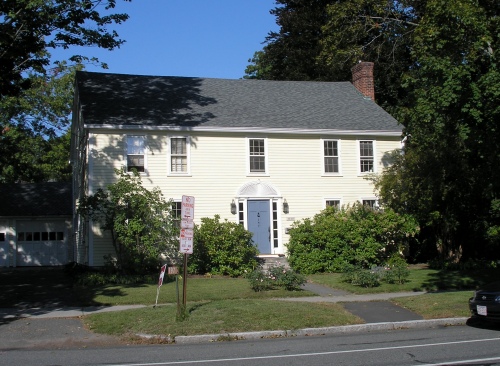
Ebenezer Clark House

Although much altered over the years, the house at 197 Elm Street in Northampton dates back to 1730. It was built Ebenezer Clark and old church and town records were kept here for many years. For eighty-five years the house was the residence of Jared Clark, who held the office of deacon at the First Congregational Church for nearly fifty years, starting in 1839. The house was later owned by Frank H. Hankins, a sociologist and professor at Smith College.

Gardner-Wood-Hersey House (1817)

by Dan/May 21, 2014/Federal, Harvard, Houses

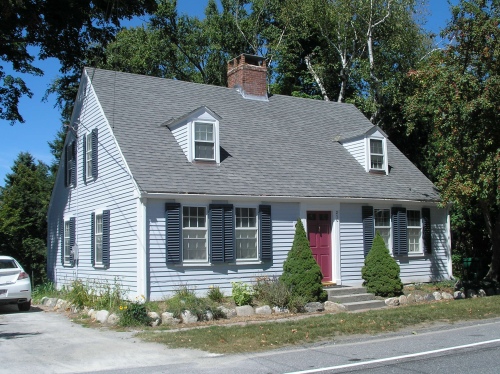
210 Still River Rd., Harvard

The center-chimney Cape house at 210 Still River Road in Harvard was erected sometime before 1817 by Reuben Gardner. It was later owned by Anne Adams, who sold it to Joshua Tucker in 1827. He sold it to Otis Atherton and Ameriah Wood, who worked at a tannery nearby on Still River, in 1830. Thomas Hersey acquired the house in 1839. He was a delegate to the 1820 convention to revise the state constitution. The house passed from Hersey’s heirs to the Haskell family in 1876.

Morgan-Way House (1817)

by Dan/May 16, 2014May 16, 2014/Federal, Houses, Westfield

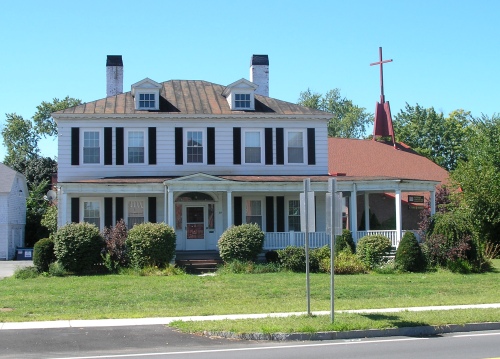
Morgan-Way House

Once thought to have been built in the 1780s by John Phelps, the house at 29 Broad Street in Westfield was actually built circa 1820 (perhaps as early as 1817) by Major Archippus Morgan (1772-1857), a merchant from Pittsfield. He also built the Morgan Block in Westfield. After Morgan‘s death in 1857, his widow, Parmelia Taylor Morgan, lived in the house until her death in 1867. The Way family owned the house from 1883 until 1944, when it was converted for use as a funeral home by Stanley and Donald Healey. In 1914, John T. Way had removed the house’s roof balustrade and added metal roofing, two dormer windows and a front porch. Continue reading “Morgan-Way House (1817)”

Old Draper Hotel (1871)

by Dan/May 7, 2014May 7, 2014/Commercial, Hotels, Italianate, Northampton

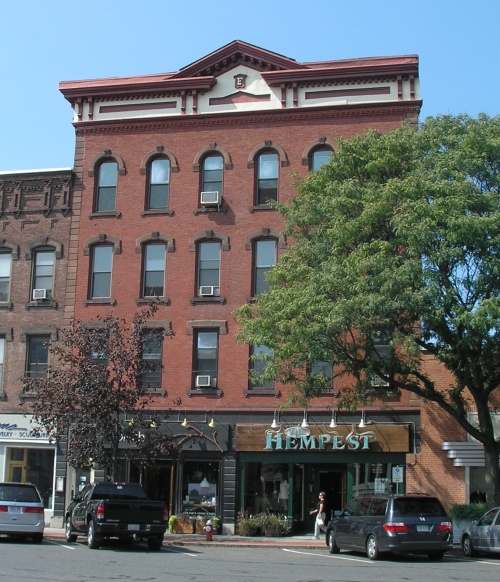
Old Draper Hotel

The Warner House, also known as the Warner Tavern or Warner’s Coffee House, was for years the most popular public house in Northampton. After it was destroyed by fire in 1870, a new building, planned by J.M. Miner, was constructed on its former location on Main Street. Called the Fitch Hotel, it consisted of a central block flanked by two wings. Only the westernmost wing survives today. It features an “F” monogram in the center of the roof pediment of the façade. The hotel, located at 179 Main Street, later became the Draper Hotel. The hotel is described in an article (“Industrial Northampton”) that appeared in Western New England (Vol. I, No. 11, October, 1911):

Northampton is unusually well-equiped, for a city of its size, with high-class hotels and restaurants. The Draper, the most prominent hotel in Northampton, is favorably known throughout the country as a result of its entertaining well the people from almost everywhere who are drawn to Northampton by college exercises and by business affairs. The Draper compares favorably in quality with hotels in large cities. The rathskeller is particularly well known among men who have occasion to visit Northampton. The hotel aims to provide its patrons with whatever they wish and to its excellent dining room and rathskeller has recently been added a “self-service” restaurant and lunch room where one may get a wholesome meal in a short time and at small cost. The Draper offers both American and European rates.

Daby-Bigelow House (1880)

by Dan/May 7, 2014/Harvard, Houses, Victorian Eclectic

Daby-Bigelow House

The lot at 5 Fairbank Street in Harvard was purchased by Asa Daby (died 1813) in 1797. He built a house there that eventually burned down in 1880. By that time the property was owned by Daby‘s two sons, Asa (1797-1887) and Ethan (1799-1876), who soon built a new house on the site. Asa Daby, Jr. served as town selectman in 1837-42 and 1844-47, was elected a state representative in 1839 and 1841, and was town treasurer from 1847 to 1879. He was also director of the Lancaster Savings Bank. Later occupied by his widow, Kate Daby, the house was purchased in 1907 by Albert H. Bigelow.

Posts navigation

Older posts
Newer posts
Privacy Policy

Categories

  • Architectural Style (943)
    • Art Deco (9)
    • Byzantine (3)
    • Colonial (177)
    • Colonial Revival (85)
    • Craftsman (6)
    • Egyptian Revival (1)
    • Federal (190)
    • Foursquare (6)
    • Gothic (67)
    • Greek Revival (100)
    • Italianate (82)
    • Mission Revival (2)
    • Mission/Spanish Colonial (1)
    • Modern (2)
    • Neoclassical (56)
    • Octagon (3)
    • Postmodern (1)
    • Queen Anne (46)
    • Renaissance Revival (26)
    • Romanesque Revival (53)
    • Second Empire (26)
    • Shingle Style (12)
    • Stick Style (13)
    • Tudor Revival (8)
    • Vernacular (49)
    • Victorian Eclectic (15)
  • Building Type (943)
    • Apartment Buildings (8)
    • Banks (18)
    • Churches (119)
    • Collegiate (32)
    • Commercial (102)
    • Hotels (16)
    • Houses (508)
    • Industrial (23)
    • Libraries (22)
    • Lighthouses (1)
    • Military (15)
    • Monuments (1)
    • Museums (12)
    • Organizations (39)
    • Outbuildings (17)
    • Public Buildings (50)
    • Schools (23)
    • Stations (5)
    • Synagogues (1)
    • Taverns (21)
    • Theaters (9)
  • Town (943)
    • Adams (11)
    • Agawam (4)
    • Amherst (50)
    • Boston (64)
    • Boylston (6)
    • Cambridge (30)
    • Clinton (21)
    • Concord (15)
    • Cummington (1)
    • Danvers (14)
    • Deerfield (31)
    • Gloucester (18)
    • Granville (10)
    • Great Barrington (2)
    • Hadley (9)
    • Hancock (15)
    • Harvard (32)
    • Holyoke (47)
    • Lenox (5)
    • Lexington (8)
    • Longmeadow (32)
    • Marblehead (40)
    • Marlborough (4)
    • Natick (22)
    • Newton (2)
    • Northampton (68)
    • Peabody (4)
    • Pittsfield (20)
    • Salem (110)
    • Saugus (4)
    • Sheffield (4)
    • South Hadley (8)
    • Southborough (8)
    • Southwick (4)
    • Springfield (67)
    • Stockbridge (19)
    • Stow (1)
    • Sturbridge (18)
    • Sudbury (7)
    • Waltham (11)
    • Watertown (1)
    • Wayland (8)
    • West Springfield (14)
    • Westfield (46)
    • Weston (2)
    • Worcester (26)
  • Uncategorized (1)

Recent Comments

  • Wilber Blackson on South Hadley
  • Tami Speiden on Stockbridge
  • DexGuru on Stockbridge

Tags

Alcott Amherst College Asher Benjamin Back Bay Baptist Beacon Hill Big E Black Heritage Trail bowfront Bulfinch Catholic Congregational Episcopal Freedom Trail Gambrel H.H. Richardson Harvard Hawthorne Historic Deerfield Isaac Damon lit Longfellow mansard Methodist Mount Holyoke Museum Museums NPS Old Sturbridge Village PEM Revolutionary War row houses saltbox Samuel McIntire Shakers Smith College SPNEA Springfield Armory Stephen C. Earle Storrowton Underground Railroad UU Washington William Fenno Pratt Witch Trials

Meta

  • Log in
  • Entries feed
  • Comments feed
  • WordPress.org
Proudly powered by WordPress | Theme: ShowMe by NEThemes.