Historic Buildings of Massachusetts

  • About
  • Index by Town
  • CT
  • About
  • Index by Town
  • CT

Category: Building Type

First Baptist Church, Clinton (1936)
by Dan/January 9, 2015/Churches, Clinton, Gothic

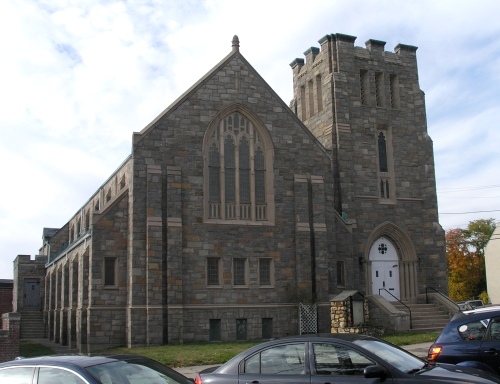
First Baptist Church, Clinton

The First Baptist Church in Clinton began in 1847, the congregation meeting in a chapel previously used by the local Congregational Church. As related in a historical sermon by Rev. Charles M. Bowers, printed in the Semi-centennial Celebration of the Incorporation of the Town of Clinton (1900):

The first year of the church had hardly ended before the poor accommodations of the chapel made it necessary to think of building a proper meeting-house, but the question of means was a fearful question. Yet the Lord gave us Alanson Chace and George Cummings to lead in generous subscriptions; others of smaller means were encouraged to follow, and the combined gifts, with contributions from neighboring churches and individuals, provided a neat and comfortable sanctuary at a cost of six thousand dollars, with a seating capacity of four hundred and fifty worshippers. This house was dedicated in 1849. In 1867, or eighteen years after, the church had so increased in numbers that a larger house seemed a necessity, and a new structure by reconstruction and addition was obtained, which, with the organ, cost about eleven thousand dollars, and gave sittings for a congregation of six hundred. The new building was dedicated in 1868.

Twenty-five more years passed away, and it seemed in the judgment of many that with a very popular and attractive preacher we should join the attractions of a still better house. Human nature takes very kindly to human nature, and our third provision for worship in less than fifty years resulted in the beautiful, commodious and well arranged house in which we are now gathered.

The 1890s church burned down in 1934 and was replaced by the current church (14 Walnut Street) in 1936.
Deacon Luke Pollard House (1806)

by Dan/January 8, 2015/Federal, Harvard, Houses

Deacon Luke Pollard House

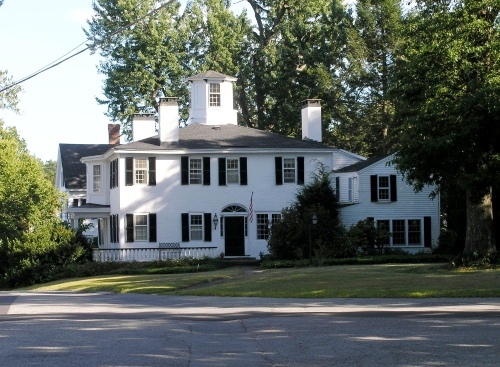
One of the Town of Harvard’s most impressive houses, topped with a distinctive belvedere, is the Pollard House at 14 Fairbank Street. It was built around 1805-1806 by Luke Pollard (1774-1866), a deacon of the town’s Congregational Church who became a founder of the seceding Evangelical Congregational Church. Later owners of the house included William and Regina Howerton and Homer F. Harman.

Sears Building (1896)

by Dan/January 4, 2015January 4, 2015/Commercial, Holyoke, Renaissance Revival, Romanesque Revival

80 Race Street, Holyoke

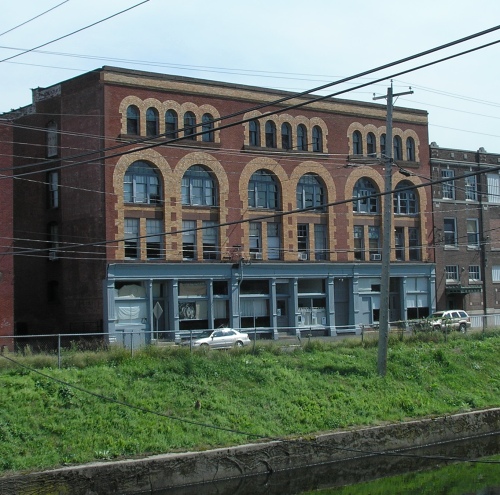
Around 1896, Henry G. Sears and Lemuel Sears (not related by blood) constructed the building at 80 Race Street in Holyoke. Henry G. Sears was born at Shelburne Falls in 1853. As related in volume 6 of the Encyclopedia of Massachusetts, Biographical–Genealogical (1916):

In March, 1871, he entered the employ of Lemuel Sears, a merchant of Holyoke, Massachusetts, remaining but a few weeks when he accepted the advice of an uncle, Henry Eldridge, and went West. He located at Dwight, Illinois, and there made an agreement by which in return for his services he was to receive twelve dollars and fifty cents per month the first year, fifteen dollars the second and twenty dollars the third year, in addition to his board. The West did not prove to his liking, and after one month in his new home he returned to Holyoke and again entered the employ of Lemuel Sears, beginning as clerk at a weekly salary of four dollars and board. He remained in that subordinate position until twenty-three years of age, when he was admitted to a partnership in the business then conducted upon a retail basis only. The partnership, begun in 1876, was continued until the death of Lemuel Sears, March 17, 1912, when Henry G. Sears purchased the interest owned by the heirs and became sole proprietor. Soon after 1876 the business was enlarged and as wholesale and retail grocers the firm became well and most favorably known, the enthusiasm, energy and efficiency of the junior partner agreeing well with the matured wisdom and long experience of the senior. After becoming sole proprietor Mr. Sears, in April, 1913, expanded the business by incorporation, as the Henry G. Sears Company, with Henry G. Sears as president and treasurer, and the business of the company has been built up until it is at the present time (1916) the largest in Western Massachusetts.

The grocery store was damaged in a fire in 1921. The building later housed a local beer and wine distributor and is now home to Paper City Studios.

Samuel L. Hill House (1845)

by Dan/December 17, 2014/Gothic, Houses, Northampton

Samuel L. Hill House

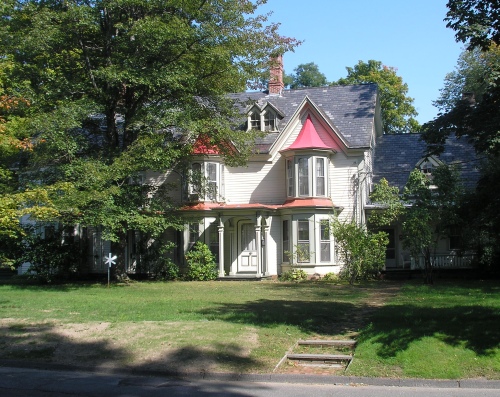
Samuel L. Hill was one of the founders of the Northampton Association of Education and Industry (NAEI), a nineteenth-century utopian community located in the village of Florence in Northampton. In the 1830s, S. L. Hill had worked as an overseer in a cotton factory in Willimantic, Connecticut. He came to Florence in 1841, where he became a leading citizen and established the Nonotuck Silk Company. An abolitionist, Hill actively aided slaves on the Underground Railroad. Among his other acts of philanthropy was the founding of the Florence Kindergarten, now the Hill Institute. His house, at 29-33 (or 31-35) Maple Street in Florence, was built around 1845. The south wing is the earliest section of the house, which is Arthur G. Hill, his son, also became one of Florence’s leading citizens and lived in the house until the 1920’s.

Mary Ellen Chase House (1827)

by Dan/December 17, 2014/Federal, Houses, Northampton

Chase House

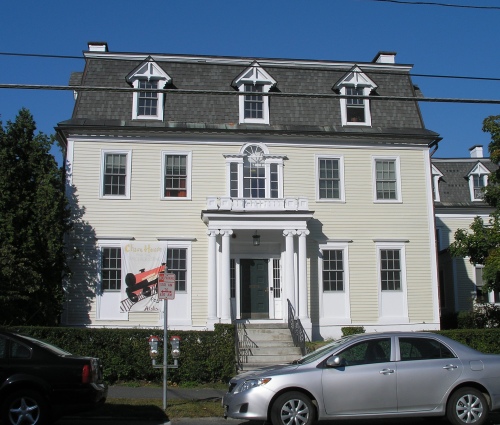
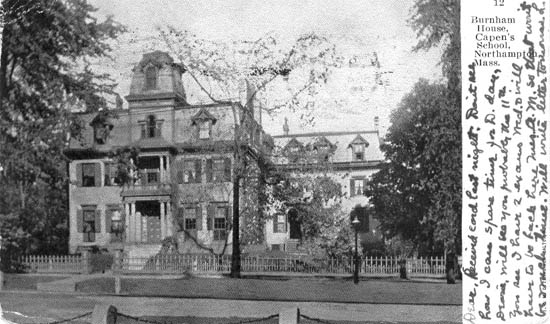
Attached to Duckett House, an 1810 residence in Northampton that is now a Smith College dorm, is the Mary Ellen Chase House, another dorm named for a Smith College professor and author. Chase House was built in 1827 (or perhaps as early as 1810) as a residence by Elijah Hunt Mills (1776-1829), a lawyer and politician. After Mills’ death, the house was owned and occupied by Thomas Napier, originally from North Carolina, who was a slave-auctioneer and anti-abolitionist. The house later passed through other owners until 1877, when it was sold to Miss Mary Burnham to establish a school for young ladies (the Northampton Classical School for Girls). The objective was to provide better academic preparation for young women wishing to attend the new Smith College. A new rear wing was soon added to the house to accommodate the school, as well as a central tower (later removed) and a Mansard roof (which remains). The Burnham School later moved out of Northampton and Smith acquired the house in 1968.

Shaker Office, Fruitlands Museum (1794)

by Dan/December 16, 2014December 16, 2014/Harvard, Organizations, Vernacular

Shaker Office

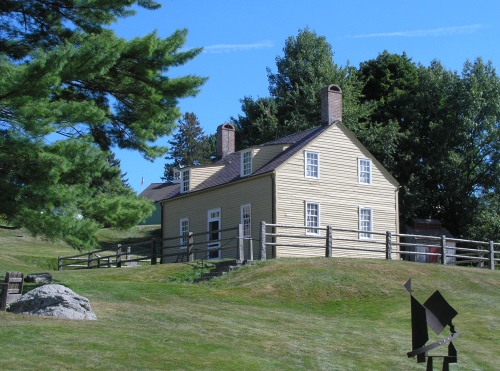
The Shaker community in Harvard began in the 1780s and flouished in the mid-nineteenth century. After the Harvard Shaker Village finally closed in 1917, the original Shaker Trustee’s Office, built in 1794, was moved in 1920 by Clara Endicott Sears to the Fruitlands Museum to become a Shaker Museum.

Gale and Dickinson Store (1896)

by Dan/December 16, 2014/Colonial Revival, Commercial, Harvard

Gale and Dickinson Store

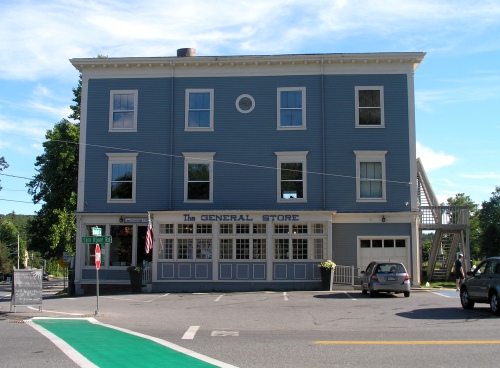
Currently home to the Harvard General Store in the Town of Harvard, the building at 1 Still River Road was built in 1896 on a site occupied by at least two other earlier stores. The Nathaniel Stacy Bookbinding Store occupied the site in a building built by 1831 that burned in 1850. This was replaced by a commercial building (Union Hall) that was moved to the current site of the Harvard Post Office to make way for the present store building, originally occupied by the Gale and Dickinson Store. Continue reading “Gale and Dickinson Store (1896)”

Posts navigation

Older posts
Newer posts
Privacy Policy

Categories

  • Architectural Style (943)
    • Art Deco (9)
    • Byzantine (3)
    • Colonial (177)
    • Colonial Revival (85)
    • Craftsman (6)
    • Egyptian Revival (1)
    • Federal (190)
    • Foursquare (6)
    • Gothic (67)
    • Greek Revival (100)
    • Italianate (82)
    • Mission Revival (2)
    • Mission/Spanish Colonial (1)
    • Modern (2)
    • Neoclassical (56)
    • Octagon (3)
    • Postmodern (1)
    • Queen Anne (46)
    • Renaissance Revival (26)
    • Romanesque Revival (53)
    • Second Empire (26)
    • Shingle Style (12)
    • Stick Style (13)
    • Tudor Revival (8)
    • Vernacular (49)
    • Victorian Eclectic (15)
  • Building Type (943)
    • Apartment Buildings (8)
    • Banks (18)
    • Churches (119)
    • Collegiate (32)
    • Commercial (102)
    • Hotels (16)
    • Houses (508)
    • Industrial (23)
    • Libraries (22)
    • Lighthouses (1)
    • Military (15)
    • Monuments (1)
    • Museums (12)
    • Organizations (39)
    • Outbuildings (17)
    • Public Buildings (50)
    • Schools (23)
    • Stations (5)
    • Synagogues (1)
    • Taverns (21)
    • Theaters (9)
  • Town (943)
    • Adams (11)
    • Agawam (4)
    • Amherst (50)
    • Boston (64)
    • Boylston (6)
    • Cambridge (30)
    • Clinton (21)
    • Concord (15)
    • Cummington (1)
    • Danvers (14)
    • Deerfield (31)
    • Gloucester (18)
    • Granville (10)
    • Great Barrington (2)
    • Hadley (9)
    • Hancock (15)
    • Harvard (32)
    • Holyoke (47)
    • Lenox (5)
    • Lexington (8)
    • Longmeadow (32)
    • Marblehead (40)
    • Marlborough (4)
    • Natick (22)
    • Newton (2)
    • Northampton (68)
    • Peabody (4)
    • Pittsfield (20)
    • Salem (110)
    • Saugus (4)
    • Sheffield (4)
    • South Hadley (8)
    • Southborough (8)
    • Southwick (4)
    • Springfield (67)
    • Stockbridge (19)
    • Stow (1)
    • Sturbridge (18)
    • Sudbury (7)
    • Waltham (11)
    • Watertown (1)
    • Wayland (8)
    • West Springfield (14)
    • Westfield (46)
    • Weston (2)
    • Worcester (26)
  • Uncategorized (1)

Recent Comments

  • Wilber Blackson on South Hadley
  • Tami Speiden on Stockbridge
  • DexGuru on Stockbridge

Tags

Alcott Amherst College Asher Benjamin Back Bay Baptist Beacon Hill Big E Black Heritage Trail bowfront Bulfinch Catholic Congregational Episcopal Freedom Trail Gambrel H.H. Richardson Harvard Hawthorne Historic Deerfield Isaac Damon lit Longfellow mansard Methodist Mount Holyoke Museum Museums NPS Old Sturbridge Village PEM Revolutionary War row houses saltbox Samuel McIntire Shakers Smith College SPNEA Springfield Armory Stephen C. Earle Storrowton Underground Railroad UU Washington William Fenno Pratt Witch Trials

Meta

  • Log in
  • Entries feed
  • Comments feed
  • WordPress.org
Proudly powered by WordPress | Theme: ShowMe by NEThemes.