Historic Buildings of Massachusetts

  • About
  • Index by Town
  • CT
  • About
  • Index by Town
  • CT

Category: Organizations

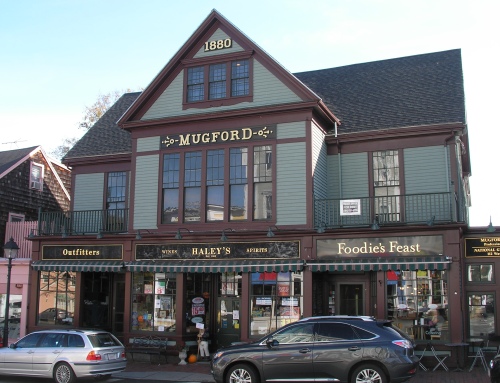
Mugford Building (1880)
by Dan/January 4, 2011/Commercial, Marblehead, Organizations, Queen Anne

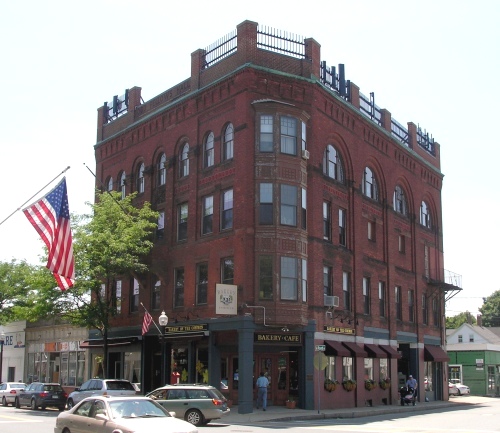
Captain James Mugford of the Continental Navy is a Marblehead hero of the American Revolution. The Mugford Association, named in honor of Capt. Mugford, built the prominent Mugford Building, on Washington Street in Marblehead, in 1880. The Association met in a hall on the second story, while the lower level of the building was used for commercial space. The Association disbanded in 1943 and the building has since had other owners. This Marblehead landmark continues to house retail shops.
Hamilton Hall (1805)

by Dan/January 3, 2011January 3, 2011/Federal, Organizations, Salem

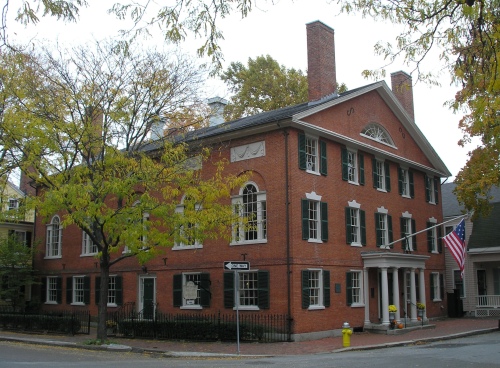
Happy New Year!!! Our first building of the new year is Hamilton Hall in Salem, named in honor of Alexander Hamilton. A three-story brick Federal-style building, designed by Samuel McIntire and built from 1805 to 1807 on Chestnut Street at Cambridge Street, Hamilton Hall was built as a gathering place and hall for functions held by Salem’s wealthy Federalist elite. A particularly notable event was the visit by the Marquis de Lafayette in 1824. With its ballroom, Hamilton Hall is still used for social and cultural events, including being rented for weddings. The west end of the building was completed in 1824 and the Greek Revival entrance was installed in 1845.

Y.M.C.A. Building, Salem (1898)

by Dan/November 24, 2010November 25, 2010/Colonial Revival, Neoclassical, Organizations, Salem

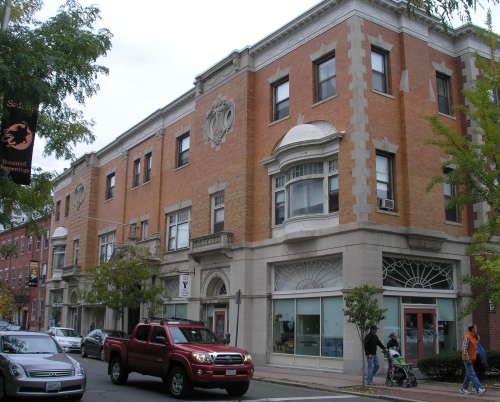
In 1873, Alexander Graham Bell took up residence in the Sanders Homestead on Essex Street in Salem. The house was home to the grandmother of Bell’s deaf pupil George Sanders, whose father, Thomas Sanders, became an investor in Bell’s telephone system. Until 1876, Bell used a room in the Sanders House to conduct the experiments which led to his development of the telephone. The house was later torn down and in 1898 a Y.M.C.A. building was completed on the site. Designed by architect Walter J. Paine of Beverly, it combines elements of the Beaux-Arts and Colonial Revival styles. The building originally had an elaborate fourth-story loggia, since removed. The Y.M.C.A. Building also houses the North Shore Children’s Museum.

Odd Fellows’ Building, Natick (1888)

by Dan/September 2, 2010/Commercial, Natick, Organizations, Romanesque Revival

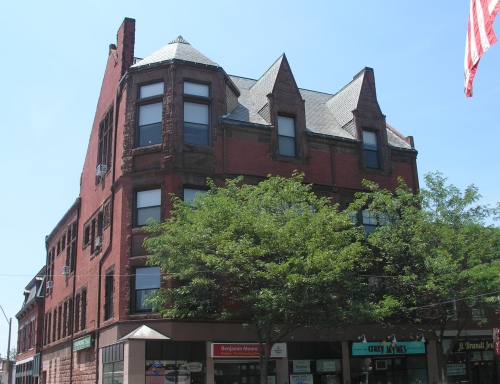
The Tackawanbait Lodge of the Independent Order of Odd Fellows in Natick was named for the town’s Native American minister, Reverend Daniel Takawambpait. Founded in 1845, the Lodge utilized the upper floors of the Odd Fellows’ Building, constructed in 1887-1888 on the corner of Main and Pond Streets off Natick’s Town Common. The Richardsonian Romanesque Odd Fellow’s Block, designed by Ernest N. Boyden of Boston, continues to have retail space on the ground floors. According to the History of Middlesex County, Vol. I (1890), “The first story on Main Street is of iron and plate-glass, while on Pond Street it is of brick and plate-glass. The remaining three stories are constructed of brick with Long Meadow sand-stone trimmings.”

Walcott Building, Natick (1888)

by Dan/September 1, 2010/Commercial, Natick, Organizations, Romanesque Revival

The last building to be constructed in the aftermath of the 1874 Natick fire is the Walcott Building, also known as the Desban Building, built in 1888 in the Richardsonian Romanesque style. It replaced the Walcott shoe factory on the same site, at the corner of Main and Summer Streets, which burned in 1874. Again quoting from the History of Middlesex County, Vol. I (1890):

The new block is by far the most beautiful and elaborately finished structure in Natick. The lower story on Main Street is constructed of iron and plate-glass, and on Summer street of red sandstone. The upper stories are of brick, with sandstone trimmings. The staircase to the second story is wholly of polished marble, while the flagging-stones of the two fronts are very large and costly stones from the Hudson River Valley, perfectly cut and fitted in the best possible manner. On the lower floor, at the corner, is the spacious, well-lighted and finely decorated store of Leamy & Tilton, with a large stock of new dry-goods and small wares. On the same floor is the Bay State Clothing Store of Hastings & Lowell. On the second floor are six rooms for offices, with a large hall. Above are the elegant quarters of the Red Men, comprising a room for the ladies of the order with ante-rooms.; also the large hall for the society’s gatherings, and their banqueting-hall, with tables and a kitchen and pantry, furnished with ranges and crockery. The walls throughout have been treated with fresco or beautifully-tinted paints, and the entire establishment would be deemed ornamental in any city of our land.

Masonic Block, Natick (1874)

by Dan/August 30, 2010/Commercial, Gothic, Natick, Organizations

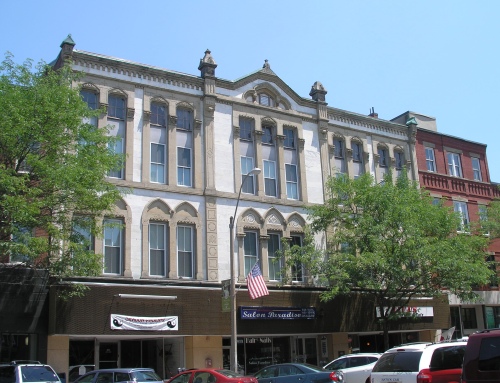
A while back, I had a week on this blog featuring buildings in South Natick. Now I’ll be featuring some buildings in downtown Natick. In 1874, a massive fire destroyed 35 buildings in the downtown. New brick and stone structures were soon built to replace the lost ones. One of the these is the Masonic Block on Main Street, constructed of Vermont marble and completed in 1874. The polychromatic High Victorian Gothic building was designed by S.S. Woodcock and has commercial space on the lower floors and rooms on the upper floors used by the Meridian Lodge, originally established in 1797 by Paul Revere. A glimpse of the building’s occupants in the late nineteenth century can be found in the History of Middlesex County, Vol. I (1890):

Masonic Brick and Marble Block.—This was erected in 1874, and belongs to the estate of the late Leonard Morse. The front is of marble, the other walls are brick. It is occupied on the lower floor by the Atlantic Tea Stores Company, Messrs. Wilde & Soule, who deal in teas, coffees and crockery; by James F. Gray, manufacturer of confectionery and keeper of fruit for sale; by Leonard P. Stone, dealer in meats and vegetables, and by Beals’ Clothing and Furnishing establishment. In the second story are Mulligan’s billiard-room, Finn’s barber-shop, Dr. Abbott’s rooms for dentistry, and Miss Mabel Morse’s musicroom. The third and fourth stories are wholly occupied for Masonic purposes.

Signet Society, Harvard (1820)

by Dan/February 2, 2010February 2, 2010/Cambridge, Federal, Organizations

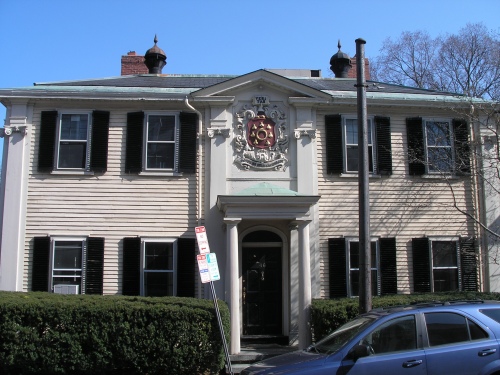
Founded in 1870, the Signet Society is an artistic and literary club at Harvard University. After initially utilizing space on University property, the Society moved off campus to 46 Dunster Street in Cambridge. In 1902, the 1820 Federal-style house was remodeled by Cram, Goodhue and Ferguson, a firm more usually associated with the Gothic style. The centerpiece of the remodeling is a two story pavilion displaying a heraldic crest of the Signet arms by Pierre LaRose.

Posts navigation

Older posts
Newer posts
Privacy Policy

Categories

  • Architectural Style (943)
    • Art Deco (9)
    • Byzantine (3)
    • Colonial (177)
    • Colonial Revival (85)
    • Craftsman (6)
    • Egyptian Revival (1)
    • Federal (190)
    • Foursquare (6)
    • Gothic (67)
    • Greek Revival (100)
    • Italianate (82)
    • Mission Revival (2)
    • Mission/Spanish Colonial (1)
    • Modern (2)
    • Neoclassical (56)
    • Octagon (3)
    • Postmodern (1)
    • Queen Anne (46)
    • Renaissance Revival (26)
    • Romanesque Revival (53)
    • Second Empire (26)
    • Shingle Style (12)
    • Stick Style (13)
    • Tudor Revival (8)
    • Vernacular (49)
    • Victorian Eclectic (15)
  • Building Type (943)
    • Apartment Buildings (8)
    • Banks (18)
    • Churches (119)
    • Collegiate (32)
    • Commercial (102)
    • Hotels (16)
    • Houses (508)
    • Industrial (23)
    • Libraries (22)
    • Lighthouses (1)
    • Military (15)
    • Monuments (1)
    • Museums (12)
    • Organizations (39)
    • Outbuildings (17)
    • Public Buildings (50)
    • Schools (23)
    • Stations (5)
    • Synagogues (1)
    • Taverns (21)
    • Theaters (9)
  • Town (943)
    • Adams (11)
    • Agawam (4)
    • Amherst (50)
    • Boston (64)
    • Boylston (6)
    • Cambridge (30)
    • Clinton (21)
    • Concord (15)
    • Cummington (1)
    • Danvers (14)
    • Deerfield (31)
    • Gloucester (18)
    • Granville (10)
    • Great Barrington (2)
    • Hadley (9)
    • Hancock (15)
    • Harvard (32)
    • Holyoke (47)
    • Lenox (5)
    • Lexington (8)
    • Longmeadow (32)
    • Marblehead (40)
    • Marlborough (4)
    • Natick (22)
    • Newton (2)
    • Northampton (68)
    • Peabody (4)
    • Pittsfield (20)
    • Salem (110)
    • Saugus (4)
    • Sheffield (4)
    • South Hadley (8)
    • Southborough (8)
    • Southwick (4)
    • Springfield (67)
    • Stockbridge (19)
    • Stow (1)
    • Sturbridge (18)
    • Sudbury (7)
    • Waltham (11)
    • Watertown (1)
    • Wayland (8)
    • West Springfield (14)
    • Westfield (46)
    • Weston (2)
    • Worcester (26)
  • Uncategorized (1)

Recent Comments

  • Wilber Blackson on South Hadley
  • Tami Speiden on Stockbridge
  • DexGuru on Stockbridge

Tags

Alcott Amherst College Asher Benjamin Back Bay Baptist Beacon Hill Big E Black Heritage Trail bowfront Bulfinch Catholic Congregational Episcopal Freedom Trail Gambrel H.H. Richardson Harvard Hawthorne Historic Deerfield Isaac Damon lit Longfellow mansard Methodist Mount Holyoke Museum Museums NPS Old Sturbridge Village PEM Revolutionary War row houses saltbox Samuel McIntire Shakers Smith College SPNEA Springfield Armory Stephen C. Earle Storrowton Underground Railroad UU Washington William Fenno Pratt Witch Trials

Meta

  • Log in
  • Entries feed
  • Comments feed
  • WordPress.org
Proudly powered by WordPress | Theme: ShowMe by NEThemes.