Historic Buildings of Massachusetts

  • About
  • Index by Town
  • CT
  • About
  • Index by Town
  • CT

Category: Vernacular

Brethren’s Shop, Hancock Shaker Village (1813)
by Dan/May 9, 2013June 21, 2013/Hancock, Industrial, Outbuildings, Vernacular

Brethren's Shop

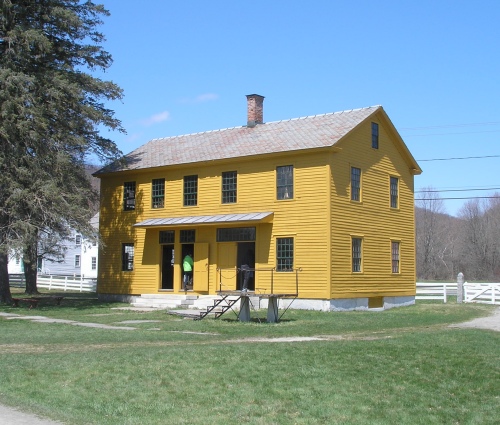
Each male Shaker was expected to practice one or more trades. Built circa 1813, the Brethren’s Shop at Hancock Shaker Village was one of several buildings used as a workshop by the brethren. Inside they made such products as chairs, baskets, shoes, brooms and the distinctive Shaker oval boxes. Paint analysis undertaken in 2007 led to the restoration of the color used when the building was painted yellow in 1845. Continue reading “Brethren’s Shop, Hancock Shaker Village (1813)”
Brick Poultry House, Hancock Shaker Village (1878)

by Dan/May 8, 2013May 10, 2013/Hancock, Outbuildings, Vernacular

Brick Poultry House

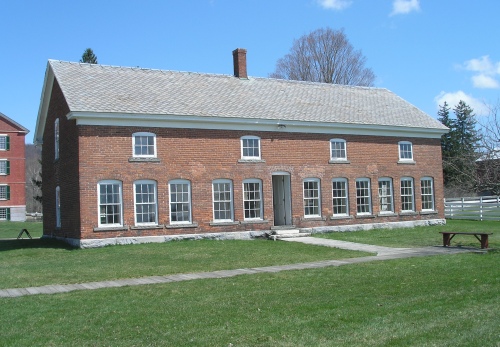
Built in 1878, the Brick Poultry House at Hancock Shaker Village is a particularly fine one, attesting to the value the Shakers placed on their poultry. The many south-facing windows provided warmth and light to the building. The interior of the Brick Poultry House is used by the Hancock Shaker Village for changing exhibitions of contemporary art.

Round Stone Barn, Hancock Shaker Village (1826)

by Dan/May 6, 2013May 7, 2013/Hancock, Outbuildings, Vernacular

Round Stone Barn

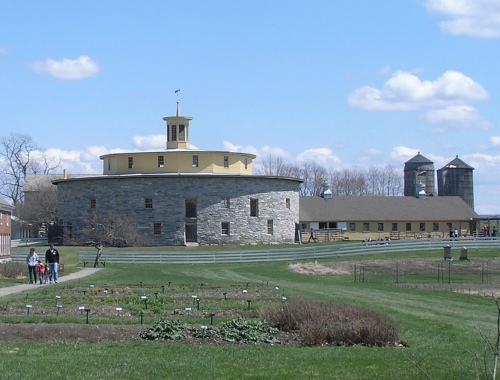
This week we look at buildings at the Hancock Shaker Village, which was active from 1783 to 1960 and is now a museum. The Village‘s most iconic building is the Round Stone Barn, a large dairy barn erected in 1826. It replaced an earlier barn complex which had burned in 1825. A circular shape was used for the barn because of its functionality. As described by “H.C.” in the New York Farmer and reprinted in The Genesee Farmer (Vol. V, No. 49, December, 1835):

The great object of agricultural curiosity at Hancock, is their magnificent stone barn, two stories in height and ninety-six feet in diameter. The great mow is in the centre, and is said to he capable of containing between three and four hundred tons of hay. The floor or driveway is on tho outside of the circle, and the team goes round and comes out at the same door at which it enters. Several teams can stand on the floor and be unloaded at the same time. In the centre of this mow a large post or mast is erected, reaching from tho ground to the roof. At the apex of the roof is a small cupola. Around this post, slats or strips of plank are placed at a small distance from it, to prevent the hay from coming in immediate contact, and the hay at the bottom, being raised by an open frame from the ground, a perfect ventilation is formed, and the steam from the new hay is in this way effectually carried off.

A fire destroyed much of the barn in 1864, but it was rebuilt. Around 1870, the 12-sided upper level loft superstructure, which provides interior ventilation and illumination, was completed. In the twentieth century, cracks began appearing in the masonry. In 1968, the walls were dismantled, the foundations shored up and the walls rebuilt using the original stones. The Round Stone Barn‘s exterior woodwork’s yellow paint color was restored in 2009. Continue reading “Round Stone Barn, Hancock Shaker Village (1826)”

Hall Judd House (1846)

by Dan/September 28, 2012/Houses, Northampton, Vernacular

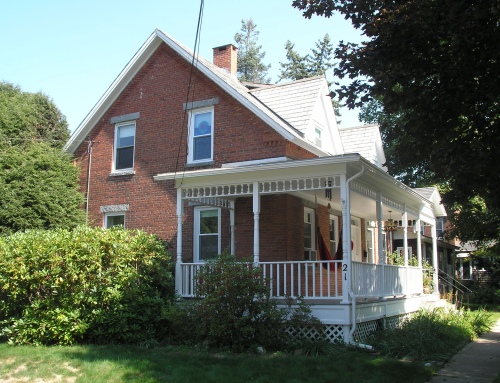
The brick house at 21 Park Street in Florence in Northampton was built in 1846 by Hall Judd, a founder and last secretary of the Northampton Association of Education and Industry. Part of the communitarian movement of the nineteenth century, the NAEI was a utopian community that was dissolved the same year that Judd was building his home. From 1851 to 1894, the house residence to (his widow?) Frances P. Judd. Dormer windows and a wraparound porch were added to the house around 1910. The house has a hidden staircase that suggests it was used in the Underground Railroad.

Sojourner Truth House (1849)

by Dan/September 22, 2012September 22, 2012/Houses, Northampton, Vernacular

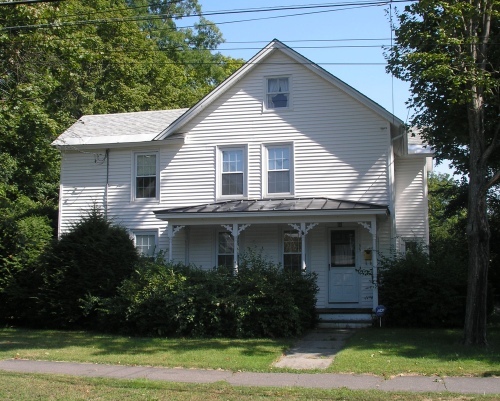
Sojourner Truth, whose name at birth was Isabella, was born an enslaved woman in upstate New York in approximately 1797. Slavery was finally abolished in the state in 1827. Taking the name Sojourner Truth, she would become a leading anti-slavery and woman’s rights lecturer. Starting in 1843, Truth was a member of the Northampton Association of Education and Industry. Located in the part of Northampton which would later come to be called Florence, the NAEI was a utopian community dedicated to abolitionism and equality. She continued to live in Northampton after the NAEI disbanded in 1846. Truth, who could not read or write, dictated her memoirs to her friend, Olive Gilbert. Sales of the Narrative of Sojourner Truth (first published in 1850), paid for her house, at 35 Park Street in Florence, where she lived from 1849/1850 to 1857. Her friend, Samuel L. Hill, who was the spiritual leader of the Northampton Association, held the mortgage on the house, which Sojourner Truth paid in 1854. In 1857, she moved to Battle Creek, Michigan, where she lived the remainder of her life.

Marblehead Lighthouse (1896)

by Dan/July 4, 2012July 4, 2012/Lighthouses, Marblehead, Vernacular

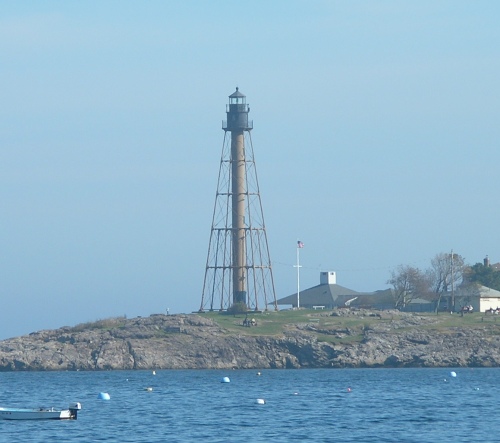
The first lighthouse to be constructed at the northern end of Marblehead Neck (called Lighthouse Point) was built in 1835. There was a 23-foot white tower and a brick keeper’s cottage, attached to the tower by a covered walkway. The original cottage was replaced by a wood-frame keeper’s house in 1878. In the 1870s, large summer houses were being built on Marblehead Neck, obscuring the lighthouse from being seen at sea. To deal with this situation, a light was hoisted to the top of a tall mast near the lighthouse in 1883. The original lighthouse was demolished and a taller tower was finally constructed, which was first illuminated on April 17, 1896. Instead of a brick tower, a 105-foot cast-iron skeleton tower was erected, the only lighthouse of its type in New England. The iron tower was most likely selected because it cost only $8,786, instead of the the $45,000 required for a brick tower. Chandler Hovey, a well-known yachtsman, purchased the land around the lighthouse and in 1948 donated it to the town for use as a park.

Shoe Shop, Old Sturbridge Village (1800)

by Dan/July 4, 2012July 4, 2012/Commercial, Sturbridge, Vernacular

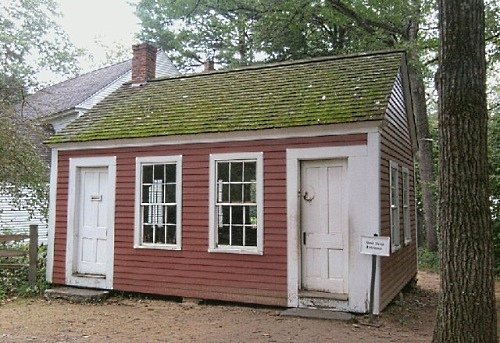
The Shoe Shop at Old Sturbridge Village was built in Sturbridge sometime between 1800 and 1850 and was moved to the Village in 1939.

Posts navigation

Older posts
Newer posts
Privacy Policy

Categories

  • Architectural Style (943)
    • Art Deco (9)
    • Byzantine (3)
    • Colonial (177)
    • Colonial Revival (85)
    • Craftsman (6)
    • Egyptian Revival (1)
    • Federal (190)
    • Foursquare (6)
    • Gothic (67)
    • Greek Revival (100)
    • Italianate (82)
    • Mission Revival (2)
    • Mission/Spanish Colonial (1)
    • Modern (2)
    • Neoclassical (56)
    • Octagon (3)
    • Postmodern (1)
    • Queen Anne (46)
    • Renaissance Revival (26)
    • Romanesque Revival (53)
    • Second Empire (26)
    • Shingle Style (12)
    • Stick Style (13)
    • Tudor Revival (8)
    • Vernacular (49)
    • Victorian Eclectic (15)
  • Building Type (943)
    • Apartment Buildings (8)
    • Banks (18)
    • Churches (119)
    • Collegiate (32)
    • Commercial (102)
    • Hotels (16)
    • Houses (508)
    • Industrial (23)
    • Libraries (22)
    • Lighthouses (1)
    • Military (15)
    • Monuments (1)
    • Museums (12)
    • Organizations (39)
    • Outbuildings (17)
    • Public Buildings (50)
    • Schools (23)
    • Stations (5)
    • Synagogues (1)
    • Taverns (21)
    • Theaters (9)
  • Town (943)
    • Adams (11)
    • Agawam (4)
    • Amherst (50)
    • Boston (64)
    • Boylston (6)
    • Cambridge (30)
    • Clinton (21)
    • Concord (15)
    • Cummington (1)
    • Danvers (14)
    • Deerfield (31)
    • Gloucester (18)
    • Granville (10)
    • Great Barrington (2)
    • Hadley (9)
    • Hancock (15)
    • Harvard (32)
    • Holyoke (47)
    • Lenox (5)
    • Lexington (8)
    • Longmeadow (32)
    • Marblehead (40)
    • Marlborough (4)
    • Natick (22)
    • Newton (2)
    • Northampton (68)
    • Peabody (4)
    • Pittsfield (20)
    • Salem (110)
    • Saugus (4)
    • Sheffield (4)
    • South Hadley (8)
    • Southborough (8)
    • Southwick (4)
    • Springfield (67)
    • Stockbridge (19)
    • Stow (1)
    • Sturbridge (18)
    • Sudbury (7)
    • Waltham (11)
    • Watertown (1)
    • Wayland (8)
    • West Springfield (14)
    • Westfield (46)
    • Weston (2)
    • Worcester (26)
  • Uncategorized (1)

Recent Comments

  • Wilber Blackson on South Hadley
  • Tami Speiden on Stockbridge
  • DexGuru on Stockbridge

Tags

Alcott Amherst College Asher Benjamin Back Bay Baptist Beacon Hill Big E Black Heritage Trail bowfront Bulfinch Catholic Congregational Episcopal Freedom Trail Gambrel H.H. Richardson Harvard Hawthorne Historic Deerfield Isaac Damon lit Longfellow mansard Methodist Mount Holyoke Museum Museums NPS Old Sturbridge Village PEM Revolutionary War row houses saltbox Samuel McIntire Shakers Smith College SPNEA Springfield Armory Stephen C. Earle Storrowton Underground Railroad UU Washington William Fenno Pratt Witch Trials

Meta

  • Log in
  • Entries feed
  • Comments feed
  • WordPress.org
Proudly powered by WordPress | Theme: ShowMe by NEThemes.