Historic Buildings of Massachusetts

  • About
  • Index by Town
  • CT
  • About
  • Index by Town
  • CT

Category: Salem

Clifford Crowninshield House (1806)
by Dan/November 27, 2008September 17, 2016/Federal, Houses, Salem

clifford-crowninshield-house.jpg

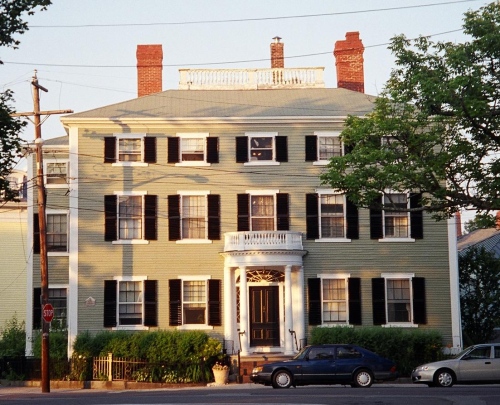
Designed by the famous builder and wood carver, Samuel McIntire, the Clifford Crowninshield House is an impressive Federal style mansion on the southeast corner of Salem Common. The house was built 1804-1806 for the merchant, Clifford Crowninsheld, who died in 1809. In 1802, the Minerva, a ship owned by Crowninshield and Nathaniel West, was the first Salem vessel to circumnavigate the globe. The house was next occupied by Crowninshield’s sister, Sarah, and her husband, James Devereux. In 1799, Devereux was captain of the Franklin when it became the first American vessel to trade with Japan. Devereux returned from Nagasaki with a variety of items, some of which are now in the Peabody Essex Museum in Salem. On June 23, 1800, Rev. William Bentley visited Devereux’s (earlier) house in Salem, where the captain “exhibited such things as engaged his attention,” including “Stone Tables, Tea Tables, Servers, Knife Cases, Small Cabinets,” and paintings. Bentley observed that the “stuffed gowns, which on both sides silk, are filled with a very fine cotton, were luxuries.” The house was later inherited by Devereux’s daughter, Abigail, who had married Captain William Dean Waters. In 1892, the Crowninshield-Devereux-Waters House was altered by its then owner, Zina Goodell, a successful Salem businessman, who had begun as a blacksmith and machinist. Before 1892, the house had been like many such Federal structures in Salem, in which, according to The Colonial Architecture of Salem, by Frank Cousins and Phil M. Riley, “a wing extended to one side of the main house along the street, instead of an L projecting from the rear, and thus by greatly elongating the oblong arrangement reduced in a measure the apparent height of a three-story structure.” Goodell, not finding the “ell” “good,” moved it from the side to the rear of the house, “about doubling the depth of the building.” He also moved the house closer to the corner of Forrester Street (the house’s address is on Washington Square East).
Jonathan Corwin House (1675)

by Dan/November 26, 2008September 17, 2016/Colonial, Houses, Salem

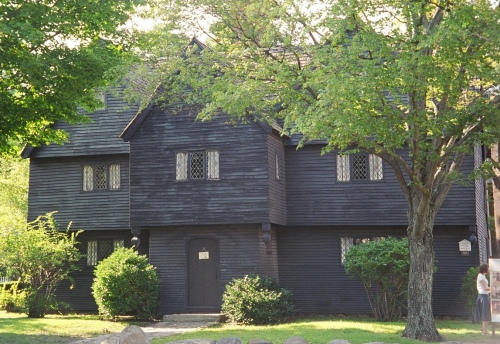
The Jonathan Corwin House, also known as the Witch House, is a seventeenth century home located on Essex Street in Salem. When Jonathan Corwin, a merchant, purchased the property in 1675, there was already a partially completed timber frame, left unfinished after being started some years earlier (older estimates put the construction date as 1642). Corwin completed the construction and moved in with his family in 1679. As a prominent citizen of Salem, Corwin served as a magistrate and was a judge during the Salem Witch Trials of 1692. The Corwin family owned the house into the nineteenth century, during which time a number of alterations were made to the home. In 1856, it was bought by a pharmacist, George Farrington, who built his shop onto one side of the building. He referred to the home as the “Witch House” and attracted tourists with his claims that the Witch Trials had occurred in the parlor. By the twentieth century, the house was being used for a shop, businesses and apartments. Threatened with demolition to accommodate the widening of North Street, Historic Salem Inc was established to return the house to a seventeenth century look and move it to the west. Given to the town, the Witch House first opened as a museum in 1946.

Nathaniel Hawthorne Birthplace (1730)

by Dan/June 23, 2008June 29, 2013/Colonial, Houses, Salem

hawthorne-birthplace.jpg

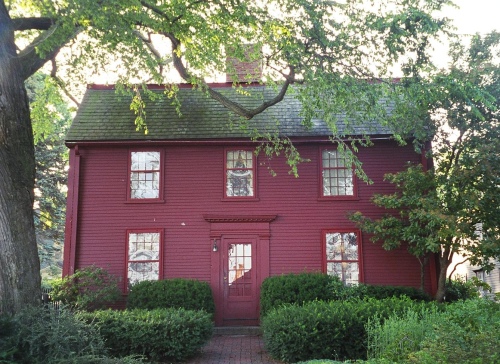
The house in which the author, Nathaniel Hawthorne, was born on July 4, 1804 and lived in until he was age 4 is located in Salem. It was originally on Union Street, but in 1958 it was moved to a site adjacent to the House of the Seven Gables, the building that would inspire Hawthorne to write the novel of the same name. The house was built between 1730 and 1745 for Joshua Pickman, a Boston mariner. It was bought by Hawthorne’s grandfather, the famous shipmaster Captain Daniel Hawthorne, in 1772. As part of the House of the Seven Gables Settlement Association property, the house is now a museum open to visitors.

John Hodges House (1788)

by Dan/June 8, 2008September 17, 2016/Colonial, Houses, Salem

john-hodges-house.jpg

Built around 1788 on Essex Street in Salem, the John Hodges House is late Georgian-style home with a grand spiral staircase within. Hodges was a merchant and passed the house on to his son, Benjamin Hodges, after it was built.

The House of the Seven Gables (1668)

by Dan/March 29, 2008June 29, 2013/Colonial, Houses, Salem

seven_gables.jpg
The House of the Seven Gables,
aka/ the Capt. John-Turner House or the Turner-Ingersoll Mansion
Few houses in the world have the fame and literary associations of the House of the Seven Gables. The earliest section was built on Derby Street in Salem, facing Salem Harbor in 1668 by Capt. John Turner I, a prosperous merchant. He then added a south ell to the house in 1677. After his death in 1680, his widow, Elizabeth Roberts took charge of the household, marrying Charles Redford in 1684. By the time of Redford’s death, in 1691, John Turner II was old enough to take charge of the estate. In the early eighteenth century, it was this John Turner who would have the house decorated in the new Georgian style. The third John Turner inherited the house after his father’s death in 1742, but he made few alterations to it, as his primary residence was about a half a mile away. John Turner III eventually experienced a financial decline and sold the house to Capt. Samuel Ingersoll in 1782. He would make a number of changes to the house, removing several of its gables and brining it in line with the taste of the Federal Period.

Capt. Ingersoll and his son died at sea in 1804 and the house was later inherited by his only surviving child, Susannah Ingersoll, who was unusual for a woman at the time in being a businesswoman, active in real estate. She was the cousin of Nathaniel Hawthorne and it was during his visits with her that he would have learned of the home’s past. In 1851, Hawthorne published his famous novel, The House of the Seven Gables. Susannah Ingersoll died in 1858 and the house passed through many different owners, remaining vacant during part of this period. In 1908, the house was purchased by the philanthropist, Caroline O. Emmerton, who thus saved it from becoming a tenement. She enlisted the prominent early preservation architect Joseph Everett Chandler to restore it. She founded the House of Seven Gables Settlement Association and opened the house to the public in 1910, using the admission proceeds to support the Settlement. Visitor expectations based on Hawthorne’s novel influenced the restoration at the expense of strict historical accuracy, although this approach was not uncommon for early twentieth century colonial revival preservation efforts.

The house museum is often visited today as a popular tourist attraction and is part of a compound containing other historic buildings, acquired by Emmerton and her successors, and a Colonial Revival Garden. In 2007, the house was designated a National Historic Landmark. A pdf file is available of the National Historic Landmark Nomination form.

Posts navigation

Newer posts
Privacy Policy

Categories

  • Architectural Style (943)
    • Art Deco (9)
    • Byzantine (3)
    • Colonial (177)
    • Colonial Revival (85)
    • Craftsman (6)
    • Egyptian Revival (1)
    • Federal (190)
    • Foursquare (6)
    • Gothic (67)
    • Greek Revival (100)
    • Italianate (82)
    • Mission Revival (2)
    • Mission/Spanish Colonial (1)
    • Modern (2)
    • Neoclassical (56)
    • Octagon (3)
    • Postmodern (1)
    • Queen Anne (46)
    • Renaissance Revival (26)
    • Romanesque Revival (53)
    • Second Empire (26)
    • Shingle Style (12)
    • Stick Style (13)
    • Tudor Revival (8)
    • Vernacular (49)
    • Victorian Eclectic (15)
  • Building Type (943)
    • Apartment Buildings (8)
    • Banks (18)
    • Churches (119)
    • Collegiate (32)
    • Commercial (102)
    • Hotels (16)
    • Houses (508)
    • Industrial (23)
    • Libraries (22)
    • Lighthouses (1)
    • Military (15)
    • Monuments (1)
    • Museums (12)
    • Organizations (39)
    • Outbuildings (17)
    • Public Buildings (50)
    • Schools (23)
    • Stations (5)
    • Synagogues (1)
    • Taverns (21)
    • Theaters (9)
  • Town (943)
    • Adams (11)
    • Agawam (4)
    • Amherst (50)
    • Boston (64)
    • Boylston (6)
    • Cambridge (30)
    • Clinton (21)
    • Concord (15)
    • Cummington (1)
    • Danvers (14)
    • Deerfield (31)
    • Gloucester (18)
    • Granville (10)
    • Great Barrington (2)
    • Hadley (9)
    • Hancock (15)
    • Harvard (32)
    • Holyoke (47)
    • Lenox (5)
    • Lexington (8)
    • Longmeadow (32)
    • Marblehead (40)
    • Marlborough (4)
    • Natick (22)
    • Newton (2)
    • Northampton (68)
    • Peabody (4)
    • Pittsfield (20)
    • Salem (110)
    • Saugus (4)
    • Sheffield (4)
    • South Hadley (8)
    • Southborough (8)
    • Southwick (4)
    • Springfield (67)
    • Stockbridge (19)
    • Stow (1)
    • Sturbridge (18)
    • Sudbury (7)
    • Waltham (11)
    • Watertown (1)
    • Wayland (8)
    • West Springfield (14)
    • Westfield (46)
    • Weston (2)
    • Worcester (26)
  • Uncategorized (1)

Recent Comments

  • Wilber Blackson on South Hadley
  • Tami Speiden on Stockbridge
  • DexGuru on Stockbridge

Tags

Alcott Amherst College Asher Benjamin Back Bay Baptist Beacon Hill Big E Black Heritage Trail bowfront Bulfinch Catholic Congregational Episcopal Freedom Trail Gambrel H.H. Richardson Harvard Hawthorne Historic Deerfield Isaac Damon lit Longfellow mansard Methodist Mount Holyoke Museum Museums NPS Old Sturbridge Village PEM Revolutionary War row houses saltbox Samuel McIntire Shakers Smith College SPNEA Springfield Armory Stephen C. Earle Storrowton Underground Railroad UU Washington William Fenno Pratt Witch Trials

Meta

  • Log in
  • Entries feed
  • Comments feed
  • WordPress.org
Proudly powered by WordPress | Theme: ShowMe by NEThemes.