Historic Buildings of Massachusetts

  • About
  • Index by Town
  • CT
  • About
  • Index by Town
  • CT

Category: Salem

Lindall-Gibbs-Osgood House (1755)
by Dan/November 20, 2010January 25, 2020/Colonial, Houses, Salem

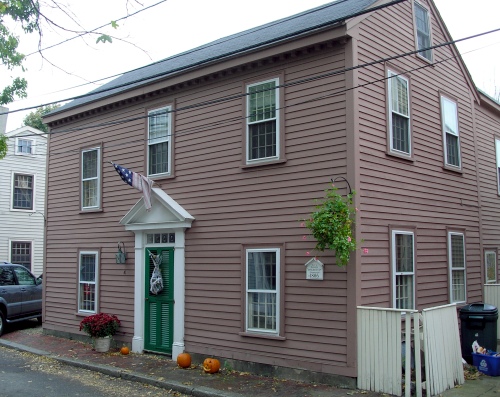
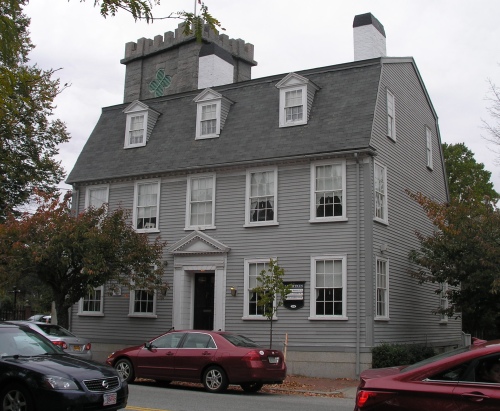
The Lindall-Gibbs-Osgood House is a gambrel-roofed residence at 314 Essex Street in Salem. Located between the “Witch House” and First Church, it was built for Mary Lindall and later had other owners, including the Gibbs family. In 1825, it was bought by Capt. William Osgood and remained in his family until was acquired by the Red Cross in the 1940s. The house continues as an office building today. According to The Colonial Architecture of Salem (1919), by Frank Cousins and Phil M. Riley, it was in this house

where Benjamin Thompson, afterward Count Rumford, commander-in-chief of the Bavarian army, lived as a boy and made some of his early experiments. Rumford ovens, invented by this eminent scientist and author, are to be found in several of the larger old mansions of Salem, a few of them even now finding occasional use.

At the age of 13, Thompson was apprenticed to John Appleton, a merchant who owned the house at the time.
St. Peter’s Episcopal Church, Salem (1833)

by Dan/November 14, 2010November 15, 2010/Churches, Gothic, Salem

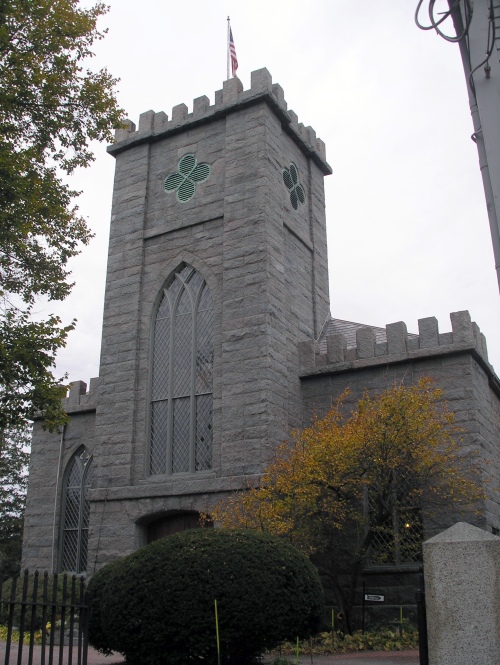
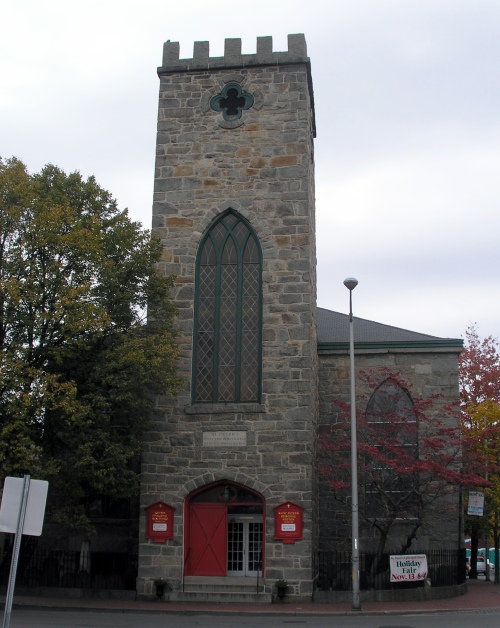
St. Peter’s Episcopal Church in Salem was established in 1733 and a wooden church was built the following year on land donated by Philip English, a wealthy merchant. English and his wife, Mary, had been accused of witchcraft during the Salem Witchcraft Trials of 1692. The original church was taken down in 1833 and replaced by the present stone church, constructed from plans by Isaiah Rogers of Boston. Like Salem’s First Church, it is a highly regarded example of a Gothic Revival stone masonry church of the early nineteenth century. It was enlarged in 1845 and a new chapel was added in 1871, built directly over the parish’s old graveyard. Some of the tombstones were incorporated into the chapel’s walls.

Cabot-Endicott-Low House (1744)

by Dan/November 13, 2010January 25, 2020/Colonial, Houses, Salem

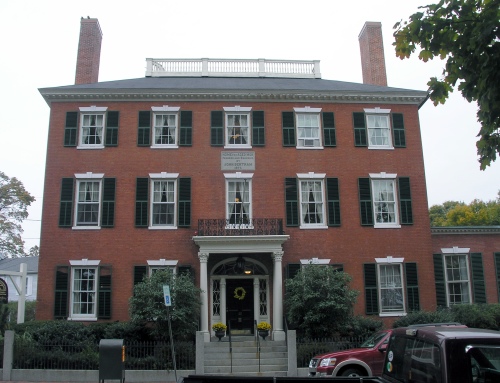
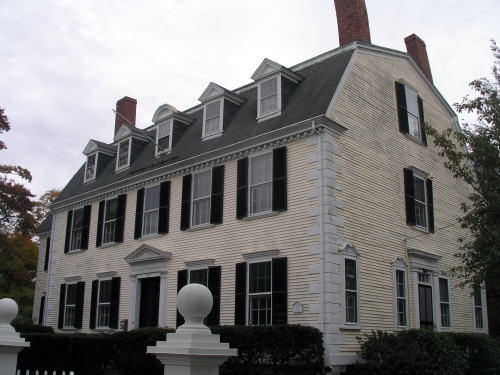
Thought to have been built sometime between 1744 and 1748, the Cabot-Endicott-Low House, at 365 Essex Street in Salem, is an important example of a high-style gambrel roof Georgian colonial residence. The house was built for Joseph Cabot, a merchant, and remained in his family until purchased by William C. Endicott in 1870. Endicott was a justice of the Massachusetts Supreme Judicial Court (1873-1882) and Secretary of War under Grover Cleveland (1885-1889). His daughter, Mary, married British prime minister Joseph Chamberlain in 1888. Endicott‘s friend, merchant and silversmith Daniel Low, owned the house from 1894 to 1919. Continue reading “Cabot-Endicott-Low House (1744)”

Daniel Bancroft, Jr. House (1806)

by Dan/November 12, 2010January 25, 2020/Federal, Houses, Salem

Daniel Bancroft was a Salem architect-builder who worked with Samuel McIntire. According to an article in The Essex Antiquarian, Vol. VI, no. 4 (October, 1902):

Daniel Bancroft, house-carpenter, lived first in Reading, and removed, in 1770, to Worcester, and then, in 1775, removed from Worcester to Salem, having married Hannah, daughter of Benjamin Symonds of Salem, chairmaker, Aug. 14, 1770. They were living in Salem in 1791.— Registry of deeds, and Salem town records.

The same article lists that “Daniel Bancroft, Jr., married Sally Cloutman, both of Salem, Aug. 5, 1794.” The Daniel Bancroft, Jr. House, built in 1806, is at 4 River Street in Salem. According to the plaque on the house, Daniel Bancroft, Jnr. was also a housewright.

Forrester-Peabody House (1818)

by Dan/November 10, 2010January 25, 2020/Federal, Houses, Salem

The Forrester-Peabody House, on Washington Square North, bordering Salem Common, is an ornate Federal mansion built in 1818-1819 for John Forrester, son of the merchant, Simon Forrester. The Mason-Roberts-Colby House is believed to have originally stood on the site until it was moved to Federal Street by a team of sixty oxen. In 1834, the Forrester House was purchased by Col. George Peabody, son of Capt. Joseph Peabody, who added a one-story ballroom wing. Peabody lived in the house until 1892 and the building later housed the Salem Club, a men’s social organization, and then the Bertram Home for Aged Men, which had been founded by the wealthy merchant and philanthropist, Captain John Bertram, in 1877. The building, also known as the Bertram House, was restored in 1989 and reopened in 1990 as an assisted living facility for both men and women.

First Church in Salem (1836)

by Dan/November 7, 2010/Churches, Gothic, Salem

The First Church in Salem, gathered in 1629, is the oldest church in North America to be continuously governed by congregationalist polity. Until 1923, the First Church congregation used four successive buildings on the same location on Washington Street (the last, built in 1826, is now the Daniel Low Building). The congregation became Unitarian early in the nineteenth century. The congregation split into other churches over the years, most of which later merged again with First Church. East Church was established in 1718 and Barton Square Church in 1824. These two merged in 1899 to form Second Church and reunited with First Church in 1923. The former East/North Church building of 1844-1846 is now the Salem Witch Museum. North Church split from First Church in 1772. Its first meeting house, on the corner of North and Lynde Streets, was used from 1772 to 1836. The second meetinghouse, on Essex Street, was begun in 1835 and completed in 1836. It is made of Quincy granite and is considered an outstanding example of a Gothic Revival stone masonry church. Since North Church reunited with First Church in 1923, the united congregation has used the old North Church building. Continue reading “First Church in Salem (1836)”

Payson-Fettyplace House (1845)

by Dan/November 5, 2010January 25, 2020/Greek Revival, Houses, Salem

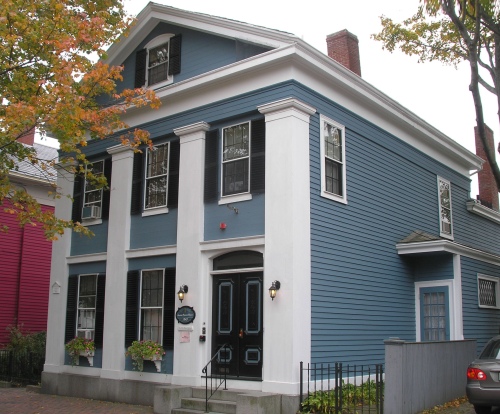
The Payson-Fettyplace House, at 16 Winter Street in Salem, was built around 1845 for Edward H. Payson. In a book published in 1886, it’s explained that Payson, “at the age of eighty, is still cashier of the First National (formerly the Commercial) Bank, to which office he was elected in 1826.” From 1850 to 1911, the house was home to the Fettyplace family. The house is now a Bed & breakfast named the Amelia Payson House in honor of Edward’s wife.

Posts navigation

Older posts
Newer posts
Privacy Policy

Categories

  • Architectural Style (943)
    • Art Deco (9)
    • Byzantine (3)
    • Colonial (177)
    • Colonial Revival (85)
    • Craftsman (6)
    • Egyptian Revival (1)
    • Federal (190)
    • Foursquare (6)
    • Gothic (67)
    • Greek Revival (100)
    • Italianate (82)
    • Mission Revival (2)
    • Mission/Spanish Colonial (1)
    • Modern (2)
    • Neoclassical (56)
    • Octagon (3)
    • Postmodern (1)
    • Queen Anne (46)
    • Renaissance Revival (26)
    • Romanesque Revival (53)
    • Second Empire (26)
    • Shingle Style (12)
    • Stick Style (13)
    • Tudor Revival (8)
    • Vernacular (49)
    • Victorian Eclectic (15)
  • Building Type (943)
    • Apartment Buildings (8)
    • Banks (18)
    • Churches (119)
    • Collegiate (32)
    • Commercial (102)
    • Hotels (16)
    • Houses (508)
    • Industrial (23)
    • Libraries (22)
    • Lighthouses (1)
    • Military (15)
    • Monuments (1)
    • Museums (12)
    • Organizations (39)
    • Outbuildings (17)
    • Public Buildings (50)
    • Schools (23)
    • Stations (5)
    • Synagogues (1)
    • Taverns (21)
    • Theaters (9)
  • Town (943)
    • Adams (11)
    • Agawam (4)
    • Amherst (50)
    • Boston (64)
    • Boylston (6)
    • Cambridge (30)
    • Clinton (21)
    • Concord (15)
    • Cummington (1)
    • Danvers (14)
    • Deerfield (31)
    • Gloucester (18)
    • Granville (10)
    • Great Barrington (2)
    • Hadley (9)
    • Hancock (15)
    • Harvard (32)
    • Holyoke (47)
    • Lenox (5)
    • Lexington (8)
    • Longmeadow (32)
    • Marblehead (40)
    • Marlborough (4)
    • Natick (22)
    • Newton (2)
    • Northampton (68)
    • Peabody (4)
    • Pittsfield (20)
    • Salem (110)
    • Saugus (4)
    • Sheffield (4)
    • South Hadley (8)
    • Southborough (8)
    • Southwick (4)
    • Springfield (67)
    • Stockbridge (19)
    • Stow (1)
    • Sturbridge (18)
    • Sudbury (7)
    • Waltham (11)
    • Watertown (1)
    • Wayland (8)
    • West Springfield (14)
    • Westfield (46)
    • Weston (2)
    • Worcester (26)
  • Uncategorized (1)

Recent Comments

  • Wilber Blackson on South Hadley
  • Tami Speiden on Stockbridge
  • DexGuru on Stockbridge

Tags

Alcott Amherst College Asher Benjamin Back Bay Baptist Beacon Hill Big E Black Heritage Trail bowfront Bulfinch Catholic Congregational Episcopal Freedom Trail Gambrel H.H. Richardson Harvard Hawthorne Historic Deerfield Isaac Damon lit Longfellow mansard Methodist Mount Holyoke Museum Museums NPS Old Sturbridge Village PEM Revolutionary War row houses saltbox Samuel McIntire Shakers Smith College SPNEA Springfield Armory Stephen C. Earle Storrowton Underground Railroad UU Washington William Fenno Pratt Witch Trials

Meta

  • Log in
  • Entries feed
  • Comments feed
  • WordPress.org
Proudly powered by WordPress | Theme: ShowMe by NEThemes.