Search
Advertisement
Become a Fan!
Buy My Book! Click Cover Image to Order!
Categories
- Architectural Style (686)
- Art Deco (2)
- Byzantine (3)
- Colonial (157)
- Colonial Revival (59)
- Craftsman (3)
- Egyptian Revival (1)
- Federal (156)
- Foursquare (3)
- Gothic (45)
- Greek Revival (75)
- Italianate (48)
- Mission Revival (1)
- Modern (1)
- Neoclassical (29)
- Octagon (2)
- Postmodern (1)
- Queen Anne (26)
- Renaissance Revival (17)
- Romanesque Revival (33)
- Second Empire (18)
- Shingle Style (9)
- Stick Style (10)
- Tudor Revival (6)
- Vernacular (29)
- Victorian Eclectic (7)
- Building Type (686)
- Apartment Buildings (5)
- Banks (7)
- Churches (82)
- Collegiate (31)
- Commercial (52)
- Hotels (11)
- Houses (403)
- Industrial (10)
- Libraries (12)
- Lighthouses (1)
- Military (13)
- Monuments (1)
- Museums (9)
- Organizations (26)
- Outbuildings (8)
- Public Buildings (33)
- Schools (16)
- Stations (2)
- Synagogues (1)
- Taverns (17)
- Theaters (5)
- Town (686)
- Adams (2)
- Agawam (4)
- Amherst (50)
- Boston (64)
- Cambridge (30)
- Clinton (8)
- Concord (8)
- Cummington (1)
- Danvers (14)
- Deerfield (31)
- Granville (10)
- Hadley (7)
- Hancock (6)
- Holyoke (19)
- Lenox (5)
- Lexington (8)
- Longmeadow (31)
- Marblehead (40)
- Marlborough (4)
- Natick (22)
- Newton (2)
- Northampton (40)
- Peabody (4)
- Pittsfield (5)
- Salem (97)
- Saugus (4)
- South Hadley (8)
- Southborough (8)
- Southwick (3)
- Springfield (50)
- Stockbridge (10)
- Stow (1)
- Sturbridge (18)
- Sudbury (7)
- Waltham (10)
- Watertown (1)
- Wayland (8)
- West Springfield (14)
- Westfield (19)
- Weston (2)
- Worcester (11)
- Uncategorized (1)
- Architectural Style (686)
Recent Comments
- peter hiller on Boston
- Pat Barnes on Springfield Municipal Group (1913)
- Paul A. Doucette on The Joseph Burnett House (1850)
- Judith on The Joseph Burnett House (1850)
- PCL on Hotel Vendome (1871)
Tags
Alcott Amherst College Asher Benjamin Back Bay Baptist Beacon Hill Big E Black Heritage Trail bowfront Bulfinch Catholic Congregational Episcopal Freedom Trail Gambrel H.H. Richardson Harvard Hawthorne Historic Deerfield Isaac Damon lit Longfellow mansard Methodist Mount Holyoke Museum Museums NPS Old Sturbridge Village PEM Revolutionary War row houses saltbox Samuel McIntire Shakers Shingle SPNEA Springfield Armory Stick Style Storrowton Underground Railroad UU Washington William Fenno Pratt Witch Trials-

Centers And SquaresBlogroll
Links
- Boston Preservation Alliance
- Cape Cod Modern House Trust
- Digital Treasures
- Historic Boston Inc.
- Historic Deerfield
- Historic New England
- Historic Salem Inc.
- Image Museum
- Old Sturbridge Village
- Preservation Massachusetts
- Preservation Worcester
- Salem Preservation, Inc.
- Springfield Preservation Trust
- The Trustees of Reservations
-
Recent Posts
- Hotel Northampton (1927)
- Berkshire Life Insurance Company (1868)
- Friends Meeting House, Adams (1782)
- Meetinghouse, Hancock Shaker Village (1793)
- Trustees’ Office and Store, Hancock Shaker Village (1813)
- Sisters’ Dairy and Weave Shop (1790)
- Brethren’s Shop, Hancock Shaker Village (1813)
- Brick Poultry House, Hancock Shaker Village (1878)
- Brick Dwelling, Hancock Shaker Village (1830)
- Round Stone Barn, Hancock Shaker Village (1826)
- First Baptist Church, Pittsfield (1927)
- Old Berkshire Athenaeum (1876)
- Susan B. Anthony Birthplace (1817)
- William Cullen Bryant Homestead (1785)
- Bray-Hoadley House (1873)
Archives
- May 2013
- April 2013
- March 2013
- February 2013
- January 2013
- December 2012
- November 2012
- October 2012
- September 2012
- August 2012
- July 2012
- June 2012
- May 2012
- April 2012
- March 2012
- February 2012
- January 2012
- December 2011
- November 2011
- October 2011
- September 2011
- August 2011
- July 2011
- June 2011
- May 2011
- April 2011
- March 2011
- February 2011
- January 2011
- December 2010
- November 2010
- October 2010
- September 2010
- August 2010
- July 2010
- June 2010
- May 2010
- April 2010
- March 2010
- February 2010
- January 2010
- December 2009
- November 2009
- October 2009
- September 2009
- August 2009
- July 2009
- June 2009
- May 2009
- April 2009
- March 2009
- February 2009
- January 2009
- December 2008
- November 2008
- October 2008
- July 2008
- June 2008
- May 2008
- April 2008
- March 2008
-

Pages
- Towns
- Adams
- Agawam
- Amherst
- Boston
- Burlington
- Cambridge
- Clinton
- Concord
- Cummington
- Danvers
- Deerfield
- Granville
- Hadley
- Hancock
- Hatfield
- Holyoke
- Lenox
- Lexington
- Longmeadow
- Marblehead
- Marlborough
- Natick
- Newton
- Northampton
- Peabody
- Pittsfield
- Salem
- Saugus
- South Hadley
- Southborough
- Southwick
- Springfield
- Stockbridge
- Stow
- Sturbridge
- Sudbury
- Waltham
- Watertown
- Wayland
- West Springfield
- Westfield
- Weston
- Worcester
- Towns
Meta
Tag Archives: SPNEA
Browne House (1698)

It’s not a great picture above, but since Watertown is making headlines I’m featuring one of its most historic buildings. The Browne House at 562 Main Street in Watertown was built in 1698 by Captain Abraham Browne (1671-1729). The earliest section of the house is located on the far left of the image. On the right is the north ell, which was built in 1725. Browne descendents lived in the house until 1897. The house became dilapidated. It was purchased by preservationist William Sumner Appleton in 1919, just days before it was to be demolished. He restored the house, which is considered to be one of the best examples of a “First Period” New England residence. Appleton had founded the Society for the Preservation of New England Antiquities (now Historic New England) in 1910, but the trustees had not thought the house could be salvaged. Having purchased and restored it, Appleton gave the house to the Society in 1922, subject to a mortgage that was finally discharged in 1949. With its unique architectural features, it is now used by Historic New England as a study property.
Merwin House (1825)

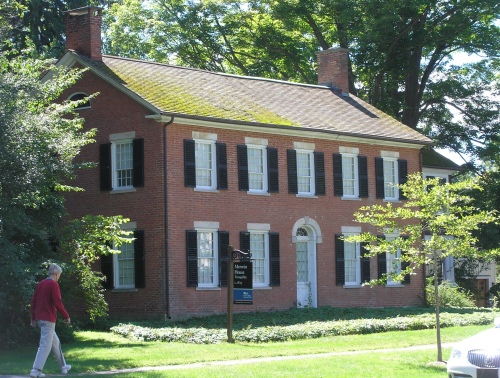
The Merwin House in Stockbridge was constructed around 1825 by Francis and Clarissa Dresser. It remained in the Dresser family until 1875, when they sold it to William and Elizabeth Doane of New York City. The couple named the house “Tranquility” and used it as a summer home. They substantially renovated the house in 1900, remodeling the interior and doubling the home’s by adding a shingle-style ell. The house was later the year-round home of the Doanes’ daughter, Vipont Merwin (1878-1965), and her third husband Edward Merwin, who died in 1932. She wanted the house, which was acquired by Historic New England in 1966, to become a museum and it is now open to the public several times a year. (more…)
The Captain Samuel Fowler House (1809)

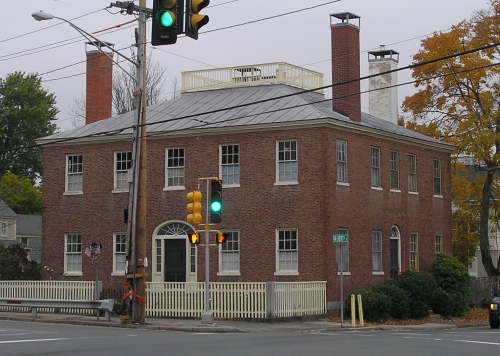
Describing Danversport, a section of Danvers, the 1916 Handbook of New England mentions that, “opposite the Baptist Church and facing the square is the Samuel Fowler house, a square brick structure built in 1809 and since 1912 the property of the Society for the Preservation of New England Antiquities. It is a fine old house in perfect preservation and occupied by the Misses Fowler, who are very liberal in the privileges they grant to callers who wish to inspect the house.” The two unmarried Fowlers had been granted life occupancy of the house, even as it was converted into a museum. Fowler was a local industrialist. As SPNEA founder, William Sumner Appleton, explained in the Society’s Bulletin, vol. III no. 1 (1912):
In 1799 he bought the land on which the house stands, and began investing in mills, two corn mills and a saw mill. His holdings of real estate were frequently added to, and he became interested in a total of five mills. He was the first to start the tanning industry in this part of Danvers, and with seven others shared the cost of building the bridge now known as Liberty Bridge. He was public-spirited and ever ready to aid financially such enterprises as tended to improve the village and town.
Some members were concerned that this second SPNEA acquisition was not grand enough for a Society purchase. In response, Appleton explained,
As might be expected, the Fowler home reflects the simple tastes of its owner. As seen from the square the house is as severely simple as it could be. It depends for its effect on its very simplicity and admirable proportions. [...] The principal features of the house may be said to be simplicity, good taste, solid construction, splendid preservation, and homogeneity.
In a letter of May 1, 1923, writer H. P. Lovecraft described his visit to the house. Led by “Sibylline wraiths of decay’d gentry,” he was even able to try a coat and Capt. Fowler’s cap from the War of 1812! The house, no longer owned by the SPNEA, is now a private residence.
The Gedney House (1665)

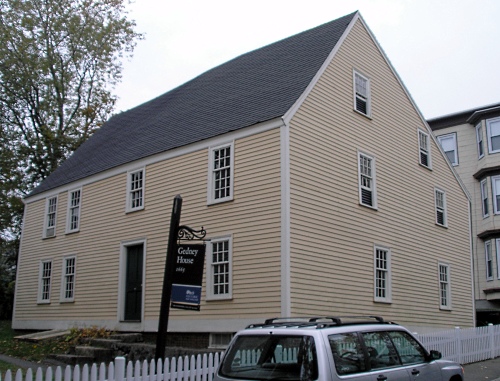
Gedney House in Salem is believed to have been built as early as 1665. As originally built by shipwright Eleazer Gedney, the house had two stories with a gabled attic to the left and a parlor with lean-to roof to the right. Gedney, who was married to the sister of John Turner, builder of the House of Seven Gables, passed the house on to his descendants, who made alterations in 1712. The Gedney family later sold the home to Benjamin Cox, who added two town house ells to the building around 1800, thus converting it to a multi-family residence. In later years, the house served as a boarding house and tenement in what became an Italian-American neighborhood. In 1967, when the house was being prepared for demolition, it was acquired by Historic New England. Now an unfurnished house museum, the original wood structure of the building’s interior is left exposed to display to visitors its original seventeenth-century construction.
The Boardman House (1687)

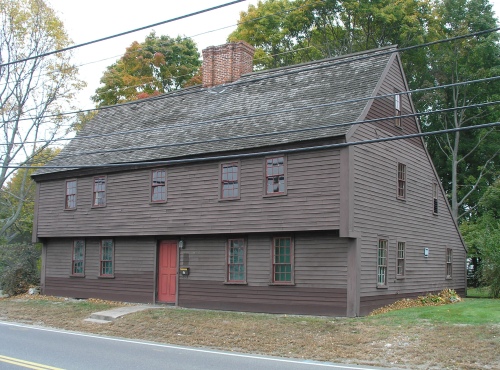
The Boardman House in Saugus is believed to have been built around 1687 (or as late as 1692) by William Boardman, a Boston-trained joiner. The house is sometimes referred to as the Scotch House because it was later confused with an earlier building on the site that once housed indentured Scottish prisoners who worked at the Saugus Iron Works. Boardman may have occupied that building before constructing the current home. A lean-to was added to the house by 1696, giving the structure a saltbox profile. Around 1725, William Boardman, Jr. made changes to the house, including replacing the original casement windows with sash windows. At some point, the building’s original two front gables were also removed. The house remained in the Boardman family until 1911, when it faced danger from modern development. In 1914, it was acquired by the Society for the Preservation of New England Antiquities (now Historic New England). While some necessary repairs were made, SPNEA founder William Sumner Appleton left the house in unspoiled condition to preserve its seventeenth-century structural fabric.
The First Harrison Gray Otis House (1796)

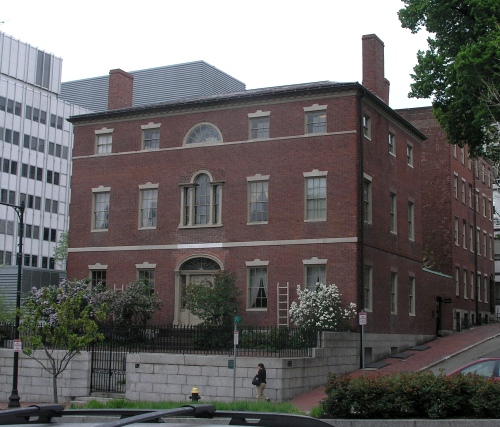
The first of three houses designed by Charles Bulfinch for Harrison Gray Otis is located on Cambridge Street in Boston. Otis was a Federalist lawyer and politician who became one of the wealthiest men in Boston in the early nineteenth century, developing the area of Beacon Hill. His brick house, with brownstone stringcourses, displays distinctive traits of the Federal style, including the semicircular window and side lights of the entryway on the first floor (added after 1801), the Palladian window on the second floor and the semicircular, or lunette, window on the shorter third floor. The Otis House‘s design was based on a house that Bulfinch saw in Philadelphia in 1789, the William Bingham House, which in turn was based on a house in London. By the 1830s, the Otis House had been subdivided and rented out and later became a boarding house. In 1916, restoration of the house was begun by the Society for the Preservation of New England Antiquities (Historic New England), which moved the house about 40 feet from its original location in 1926, to save it from a widening of Cambridge Street. Today the house is attached to additional buildings to the rear and serves as a museum and headquarters of Historic New England. (more…)
The Lyman Estate (1793)

The Lyman Estate, formerly known as “The Vale,” is a country estate in Waltham, originally established in 1793 by Boston merchant Theodore Lyman. The Estate’s grand Federal-style mansion was completed in 1798 and was designed by the Salem architect, Samuel McIntire. The mansion remained in the Lyman family as a summer home for the next century-and-a-half. Lydia Lyman Paine, daughter of nineteenth century owner George Lyman, married Robert Treat Paine, who built Stonehurst on a neighboring estate. The Lyman family added an upper story to their house in 1882. The estate, now owned by Historic New England, is known for its greenhouses (the earliest of which dates to 1800), which are open to the public.