Historic Buildings of Massachusetts

  • About
  • Index by Town
  • CT
  • About
  • Index by Town
  • CT

Tag: saltbox

Rev. John Williams House (1760)
by Dan/September 27, 2012/Colonial, Deerfield, Houses

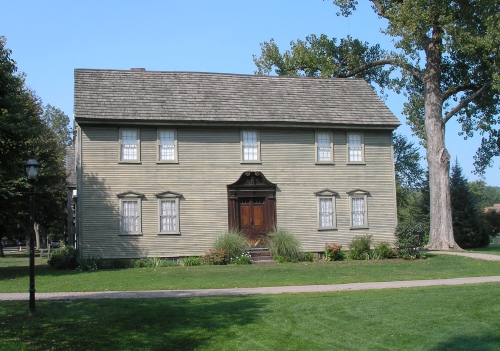
In 1877 a house on Deerfield‘s Town Common on the Old Albany Road was moved back to make way for a new main school building constructed by Deerfield Academy (and since demolished). The house was believed at the time to have been the one built in 1707 for Reverend John Williams. Survivor of the 1704 French and Indian Raid on Deerfield and subsequent captivity in Canada, Rev. Williams wrote the book The Redeemed Captive about his experiences. His new house replaced the one destroyed in the raid. The current Williams House was actually built in 1760 on the site of the 1707 house by Rev. John Williams’ son, Elijah Williams, who was a shopkeeper and tavern-owner. When the house was in danger of being torn down in 1877, Deerfield historian George Sheldon wrote a series of articles (collected in the book The Rev. John Williams House, published in 1918) that raised awareness of the home’s importance and helped save it from destruction. Today the house is used by Deerfield Academy as the Elijah Williams Dormitory. The house’s original Connecticut River Valley doorway, crafted in 1760 by Samuel Partridge, a renowned joiner, was removed in 2001 to preserve and display it (the doorway is now in Historic Deerfield‘s Flynt Center of Early New England Life). The current doorway is a reproduction.
Solomon Richardson House (1748)

by Dan/September 23, 2011/Colonial, Houses, Sturbridge

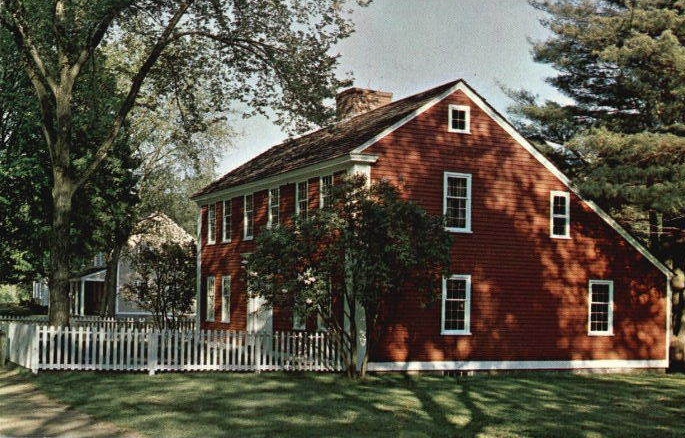
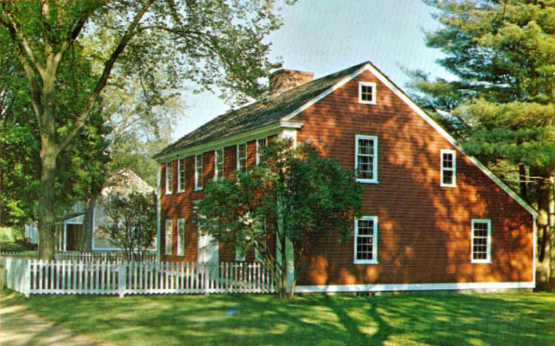
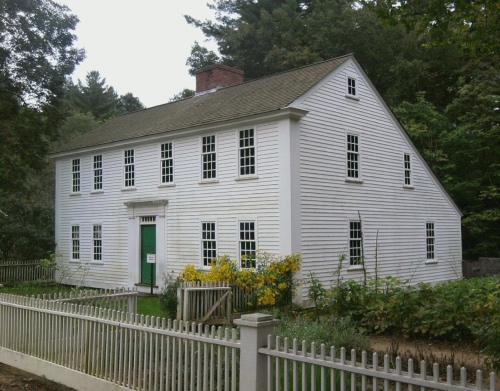
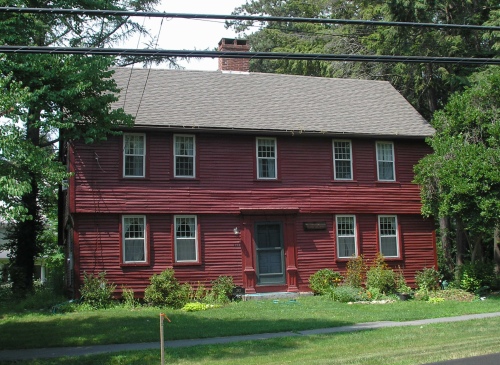
The saltbox house in Old Sturbridge Village known as the Parsonage was built in the village of Podunk in the town of East Brookfield in 1748 by Thomas Bannister for the Richardson family. Called the Solomon Richardson House, it was moved to Old Sturbridge Village in 1940. Now known as the Parsonage (although it never served as a parsonage while it was a residence), it is now interpreted as a minister‘s home. In earlier years at the Village, it was painted red, but was recently repainted white to harmonize with the other Greek Revival era buildings on the Old Sturbridge Village Common.

Solomon Boltwood House (1745)

by Dan/September 8, 2011/Amherst, Colonial, Houses

Solomon Boltwood built the house at 243 Amity Street in Amherst around 1745. His brother, Samuel, built the Boltwood-Stockbridge House on the UMASS campus. Solomon Boltwood was the grandfather of Elijah Boltwood, proprietor of the famous Boltwood Tavern.

Rebecca Nurse Homestead (1678)

by Dan/December 17, 2010January 18, 2020/Colonial, Danvers, Houses

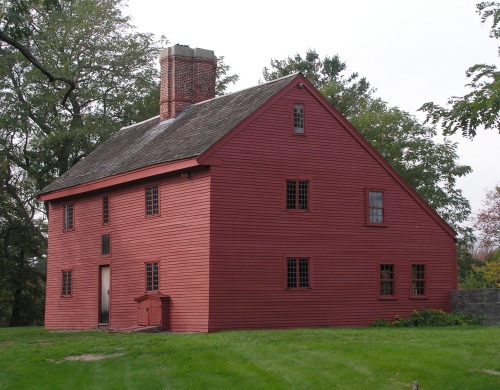
Located on a proprty of 25 acres of fields, pasture and woods at 149 Pine Street in Danvers is the Rebecca Nurse Homestead. The house was mostly likely built in 1678, when Francis Nurse, a skilled maker of wooden household items, began renting the property from owner James Allen. Nurse would eventually purchase the house, where he lived with his wife Rebecca and eight children. In 1692, during the Salem Witch Trials, the 71-year-old Rebecca Nurse was accused of practicing witchcraft. Initially found not guilty at her trial, her young accusers went into convulsive fits which led the jury to return with a guilty verdict. Rebecca Nurse was hanged and her family secretly buried her on the Homestead land. In 1885, the family dedicated a granite memorial in her honor in the Nurse family graveyard. The monument is inscribed with a poem by John Greenleaf Whittier. Francis Nurse died in 1695 and the Homestead remained in the Nurse family into the eighteenth century. Rebecca’s great-grandson, Francis, lived in the house and, as a sergeant in the Danvers Alarm Company, responded to the Lexington Alarm in 1775. The Homestead was owned by the Putnam family from 1784 to 1908. Purchased and restored by the Rebecca Nurse Memorial Asociation, the property was given to the Society for the Preservation of New England Antiquities in 1926 and, since 1981, has been a museum owned by the Danvers Alarm List Company.

Boardman House (1687)

by Dan/October 28, 2010January 16, 2020/Colonial, Houses, Saugus

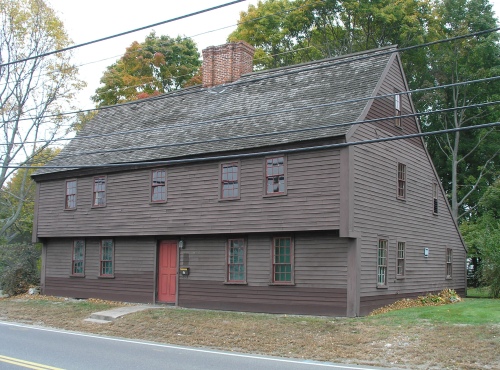
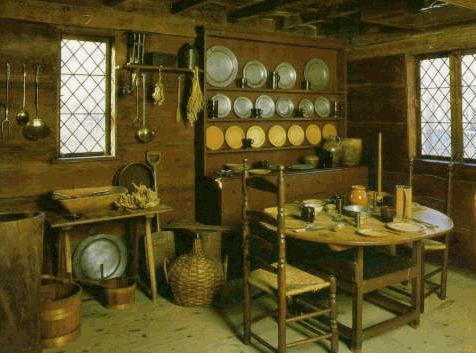
The Boardman House in Saugus is believed to have been built around 1687 (or as late as 1692) by William Boardman, a Boston-trained joiner. The house is sometimes referred to as the Scotch House because it was later confused with an earlier building on the site that once housed indentured Scottish prisoners who worked at the Saugus Iron Works. Boardman may have occupied that building before constructing the current home. A lean-to was added to the house by 1696, giving the structure a saltbox profile. Around 1725, William Boardman, Jr. made changes to the house, including replacing the original casement windows with sash windows. At some point, the building’s original two front gables were also removed. The house remained in the Boardman family until 1911, when it faced danger from modern development. In 1914, it was acquired by the Society for the Preservation of New England Antiquities (now Historic New England). While some necessary repairs were made, SPNEA founder William Sumner Appleton left the house in unspoiled condition to preserve its seventeenth-century structural fabric.

John Ward House (1684)

by Dan/October 27, 2010January 25, 2020/Colonial, Houses, Salem

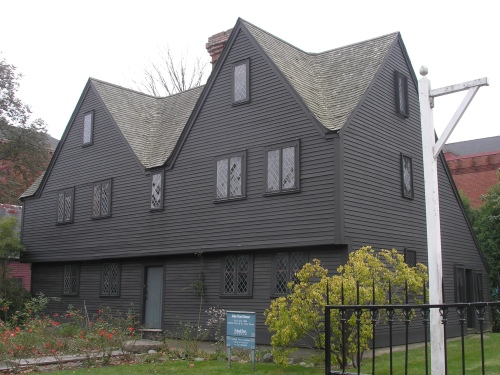
The John Ward House in Salem is a First Period house built in 1684. John Ward was a currier (leather finisher), who is believed to have fled the plague in England around 1660. The house originally stood at 38 St. Peter Street and consisted of one room over one room. At some point around the time of Ward’s death in 1732, the house was expanded with a matching set of rooms. The house went through various changes over the years, with the original front gables being removed. The building‘s eighteenth-century ell was once used for a cent shop and for a time, Sarah W. Symonds, a Salem artist, had her studio and gallery in the home. In 1910, the house was acquired by the Essex Institute and moved to its current location on Brown Street. It was restored under the direction of preservationist George Francis Dow, with period rooms containing seventeenth-century furnishings. Today, the house is a museum owned by the Peabody Essex Museum.

William Hagar House (1760)

by Dan/August 30, 2009September 17, 2016/Colonial, Houses, Marlborough

William Hagar House

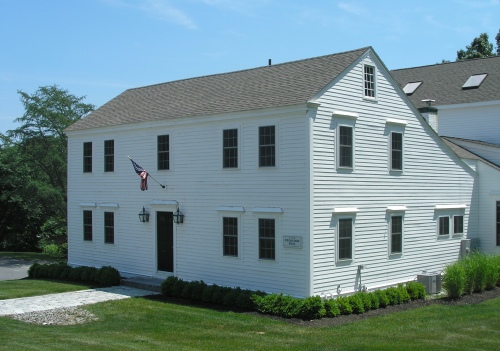
William Hager was a farmer and miller who built a house around 1760 on the Boston Post Road in Marlborough. William married Sarah Stow in 1761 (his brother, Ebenezer, had married Sarah’s sister Abigail in 1753). The brothers operated a sawmill on a nearby brook, built around 1730 by their father Ebenezer Hager. The house was later owned by William and Sarah‘s son, William Hager, Jr. (he was originally named Billy Hager and had his name officially changed to William), who was a staunch Federalist and opposed the War of 1812. The house once had a series of rear ells and an attached barn, all later demolished. In the nineteenth century, it was Victorianized and then re-Colonialized in the 1930s. Today, the house, which has a saltbox profile on its west elevation, has been converted for offices and has a large modern addition to the rear.

Posts navigation

Older posts
Privacy Policy

Categories

  • Architectural Style (943)
    • Art Deco (9)
    • Byzantine (3)
    • Colonial (177)
    • Colonial Revival (85)
    • Craftsman (6)
    • Egyptian Revival (1)
    • Federal (190)
    • Foursquare (6)
    • Gothic (67)
    • Greek Revival (100)
    • Italianate (82)
    • Mission Revival (2)
    • Mission/Spanish Colonial (1)
    • Modern (2)
    • Neoclassical (56)
    • Octagon (3)
    • Postmodern (1)
    • Queen Anne (46)
    • Renaissance Revival (26)
    • Romanesque Revival (53)
    • Second Empire (26)
    • Shingle Style (12)
    • Stick Style (13)
    • Tudor Revival (8)
    • Vernacular (49)
    • Victorian Eclectic (15)
  • Building Type (943)
    • Apartment Buildings (8)
    • Banks (18)
    • Churches (119)
    • Collegiate (32)
    • Commercial (102)
    • Hotels (16)
    • Houses (508)
    • Industrial (23)
    • Libraries (22)
    • Lighthouses (1)
    • Military (15)
    • Monuments (1)
    • Museums (12)
    • Organizations (39)
    • Outbuildings (17)
    • Public Buildings (50)
    • Schools (23)
    • Stations (5)
    • Synagogues (1)
    • Taverns (21)
    • Theaters (9)
  • Town (943)
    • Adams (11)
    • Agawam (4)
    • Amherst (50)
    • Boston (64)
    • Boylston (6)
    • Cambridge (30)
    • Clinton (21)
    • Concord (15)
    • Cummington (1)
    • Danvers (14)
    • Deerfield (31)
    • Gloucester (18)
    • Granville (10)
    • Great Barrington (2)
    • Hadley (9)
    • Hancock (15)
    • Harvard (32)
    • Holyoke (47)
    • Lenox (5)
    • Lexington (8)
    • Longmeadow (32)
    • Marblehead (40)
    • Marlborough (4)
    • Natick (22)
    • Newton (2)
    • Northampton (68)
    • Peabody (4)
    • Pittsfield (20)
    • Salem (110)
    • Saugus (4)
    • Sheffield (4)
    • South Hadley (8)
    • Southborough (8)
    • Southwick (4)
    • Springfield (67)
    • Stockbridge (19)
    • Stow (1)
    • Sturbridge (18)
    • Sudbury (7)
    • Waltham (11)
    • Watertown (1)
    • Wayland (8)
    • West Springfield (14)
    • Westfield (46)
    • Weston (2)
    • Worcester (26)
  • Uncategorized (1)

Recent Comments

  • Wilber Blackson on South Hadley
  • Tami Speiden on Stockbridge
  • DexGuru on Stockbridge

Tags

Alcott Amherst College Asher Benjamin Back Bay Baptist Beacon Hill Big E Black Heritage Trail bowfront Bulfinch Catholic Congregational Episcopal Freedom Trail Gambrel H.H. Richardson Harvard Hawthorne Historic Deerfield Isaac Damon lit Longfellow mansard Methodist Mount Holyoke Museum Museums NPS Old Sturbridge Village PEM Revolutionary War row houses saltbox Samuel McIntire Shakers Smith College SPNEA Springfield Armory Stephen C. Earle Storrowton Underground Railroad UU Washington William Fenno Pratt Witch Trials

Meta

  • Log in
  • Entries feed
  • Comments feed
  • WordPress.org
Proudly powered by WordPress | Theme: ShowMe by NEThemes.