Search
Advertisement
Become a Fan!
Buy My Book! Click Cover Image to Order!
Categories
- Architectural Style (684)
- Art Deco (2)
- Byzantine (3)
- Colonial (157)
- Colonial Revival (58)
- Craftsman (3)
- Egyptian Revival (1)
- Federal (156)
- Foursquare (3)
- Gothic (45)
- Greek Revival (75)
- Italianate (48)
- Mission Revival (1)
- Modern (1)
- Neoclassical (28)
- Octagon (2)
- Postmodern (1)
- Queen Anne (26)
- Renaissance Revival (16)
- Romanesque Revival (33)
- Second Empire (18)
- Shingle Style (9)
- Stick Style (10)
- Tudor Revival (6)
- Vernacular (29)
- Victorian Eclectic (7)
- Building Type (684)
- Apartment Buildings (5)
- Banks (7)
- Churches (82)
- Collegiate (31)
- Commercial (51)
- Hotels (10)
- Houses (403)
- Industrial (10)
- Libraries (12)
- Lighthouses (1)
- Military (13)
- Monuments (1)
- Museums (9)
- Organizations (26)
- Outbuildings (8)
- Public Buildings (33)
- Schools (16)
- Stations (2)
- Synagogues (1)
- Taverns (17)
- Theaters (5)
- Town (684)
- Adams (2)
- Agawam (4)
- Amherst (50)
- Boston (64)
- Cambridge (30)
- Clinton (8)
- Concord (8)
- Cummington (1)
- Danvers (14)
- Deerfield (31)
- Granville (10)
- Hadley (7)
- Hancock (6)
- Holyoke (19)
- Lenox (5)
- Lexington (8)
- Longmeadow (31)
- Marblehead (40)
- Marlborough (4)
- Natick (22)
- Newton (2)
- Northampton (39)
- Peabody (4)
- Pittsfield (4)
- Salem (97)
- Saugus (4)
- South Hadley (8)
- Southborough (8)
- Southwick (3)
- Springfield (50)
- Stockbridge (10)
- Stow (1)
- Sturbridge (18)
- Sudbury (7)
- Waltham (10)
- Watertown (1)
- Wayland (8)
- West Springfield (14)
- Westfield (19)
- Weston (2)
- Worcester (11)
- Uncategorized (1)
- Architectural Style (684)
Recent Comments
- Pat Barnes on Springfield Municipal Group (1913)
- Paul A. Doucette on The Joseph Burnett House (1850)
- Judith on The Joseph Burnett House (1850)
- PCL on Hotel Vendome (1871)
- jennider D on The Joseph Burnett House (1850)
Tags
Alcott Amherst College Asher Benjamin Back Bay Baptist Beacon Hill Big E Black Heritage Trail bowfront Bulfinch Catholic Congregational Episcopal Freedom Trail Gambrel H.H. Richardson Harvard Hawthorne Historic Deerfield Isaac Damon lit Longfellow mansard Methodist Mount Holyoke Museum Museums NPS Old Sturbridge Village PEM Revolutionary War row houses saltbox Samuel McIntire Shakers Shingle SPNEA Springfield Armory Stick Style Storrowton Underground Railroad UU Washington William Fenno Pratt Witch Trials-

Centers And SquaresBlogroll
Links
- Boston Preservation Alliance
- Cape Cod Modern House Trust
- Digital Treasures
- Historic Boston Inc.
- Historic Deerfield
- Historic New England
- Historic Salem Inc.
- Image Museum
- Old Sturbridge Village
- Preservation Massachusetts
- Preservation Worcester
- Salem Preservation, Inc.
- Springfield Preservation Trust
- The Trustees of Reservations
-
Recent Posts
- Friends Meeting House, Adams (1782)
- Meetinghouse, Hancock Shaker Village (1793)
- Trustees’ Office and Store, Hancock Shaker Village (1813)
- Sisters’ Dairy and Weave Shop (1790)
- Brethren’s Shop, Hancock Shaker Village (1813)
- Brick Poultry House, Hancock Shaker Village (1878)
- Brick Dwelling, Hancock Shaker Village (1830)
- Round Stone Barn, Hancock Shaker Village (1826)
- First Baptist Church, Pittsfield (1927)
- Old Berkshire Athenaeum (1876)
- Susan B. Anthony Birthplace (1817)
- William Cullen Bryant Homestead (1785)
- Bray-Hoadley House (1873)
- Dewey Block, Northampton (1912)
- Browne House (1698)
Archives
- May 2013
- April 2013
- March 2013
- February 2013
- January 2013
- December 2012
- November 2012
- October 2012
- September 2012
- August 2012
- July 2012
- June 2012
- May 2012
- April 2012
- March 2012
- February 2012
- January 2012
- December 2011
- November 2011
- October 2011
- September 2011
- August 2011
- July 2011
- June 2011
- May 2011
- April 2011
- March 2011
- February 2011
- January 2011
- December 2010
- November 2010
- October 2010
- September 2010
- August 2010
- July 2010
- June 2010
- May 2010
- April 2010
- March 2010
- February 2010
- January 2010
- December 2009
- November 2009
- October 2009
- September 2009
- August 2009
- July 2009
- June 2009
- May 2009
- April 2009
- March 2009
- February 2009
- January 2009
- December 2008
- November 2008
- October 2008
- July 2008
- June 2008
- May 2008
- April 2008
- March 2008
-

Pages
- Towns
- Adams
- Agawam
- Amherst
- Boston
- Burlington
- Cambridge
- Clinton
- Concord
- Cummington
- Danvers
- Deerfield
- Granville
- Hadley
- Hancock
- Hatfield
- Holyoke
- Lenox
- Lexington
- Longmeadow
- Marblehead
- Marlborough
- Natick
- Newton
- Northampton
- Peabody
- Pittsfield
- Salem
- Saugus
- South Hadley
- Southborough
- Southwick
- Springfield
- Stockbridge
- Stow
- Sturbridge
- Sudbury
- Waltham
- Watertown
- Wayland
- West Springfield
- Westfield
- Weston
- Worcester
- Towns
Meta
Tag Archives: Freedom Trail
King’s Chapel, Boston (1749)
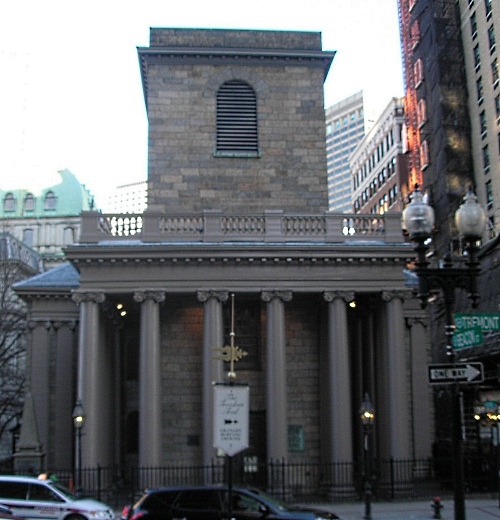
King’s Chapel, originally founded to serve British officers, was the first Anglican church in Puritan Boston. The Chapel‘s first building was a wood structure, built in 1686 on land that had been part of the town’s oldest burying ground. The current Chapel, built of Quincy granite, was constructed around the old one in 1749-1754 (the dismantled remains of the old church were then removed through the windows). The architect was Peter Harrison, of Newport, RI, considered to be America’s “first architect,” who modeled the Georgian-style building on those designed by James Gibbs in England, like St. Martin in the Fields in London, except the steeple of King’s Chapel was never built due to a lack of funds. When the British evacuated Boston during the Revolutionary War, there were few Anglican families remaining in town. James Freeman, a lay reader, became minister in 1783 and led Stone Chapel (as King’s Chapel had come to be called) to become America’s first Unitarian church in 1789 (although the congregation continued to follow a liturgy based on the Book of Common Prayer). That same year, George Washington attended an oratorio at the Chapel intended to raise funds for the construction of a portico of wood Ionic columns, painted to resemble stone. When the Chapel’s bell cracked in 1814, it was recast by Paul Revere. Both the Chapel and the adjacent King’s Chapel Burying Ground are on the Boston Freedom Trail.
Posted in Boston, Churches, Colonial
Tagged Episcopal, Freedom Trail, Paul Revere, Revolutionary War, UU, Washington
Leave a comment
Park Street Church (1809)

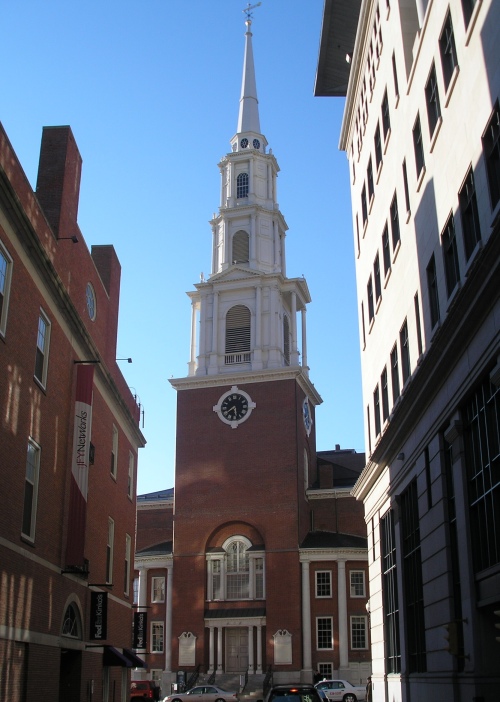
Boston’s Park Street Church was built in 1809-1810 on the site of the 1738 town granary (the Old Granary Burying Ground is next door). The church‘s architect, Peter Banner, adapted the steeple from a design by Sir Christopher Wren. Solomon Willard carved the wooden capitals of the front columns. Either because of the “fire and brimstone” sermons of its Congregational preachers or the fact that gunpowder was stored in its basement during the War of 1812, the corner of Tremont and Park Streets, where the church is located, came to be known as “Brimstone Corner.” The church has had many firsts: the first Sunday School in America was founded here in 1817; the first missionaries to be sent to Hawaii started from here in 1819; the first prison aid society was founded here in 1824; William Lloyd Garrison made his first public anti-slavery speech here in 1829; and Samuel Francis Smith’s hymn, America (“My Country ‘Tis of Thee“) was sung for the first time on the church‘s steeps by Park Street’s Children’s Choir in 1831. Park Street Church is on Boston’s Freedom Trail.
Posted in Boston, Churches, Federal
Tagged Congregational, Freedom Trail, War of 1812
Leave a comment
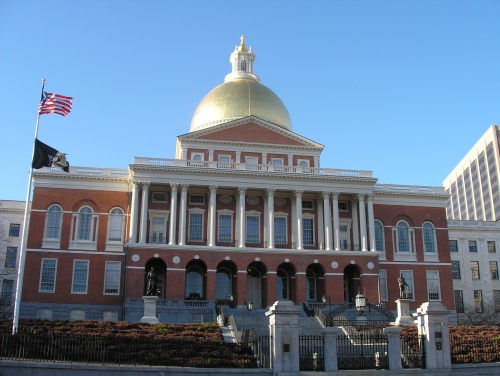
Massachusetts State House (1798)

The Massachusetts State Capitol building in Boston, designed by Charles Bulfinch, was completed in 1798. The government of Massachusetts had previously used the Old State House, so the current building is sometimes called the New State House. It was built on Beacon Hill, on land once owned by John Hancock. The site on Beacon Hill was lowered 50 feet for the construction, with the excavated dirt being used as landfill. Bulfinch modeled his design on William Chambers‘s Somerset House and James Wyatt‘s Pantheon, both in London. The capitol building‘s dome was originally made of wood, which soon leaked. In 1802, it was covered with copper by Paul Revere’s company. Originally painted gray, to resemble stone, it was later painted yellow and, in 1874, gilded with gold. It was most recently regilded in 1997. The building was expanded with the addition of a yellow brick annex in 1895 and the two massive marble wings, on each side, in 1914 and 1917. The State House underwent a restoration in 2000. Today, this important structure, which Oliver Wendell Holmes once called, “the hub of the solar system,” is open to the public for tours.
Posted in Boston, Federal, Public Buildings
Tagged Beacon Hill, Bulfinch, Freedom Trail, Paul Revere
Leave a comment
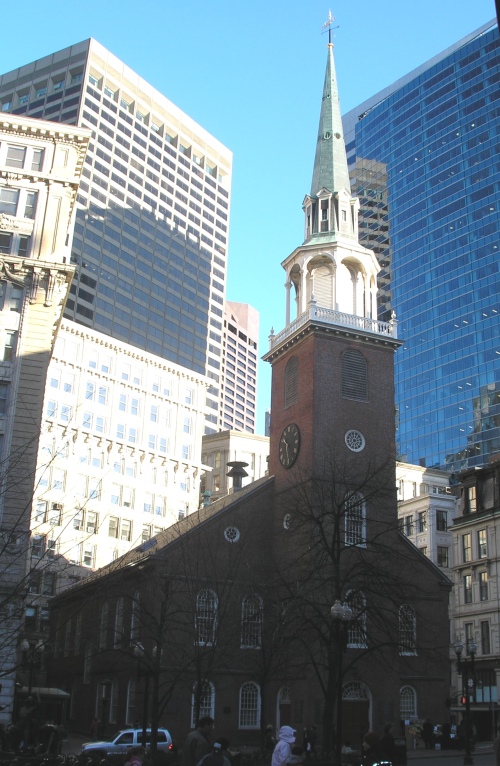
Old South Meeting House (1729)

Built in 1729, Boston’s Old South Meeting House was the largest building in the colonial town. The congregation began in 1669, when it separated from Boston’s First Church (becoming the Third Church of Boston). In the years immediately preceding the outbreak of the American Revolution, citizens would gather in the Old South Meeting House to debate and argue in the aftermath of events like the Boston Massacre. On the night of December 16, 1773, over 5,000 colonists, angered over the tax on tea, met at Old South and after hours of debate, Samuel Adams gave a secret signal which began the famous Boston Tea Party. During the war, occupying British troops took revenge for the Tea Party by ripping out the church‘s pews and using the building as a riding stable. They also set up a bar on the first balcony. The church continued to be used as a house of worship, but after it was nearly destroyed in the Great Boston Fire of 1872, the congregation built the New Old South Church at Copley Square. In danger of being torn down, pioneering preservation efforts led to the restoration of the building, which has been a museum and historic site since 1877. It is also a stop on the Boston Freedom Trail. The steeple has been replaced twice, after storms in 1804 and 1954.
Posted in Boston, Churches, Colonial
Tagged Congregational, Freedom Trail, Museum, Revolutionary War
1 Comment
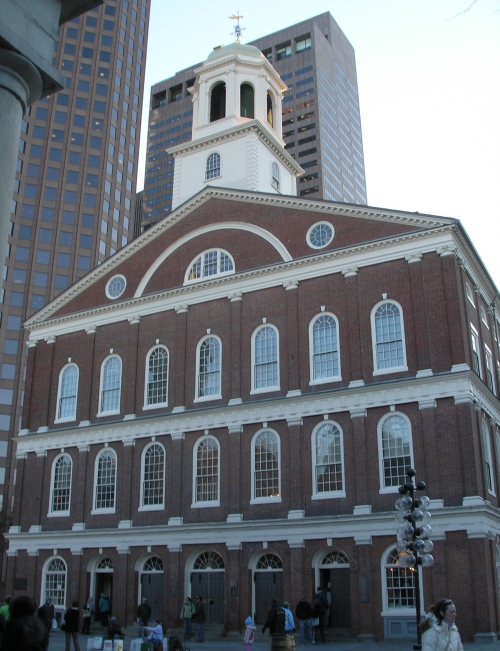
Faneuil Hall (1742)

Peter Faneuil was a Boston merchant whose parents were Huguenots. In 1740, he proposed donating a market building to the town, with a marketplace below and a public meeting hall above. The original Faneuil Hall, completed in 1742, was designed by the Scottish artist John Smibert. After the building suffered in a fire in 1761, it was rebuilt the following year. The building now entered the period when it would become known as “The Cradle of Liberty.” James Otis dedicated the meeting room to the “Cause of Liberty” and it was here that the many important gatherings protesting British taxes on the colonies were held, under the leadership of such patriots as Samuel Adams and John Hancock. After the Boston Tea Party, the British closed the building to public meetings and it was used to garrison soldiers.
After the Revolutionary War, Faneuil Hall was rebuilt and enlarged in 1806 by Charles Bulfinch, who retained its colonial style, but increased its width, added a third floor and enclosed the ground floor’s open market arcades. He also added galleries to the meeting hall, which, as Peter Faneuil had requested, has continued to be used for public forums. Over the years it has heard abolitionists, suffragists and political candidates. The third floor, now a museum, is the armory of the Ancient and Honorable Artillery Company of Massachusetts, the oldest military organization in the United States which has had its headquarters in Faneuil Hall since 1746. Faneuil Hall also has a distinctive copper gilt Grasshopper weather vane, made by the artisan Shem Drowne. It was stolen, but found a few days later in 1974. In 1898-1899, the building was rebuilt using noncombustible materials. Faneuil Hall, together with the neighboring Quincy Market, is now part of the Faneuil Hall Marketplace. It is also on Boston’s Freedom Trail.
Posted in Boston, Colonial, Public Buildings
Tagged Adams, Bulfinch, Freedom Trail, Museum, Revolutionary War
Leave a comment
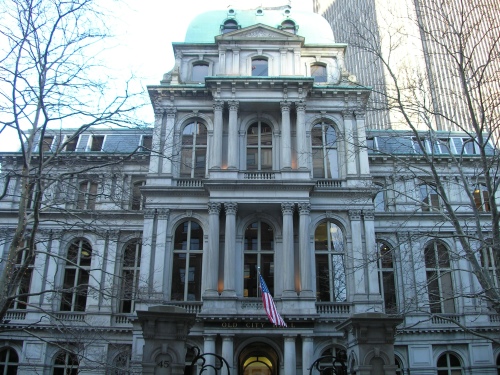
Old City Hall, Boston (1865)

Boston’s Old City Hall, constructed from 1862-1865, was built on School Street, the location, from 1704 to 1748, of the Boston Latin School, America’s first public school. Preceded by a City Hall on the same site designed by Bulfinch, the 1864 building was one of the first in America to be designed in the elaborate French Second Empire style and further helped to popularize the use of the style throughout the country. With the 1969 move to the new City Hall, the old building was adapted to serve as space for offices and a restaurant, although at the cost of some of the original impressive interiors. The preservation of Old City Hall is one of the earliest examples of the adaptive reuse of a historic structure. Old City Hall is also on the route of Boston’s Freedom Trail. See below for more pictures:
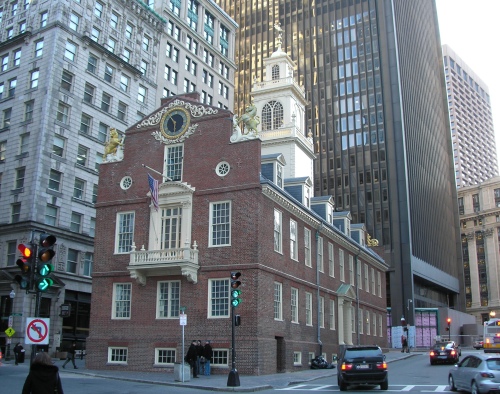
The Old State House (1713)

Since the 1630s, what would become the site of the Old State House in Boston was where the Puritans’ stocks and whipping posts were located and where the town’s earliest market was held. A wood Town House was built there in 1657, which had an open air market on the ground floor and a meeting place above. After this structure burned down in 1711, a new brick one was built in 1713, although the interior was gutted by fire in 1747 and had to be restored afterwards. This historic structure at the head of State Street, which became the seat of British Royal government in Massachusetts, was the site of many significant events: James Otis‘ speech against the writs of assistance in 1761; the March 5, 1770 Boston Massacre, which occurred just in front of the building; the first reading for Bostonians of the Declaration of Independence by Col. Thomas Crafts from the east balcony on July 18, 1776 (at which time the people torn down from the building the original royal lion and unicorn to be consigned to a bonfire); and the 1789 visit of President George Washington. After the Revolutionary War, it continued to serve as the State House until 1798, when it was given to the town in exchange for a new State House site on Beacon Hill. In 1830, it was altered by architect Isaiah Rogers in the Classical Revival style to serve as a City Hall until 1841. After that, it began a long decline. Housing offices and shops, the exterior was covered with advertisements. There were thoughts of demolishing it to widen the street and Chicagoans even offered to move it to Illinois! In 1882, it was eventually restored (with replicas of the old lion and unicorn) and rededicated as a museum, run by the Bostonian Society. A more recent restoration was completed by Goody, Clancy & Associates in 1991. The building is part of the Boston Freedom Trail. See below for more pictures of the Old State House:
Posted in Boston, Colonial, Public Buildings
Tagged Freedom Trail, Museum, Revolutionary War, Washington
Leave a comment