Search
Advertisement
Become a Fan!
Buy My Book! Click Cover Image to Order!
Categories
- Architectural Style (684)
- Art Deco (2)
- Byzantine (3)
- Colonial (157)
- Colonial Revival (58)
- Craftsman (3)
- Egyptian Revival (1)
- Federal (156)
- Foursquare (3)
- Gothic (45)
- Greek Revival (75)
- Italianate (48)
- Mission Revival (1)
- Modern (1)
- Neoclassical (28)
- Octagon (2)
- Postmodern (1)
- Queen Anne (26)
- Renaissance Revival (16)
- Romanesque Revival (33)
- Second Empire (18)
- Shingle Style (9)
- Stick Style (10)
- Tudor Revival (6)
- Vernacular (29)
- Victorian Eclectic (7)
- Building Type (684)
- Apartment Buildings (5)
- Banks (7)
- Churches (82)
- Collegiate (31)
- Commercial (51)
- Hotels (10)
- Houses (403)
- Industrial (10)
- Libraries (12)
- Lighthouses (1)
- Military (13)
- Monuments (1)
- Museums (9)
- Organizations (26)
- Outbuildings (8)
- Public Buildings (33)
- Schools (16)
- Stations (2)
- Synagogues (1)
- Taverns (17)
- Theaters (5)
- Town (684)
- Adams (2)
- Agawam (4)
- Amherst (50)
- Boston (64)
- Cambridge (30)
- Clinton (8)
- Concord (8)
- Cummington (1)
- Danvers (14)
- Deerfield (31)
- Granville (10)
- Hadley (7)
- Hancock (6)
- Holyoke (19)
- Lenox (5)
- Lexington (8)
- Longmeadow (31)
- Marblehead (40)
- Marlborough (4)
- Natick (22)
- Newton (2)
- Northampton (39)
- Peabody (4)
- Pittsfield (4)
- Salem (97)
- Saugus (4)
- South Hadley (8)
- Southborough (8)
- Southwick (3)
- Springfield (50)
- Stockbridge (10)
- Stow (1)
- Sturbridge (18)
- Sudbury (7)
- Waltham (10)
- Watertown (1)
- Wayland (8)
- West Springfield (14)
- Westfield (19)
- Weston (2)
- Worcester (11)
- Uncategorized (1)
- Architectural Style (684)
Recent Comments
- Pat Barnes on Springfield Municipal Group (1913)
- Paul A. Doucette on The Joseph Burnett House (1850)
- Judith on The Joseph Burnett House (1850)
- PCL on Hotel Vendome (1871)
- jennider D on The Joseph Burnett House (1850)
Tags
Alcott Amherst College Asher Benjamin Back Bay Baptist Beacon Hill Big E Black Heritage Trail bowfront Bulfinch Catholic Congregational Episcopal Freedom Trail Gambrel H.H. Richardson Harvard Hawthorne Historic Deerfield Isaac Damon lit Longfellow mansard Methodist Mount Holyoke Museum Museums NPS Old Sturbridge Village PEM Revolutionary War row houses saltbox Samuel McIntire Shakers Shingle SPNEA Springfield Armory Stick Style Storrowton Underground Railroad UU Washington William Fenno Pratt Witch Trials-

Centers And SquaresBlogroll
Links
- Boston Preservation Alliance
- Cape Cod Modern House Trust
- Digital Treasures
- Historic Boston Inc.
- Historic Deerfield
- Historic New England
- Historic Salem Inc.
- Image Museum
- Old Sturbridge Village
- Preservation Massachusetts
- Preservation Worcester
- Salem Preservation, Inc.
- Springfield Preservation Trust
- The Trustees of Reservations
-
Recent Posts
- Friends Meeting House, Adams (1782)
- Meetinghouse, Hancock Shaker Village (1793)
- Trustees’ Office and Store, Hancock Shaker Village (1813)
- Sisters’ Dairy and Weave Shop (1790)
- Brethren’s Shop, Hancock Shaker Village (1813)
- Brick Poultry House, Hancock Shaker Village (1878)
- Brick Dwelling, Hancock Shaker Village (1830)
- Round Stone Barn, Hancock Shaker Village (1826)
- First Baptist Church, Pittsfield (1927)
- Old Berkshire Athenaeum (1876)
- Susan B. Anthony Birthplace (1817)
- William Cullen Bryant Homestead (1785)
- Bray-Hoadley House (1873)
- Dewey Block, Northampton (1912)
- Browne House (1698)
Archives
- May 2013
- April 2013
- March 2013
- February 2013
- January 2013
- December 2012
- November 2012
- October 2012
- September 2012
- August 2012
- July 2012
- June 2012
- May 2012
- April 2012
- March 2012
- February 2012
- January 2012
- December 2011
- November 2011
- October 2011
- September 2011
- August 2011
- July 2011
- June 2011
- May 2011
- April 2011
- March 2011
- February 2011
- January 2011
- December 2010
- November 2010
- October 2010
- September 2010
- August 2010
- July 2010
- June 2010
- May 2010
- April 2010
- March 2010
- February 2010
- January 2010
- December 2009
- November 2009
- October 2009
- September 2009
- August 2009
- July 2009
- June 2009
- May 2009
- April 2009
- March 2009
- February 2009
- January 2009
- December 2008
- November 2008
- October 2008
- July 2008
- June 2008
- May 2008
- April 2008
- March 2008
-

Pages
- Towns
- Adams
- Agawam
- Amherst
- Boston
- Burlington
- Cambridge
- Clinton
- Concord
- Cummington
- Danvers
- Deerfield
- Granville
- Hadley
- Hancock
- Hatfield
- Holyoke
- Lenox
- Lexington
- Longmeadow
- Marblehead
- Marlborough
- Natick
- Newton
- Northampton
- Peabody
- Pittsfield
- Salem
- Saugus
- South Hadley
- Southborough
- Southwick
- Springfield
- Stockbridge
- Stow
- Sturbridge
- Sudbury
- Waltham
- Watertown
- Wayland
- West Springfield
- Westfield
- Weston
- Worcester
- Towns
Meta
Tag Archives: Back Bay
326-328 Dartmouth Street, Boston (1871)
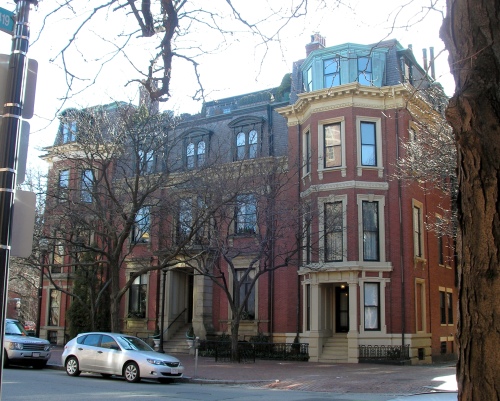
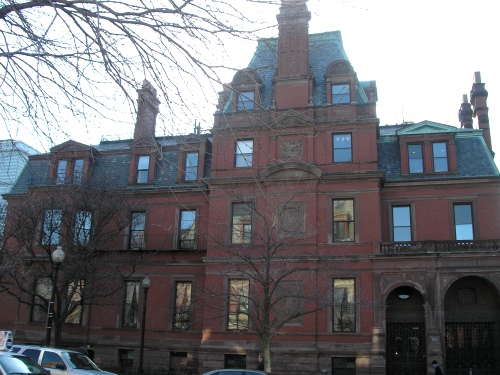
The Cushing-Endicott House, at 163 Marlborough Street in Boston, is considered one of the Back Bay‘s greatest architectural achievements. Designed in the French Academic Style, it was built in 1871 of brick, with Nova Scotia sandstone trim, for Thomas F. Cushing by the firm of Snell and Gregerson. The house later served as the home of William C. Endicott, secretary of war under President Grover Cleveland. In 1903, John Singer Sargent used one of the bedrooms as his studio. The house is now divided into condominiums. The house is joined to two neighboring houses, one with an interesting T-shape interior plan, which are located around the corner at 326-328 Dartmouth Street and have a similar architectural style.
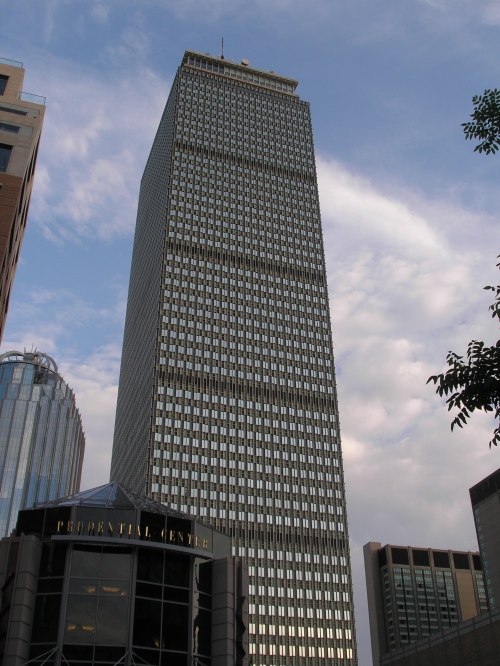
Prudential Tower (1964)

The Prudential Tower, part of Boston’s Prudential Center complex in the Back Bay, is the city’s second tallest skyscraper. It was designed by Charles Luckman and Associates for Prudential Insurance and built between 1960 and 1964. It towered over the nearby John Hancock building of 1947, which prompted the rival insurance company to build a taller tower in 1975.
The Ames-Webster House (1872)

The 1872 Mansard-roofed house of industrialist and congressman Frederick L. Ames, originally designed by Peabody and Stearns and located at the intersection of Dartmouth Street and Commonwealth Avenue, in Boston’s Back Bay, was significantly enlarged in 1882 by the architect, John Hubbard Sturgis. Sturgis had earlier designed the Gothic Revival-style Museum of Fine Arts building of 1876 and in the Ames House he worked in the English Queen Anne style. The expanded Ames Mansion, which was occupied for 90 years by the Ames and Webster families, features a two-level conservatory, large tower and chimney and porte-cochere. The interior is lavish, with stained glass by John La Farge and murals by Benjamin Constant. In 1972, the house was converted to serve as offices, a notable example of adaptive reuse.
Boston Public Library (1895)

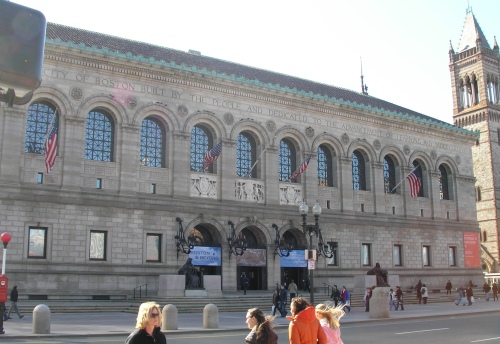
Founded in 1848 by an act of the Massachusetts legislature and first opened in 1854, the Boston Public Library moved to its current building, on Copley Square, in 1895. Designed by Charles Follen McKim, of McKim, Mead, and White, the building (built 1887-1895) is modeled on the style of an Italian Renaissance palazzo and is also influenced by Alberti’s San Francesco at Rimini, with an inner courtyard, based on the Palazzo della Cancelleria in Rome. McKim’s Beaux Arts training led to the classicism of the Library building, influenced in particular by Henri Labrouste‘s Bibliothèque Sainte-Geneviève (built 1843-1850) in Paris. This style would greatly influence the design of American public buildings in the following decades. The Boston Public Library, both inside and out, combines architecture with famous sculpture and mural painting. The neighboring Harvard Medical School building of 1883 was demolished and replaced by Philip Johnson‘s New Brutalist-style Library Addition in 1966 to 1972.
Copley Plaza Hotel (1912)

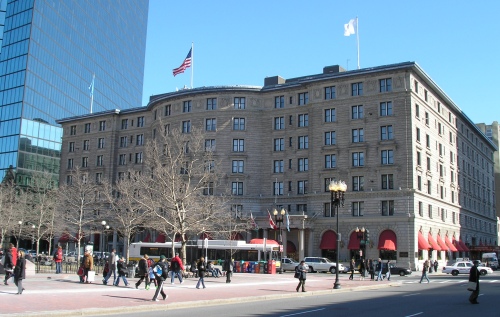
The Copley Plaza Hotel in Boston was built in 1912 on Copley Square, at the site of the old Museum of Fine Arts building (1876), which was torn down in 1909. The hotel was designed by the local architect Clarence Blackall, working with Henry J. Hardenbergh, a nationally renowned architect of hotels, who had studied with the Ecole des Beaux Arts-trained Detlef Lienau. John Singer Sargent had a suite in the hotel in the early 1920s. The building is now the Fairmont Copley Plaza Hotel.
The J.P. Putnam House (1878)

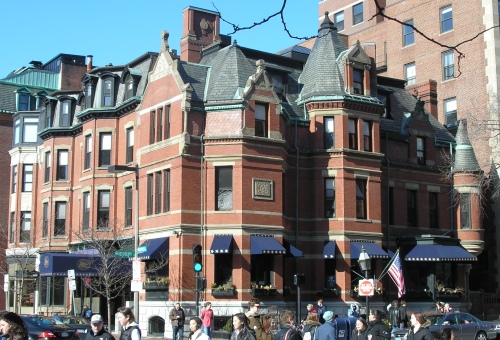
The Boston architect, J. Pickering Putnam, designed his own house, built in 1878 at the intersection of Newbury and Dartmouth Streets in Boston. With many references to Medieval architecture, this complex Queen Anne-style house features multiple towers and gables. The building now houses a restaurant.
Haberstroh Building (1886)

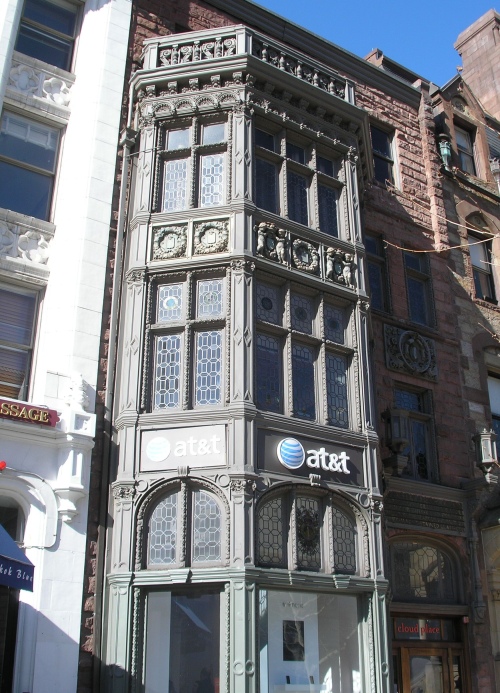
The Haberstroh Building, at 647 Boylston Street in Boston, next to the New Old South Church, was originally a house, built in 1886. From 1888 to 1902, it was the home of Dr. Edward Newton Whittier, a Civil War recipient of the Congressional Medal of Honor, who worked at Harvard Medical School. The house became a business and in 1905, Albert Haberstroh, of the Boston firm of L. Haberstoh & Son, added the four-story bay, which has elaborate copper ornamentation, designed by Haberstroh and done by the Van Noorden sheet metal company.