Brethren’s Shop, Hancock Shaker Village (1813)

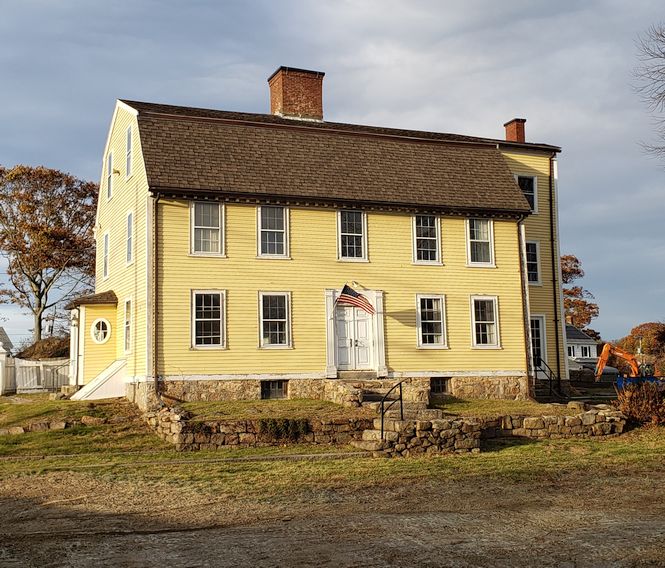
Brethren's Shop

Each male Shaker was expected to practice one or more trades. Built circa 1813, the Brethren’s Shop at Hancock Shaker Village was one of several buildings used as a workshop by the brethren. Inside they made such products as chairs, baskets, shoes, brooms and the distinctive Shaker oval boxes. Paint analysis undertaken in 2007 led to the restoration of the color used when the building was painted yellow in 1845. Continue reading

Share Button
Posted in Hancock, Industrial, Organizations, Outbuildings, Vernacular | Tagged , | Leave a comment

Brick Poultry House, Hancock Shaker Village (1878)

Brick Poultry House

Built in 1878, the Brick Poultry House at Hancock Shaker Village is a particularly fine one, attesting to the value the Shakers placed on their poultry. The many south-facing windows provided warmth and light to the building. The interior of the Brick Poultry House is used by the Hancock Shaker Village for changing exhibitions of contemporary art.

Share Button
Posted in Hancock, Outbuildings, Vernacular | Tagged , | Leave a comment

Brick Dwelling, Hancock Shaker Village (1830)

Brick Dwelling

The Brick Dwelling at Hancock Shaker Village replaced two earlier dwelling structures, dating to the 1790s. The Brick Dwelling was built in 1830-1831 and was designed by Elder William Deming. The building’s basement was used for the kitchen and food storage and the first floor contained various waiting rooms, with the large dining room and the meeting room at opposite ends. The upper floors contained the separated brethren and sisters retiring rooms (Elders and Eldresses retiring rooms were on the second floor). The restored Brick Dwelling can be visited as part of the Hancock Shaker Village museum.

Continue reading

Share Button
Posted in Apartment Buildings, Federal, Hancock, Houses, Organizations, Outbuildings | Tagged , | Leave a comment

Round Stone Barn, Hancock Shaker Village (1826)

Round Stone Barn

This week we look at buildings at the Hancock Shaker Village, which was active from 1783 to 1960 and is now a museum. The Village‘s most iconic building is the Round Stone Barn, a large dairy barn erected in 1826. It replaced an earlier barn complex which had burned in 1825. A circular shape was used for the barn because of its functionality. As described by “H.C.” in the New York Farmer and reprinted in The Genesee Farmer (Vol. V, No. 49, December, 1835):

The great object of agricultural curiosity at Hancock, is their magnificent stone barn, two stories in height and ninety-six feet in diameter. The great mow is in the centre, and is said to he capable of containing between three and four hundred tons of hay. The floor or driveway is on tho outside of the circle, and the team goes round and comes out at the same door at which it enters. Several teams can stand on the floor and be unloaded at the same time. In the centre of this mow a large post or mast is erected, reaching from tho ground to the roof. At the apex of the roof is a small cupola. Around this post, slats or strips of plank are placed at a small distance from it, to prevent the hay from coming in immediate contact, and the hay at the bottom, being raised by an open frame from the ground, a perfect ventilation is formed, and the steam from the new hay is in this way effectually carried off.

A fire destroyed much of the barn in 1864, but it was rebuilt. Around 1870, the 12-sided upper level loft superstructure, which provides interior ventilation and illumination, was completed. In the twentieth century, cracks began appearing in the masonry. In 1968, the walls were dismantled, the foundations shored up and the walls rebuilt using the original stones. The Round Stone Barn‘s exterior woodwork’s yellow paint color was restored in 2009. Continue reading

Share Button
Posted in Hancock, Outbuildings, Vernacular | Tagged , | Leave a comment

First Baptist Church, Pittsfield (1927)

First Baptist Church, Pittsfield

The origins of the Baptist church in Pittsfield go back to the eighteenth century, but its first meeting house was completed in 1827. It was located on North Street, on the northwest corner of the burial ground. The church’s growth led to the construction of a larger building in 1850, which was enlarged and remodeled in 1874-1875. This church was demolished in 1920 to make way for the Onota Building. The First Baptist Church‘s current edifice, at 88 South Street, was built in 1927-1930 (the parish house being completed first in 1926). It was designed by Joseph McArthur Vance.

Share Button
Posted in Churches, Colonial Revival, Pittsfield | Tagged , | Leave a comment

Old Berkshire Athenaeum (1876)

Berkshire Athenaeum

The old Berkshire Athenaeum building, at 44 Bank Row in Pittsfield, was built in 1874-1876. A gift of railway magnate Thomas Allen, it is a High Victorian Gothic building, designed by William Appleton Potter of New York, and displays that style’s distinctive ploychromatic masonry. An addition was made to the rear of the building in 1897. The addition was raised to two stories in 1926, the same year the building’s chimneys were removed. The building served as Pittsfield’s library until 1976, when a new building was constructed across the street on Wendell Avenue. The building was also home to the county museum until the Berkshire Museum was built in 1903. The Athenaeum had responsibility for the museum until it became a separate institution in 1932. The old Athenaeum building stood vacant for three years until it reopened in 1980 as an annex to the Berkshire County Courthouse. It currently houses the Berkshire Probate and Family Court.

Share Button
Posted in Gothic, Libraries, Pittsfield | Leave a comment

Susan B. Anthony Birthplace (1817)

Susan B. Anthony Birthplace

[Note--This is a non-partisan post, but some of the links lead to pages reflecting representing strong opinions on both sides of the abortion issue.] The famous women’s suffrage leader Susan B. Anthony was born in 1820 in a house in Adams. The house had been built by her father, Daniel Anthony, in 1817. He was a cotton manufacturer and abolitionist who raised Susan in the family’s Quaker religion. The family left the house in 1827 and moved to New York State. Their former home, located at 67 East Road in Adams, passed through several owners. From 1926 to 1949, The Society of Friends Descendents owned the house and operated a museum about Susan B. Anthony. After a few unsuccessful attempts by later owners to again make the house a museum, it was purchased at auction in 2006 by Carol Crossed, of the pro-life group Feminists for Life. The restored house opened to the public in 2010 as the Susan B. Anthony Birthplace Museum. It did not open without controversy, however, as there were objections to the museum’s presentation of Anthony’s position on abortion.

Share Button
Posted in Adams, Federal, Houses | Tagged | Leave a comment