Deerfield


Memorial Hall

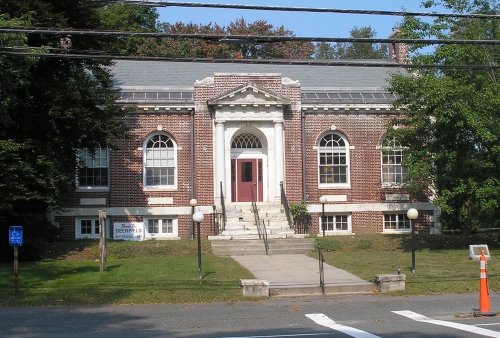
Deerfield Academy was founded in 1797 and a brick building, designed by Asher Benjamin, was built to house the school in 1799. The Academy later expanded and the Pocumtuck Valley Memorial Association purchased the old school building in 1877. The building was renovated and opened in 1880 as the Memorial Hall Museum, displaying a collection of objects gathered by antiquarian George Sheldon. Memorial Hall continues today as a museum of Deerfield history and an adjacent building houses the libraries of the PVMA and Historic Deerfield.

white-church-deerfield.jpg

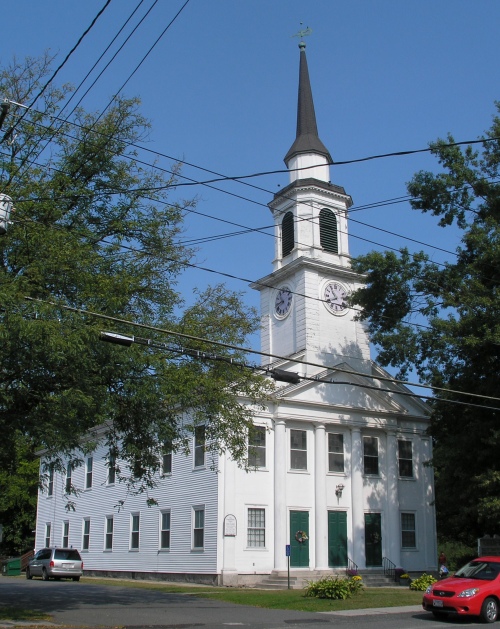
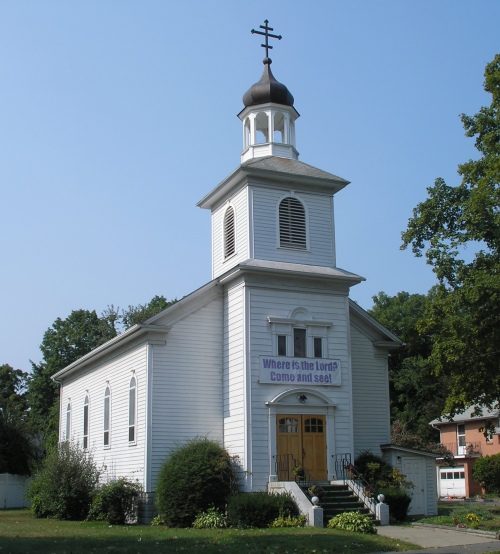
After the First Congregational Church in Deerfield became Unitarian, a group of orthodox Congregationalists separated to make their own church. In 1838, they constructed the “White Church.” The differences between the two churches were resolved in 1931 and in 1957, the White Church was purchased to become part of Historic Deerfield. It is now the White Church Community Center.

first-church-deerfield.jpg

The First Church of Deerfield‘s current meeting house is the town’s fifth in succession, all of which were built on or around Meeting House Hill. The earliest of these buildings was burned during King Philip’s War. The second and third meeting houses are pictured in a sketch of Deerfield buildings made by Dudley Woodbridge in 1738. The second was built in 1682, the third in 1695. In 1952, Deerfield’s post office was remodeled to resemble the third meeting house, which was in use until 1728. The fourth meeting house, the first to have a steeple, was built in 1729 and taken down in 1824, to make way for the current church, which is known as the “Brick Church.” In 1807, a controversy began when the church ordained a Unitarian minister, Rev. Samuel Willard. He was succeeded by other Unitarians. Orthodox Congregationalists eventually broke away and built their own church in 1838. The Brick Church remains a Unitarian Universalist Church today.

flynt-silver-and-metalware-collection.jpg

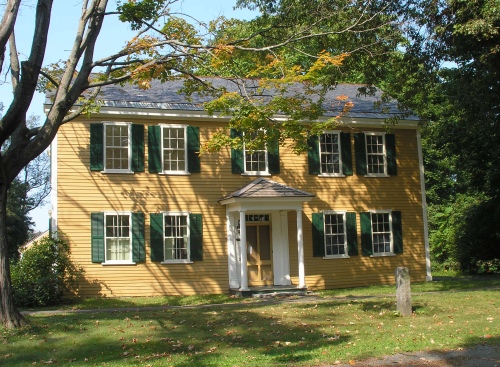
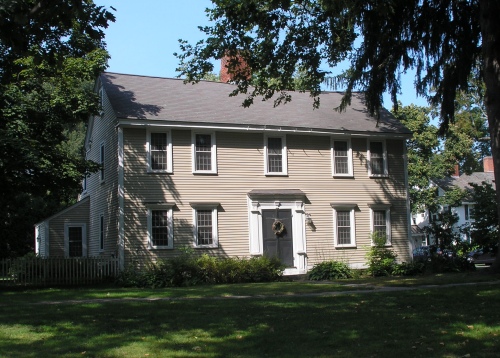
Today part of Historic Deerfield, the Joseph Clesson House was built in 1814, probably planned to be the ell of a larger house Clesson, who died two years later, had intended to build on the site. The house was moved moved around the corner in 1872 and replaced with a Victorian-style home. Eventually, the Clesson House was moved to Greenfield. In 1960, the later Victorian house was torn down and the Clesson House returned to its original lot in Deerfield. The following year, the house opened to the public as the home of the Henry Needham Flynt Silver and Metalware Collection. The house’s kitchen was set up as an example of a silversmith’s workshop. To accommodate the collection, a fireproof wing, made of cinder blocks, was added to the house, with its exterior disguised to resemble the original section.

hall-tavern.jpg

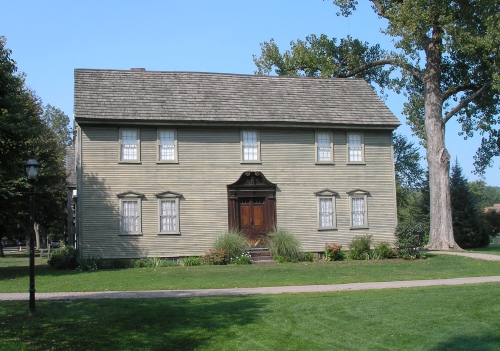
The Hall Tavern Visitor Center at Historic Deerfield was originally built around 1760 on the Mohawk Trail in East Charlemont, not far from Deerfield. It became a tavern in the 1780s and a ballroom was added around 1800. In the early nineteenth century, the tavern was operated by Joel Hall and his wife, Lucretia Street Hall, whose embroidered blanket is in the collection of Historic Deerfield. Joel Hall, who purchased the building in 1807, also manufactured axes. In 1935, the Hall Tavern was the site of an exhibition by the Deerfield Valley Art Association. In the 1950s, the Tavern was moved to a site in Deerfield where a similar tavern, which burned down in 1799, had once stood. It is now the Visitor Center for tours of Historic Deerfield and the restored tavern kitchen is used for open hearth cooking classes. Behind the Tavern is the Cook’s Garden.

frary-house-barnard-tavern.jpg

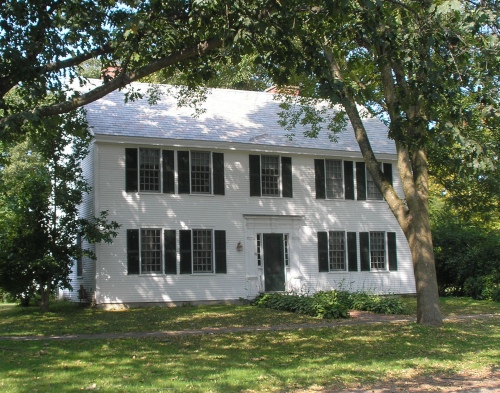
In 1890, Miss Charlotte Alice Baker purchased a colonial home in Deerfield and, assisted by the architectural firm of Shepley, Rutan & Coolidge, restored it in 1892 in one of the earliest efforts at historic preservation in Western Massachusetts. Baker also furnished the home in line with the ideas of the Colonial Revival and Arts and Crafts movements. At the time, the house was believed to have been built by the original Deerfield settler, Samson Frary, who owned the lot and built a house on it sometime after 1683. Frary was killed during the famous 1704 French and Indian Raid on Deerfield. C. Alice Baker, who was a descendant of Samson Frary, did research on the Deerfield captives and wrote a book called True Stories of New England Captives Carried to Canada During the Old French and Indian Wars (1897). She also wrote A Summer in the Azores (1882). Baker’s lifelong companion, Miss Susan Lane, died in 1893 and Miss Baker died in 1909.

The Frary House, now believed to have been built sometime in the late 1750s, is currently owned by Historic Deerfield. The Barnard Tavern is an addition to the Frary House, constructed in 1795. The home had been sold from the Frary to the Barnard families in 1752. With a large second-floor meeting room, the tavern was one of the centers of village life. At the Tavern’s bar, in 1775, Col. Benedict Arnold closed a contract to supply the expedition against Fort Ticonderoga. Recent research, though, suggests that the building may not have served the full functions of a tavern. Archeological work is also planned for the site.

deerfield-post-office.jpg

Built in 1912, the United States Post Office in Deerfield was remodeled in 1952 to look like Deerfield’s third meeting house, which was in use from 1696 to 1728. It originally stood on Deerfield’s town common. An original picture of the meeting house is on the upper right corner of a drawing of town, Delineated Deerfield, by Dudley Woodbridge, a physician from Mystic, Connecticut who kept a 5-page journal of his 1728 journey from Cambridge to Sunderland.

Next Page »