Search
Advertisement
Become a Fan!
Buy My Book! Click Cover Image to Order!
Categories
- Architectural Style (687)
- Art Deco (2)
- Byzantine (3)
- Colonial (157)
- Colonial Revival (59)
- Craftsman (3)
- Egyptian Revival (1)
- Federal (156)
- Foursquare (3)
- Gothic (45)
- Greek Revival (75)
- Italianate (48)
- Mission Revival (1)
- Modern (1)
- Neoclassical (29)
- Octagon (2)
- Postmodern (1)
- Queen Anne (26)
- Renaissance Revival (18)
- Romanesque Revival (33)
- Second Empire (18)
- Shingle Style (9)
- Stick Style (10)
- Tudor Revival (6)
- Vernacular (29)
- Victorian Eclectic (7)
- Building Type (687)
- Apartment Buildings (5)
- Banks (7)
- Churches (82)
- Collegiate (31)
- Commercial (52)
- Hotels (11)
- Houses (403)
- Industrial (10)
- Libraries (12)
- Lighthouses (1)
- Military (13)
- Monuments (1)
- Museums (9)
- Organizations (27)
- Outbuildings (8)
- Public Buildings (33)
- Schools (16)
- Stations (2)
- Synagogues (1)
- Taverns (17)
- Theaters (6)
- Town (687)
- Adams (2)
- Agawam (4)
- Amherst (50)
- Boston (64)
- Cambridge (30)
- Clinton (8)
- Concord (8)
- Cummington (1)
- Danvers (14)
- Deerfield (31)
- Granville (10)
- Hadley (7)
- Hancock (6)
- Holyoke (19)
- Lenox (5)
- Lexington (8)
- Longmeadow (31)
- Marblehead (40)
- Marlborough (4)
- Natick (22)
- Newton (2)
- Northampton (40)
- Peabody (4)
- Pittsfield (5)
- Salem (97)
- Saugus (4)
- South Hadley (8)
- Southborough (8)
- Southwick (3)
- Springfield (50)
- Stockbridge (10)
- Stow (1)
- Sturbridge (18)
- Sudbury (7)
- Waltham (10)
- Watertown (1)
- Wayland (8)
- West Springfield (14)
- Westfield (19)
- Weston (2)
- Worcester (12)
- Uncategorized (1)
- Architectural Style (687)
Recent Comments
- gutter cleaning memphis on Massachusetts Hall (1718)
- peter hiller on Boston
- Pat Barnes on Springfield Municipal Group (1913)
- Paul A. Doucette on The Joseph Burnett House (1850)
- Judith on The Joseph Burnett House (1850)
Tags
Alcott Amherst College Asher Benjamin Back Bay Baptist Beacon Hill Big E Black Heritage Trail bowfront Bulfinch Catholic Congregational Episcopal Freedom Trail Gambrel H.H. Richardson Harvard Hawthorne Historic Deerfield Isaac Damon lit Longfellow mansard Methodist Mount Holyoke Museum Museums NPS Old Sturbridge Village PEM Revolutionary War row houses saltbox Samuel McIntire Shakers Shingle SPNEA Springfield Armory Stick Style Storrowton Underground Railroad UU Washington William Fenno Pratt Witch Trials-

Centers And SquaresBlogroll
Links
- Boston Preservation Alliance
- Cape Cod Modern House Trust
- Digital Treasures
- Historic Boston Inc.
- Historic Deerfield
- Historic New England
- Historic Salem Inc.
- Image Museum
- Old Sturbridge Village
- Preservation Massachusetts
- Preservation Worcester
- Salem Preservation, Inc.
- Springfield Preservation Trust
- The Trustees of Reservations
-
Recent Posts
- Mechanics Hall (1857)
- Hotel Northampton (1927)
- Berkshire Life Insurance Company (1868)
- Friends Meeting House, Adams (1782)
- Meetinghouse, Hancock Shaker Village (1793)
- Trustees’ Office and Store, Hancock Shaker Village (1813)
- Sisters’ Dairy and Weave Shop (1790)
- Brethren’s Shop, Hancock Shaker Village (1813)
- Brick Poultry House, Hancock Shaker Village (1878)
- Brick Dwelling, Hancock Shaker Village (1830)
- Round Stone Barn, Hancock Shaker Village (1826)
- First Baptist Church, Pittsfield (1927)
- Old Berkshire Athenaeum (1876)
- Susan B. Anthony Birthplace (1817)
- William Cullen Bryant Homestead (1785)
Archives
- May 2013
- April 2013
- March 2013
- February 2013
- January 2013
- December 2012
- November 2012
- October 2012
- September 2012
- August 2012
- July 2012
- June 2012
- May 2012
- April 2012
- March 2012
- February 2012
- January 2012
- December 2011
- November 2011
- October 2011
- September 2011
- August 2011
- July 2011
- June 2011
- May 2011
- April 2011
- March 2011
- February 2011
- January 2011
- December 2010
- November 2010
- October 2010
- September 2010
- August 2010
- July 2010
- June 2010
- May 2010
- April 2010
- March 2010
- February 2010
- January 2010
- December 2009
- November 2009
- October 2009
- September 2009
- August 2009
- July 2009
- June 2009
- May 2009
- April 2009
- March 2009
- February 2009
- January 2009
- December 2008
- November 2008
- October 2008
- July 2008
- June 2008
- May 2008
- April 2008
- March 2008
-

Pages
- Towns
- Adams
- Agawam
- Amherst
- Boston
- Burlington
- Cambridge
- Clinton
- Concord
- Cummington
- Danvers
- Deerfield
- Granville
- Hadley
- Hancock
- Hatfield
- Holyoke
- Lenox
- Lexington
- Longmeadow
- Marblehead
- Marlborough
- Natick
- Newton
- Northampton
- Peabody
- Pittsfield
- Salem
- Saugus
- South Hadley
- Southborough
- Southwick
- Springfield
- Stockbridge
- Stow
- Sturbridge
- Sudbury
- Waltham
- Watertown
- Wayland
- West Springfield
- Westfield
- Weston
- Worcester
- Towns
Meta
Category Archives: Sudbury
Presbyterian Church in Sudbury (1835)
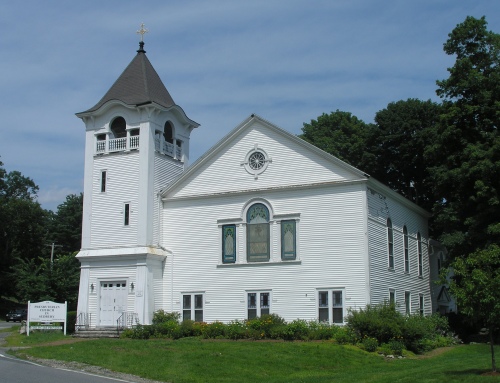
The earliest Methodist meetings in Sudbury were held in the schoolhouse of the town’s north-west district until 1835, when the town decided to no longer allow the use of school buildings for religious meetings. That year, a Methodist meeting house was constructed between Sudbury Green and the Old Revolutionary Cemetery. The church was expanded in 1896, but it now serves as the Presbyterian Church in Sudbury.
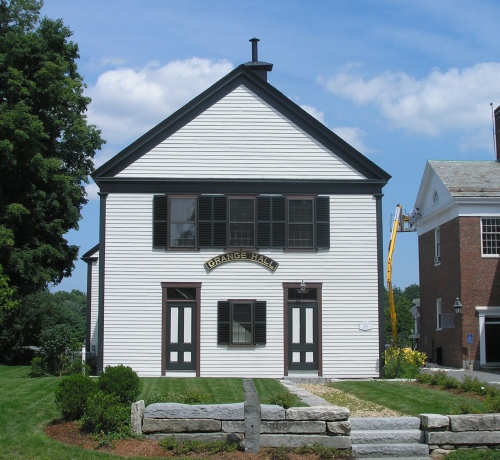
Sudbury Grange Hall (1846)

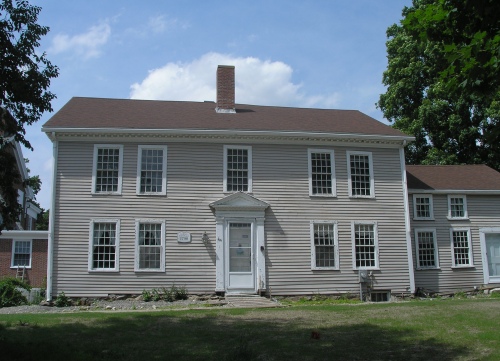
In 1846, the same year Sudbury’s original Town Hall (rebuilt in 1932) was constructed, a schoolhouse was built on the southeast corner of Sudbury Common. The structure was later raised to two-stories. The building, later moved to its current location next to the Town Hall, served as a school until 1890, when it was sold to the Sudbury Grange. In 2006, the building was acquired by the Sudbury Foundation and has been restored and modernized, with a new rear addition. The first floor is now the Foundation’s offices and the second floor is used by the Sudbury Grange and as a public meeting space by the town.
Posted in Organizations, Schools, Sudbury, Vernacular
Leave a comment
Sudbury Town Hall (1932)

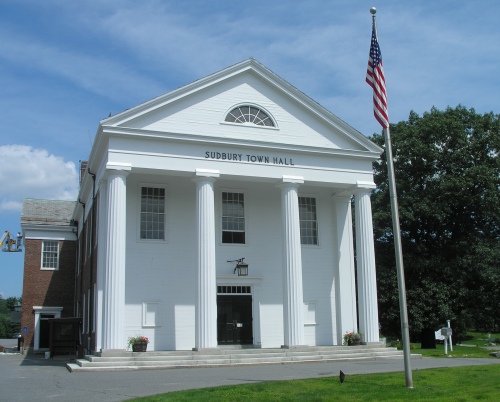
Sudbury‘s original Greek Revival-style Town Hall, built in 1846, stood in Sudbury Center until it was destroyed by fire in 1930. A new building, following the same design but enlarged to plans by Charles H. Way, a Sudbury architect, was built in 1932. The Sudbury Historical Society is located on the Town Hall’s upper floor.
Posted in Greek Revival, Public Buildings, Sudbury
Leave a comment
The Loring Parsonage (1700)

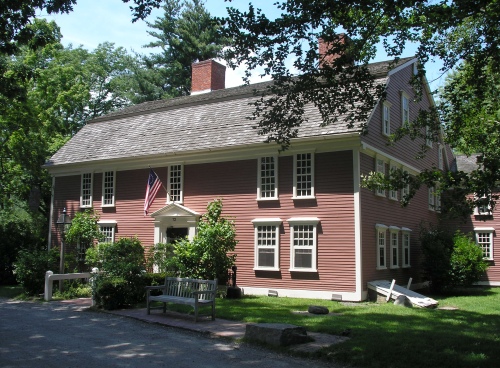
Built around 1700, the Loring Parsonage in Sudbury Center was later the home of Reverend Israel Loring, who became the first minister to serve west of the Sudbury River, settling there in 1723. The Parsonage was later known as the Wheeler-Haynes House and Walter Haynes kept a tavern there. Today the house, which is located behind the town hall, is owned by the town, having meeting rooms and other space which is rented to a credit union.
Posted in Colonial, Houses, Sudbury
Leave a comment
Longfellow’s Wayside Inn (1716)

The Wayside Inn in Sudbury is the oldest operating Inn in the United States and was immortalized in Henry Wadsworth Longfellow‘s sequence of poems, Tales of a Wayside Inn (1863). Built in 1716, the Inn was first known as Howe’s Tavern, for its first innkeeper, David Howe. His descendants continued to operate the Inn, adding to the original structure over time, until 1861. These included Howe’s son, Ezekiel, who led the Sudbury militia to Concord for the battle of April 19, 1775. After passing from the Howes to new owners, the Inn served as a boarding house for temporary lodgers. In October of 1862, Longfellow and his publisher, James Fields, visited the Inn and this inspired the poet to write Tales of a Wayside Inn, which became a bestseller. Although it continued to serve as a boarding house, the Wayside Inn soon began to attract tourists, anxious to see the place which had captured the public imagination. In 1896, Edward Rivers Lemon, a wealthy Medford wool merchant, purchased the Inn as a business venture, inviting the Society of Colonial Wars to meet there in 1897. On that occasion, the orator Samuel Arthur Bent gave a speech entitled: “The Wayside Inn—Its History and Literature.” Lemon intended the Inn to be a literary and artistic retreat and a group artists, poets, and writers, known as the Paint and Clay Club, met there frequently.
The Wayside Inn entered a new phase of its existence when it was purchased by Henry Ford in 1923. He intended to create a living museum of Americana centered on the historic building and bought many acres of land around it. He built a gristmill and the non-denominational Martha-Mary Chapel on the property and and also relocated a schoolhouse from Sterling, which he believed was the actual building mentioned in Sarah Josepha Hale‘s poem “Mary Had a Little Lamb.” The property was placed in a non-profit trust in 1947, with many representatives of the Ford family on the Board, and this transitioned to governance by the National Trust for Historic Preservation in 1957. Restoration of the Inn was necessary, with help from the Ford family, after a devastating fire in December 1955. As of 1960, the Inn came under the governance of local trustees. There would be no further support coming from Ford interests and there was no endowment, but by this time the Inn had become self-sufficient as an inn, restaurant and museum.
Below are pictures of some interiors in the museum section of the Inn: (more…)
The Hosmer House (1793)

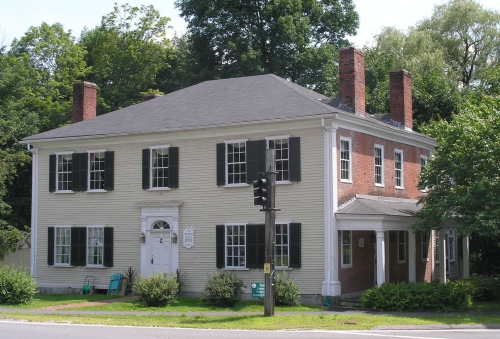
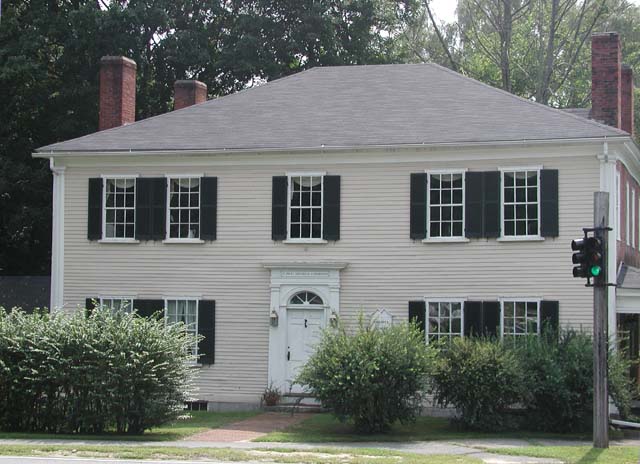
The Hosmer House, at the intersection of Concord and Old Sudbury Roads in Sudbury Center, is a 1793 Federal-style house with a brick end facing Concord Road. It was built by Elisha Wheeler and Asher Goodnow as a commercial venture and was purchased by Ella and James Willis, who ran a general store and post office out of the building, with a ballroom above and a cobbler’s shop attached on the side. A retired Congregational minister, the Rev. Edwin Barrett Hosmer, bought the house in 1897 and lived there with his wife, Abbie Louisa Ames. Their daughter, Florence Ames Hosmer, was an artist and lived in the house until her death in 1978. The historic building had already been deeded to the town as a memorial to her father, along with nearly 500 of her paintings. The house, which displays many of the paintings, is now the headquarters of the Sudbury Historical Commission and is opened to the public on many holidays and special occasions. There is a pdf brochure for the house.
First Parish Church in Sudbury (1797)

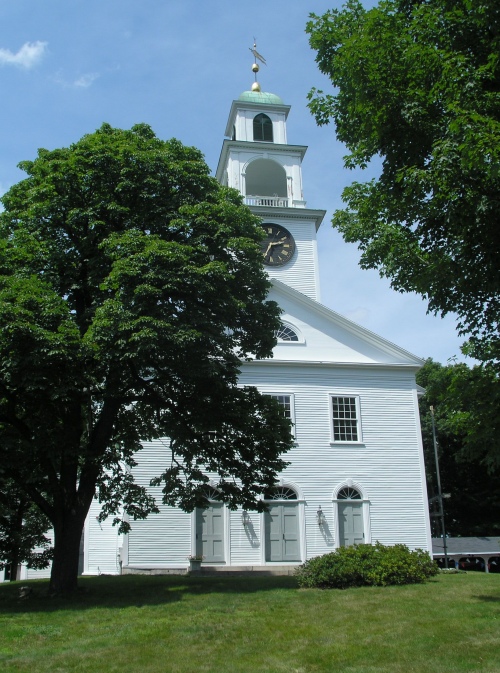
The first religious services in the Parish of Sudbury took place in 1640, east of the Sudbury River in what is now Wayland. The congregation west of the river completed their own meeting house in 1722 and Rev. Israel Loring became their first minister. The current First Parish Church in Sudbury replaced the original structure on the same location in 1797. In 1837, the rise of the Unitarian movement split the congregation and the First Parish became a Unitarian church. According to the History of Sudbury (1889), by Alfred Sereno Hudson,
For a time the old society had different preachers to supply the pulpit. From March 30 to September 22, according to a record book of Capt. Israel Haynes, no less than twelve different ministers preached there. In the summer of 1841, Rev. Linus Shaw was invited to preach, which he did till fall. Soon after, the meeting-house was remodelled, and in 1844, he was invited to preach there again ; he did so, and the result was his settlement as pastor. He was installed June 5, 1845, and continued in the pastorate till his death.