Search
Advertisement
Become a Fan!
Buy My Book! Click Cover Image to Order!
Categories
- Architectural Style (686)
- Art Deco (2)
- Byzantine (3)
- Colonial (157)
- Colonial Revival (59)
- Craftsman (3)
- Egyptian Revival (1)
- Federal (156)
- Foursquare (3)
- Gothic (45)
- Greek Revival (75)
- Italianate (48)
- Mission Revival (1)
- Modern (1)
- Neoclassical (29)
- Octagon (2)
- Postmodern (1)
- Queen Anne (26)
- Renaissance Revival (17)
- Romanesque Revival (33)
- Second Empire (18)
- Shingle Style (9)
- Stick Style (10)
- Tudor Revival (6)
- Vernacular (29)
- Victorian Eclectic (7)
- Building Type (686)
- Apartment Buildings (5)
- Banks (7)
- Churches (82)
- Collegiate (31)
- Commercial (52)
- Hotels (11)
- Houses (403)
- Industrial (10)
- Libraries (12)
- Lighthouses (1)
- Military (13)
- Monuments (1)
- Museums (9)
- Organizations (26)
- Outbuildings (8)
- Public Buildings (33)
- Schools (16)
- Stations (2)
- Synagogues (1)
- Taverns (17)
- Theaters (5)
- Town (686)
- Adams (2)
- Agawam (4)
- Amherst (50)
- Boston (64)
- Cambridge (30)
- Clinton (8)
- Concord (8)
- Cummington (1)
- Danvers (14)
- Deerfield (31)
- Granville (10)
- Hadley (7)
- Hancock (6)
- Holyoke (19)
- Lenox (5)
- Lexington (8)
- Longmeadow (31)
- Marblehead (40)
- Marlborough (4)
- Natick (22)
- Newton (2)
- Northampton (40)
- Peabody (4)
- Pittsfield (5)
- Salem (97)
- Saugus (4)
- South Hadley (8)
- Southborough (8)
- Southwick (3)
- Springfield (50)
- Stockbridge (10)
- Stow (1)
- Sturbridge (18)
- Sudbury (7)
- Waltham (10)
- Watertown (1)
- Wayland (8)
- West Springfield (14)
- Westfield (19)
- Weston (2)
- Worcester (11)
- Uncategorized (1)
- Architectural Style (686)
Recent Comments
- peter hiller on Boston
- Pat Barnes on Springfield Municipal Group (1913)
- Paul A. Doucette on The Joseph Burnett House (1850)
- Judith on The Joseph Burnett House (1850)
- PCL on Hotel Vendome (1871)
Tags
Alcott Amherst College Asher Benjamin Back Bay Baptist Beacon Hill Big E Black Heritage Trail bowfront Bulfinch Catholic Congregational Episcopal Freedom Trail Gambrel H.H. Richardson Harvard Hawthorne Historic Deerfield Isaac Damon lit Longfellow mansard Methodist Mount Holyoke Museum Museums NPS Old Sturbridge Village PEM Revolutionary War row houses saltbox Samuel McIntire Shakers Shingle SPNEA Springfield Armory Stick Style Storrowton Underground Railroad UU Washington William Fenno Pratt Witch Trials-

Centers And SquaresBlogroll
Links
- Boston Preservation Alliance
- Cape Cod Modern House Trust
- Digital Treasures
- Historic Boston Inc.
- Historic Deerfield
- Historic New England
- Historic Salem Inc.
- Image Museum
- Old Sturbridge Village
- Preservation Massachusetts
- Preservation Worcester
- Salem Preservation, Inc.
- Springfield Preservation Trust
- The Trustees of Reservations
-
Recent Posts
- Hotel Northampton (1927)
- Berkshire Life Insurance Company (1868)
- Friends Meeting House, Adams (1782)
- Meetinghouse, Hancock Shaker Village (1793)
- Trustees’ Office and Store, Hancock Shaker Village (1813)
- Sisters’ Dairy and Weave Shop (1790)
- Brethren’s Shop, Hancock Shaker Village (1813)
- Brick Poultry House, Hancock Shaker Village (1878)
- Brick Dwelling, Hancock Shaker Village (1830)
- Round Stone Barn, Hancock Shaker Village (1826)
- First Baptist Church, Pittsfield (1927)
- Old Berkshire Athenaeum (1876)
- Susan B. Anthony Birthplace (1817)
- William Cullen Bryant Homestead (1785)
- Bray-Hoadley House (1873)
Archives
- May 2013
- April 2013
- March 2013
- February 2013
- January 2013
- December 2012
- November 2012
- October 2012
- September 2012
- August 2012
- July 2012
- June 2012
- May 2012
- April 2012
- March 2012
- February 2012
- January 2012
- December 2011
- November 2011
- October 2011
- September 2011
- August 2011
- July 2011
- June 2011
- May 2011
- April 2011
- March 2011
- February 2011
- January 2011
- December 2010
- November 2010
- October 2010
- September 2010
- August 2010
- July 2010
- June 2010
- May 2010
- April 2010
- March 2010
- February 2010
- January 2010
- December 2009
- November 2009
- October 2009
- September 2009
- August 2009
- July 2009
- June 2009
- May 2009
- April 2009
- March 2009
- February 2009
- January 2009
- December 2008
- November 2008
- October 2008
- July 2008
- June 2008
- May 2008
- April 2008
- March 2008
-

Pages
- Towns
- Adams
- Agawam
- Amherst
- Boston
- Burlington
- Cambridge
- Clinton
- Concord
- Cummington
- Danvers
- Deerfield
- Granville
- Hadley
- Hancock
- Hatfield
- Holyoke
- Lenox
- Lexington
- Longmeadow
- Marblehead
- Marlborough
- Natick
- Newton
- Northampton
- Peabody
- Pittsfield
- Salem
- Saugus
- South Hadley
- Southborough
- Southwick
- Springfield
- Stockbridge
- Stow
- Sturbridge
- Sudbury
- Waltham
- Watertown
- Wayland
- West Springfield
- Westfield
- Weston
- Worcester
- Towns
Meta
Monthly Archives: January 2011
The Jeremiah Lee Mansion (1768)
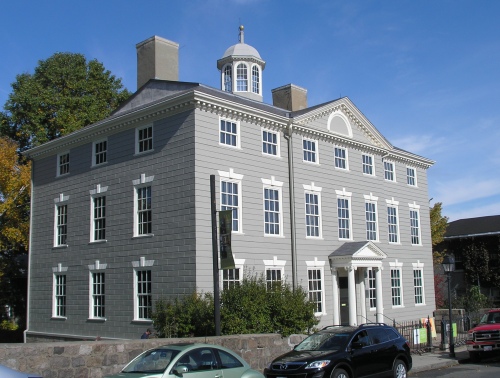
Jeremiah Lee, wealthy merchant and ship owner, built his fabulous Marblehead mansion in 1766-1768. With its lavish interiors and an exterior designed to make this wooden house appear to have a stone ashlar facade, the Jeremiah Lee Mansion in considered to be one of America’s greatest surviving examples of colonial Georgian architecture. Lee died in 1775 and the Mansion remained in the Lee family until 1785, by which time the great merchant’s empire had gone bankrupt. From 1804 to 1904, the Mansion served as the Marblehead Bank, an institution that made remarkably few alterations to the historic building. Since 1909, the house has been owned by the Marblehead Historical Society and is operated as a historic house museum.
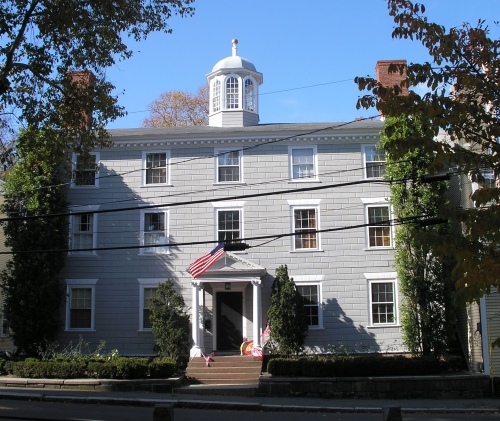
The Col. William Lee House (1743)

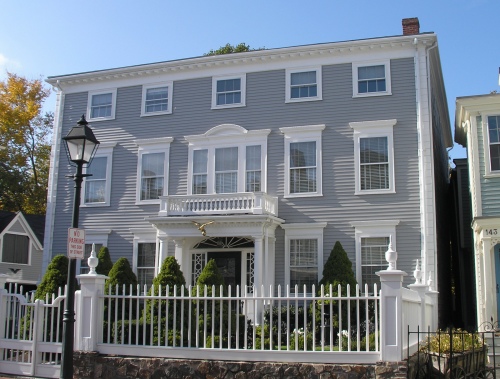
In 1743, Robert “King” Hooper sold land at what is now 185 Washington Street in Marblehead to Justice William Lee, who had plans to build a new house on the site which were not carried out. Instead, the smaller home located on the property was inherited by his grandson, Col. William R. Lee, a merchant and officer in the Revolutionary War, who hired Charles Bulfinch to design an expansion of his home into a mansion that would resemble that of his uncle, Jeremiah Lee. The house features a wood exterior designed to resemble granite.
Gray Manor (1740)

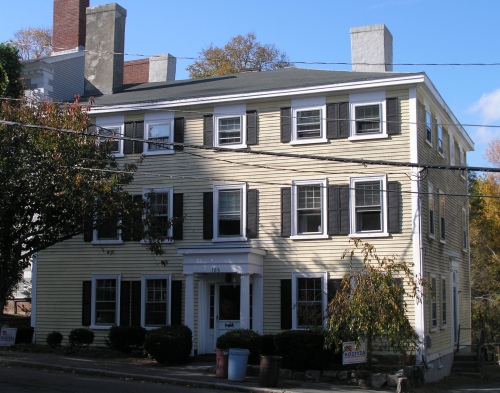
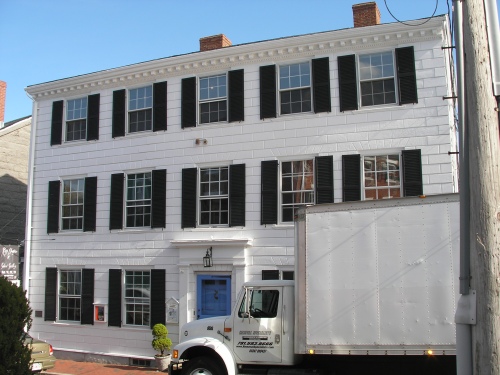
The Georgian-style mansion at 183 Washington Street, across from Abbot Hall in Marblehead, was built around 1740. It has a connection to the Hooper family through Susannah Hooper, daughter of Robert and Mary Glover Hooper. Susannah resided in the house after her marriage to Captain Henry Gallison Gray in 1835. Gray was a shipmaster and later a member of the Massachusetts Senate. The house, traditionally referred to as the Gray Manor, is currently subdivided into multiple apartments.
Posted in Colonial, Houses, Marblehead
Leave a comment
The Nathaniel Hooper Mansion (1754)

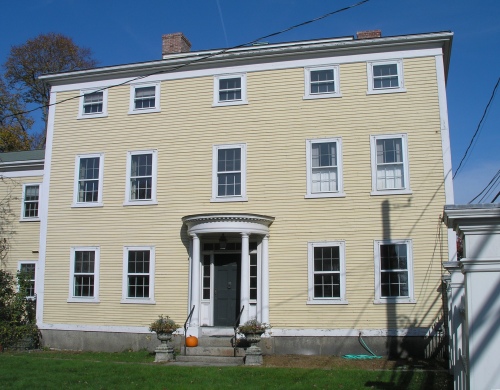
In 1801, Nathaniel Hooper, son of Robert Hooper and brother of Capt. John Hooper, purchased a parcel of land at the foot of Washington Street in Marblehead. A c. 1754 house was already on the property, which Hooper expanded into a Federal-style mansion. According to the Hooper Genealogy (1908), Nathaniel Hooper (1770-1825), “made public profession of his faith in Christ, his Saviour, in 1811, uniting with the Congregational church of Marblehead [the Hoopers had traditionally been Episcopalians]; became a deacon of the church, a man of large generosity and of much public spirit. He was known among the fishermen as ‘The Oracle,’ being very helpful in settling controversies. He represented the town at the General Court 1813-15 and 1822; was a member of the [Massachusetts Constitutional] Convention of 1820.” The Nathaniel Hooper Mansion, at 147 Washington Street, was later owned by the members of Fabens family of Salem. It was acquired by its current owners in 1983 and has been restored.
Posted in Colonial, Federal, Houses, Marblehead
Leave a comment
The Capt. John Hooper House (1800)

Capt. John Hooper was a son of Robert Hooper and Mary (Polly) Ingalls. In 1811, his father deeded John land on Washington Street in Marblehead near his own house. This land included a house built in 1790, but this was replaced around 1815 (or as early as 1800) by John Hooper’s Federal-style mansion at 187 Washington Street. According to the Hooper Genealogy (1908), “He was known at the beginning of the century as ‘John Hooper, 4th;’ the term changed as he grew older. He was a man of great business energy and shrewdness, combined with much regard for equity and public spirit; amassed a large fortune for those days. Was president of the Marblehead Bank a long time. He built the handsome colonial mansion known as ‘The Hooper House,’ on the northern side of the Square, fronting the Common. He represented the town in the General Court 1819-1821.”
Posted in Federal, Houses, Marblehead
Leave a comment
The Hooper-Parker House (1761)

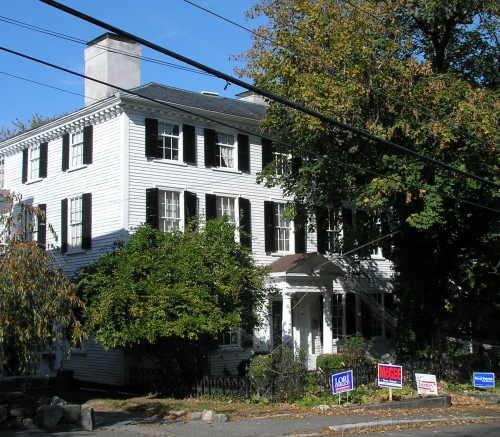
Nathaniel Hooper, successful Marblehead merchant, built a house that was later inherited, at his death in 1760, by his eldest son Robert. In 1761, Robert married Mary (Polly) Ingalls, his next door neighbor. Purchasing the adjacent plot of land from his father-in-law, Robert Hooper expanded his father’s small home into a much larger Georgian-style mansion, known today as the Hooper-Parker House and located at 181 Washington Street. After Robert’s death in 1815, his oldest son, also named Robert, inherited the house and lived there with his wife, Mary Glover, daughter of Capt. John Glover. Mary Glover Hooper was famed as a hostess, entertaining such guests as George Washington and General Lafayette. After Robert’s death in 1843, the house passed to his brother Henry and was later sold to merchant Robert Bridge, who sold it to Rev. Robert B. Parker, Rector of St. Michael’s Episcopal Church from 1922 to 1925. Rev. Parker’s wife Sarah left the house to the SPNEA, which eventually sold the house to a private owner in 1960.
Posted in Colonial, Houses, Marblehead
Leave a comment
The King Hooper Mansion (1745)

This week, we’ll be looking at some mansions in Marblehead built by members of the wealthy Hooper family. The oldest section of the King Hooper Mansion, at 8 Hooper Street, dates to 1728 and was built by Greenfield Hooper, a candle maker. The front section, with its elegant Georgian facade, was erected in 1745 by his son, Robert Hooper. As described in The Loyalists of Massachusetts and the Other Side of the American Revolution (1910), by James H. Stark:
Robert Hooper, known as “King Hooper,” was born at Marblehead, June 26, 1709, son of the aforesaid Greenfield Hooper. He was married four times. Was a merchant who rose from poverty to apparently inexhaustible wealth, engrossing for years a large part of the foreign fishing business of Marblehead, which was very extensive about the year 1760. For awhile he purchased all the fish brought into that port, sent it to Bilboa and other parts of Spain and received gold and silver in return, with which he purchased goods in England. He owned lands in Marblehead, Salem, Danvers, and an extensive tract at Lyndeborough, N. H.. and elsewhere. He had a large and elegant house at Marblehead, and also a mansion at Danvers, where he did “royal” entertaining, rode in a chariot like a prince, and was ever after known as “King Hooper.” He was one of the wealthiest and most benevolent men in the colony.
Robert Hooper was also called “King” by the local sailors for his fairness and integrity. In 1819, the mansion was traded to Jason Chamberlain for the schooner Economy. Chamberlain’s heirs owned the house until 1888, using the front room as a dry goods store. It was next owned by the YMCA and then used as a tea room and an antique shop. Since 1938, the house has been owned by the Marblehead Arts Association. The King Hooper Mansion now hosts art exhibitions and can be rented for events.
Posted in Colonial, Houses, Marblehead
1 Comment