Search
Advertisement
Become a Fan!
Buy My Book! Click Cover Image to Order!
Categories
- Architectural Style (687)
- Art Deco (2)
- Byzantine (3)
- Colonial (157)
- Colonial Revival (59)
- Craftsman (3)
- Egyptian Revival (1)
- Federal (156)
- Foursquare (3)
- Gothic (45)
- Greek Revival (75)
- Italianate (48)
- Mission Revival (1)
- Modern (1)
- Neoclassical (29)
- Octagon (2)
- Postmodern (1)
- Queen Anne (26)
- Renaissance Revival (18)
- Romanesque Revival (33)
- Second Empire (18)
- Shingle Style (9)
- Stick Style (10)
- Tudor Revival (6)
- Vernacular (29)
- Victorian Eclectic (7)
- Building Type (687)
- Apartment Buildings (5)
- Banks (7)
- Churches (82)
- Collegiate (31)
- Commercial (52)
- Hotels (11)
- Houses (403)
- Industrial (10)
- Libraries (12)
- Lighthouses (1)
- Military (13)
- Monuments (1)
- Museums (9)
- Organizations (27)
- Outbuildings (8)
- Public Buildings (33)
- Schools (16)
- Stations (2)
- Synagogues (1)
- Taverns (17)
- Theaters (6)
- Town (687)
- Adams (2)
- Agawam (4)
- Amherst (50)
- Boston (64)
- Cambridge (30)
- Clinton (8)
- Concord (8)
- Cummington (1)
- Danvers (14)
- Deerfield (31)
- Granville (10)
- Hadley (7)
- Hancock (6)
- Holyoke (19)
- Lenox (5)
- Lexington (8)
- Longmeadow (31)
- Marblehead (40)
- Marlborough (4)
- Natick (22)
- Newton (2)
- Northampton (40)
- Peabody (4)
- Pittsfield (5)
- Salem (97)
- Saugus (4)
- South Hadley (8)
- Southborough (8)
- Southwick (3)
- Springfield (50)
- Stockbridge (10)
- Stow (1)
- Sturbridge (18)
- Sudbury (7)
- Waltham (10)
- Watertown (1)
- Wayland (8)
- West Springfield (14)
- Westfield (19)
- Weston (2)
- Worcester (12)
- Uncategorized (1)
- Architectural Style (687)
Recent Comments
- gutter cleaning memphis on Massachusetts Hall (1718)
- peter hiller on Boston
- Pat Barnes on Springfield Municipal Group (1913)
- Paul A. Doucette on The Joseph Burnett House (1850)
- Judith on The Joseph Burnett House (1850)
Tags
Alcott Amherst College Asher Benjamin Back Bay Baptist Beacon Hill Big E Black Heritage Trail bowfront Bulfinch Catholic Congregational Episcopal Freedom Trail Gambrel H.H. Richardson Harvard Hawthorne Historic Deerfield Isaac Damon lit Longfellow mansard Methodist Mount Holyoke Museum Museums NPS Old Sturbridge Village PEM Revolutionary War row houses saltbox Samuel McIntire Shakers Shingle SPNEA Springfield Armory Stick Style Storrowton Underground Railroad UU Washington William Fenno Pratt Witch Trials-

Centers And SquaresBlogroll
Links
- Boston Preservation Alliance
- Cape Cod Modern House Trust
- Digital Treasures
- Historic Boston Inc.
- Historic Deerfield
- Historic New England
- Historic Salem Inc.
- Image Museum
- Old Sturbridge Village
- Preservation Massachusetts
- Preservation Worcester
- Salem Preservation, Inc.
- Springfield Preservation Trust
- The Trustees of Reservations
-
Recent Posts
- Mechanics Hall (1857)
- Hotel Northampton (1927)
- Berkshire Life Insurance Company (1868)
- Friends Meeting House, Adams (1782)
- Meetinghouse, Hancock Shaker Village (1793)
- Trustees’ Office and Store, Hancock Shaker Village (1813)
- Sisters’ Dairy and Weave Shop (1790)
- Brethren’s Shop, Hancock Shaker Village (1813)
- Brick Poultry House, Hancock Shaker Village (1878)
- Brick Dwelling, Hancock Shaker Village (1830)
- Round Stone Barn, Hancock Shaker Village (1826)
- First Baptist Church, Pittsfield (1927)
- Old Berkshire Athenaeum (1876)
- Susan B. Anthony Birthplace (1817)
- William Cullen Bryant Homestead (1785)
Archives
- May 2013
- April 2013
- March 2013
- February 2013
- January 2013
- December 2012
- November 2012
- October 2012
- September 2012
- August 2012
- July 2012
- June 2012
- May 2012
- April 2012
- March 2012
- February 2012
- January 2012
- December 2011
- November 2011
- October 2011
- September 2011
- August 2011
- July 2011
- June 2011
- May 2011
- April 2011
- March 2011
- February 2011
- January 2011
- December 2010
- November 2010
- October 2010
- September 2010
- August 2010
- July 2010
- June 2010
- May 2010
- April 2010
- March 2010
- February 2010
- January 2010
- December 2009
- November 2009
- October 2009
- September 2009
- August 2009
- July 2009
- June 2009
- May 2009
- April 2009
- March 2009
- February 2009
- January 2009
- December 2008
- November 2008
- October 2008
- July 2008
- June 2008
- May 2008
- April 2008
- March 2008
-

Pages
- Towns
- Adams
- Agawam
- Amherst
- Boston
- Burlington
- Cambridge
- Clinton
- Concord
- Cummington
- Danvers
- Deerfield
- Granville
- Hadley
- Hancock
- Hatfield
- Holyoke
- Lenox
- Lexington
- Longmeadow
- Marblehead
- Marlborough
- Natick
- Newton
- Northampton
- Peabody
- Pittsfield
- Salem
- Saugus
- South Hadley
- Southborough
- Southwick
- Springfield
- Stockbridge
- Stow
- Sturbridge
- Sudbury
- Waltham
- Watertown
- Wayland
- West Springfield
- Westfield
- Weston
- Worcester
- Towns
Meta
Monthly Archives: March 2009
77 Mount Vernon Street, Boston (1837)
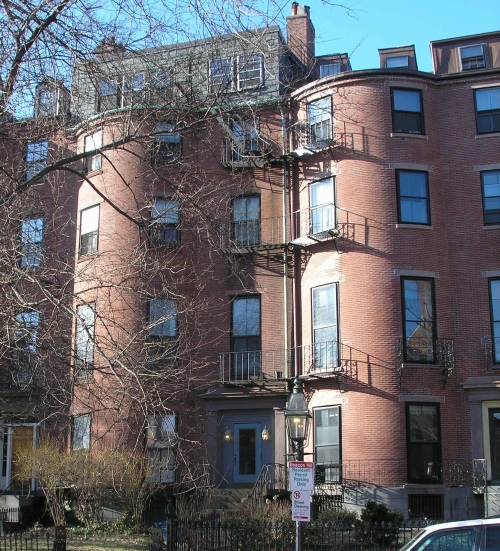
No. 77 Mount Vernon Street in Boston is part of a row of Greek Revival Houses constructed in 1836-1837 on the site of the former Bulfinch-designed mansion of Jonathan Mason. These buildings are set back 30 feet from the street, in line with other earlier houses in this block. It later nineteenth century, the house at no. 77 was the home of Sarah Wyman Whitman, an artist and graphic designer who created book bindings for Houghton Mifflin. Whitman‘s work appeared on books by such authors as Sarah Orne Jewett, Celia Thaxter, Lafcadio Hearn and many others. In 1936, the house became the headquarters of the Club of Odd Volumes, a society of bibliophiles founded in 1887. The club had previously rented space in a large building across the street.
87 Mount Vernon Street, Boston (1805)

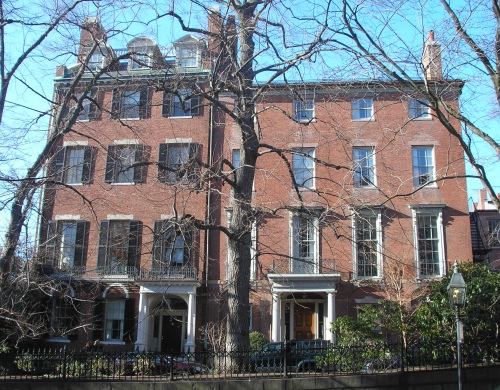
No.87 Mount Vernon St. (right); No. 89 (left)
In 1805, Charles Bulfinch began building twin houses on the adjoining lots at nos. 87-89 Mount Vernon Street in Boston, which he had purchased from Harrison Gray Otis. There is an unverified story that he had intended one to be his own home, but facing financial difficulties, he sold them: no. 87 to Stephen Higginson, Jr., the father of Thomas Wentworth Higginson, and no. 89 to David Humphreys. The two buildings were set back from the street in order to line up with the adjacent Second Harrison Gray Otis House, also designed by Bulfinch. No. 89 was later replaced by a new building, which was later remodeled in the Colonial Revival style. No. 87 was, for a time, the residence of Gen. Charles J. Paine, a Civil War general and yachtsman. Since 1955, it has been the home of the Colonial Society of Massachusetts.
86 Pinckney Street, Boston (1840)

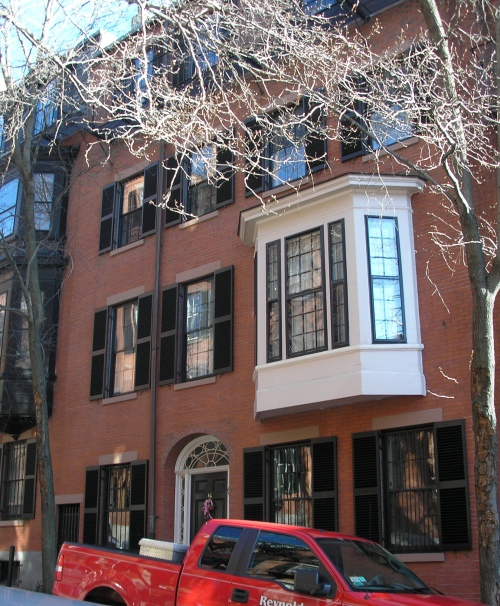
John J. Smith was born a free black in Richmond, VA and later moved to Boston, where he became a barber. His shop, on the corner of Howard and Bulfinch Streets, was a center of abolitionist activity and abolitionist Senator Charles Sumner could frequently be found there. Smith’s wife, Georgiana, was active in the effort to integrate Boston’s public schools. During the Civil War, Smith recruited for the Fifth Cavalry, an all black unit. After the War, Smith served in the Massachusetts House of Representatives. Smith, who died in 1906, lived at 86 Pinckney Street in Boston (built in 1840) from 1878 to 1893. The house is a stop on the Black Heritage Trail.
Posted in Boston, Federal, Houses
Tagged Beacon Hill, Black Heritage Trail, row houses
Leave a comment
8 Walnut Street, Boston (1811)

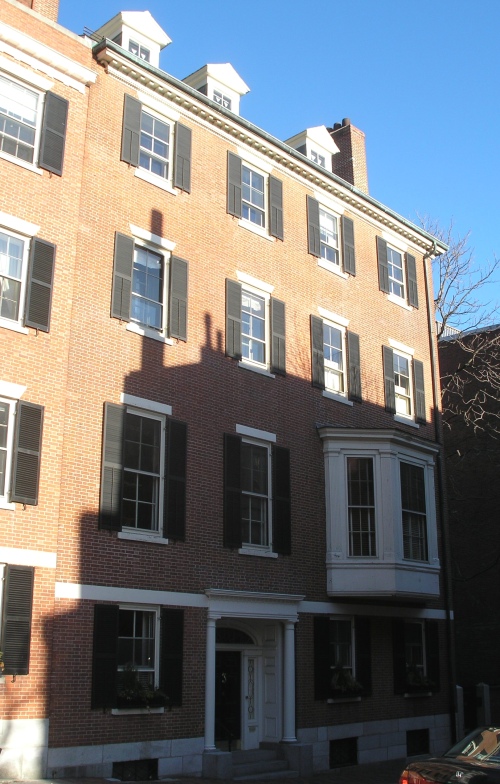
The initial construction of the Federal-style house at no. 8 Walnut Street in Boston was completed by 1811. The building was enlarged later (possibly around 1850) and has since been converted into condominiums. In the early nineteenth century, it was the home of Dr. George Parkman, a pioneer in the field of mental health and member of a prominent Boston family. In 1849, Dr. Parkman disappeared after a visit to collect debts owed to him by Dr. John Webster, a professor of chemistry and mineralogy at Harvard Medical College. After parts of Dr. Parkman’s body were found in Dr. Webster’s laboratory, Webster was arrested for murder. The 1850 trial was a sensational event which prompted much media attention and public interest. Webster was convicted and hanged for the famous murder. In the twentieth century, interest in the case and debates about Webster’s guilt have continued.
59 Mount Vernon Street (1837)

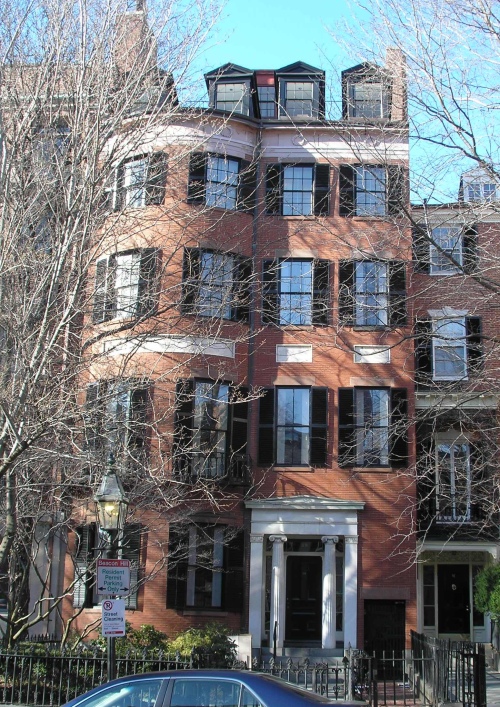
An earlier entry on this blog featured no. 59 Mt. Vernon Street in Boston together with nos. 55-57, but this house is architecturally and historically significant and deserves it’s own seperate entry. Considered to be the great example of Greek Revival architecture on Beacon Hill, the 1837 house was designed by Edward Shaw, an architect and author of such works as Civil Architecture (1831), Operative Masonry (1832), and The Modern Architect (1854). The house was home to Thomas Bailey Aldrich, who replaced William Dean Howells as editor of the Atlantic Monthly in 1881. Aldrich was also an author and poet. Images of the house’s great Greek Revival doorway appear in two books about Aldrich: The Life of Thomas Bailey Aldrich (1908) by Ferris Greenslet and Crowding Memories (1920) by Lilian Woodman Aldrich.
65 Mount Vernon Street, Boston (1903)

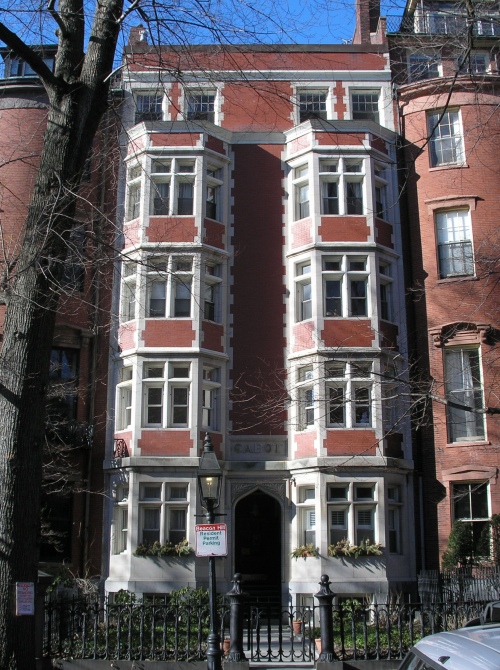
65 Mount Vernon Street in Boston was the site of the residence of Henry Cabot Lodge, the senator and his son, George Cabot Lodge, the poet and dramatist. There is a 1911 biography of George Cabot Lodge, who died very young, written by Henry Adams, and an introduction to his works by Theodore Roosevelt. Although Henry Cabot Lodge is listed as living at 65 Mt. Vernon in 1894, in 1903 an apartment building, known as the Cabot, had been built at the address. One of the residents to move into the new building that year was Charles S. Hopkinson, the portrait painter and landscape watercolorist, who lived there from 1903, the year of his marriage to Elinor Curtis, to 1905. The building seems to have been inspired by the Jacobethan style.
The Middleton-Glapion House (1790)

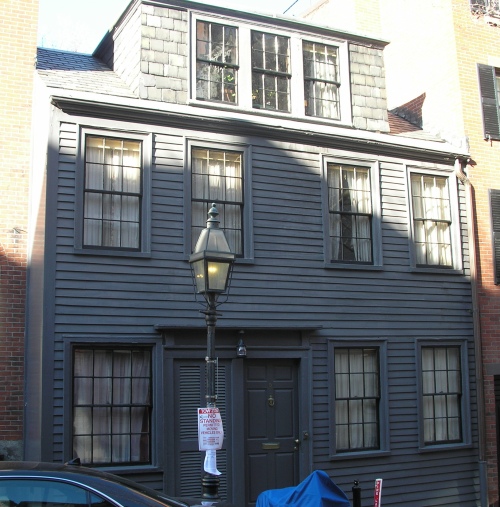
The oldest surviving house built by African-Americans on Boston’s Beacon Hill is the Middleton-Glapion House at 5-7 Pinckney Street. It is also the oldest standing private residence on Beacon Hill. The house has two street numbers because it was originally home to two bachelor friends: George Middleton was a black liveryman and a veteran of the Revolutionary War, who had led the all black company called the Bucks of America; Louis Glapion was a French mulatto barber, who used his half of the house for his work. The property was purchased by the two men in 1786 and a house was first assessed in 1791. The original house was one story. Today it has two stories, but the first floor matches the earliest descriptions. The house is on the Black Heritage Trail.