Search
Advertisement
Become a Fan!
Buy My Book! Click Cover Image to Order!
Categories
- Architectural Style (684)
- Art Deco (2)
- Byzantine (3)
- Colonial (157)
- Colonial Revival (58)
- Craftsman (3)
- Egyptian Revival (1)
- Federal (156)
- Foursquare (3)
- Gothic (45)
- Greek Revival (75)
- Italianate (48)
- Mission Revival (1)
- Modern (1)
- Neoclassical (28)
- Octagon (2)
- Postmodern (1)
- Queen Anne (26)
- Renaissance Revival (16)
- Romanesque Revival (33)
- Second Empire (18)
- Shingle Style (9)
- Stick Style (10)
- Tudor Revival (6)
- Vernacular (29)
- Victorian Eclectic (7)
- Building Type (684)
- Apartment Buildings (5)
- Banks (7)
- Churches (82)
- Collegiate (31)
- Commercial (51)
- Hotels (10)
- Houses (403)
- Industrial (10)
- Libraries (12)
- Lighthouses (1)
- Military (13)
- Monuments (1)
- Museums (9)
- Organizations (26)
- Outbuildings (8)
- Public Buildings (33)
- Schools (16)
- Stations (2)
- Synagogues (1)
- Taverns (17)
- Theaters (5)
- Town (684)
- Adams (2)
- Agawam (4)
- Amherst (50)
- Boston (64)
- Cambridge (30)
- Clinton (8)
- Concord (8)
- Cummington (1)
- Danvers (14)
- Deerfield (31)
- Granville (10)
- Hadley (7)
- Hancock (6)
- Holyoke (19)
- Lenox (5)
- Lexington (8)
- Longmeadow (31)
- Marblehead (40)
- Marlborough (4)
- Natick (22)
- Newton (2)
- Northampton (39)
- Peabody (4)
- Pittsfield (4)
- Salem (97)
- Saugus (4)
- South Hadley (8)
- Southborough (8)
- Southwick (3)
- Springfield (50)
- Stockbridge (10)
- Stow (1)
- Sturbridge (18)
- Sudbury (7)
- Waltham (10)
- Watertown (1)
- Wayland (8)
- West Springfield (14)
- Westfield (19)
- Weston (2)
- Worcester (11)
- Uncategorized (1)
- Architectural Style (684)
Recent Comments
- Pat Barnes on Springfield Municipal Group (1913)
- Paul A. Doucette on The Joseph Burnett House (1850)
- Judith on The Joseph Burnett House (1850)
- PCL on Hotel Vendome (1871)
- jennider D on The Joseph Burnett House (1850)
Tags
Alcott Amherst College Asher Benjamin Back Bay Baptist Beacon Hill Big E Black Heritage Trail bowfront Bulfinch Catholic Congregational Episcopal Freedom Trail Gambrel H.H. Richardson Harvard Hawthorne Historic Deerfield Isaac Damon lit Longfellow mansard Methodist Mount Holyoke Museum Museums NPS Old Sturbridge Village PEM Revolutionary War row houses saltbox Samuel McIntire Shakers Shingle SPNEA Springfield Armory Stick Style Storrowton Underground Railroad UU Washington William Fenno Pratt Witch Trials-

Centers And SquaresBlogroll
Links
- Boston Preservation Alliance
- Cape Cod Modern House Trust
- Digital Treasures
- Historic Boston Inc.
- Historic Deerfield
- Historic New England
- Historic Salem Inc.
- Image Museum
- Old Sturbridge Village
- Preservation Massachusetts
- Preservation Worcester
- Salem Preservation, Inc.
- Springfield Preservation Trust
- The Trustees of Reservations
-
Recent Posts
- Friends Meeting House, Adams (1782)
- Meetinghouse, Hancock Shaker Village (1793)
- Trustees’ Office and Store, Hancock Shaker Village (1813)
- Sisters’ Dairy and Weave Shop (1790)
- Brethren’s Shop, Hancock Shaker Village (1813)
- Brick Poultry House, Hancock Shaker Village (1878)
- Brick Dwelling, Hancock Shaker Village (1830)
- Round Stone Barn, Hancock Shaker Village (1826)
- First Baptist Church, Pittsfield (1927)
- Old Berkshire Athenaeum (1876)
- Susan B. Anthony Birthplace (1817)
- William Cullen Bryant Homestead (1785)
- Bray-Hoadley House (1873)
- Dewey Block, Northampton (1912)
- Browne House (1698)
Archives
- May 2013
- April 2013
- March 2013
- February 2013
- January 2013
- December 2012
- November 2012
- October 2012
- September 2012
- August 2012
- July 2012
- June 2012
- May 2012
- April 2012
- March 2012
- February 2012
- January 2012
- December 2011
- November 2011
- October 2011
- September 2011
- August 2011
- July 2011
- June 2011
- May 2011
- April 2011
- March 2011
- February 2011
- January 2011
- December 2010
- November 2010
- October 2010
- September 2010
- August 2010
- July 2010
- June 2010
- May 2010
- April 2010
- March 2010
- February 2010
- January 2010
- December 2009
- November 2009
- October 2009
- September 2009
- August 2009
- July 2009
- June 2009
- May 2009
- April 2009
- March 2009
- February 2009
- January 2009
- December 2008
- November 2008
- October 2008
- July 2008
- June 2008
- May 2008
- April 2008
- March 2008
-

Pages
- Towns
- Adams
- Agawam
- Amherst
- Boston
- Burlington
- Cambridge
- Clinton
- Concord
- Cummington
- Danvers
- Deerfield
- Granville
- Hadley
- Hancock
- Hatfield
- Holyoke
- Lenox
- Lexington
- Longmeadow
- Marblehead
- Marlborough
- Natick
- Newton
- Northampton
- Peabody
- Pittsfield
- Salem
- Saugus
- South Hadley
- Southborough
- Southwick
- Springfield
- Stockbridge
- Stow
- Sturbridge
- Sudbury
- Waltham
- Watertown
- Wayland
- West Springfield
- Westfield
- Weston
- Worcester
- Towns
Meta
Monthly Archives: December 2008
First Congregational Church of Hadley (1808)
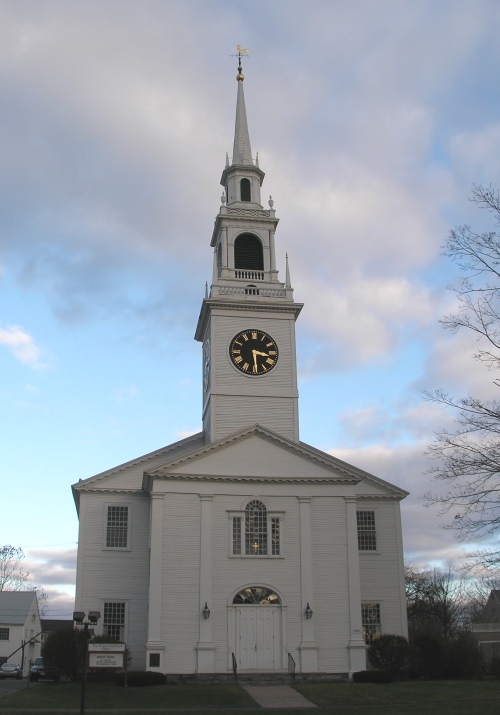
The current meeting house of the First Congregational Church of Hadley, on Middle Street, was built in 1808. The congregation dates back to 1659. The original meeting house was not built right away: although the town had planned to construct it in 1661, work did not begin until 1663 and it took seven years to complete. “Probably during this time meetings were held in the home of some leading church member.” By 1713, “The little old first edifice was falling in pieces,” and the Town decided to build a new church, completed in 1714. This was later replaced by the current building at the same location.
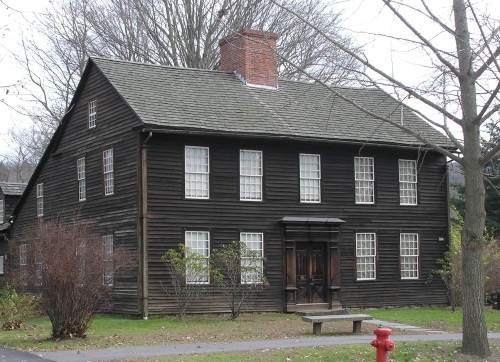
The Allen House (1734)

The colonial saltbox known as the Allen House was renovated in 1945 to become the Deerfield home of Henry and Helen Flynt, the founders of Historic Deerfield. They believed the house had been built around 1705, just after the Deerfield Raid of 1704. Current research indicates it was built around 1734. The land was originally owned by Simon and Hannah Beaman, who had been captured during the raid. The house was occupied by the Bardwell family and then by the Allen family, after the 1842 marriage of Catherine Elizabeth Bardwell and Caleb Allen. In 1896, Caleb Bardwell’s nieces, Frances and Mary Allen, with their mother took possession of the house. The Allen sisters were photographers, famous for their Deerfield scenes. They sold their work out of a shop in the house. During the nineteenth century, the interior of the house had been completely changed, leading the Flynts to gut it and recreate an eighteenth century plan. Open to visitors, the antiques-filled interior decoration of the house remains as it was when the Flynts were in residence.
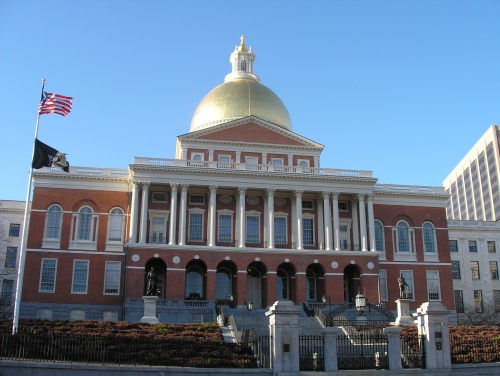
Massachusetts State House (1798)

The Massachusetts State Capitol building in Boston, designed by Charles Bulfinch, was completed in 1798. The government of Massachusetts had previously used the Old State House, so the current building is sometimes called the New State House. It was built on Beacon Hill, on land once owned by John Hancock. The site on Beacon Hill was lowered 50 feet for the construction, with the excavated dirt being used as landfill. Bulfinch modeled his design on William Chambers‘s Somerset House and James Wyatt‘s Pantheon, both in London. The capitol building‘s dome was originally made of wood, which soon leaked. In 1802, it was covered with copper by Paul Revere’s company. Originally painted gray, to resemble stone, it was later painted yellow and, in 1874, gilded with gold. It was most recently regilded in 1997. The building was expanded with the addition of a yellow brick annex in 1895 and the two massive marble wings, on each side, in 1914 and 1917. The State House underwent a restoration in 2000. Today, this important structure, which Oliver Wendell Holmes once called, “the hub of the solar system,” is open to the public for tours.
Posted in Boston, Federal, Public Buildings
Tagged Beacon Hill, Bulfinch, Freedom Trail, Paul Revere
Leave a comment
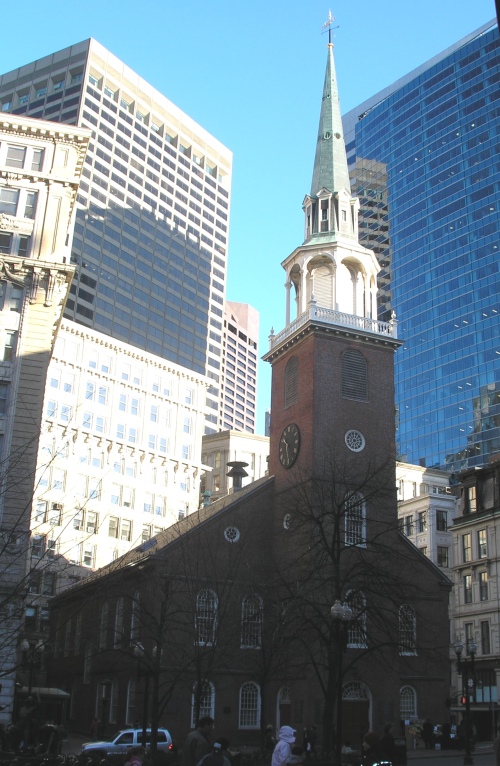
Old South Meeting House (1729)

Built in 1729, Boston’s Old South Meeting House was the largest building in the colonial town. The congregation began in 1669, when it separated from Boston’s First Church (becoming the Third Church of Boston). In the years immediately preceding the outbreak of the American Revolution, citizens would gather in the Old South Meeting House to debate and argue in the aftermath of events like the Boston Massacre. On the night of December 16, 1773, over 5,000 colonists, angered over the tax on tea, met at Old South and after hours of debate, Samuel Adams gave a secret signal which began the famous Boston Tea Party. During the war, occupying British troops took revenge for the Tea Party by ripping out the church‘s pews and using the building as a riding stable. They also set up a bar on the first balcony. The church continued to be used as a house of worship, but after it was nearly destroyed in the Great Boston Fire of 1872, the congregation built the New Old South Church at Copley Square. In danger of being torn down, pioneering preservation efforts led to the restoration of the building, which has been a museum and historic site since 1877. It is also a stop on the Boston Freedom Trail. The steeple has been replaced twice, after storms in 1804 and 1954.
Posted in Boston, Churches, Colonial
Tagged Congregational, Freedom Trail, Museum, Revolutionary War
1 Comment
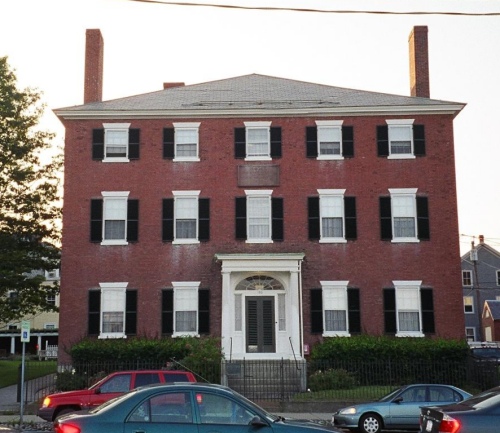
The Benjamin W. Crowninshield House (1812)

Built 1810-1812 on Derby Street in Salem, the Benjamin W. Crowninshield House may be based on a plan by Samuel McIntire, but completed after his death by his son, Samuel Field McIntire. Benjamin Williams Crowninshield was a congressman and Secretary of the Navy (1815-1818) under presidents Madison and Monroe, the latter of whom once stayed in the house. Brigader General James Miller, a hero of the War of 1812, lived in the house while he was serving as collector at the Custom House next door from 1825 to 1829. The house’s Greek Revival front porch was added after 1820 and the building was expanded in the rear in 1906 and 1916. The house has been used, as noted on a panel on the front facade, as a “Home for Aged Women presented by Robert Brookhouse in 1861″
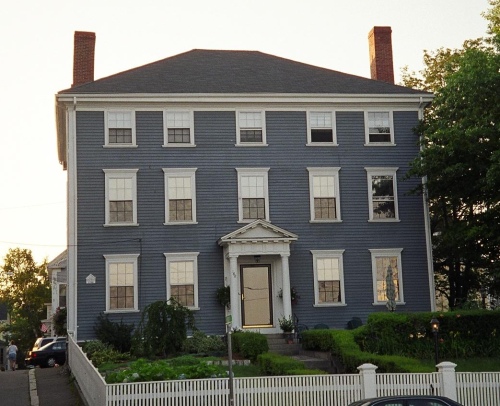
The Simon Forrester House (1790)

In 1791, Capt. Simon Forrester acquired an unfinished house on Derby Street in Salem. The three-story hipped-roof house has been attributed to Samuel McIntire and the east parlor mantelpiece, carved by McIntire, is now in the Peabody Essex Museum. Forrester was a Irish born ship captain, brought to America by Capt. Daniel Hathorne, the grandfather of Nathaniel Hawthorne (Forrester is mentioned in The Scarlet Letter). Forrester married Capt. Hathorne’s daughter and became wealthy during the Revolutionary War. Many of the house‘s architectural details were removed or altered after the First World War, but more recently the house has been restored to a more original appearance.
The Derby-Ward House (1738)

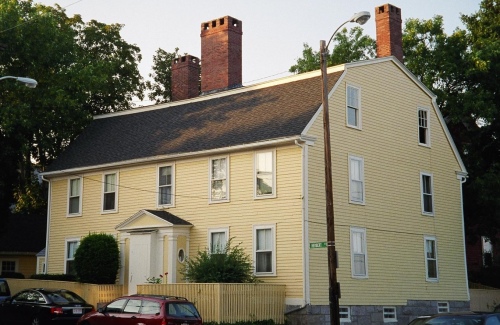
The Derby-Ward House, on Derby Street in Salem, was built around 1738 by the sea captain Richard Derby. He was the father of the wealthy and celebrated merchant Elias Hasket Derby, the statesman Richard Derby, Jr. and the ship captain John Derby. The gambrel-roofed house has an enclosed entry porch, similar to those on other homes of wealthy Salem families, which was added after the house was built. The house was purchased by the Ward family after the Revolutionary War. Update: Check out the recent article on the house at SalemPatch.