Search
Advertisement
Become a Fan!
Buy My Book! Click Cover Image to Order!
Categories
- Architectural Style (684)
- Art Deco (2)
- Byzantine (3)
- Colonial (157)
- Colonial Revival (58)
- Craftsman (3)
- Egyptian Revival (1)
- Federal (156)
- Foursquare (3)
- Gothic (45)
- Greek Revival (75)
- Italianate (48)
- Mission Revival (1)
- Modern (1)
- Neoclassical (28)
- Octagon (2)
- Postmodern (1)
- Queen Anne (26)
- Renaissance Revival (16)
- Romanesque Revival (33)
- Second Empire (18)
- Shingle Style (9)
- Stick Style (10)
- Tudor Revival (6)
- Vernacular (29)
- Victorian Eclectic (7)
- Building Type (684)
- Apartment Buildings (5)
- Banks (7)
- Churches (82)
- Collegiate (31)
- Commercial (51)
- Hotels (10)
- Houses (403)
- Industrial (10)
- Libraries (12)
- Lighthouses (1)
- Military (13)
- Monuments (1)
- Museums (9)
- Organizations (26)
- Outbuildings (8)
- Public Buildings (33)
- Schools (16)
- Stations (2)
- Synagogues (1)
- Taverns (17)
- Theaters (5)
- Town (684)
- Adams (2)
- Agawam (4)
- Amherst (50)
- Boston (64)
- Cambridge (30)
- Clinton (8)
- Concord (8)
- Cummington (1)
- Danvers (14)
- Deerfield (31)
- Granville (10)
- Hadley (7)
- Hancock (6)
- Holyoke (19)
- Lenox (5)
- Lexington (8)
- Longmeadow (31)
- Marblehead (40)
- Marlborough (4)
- Natick (22)
- Newton (2)
- Northampton (39)
- Peabody (4)
- Pittsfield (4)
- Salem (97)
- Saugus (4)
- South Hadley (8)
- Southborough (8)
- Southwick (3)
- Springfield (50)
- Stockbridge (10)
- Stow (1)
- Sturbridge (18)
- Sudbury (7)
- Waltham (10)
- Watertown (1)
- Wayland (8)
- West Springfield (14)
- Westfield (19)
- Weston (2)
- Worcester (11)
- Uncategorized (1)
- Architectural Style (684)
Recent Comments
- Pat Barnes on Springfield Municipal Group (1913)
- Paul A. Doucette on The Joseph Burnett House (1850)
- Judith on The Joseph Burnett House (1850)
- PCL on Hotel Vendome (1871)
- jennider D on The Joseph Burnett House (1850)
Tags
Alcott Amherst College Asher Benjamin Back Bay Baptist Beacon Hill Big E Black Heritage Trail bowfront Bulfinch Catholic Congregational Episcopal Freedom Trail Gambrel H.H. Richardson Harvard Hawthorne Historic Deerfield Isaac Damon lit Longfellow mansard Methodist Mount Holyoke Museum Museums NPS Old Sturbridge Village PEM Revolutionary War row houses saltbox Samuel McIntire Shakers Shingle SPNEA Springfield Armory Stick Style Storrowton Underground Railroad UU Washington William Fenno Pratt Witch Trials-

Centers And SquaresBlogroll
Links
- Boston Preservation Alliance
- Cape Cod Modern House Trust
- Digital Treasures
- Historic Boston Inc.
- Historic Deerfield
- Historic New England
- Historic Salem Inc.
- Image Museum
- Old Sturbridge Village
- Preservation Massachusetts
- Preservation Worcester
- Salem Preservation, Inc.
- Springfield Preservation Trust
- The Trustees of Reservations
-
Recent Posts
- Friends Meeting House, Adams (1782)
- Meetinghouse, Hancock Shaker Village (1793)
- Trustees’ Office and Store, Hancock Shaker Village (1813)
- Sisters’ Dairy and Weave Shop (1790)
- Brethren’s Shop, Hancock Shaker Village (1813)
- Brick Poultry House, Hancock Shaker Village (1878)
- Brick Dwelling, Hancock Shaker Village (1830)
- Round Stone Barn, Hancock Shaker Village (1826)
- First Baptist Church, Pittsfield (1927)
- Old Berkshire Athenaeum (1876)
- Susan B. Anthony Birthplace (1817)
- William Cullen Bryant Homestead (1785)
- Bray-Hoadley House (1873)
- Dewey Block, Northampton (1912)
- Browne House (1698)
Archives
- May 2013
- April 2013
- March 2013
- February 2013
- January 2013
- December 2012
- November 2012
- October 2012
- September 2012
- August 2012
- July 2012
- June 2012
- May 2012
- April 2012
- March 2012
- February 2012
- January 2012
- December 2011
- November 2011
- October 2011
- September 2011
- August 2011
- July 2011
- June 2011
- May 2011
- April 2011
- March 2011
- February 2011
- January 2011
- December 2010
- November 2010
- October 2010
- September 2010
- August 2010
- July 2010
- June 2010
- May 2010
- April 2010
- March 2010
- February 2010
- January 2010
- December 2009
- November 2009
- October 2009
- September 2009
- August 2009
- July 2009
- June 2009
- May 2009
- April 2009
- March 2009
- February 2009
- January 2009
- December 2008
- November 2008
- October 2008
- July 2008
- June 2008
- May 2008
- April 2008
- March 2008
-

Pages
- Towns
- Adams
- Agawam
- Amherst
- Boston
- Burlington
- Cambridge
- Clinton
- Concord
- Cummington
- Danvers
- Deerfield
- Granville
- Hadley
- Hancock
- Hatfield
- Holyoke
- Lenox
- Lexington
- Longmeadow
- Marblehead
- Marlborough
- Natick
- Newton
- Northampton
- Peabody
- Pittsfield
- Salem
- Saugus
- South Hadley
- Southborough
- Southwick
- Springfield
- Stockbridge
- Stow
- Sturbridge
- Sudbury
- Waltham
- Watertown
- Wayland
- West Springfield
- Westfield
- Weston
- Worcester
- Towns
Meta
Monthly Archives: November 2008
The Clifford Crowninshield House (1806)
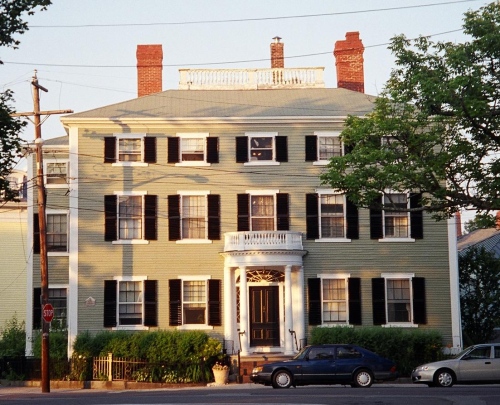
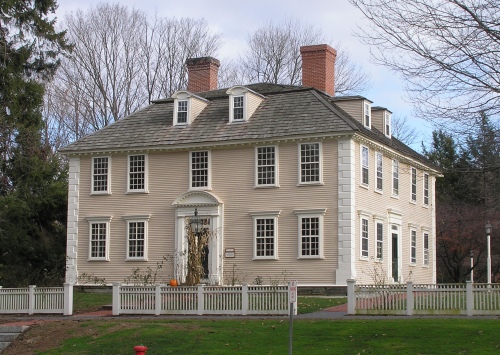
Designed by the famous builder and wood carver, Samuel McIntire, the Clifford Crowninshield House is an impressive Federal style mansion on the southeast corner of Salem Common. The house was built 1804-1806 for the merchant, Clifford Crowninsheld, who died in 1809. In 1802, the Minerva, a ship owned by Crowninshield and Nathaniel West, was the first Salem vessel to circumnavigate the globe. The house was next occupied by Crowninshield’s sister, Sarah, and her husband, James Devereux. In 1799, Devereux was captain of the Franklin when it became the first American vessel to trade with Japan. Devereux returned from Nagasaki with a variety of items, some of which are now in the Peabody Essex Museum in Salem. On June 23, 1800, Rev. William Bentley visited Devereux’s (earlier) house in Salem, where the captain “exhibited such things as engaged his attention,” including “Stone Tables, Tea Tables, Servers, Knife Cases, Small Cabinets,” and paintings. Bentley observed that the “stuffed gowns, which on both sides silk, are filled with a very fine cotton, were luxuries.” The house was later inherited by Devereux’s daughter, Abigail, who had married Captain William Dean Waters. In 1892, the Crowninshield-Devereux-Waters House was altered by its then owner, Zina Goodell, a successful Salem businessman, who had begun as a blacksmith and machinist. Before 1892, the house had been like many such Federal structures in Salem, in which, according to The Colonial Architecture of Salem, by Frank Cousins and Phil M. Riley, “a wing extended to one side of the main house along the street, instead of an L projecting from the rear, and thus by greatly elongating the oblong arrangement reduced in a measure the apparent height of a three-story structure.” Goodell, not finding the “ell” “good,” moved it from the side to the rear of the house, “about doubling the depth of the building.” He also moved the house closer to the corner of Forrester Street (the house’s address is on Washington Square East).
The Jonathan Corwin House (1675)
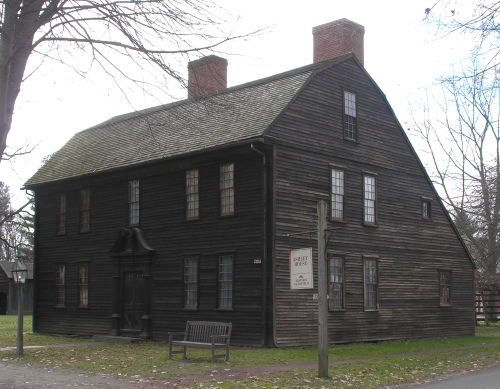
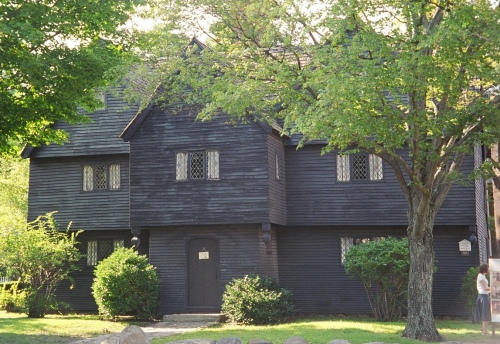
The Jonathan Corwin House, also known as the Witch House, is a seventeenth century home located on Essex Street in Salem. When Jonathan Corwin, a merchant, purchased the property in 1675, there was already a partially completed timber frame, left unfinished after being started some years earlier (older estimates put the construction date as 1642). Corwin completed the construction and moved in with his family in 1679. As a prominent citizen of Salem, Corwin served as a magistrate and was a judge during the Salem Witch Trials of 1692. The Corwin family owned the house into the nineteenth century, during which time a number of alterations were made to the home. In 1856, it was bought by a pharmacist, George Farrington, who built his shop onto one side of the building. He referred to the home as the “Witch House” and attracted tourists with his claims that the Witch Trials had occurred in the parlor. By the twentieth century, the house was being used for a shop, businesses and apartments. Threatened with demolition to accommodate the widening of North Street, Historic Salem Inc was established to return the house to a seventeenth century look and move it to the west. Given to the town, the Witch House first opened as a museum in 1946.
The Jonathan Hoyt House (1755)

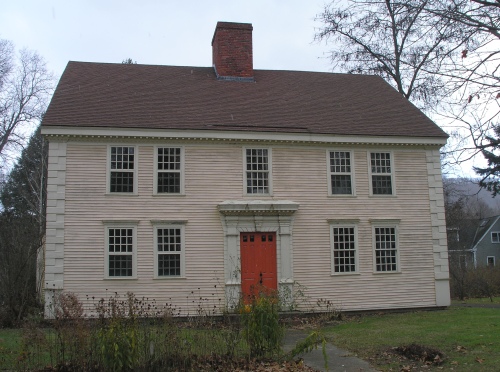
Built around 1755, in the Cheapside section of Deerfield, the Jonathan Hoyt House was once the home of Rev. Henry Colman, a prominent agriculturalist. Colman had become an ordained minister, but ill health forced him to retire as a pastor. He devoted himself to agriculture, in the 1830s purchasing the Hoyt Farm and the White Horse Inn, as the Hoyt House had come to be called. Later, the house was moved to Greenfield, but in 1965-1966, at the urging of John Radovich, who had grown up in the house, the building was moved to the Street in Old Deerfield and restored in the Colonial Revival style to serve as a parsonage for the First Church of Deerfield.
Posted in Colonial, Deerfield, Houses
2 Comments
The William Hickling Prescott House (1808)

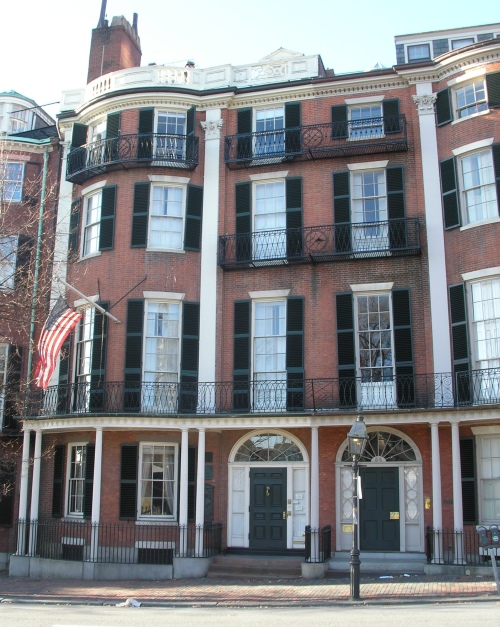
William Hickling Prescott was an important nineteenth century historian who is best known for his works, History of the Conquest of Mexico (1843) and History of the Conquest of Peru (1847). The latter work was written in a house that Prescott lived in on Beacon Street in Boston from 1845 to 1859. The 1808 house (on the left in the photo above) was designed by Asher Benjamin and features Greek design motifs and a Federal style doorway. William Makepeace Thackeray, a friend of Prescott, visited the house. Thackeray was as inspired to write his novel, The Virginians (1859), after seeing two crossed swords displayed in the home, one belonging to Prescott‘s grandfather (Col. William Prescott) and one by Prescott’s wife’s father (Capt. John Linzee), each on opposing sides at the Battle of Bunker Hill. The Prescott House is now a museum and the headquarters of the National Society of the Colonial Dames of America in the Commonwealth of Massachusetts.
Posted in Boston, Federal, Houses
Tagged Asher Benjamin, Beacon Hill, bowfront, Dames, Museum
Leave a comment
The Manse [Deerfield Academy] (1768)

The building in Old Deerfield known as the Manse, or the Willard House, is a 1768 Georgian mansion that was at one time the home of Rev. Samuel Willard. An earlier house, constructed in 1694, was already on the lot when the land was sold by Samuel Allen, the grandfather of Ethan Allen, to Samuel Barnard of Salem. Barnard bequeathed the land to his nephew, Joseph Barnard, who built the Manse in 1768, spending thirteen years selecting wood without knots. The earlier gambrel roofed building became the current ell. The Barnards continued to live in the house until 1795 when, facing financial difficulties, Samuel Barnard moved his family to Vermont. In 1807, the house was rented to Hosea Hildreth, preceptor at Deerfield Academy, whose son Richard Hildreth, later author of a well-known History of the United States, was born in the house. In 1811, the house was bought by Rev. Samuel Willard, who had already been living there since 1807 and would own the house until his death in 1859. Dr. Willard was the first Unitarian minister in Western Massachusetts and entertained such visitors as Charles Sumner, Horace Greeley and Ralph Waldo Emerson in the house. Willard’s heirs sold the home in 1885 and it had other owners. Today it serves as the residence of the Head of School of Deerfield Academy.
Edit (01/24/2011): A book about the house was published in 1887, Story of the Old Willard House of Deerfield, Mass., by Catharine B. Yale.
The Rev. Jonathan Ashley House (1734)

Rev. Jonathan Ashley was the second minister in Deerfield, serving from 1712 to 1780. He married Dorothy Williams, the daughter of the Rev. William Williams of Hatfield. Given a home lot in town, he constructed his house around 1734. Originally having a center chimney, the house was modified by Ashley in the 1750s into a center hallway home with a distinctive Connecticut River Valley doorway. As one of the elite Valley citizens known as “River Gods,” Ashley installed fine paneling in his home and furnished it with high style furniture. By the twentieth century, the house had been moved back on the lot and replaced with a nineteenth century Italianate style house. The former “mansion house” was now used as a tobacco barn. It was restored (the current doorway is a reproduction) and moved back to a position in the Street by the founders of Historic Deerfield, Henry and Helen Flynt. In 1948, the house became their first restoration opened to the public. It currently houses an extensive collection of Connecticut River Valley antiques.
Posted in Colonial, Deerfield, Houses
Tagged Gambrel, Historic Deerfield, Museum, saltbox
Leave a comment
The Francis Parkman House (1830)

Francis Parkman was one of nineteenth century America’s most noted historians. His first book, The Oregon Trail (1849), became a classic and he went on to write his multi-volume epic, France and England in North America. From 1865 until his death in 1893, Francis Parkman resided at a house at 50 Chestnut Street on Boston’s Beacon Hill. It is one of several houses built sometime in the late 1820s or 1830s by Cornelius Coolidge.
Here’s an additional photo and a list of Parkman‘s works (with links to Google Books) which, although dated in many ways, are considered to be significant literary works: (more…)