Search
Advertisement
Become a Fan!
Buy My Book! Click Cover Image to Order!
Categories
- Architectural Style (684)
- Art Deco (2)
- Byzantine (3)
- Colonial (157)
- Colonial Revival (58)
- Craftsman (3)
- Egyptian Revival (1)
- Federal (156)
- Foursquare (3)
- Gothic (45)
- Greek Revival (75)
- Italianate (48)
- Mission Revival (1)
- Modern (1)
- Neoclassical (28)
- Octagon (2)
- Postmodern (1)
- Queen Anne (26)
- Renaissance Revival (16)
- Romanesque Revival (33)
- Second Empire (18)
- Shingle Style (9)
- Stick Style (10)
- Tudor Revival (6)
- Vernacular (29)
- Victorian Eclectic (7)
- Building Type (684)
- Apartment Buildings (5)
- Banks (7)
- Churches (82)
- Collegiate (31)
- Commercial (51)
- Hotels (10)
- Houses (403)
- Industrial (10)
- Libraries (12)
- Lighthouses (1)
- Military (13)
- Monuments (1)
- Museums (9)
- Organizations (26)
- Outbuildings (8)
- Public Buildings (33)
- Schools (16)
- Stations (2)
- Synagogues (1)
- Taverns (17)
- Theaters (5)
- Town (684)
- Adams (2)
- Agawam (4)
- Amherst (50)
- Boston (64)
- Cambridge (30)
- Clinton (8)
- Concord (8)
- Cummington (1)
- Danvers (14)
- Deerfield (31)
- Granville (10)
- Hadley (7)
- Hancock (6)
- Holyoke (19)
- Lenox (5)
- Lexington (8)
- Longmeadow (31)
- Marblehead (40)
- Marlborough (4)
- Natick (22)
- Newton (2)
- Northampton (39)
- Peabody (4)
- Pittsfield (4)
- Salem (97)
- Saugus (4)
- South Hadley (8)
- Southborough (8)
- Southwick (3)
- Springfield (50)
- Stockbridge (10)
- Stow (1)
- Sturbridge (18)
- Sudbury (7)
- Waltham (10)
- Watertown (1)
- Wayland (8)
- West Springfield (14)
- Westfield (19)
- Weston (2)
- Worcester (11)
- Uncategorized (1)
- Architectural Style (684)
Recent Comments
- Pat Barnes on Springfield Municipal Group (1913)
- Paul A. Doucette on The Joseph Burnett House (1850)
- Judith on The Joseph Burnett House (1850)
- PCL on Hotel Vendome (1871)
- jennider D on The Joseph Burnett House (1850)
Tags
Alcott Amherst College Asher Benjamin Back Bay Baptist Beacon Hill Big E Black Heritage Trail bowfront Bulfinch Catholic Congregational Episcopal Freedom Trail Gambrel H.H. Richardson Harvard Hawthorne Historic Deerfield Isaac Damon lit Longfellow mansard Methodist Mount Holyoke Museum Museums NPS Old Sturbridge Village PEM Revolutionary War row houses saltbox Samuel McIntire Shakers Shingle SPNEA Springfield Armory Stick Style Storrowton Underground Railroad UU Washington William Fenno Pratt Witch Trials-

Centers And SquaresBlogroll
Links
- Boston Preservation Alliance
- Cape Cod Modern House Trust
- Digital Treasures
- Historic Boston Inc.
- Historic Deerfield
- Historic New England
- Historic Salem Inc.
- Image Museum
- Old Sturbridge Village
- Preservation Massachusetts
- Preservation Worcester
- Salem Preservation, Inc.
- Springfield Preservation Trust
- The Trustees of Reservations
-
Recent Posts
- Friends Meeting House, Adams (1782)
- Meetinghouse, Hancock Shaker Village (1793)
- Trustees’ Office and Store, Hancock Shaker Village (1813)
- Sisters’ Dairy and Weave Shop (1790)
- Brethren’s Shop, Hancock Shaker Village (1813)
- Brick Poultry House, Hancock Shaker Village (1878)
- Brick Dwelling, Hancock Shaker Village (1830)
- Round Stone Barn, Hancock Shaker Village (1826)
- First Baptist Church, Pittsfield (1927)
- Old Berkshire Athenaeum (1876)
- Susan B. Anthony Birthplace (1817)
- William Cullen Bryant Homestead (1785)
- Bray-Hoadley House (1873)
- Dewey Block, Northampton (1912)
- Browne House (1698)
Archives
- May 2013
- April 2013
- March 2013
- February 2013
- January 2013
- December 2012
- November 2012
- October 2012
- September 2012
- August 2012
- July 2012
- June 2012
- May 2012
- April 2012
- March 2012
- February 2012
- January 2012
- December 2011
- November 2011
- October 2011
- September 2011
- August 2011
- July 2011
- June 2011
- May 2011
- April 2011
- March 2011
- February 2011
- January 2011
- December 2010
- November 2010
- October 2010
- September 2010
- August 2010
- July 2010
- June 2010
- May 2010
- April 2010
- March 2010
- February 2010
- January 2010
- December 2009
- November 2009
- October 2009
- September 2009
- August 2009
- July 2009
- June 2009
- May 2009
- April 2009
- March 2009
- February 2009
- January 2009
- December 2008
- November 2008
- October 2008
- July 2008
- June 2008
- May 2008
- April 2008
- March 2008
-

Pages
- Towns
- Adams
- Agawam
- Amherst
- Boston
- Burlington
- Cambridge
- Clinton
- Concord
- Cummington
- Danvers
- Deerfield
- Granville
- Hadley
- Hancock
- Hatfield
- Holyoke
- Lenox
- Lexington
- Longmeadow
- Marblehead
- Marlborough
- Natick
- Newton
- Northampton
- Peabody
- Pittsfield
- Salem
- Saugus
- South Hadley
- Southborough
- Southwick
- Springfield
- Stockbridge
- Stow
- Sturbridge
- Sudbury
- Waltham
- Watertown
- Wayland
- West Springfield
- Westfield
- Weston
- Worcester
- Towns
Meta
Monthly Archives: July 2008
Memorial Church, Harvard (1931)
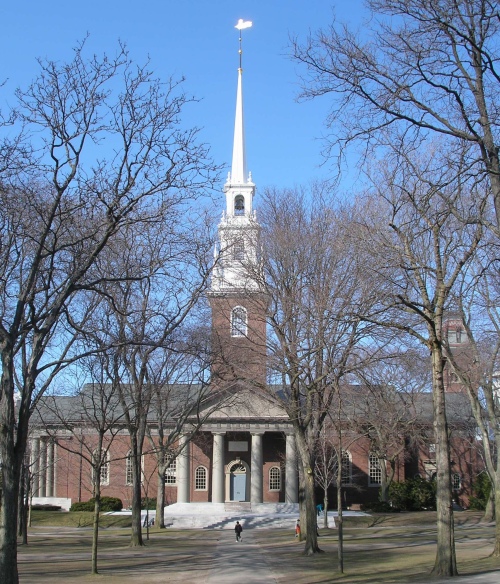
Built to face the massive Widener Library across Harvard Yard, Memorial Church was built in 1931-2 and dedicated on Armistice Day 1932 in honor of those who died in World War I. Memorials to Harvard students who died in later wars have since been added inside the church. Memorial Church was designed in the Georgian Revival style by the architectural firm of Coolidge Shepley Bulfinch and Abbot.
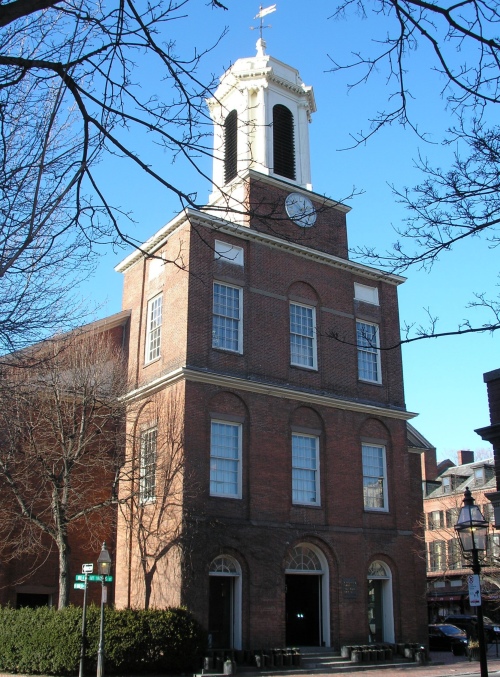
Charles Street Meeting House (1804)

Designed by Asher Benjamin in 1804, the Charles Street Meeting House in Boston’s Beacon Hill neighborhood began as the Third Baptist Church of Boston (it was built on reclaimed land near the Charles River where baptisms could be performed). In the 1830s, abolitionist members, led by Timothy Gilbert, challenged the church’s segregationist seating arrangements and went on to found the integrated Tremont Temple Baptist Church. In the years before the Civil War, the church became a center of abolitionism, with many notable speakers addressing audiences there, including William Lloyd Garrison, Wendell Phillips, Frederick Douglass, Harriet Tubman and Sojourner Truth. From 1876 to 1939, the building was the African Methodist Episcopal Church. In 1920, the church was moved ten feet west to accommodate the widening of Charles Street. With the departure of the African-American community from the north slope of Beacon Hill, it served as an Albanian Orthodox Church and lastly a Unitarian Universalist Church to 1979. In the 1980s, the Charles Street Meeting House was converted to secular use as offices. The building is on the Black Heritage Trail.
Posted in Boston, Churches, Federal
Tagged Asher Benjamin, Baptist, Beacon Hill, Black Heritage Trail, Methodist, UU
1 Comment
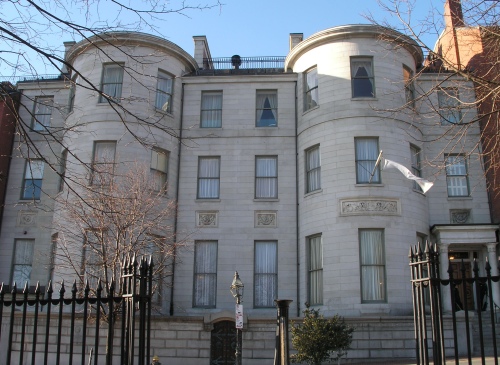
Somerset Club (1819)

The home of David Sears, on Beacon Street in Boston, began as a 2-story bowfront house, built in 1816-1819 and designed by Alexander Parris. The left section of the house, featuring a second bowfront, was added by Sears in 1832, and in the 1830s, the house was the most expensive in Boston. The building has been home to the exclusive Somerset Club since 1872, when the third floor was added. Today, the house gives an impression of monumentality, with its large size and granite facade.
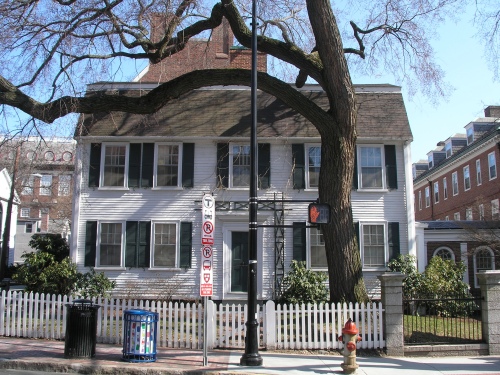
The John Hicks House (1762)

Originally located on Dunster and Winthrop in Cambridge, the 1762 John Hicks House was later moved to its current address on John F. Kennedy Street to become the library of Harvard University‘s Kirkland House. A historic marker in front of the house explains that it was the home of John Hicks, who was killed by British soldiers in 1775. He was killed near the junction of North avenue and Spruce Street by the retreating British on April 19, 1775. The marker also indicates that the house was used by General Putnam as his office during the Revolutionary War. In 1773, the house was purchased by John Foxcroft. A car crashed into the house in 2006.
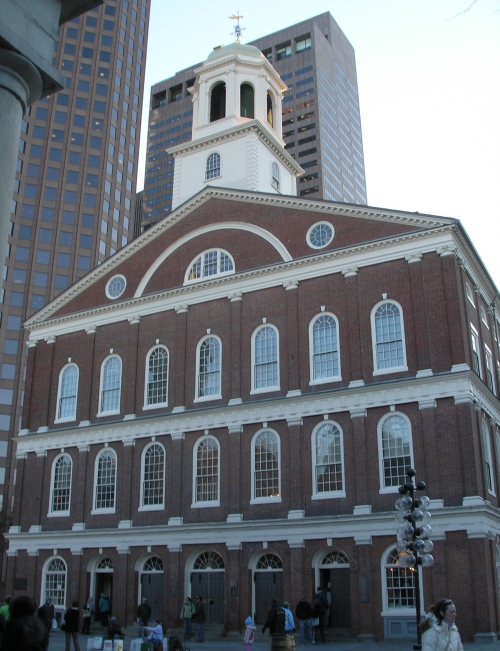
Faneuil Hall (1742)

Peter Faneuil was a Boston merchant whose parents were Huguenots. In 1740, he proposed donating a market building to the town, with a marketplace below and a public meeting hall above. The original Faneuil Hall, completed in 1742, was designed by the Scottish artist John Smibert. After the building suffered in a fire in 1761, it was rebuilt the following year. The building now entered the period when it would become known as “The Cradle of Liberty.” James Otis dedicated the meeting room to the “Cause of Liberty” and it was here that the many important gatherings protesting British taxes on the colonies were held, under the leadership of such patriots as Samuel Adams and John Hancock. After the Boston Tea Party, the British closed the building to public meetings and it was used to garrison soldiers.
After the Revolutionary War, Faneuil Hall was rebuilt and enlarged in 1806 by Charles Bulfinch, who retained its colonial style, but increased its width, added a third floor and enclosed the ground floor’s open market arcades. He also added galleries to the meeting hall, which, as Peter Faneuil had requested, has continued to be used for public forums. Over the years it has heard abolitionists, suffragists and political candidates. The third floor, now a museum, is the armory of the Ancient and Honorable Artillery Company of Massachusetts, the oldest military organization in the United States which has had its headquarters in Faneuil Hall since 1746. Faneuil Hall also has a distinctive copper gilt Grasshopper weather vane, made by the artisan Shem Drowne. It was stolen, but found a few days later in 1974. In 1898-1899, the building was rebuilt using noncombustible materials. Faneuil Hall, together with the neighboring Quincy Market, is now part of the Faneuil Hall Marketplace. It is also on Boston’s Freedom Trail.
Posted in Boston, Colonial, Public Buildings
Tagged Adams, Bulfinch, Freedom Trail, Museum, Revolutionary War
Leave a comment
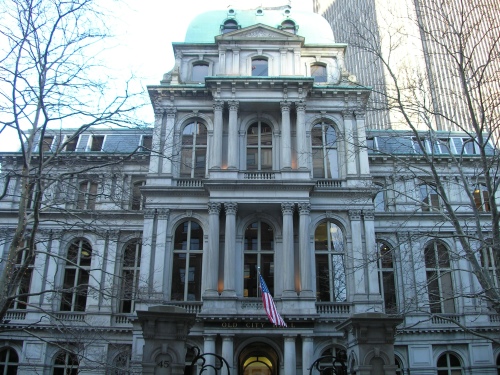
Old City Hall, Boston (1865)

Boston’s Old City Hall, constructed from 1862-1865, was built on School Street, the location, from 1704 to 1748, of the Boston Latin School, America’s first public school. Preceded by a City Hall on the same site designed by Bulfinch, the 1864 building was one of the first in America to be designed in the elaborate French Second Empire style and further helped to popularize the use of the style throughout the country. With the 1969 move to the new City Hall, the old building was adapted to serve as space for offices and a restaurant, although at the cost of some of the original impressive interiors. The preservation of Old City Hall is one of the earliest examples of the adaptive reuse of a historic structure. Old City Hall is also on the route of Boston’s Freedom Trail. See below for more pictures: